Literature Review - Lighting adjustments to mitigate against deck - - PowerPoint PPT Presentation

literature review lighting adjustments to mitigate
SMART_READER_LITE
LIVE PREVIEW

Literature Review - Lighting adjustments to mitigate against deck - - PowerPoint PPT Presentation

Literature Review - Lighting adjustments to mitigate against deck strikes/ vessel impacts - MIT2019-03 Kerry Lukies Image: Whitehead, 2018 Seabirds are attracted to and disorientated by artificial light at night (ALAN) in both terrestrial


slide-1
SLIDE 1

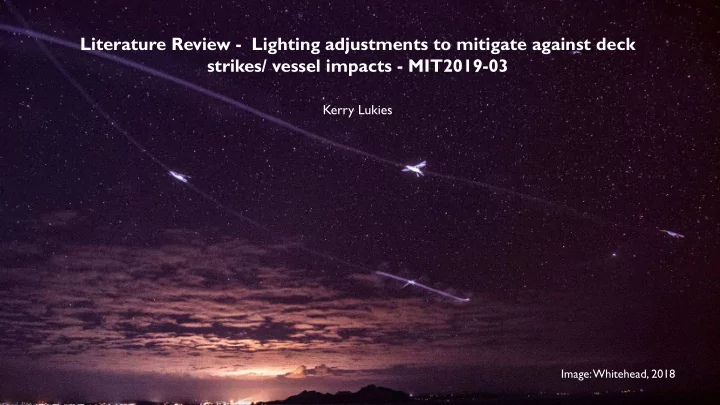
Literature Review - Lighting adjustments to mitigate against deck strikes/ vessel impacts - MIT2019-03

Kerry Lukies

Image: Whitehead, 2018

slide-2
SLIDE 2

OVERVIEW OF SEABIRD ATTRACTION TO ALAN

  • Seabirds are attracted to and

disorientated by artificial light at night (ALAN) in both terrestrial and marine environments

  • Birds become confused or are blinded

by lights which can result in collisions with structures causing injury or death

  • Exhaustion caused by the continuous

circling of the light source and are unable to get airborne again

  • At risk of predation, vehicles (urban),

dehydration, starvation, hypothermia if waterlogged or oiled (marine)

slide-3
SLIDE 3
  • Much of the literature focussed on artificial light impacts in urban environment with little

information on deck-strike in scientific literature

  • Urban grounding recorded around the world e.g. NZ, Australia, Hawaii, Reunion Island, Canary

Islands, Portugal, UK, Chile

  • Marine environment deck-strike examples from USA, NZ, Australia, Alaska, Greenland,

Southern Ocean including Tristan archipelago and Gough Island.

slide-4
SLIDE 4

SOME SPECIES MORE VULNERABLE THAN OTHERS Gadfly petrels, shearwaters and storm petrels (order Procellariiformes) are disproportionately attracted to artificial light at night.

  • At least 56 species are negatively impacted globally

(Rodríguez, Holmes, et al., 2017), an increase on the 21 known species in the 1980’s (reviewed in Reed et al. (1985).

  • Nocturnally active, vulnerable to light attraction during

migration, foraging or when returning to colonies .

slide-5
SLIDE 5

SOME AGE-CLASSES MORE VULNERABLE THAN OTHERS

  • Fledgling petrels and shearwaters are

particularly vulnerable to land-based artificial lighting on their maiden flight

  • Frequently make up >90% of grounded birds
  • Why? – three hypotheses
  • Bioluminescent prey
  • Navigate using the moon and stars
  • Light and food association through burrow
slide-6
SLIDE 6

THREATENED STATUS OF MANY SEABIRDS

  • Artificial light at night is increasing globally (Kyba

et al., 2017) and light-induced mortality is thought be contributing to the decline of several petrel and shearwater species.

  • Especially concerning as seabirds are the most

threatened group of birds in the world already.

  • E.g. Of the 2,348 birds grounded by lights on

Reunion Island between January 1996 and December 1999

  • 70% were endangered Barau’s petrels

(P terodroma baraui)

  • 29% were non-threatened Audubon’s shearwaters

(P uffinus lherminieri bailloni)

  • several were endangered Mascarene petrels

(P seudobulweria aterrima)

slide-7
SLIDE 7

DECK STRIKES VARY WITH DIFFERENT FISHING METHODS AND FISHERIES

  • Trawlers most commonly mentioned

fishing method in the literature

  • Use lights during night setting
  • Invertebrate fisheries (e.g. squid, crabs)

most commonly mentioned in deck- strike literature

  • Use lights to attract target species

All vessels use deck lights for crew safety

slide-8
SLIDE 8

(Nguyen & Winger, 2019).

slide-9
SLIDE 9
slide-10
SLIDE 10
slide-11
SLIDE 11

STUDIES OF DIFFERENT LIGHT TYPES AND SEABIRD ATTRACTION

  • Reed et al. 1985, 1986 & 1987 did field

experiments in Hawaii that were inconclusive

  • Rodríguez et al. (2017) in Phillip Island,

Australia tested high pressure sodium, metal halide and LED lights in urban environment near Short-tailed shearwater colony

  • Metal halide had highest fallout rate at 47%
  • LED - 29%
  • High pressure sodium - 24%
slide-12
SLIDE 12
slide-13
SLIDE 13

ENVIRONMENTAL INFLUENCES ON SEABIRD FALLOUT

  • The moon phase is an important factor
  • Little fallout during full moon

More ambient light

  • As is weather
  • More birds attracted to artificial night on
  • vercast/foggy nights
  • Water droplets refract light, increasing lit-

up area

  • Hides the moon, difficult to navigate
slide-14
SLIDE 14

SEABIRD ATTRACTION TO ARTIFICIAL LIGHT AT NIGHT – NEW ZEALAND CONTEXT

  • New Zealand is a global seabird hotspot

with one quarter of the world’s species breeding here

  • Most endemic species
  • Most threatened species
  • Examples of seabird attraction to

artificial light from Kaikoura, West coast/Punakaiki, Whakatane, Mokohinau Islands, Hauraki Gulf, throughout EEZ

slide-15
SLIDE 15

SEABIRD ATTRACTION TO ARTIFICIAL LIGHT AT NIGHT – NORTHERN NEW ZEALAND CONTEXT

  • 27 species of seabird in Hauraki Gulf

region

  • Mainly on offshore islands
  • Lights on vessels (fishing vessels, cruise

ships, cargo ships) near seabird islands pose a threat to the species that breed there

  • Especially fledglings
  • Especially those already considered

threatened.

slide-16
SLIDE 16

Season Species Spring (Sept – Nov) Summer (Dec – Feb) Autumn (March – May) Winter (June – Aug) Kuaka/Common diving petrel (P elecanoides urinatrix) Nov – Jan Nov – Jan Little shearwater (P uffinus ass imilis) Nov – Jan Nov – Jan Oī/Grey-faced petrel (Pterodroma gouldi) Dec – Jan Tītī wainui/Fairy prion (P achyptila turtur) Jan – Feb Pakahā/Fluttering shearwater (P uffinus gavia) Jan/Feb Takahikare-moana/White-faced storm petrel (P elagodroma marina) Feb – March Feb – March Tītī/Cook’s petrel (Pterodroma cookii) March – April Tītī/Pycroft’s petrel (Pterodroma pycrofti) March – April Tītī/Sooty Shearwater (Pterodroma gris eus) April - May Takoketai/Black Petrel (P rocellaria parkins oni) April – June April - June Rako/Buller’s shearwater (Ardenna bulleri) May Toanui/Flesh-footed shearwater (P uffinus carneipes) May Tītī/Black-winged Petrel (Pterodroma nigripennis) May – June May – June New Zealand storm petrel (Fregetta maorianus) May – June May - June

Table 1. Fledgling dates for seabird species in northern New Zealand at risk of deck strike. Table adapted from DOC (2019).

slide-17
SLIDE 17

Conservation status Species IUCN DOC Endemism Black-winged Petrel (Pterodroma nigripennis) Least Concern Not threatened Native Oī/Grey-faced petrel (Pterodroma gouldi) Least concern Not threatened Native Kuaka/Common diving petrel (P elecanoides urinatrix) Least Concern At risk - relict Native Little shearwater (Puffinus ass imilis) Least concern At risk – recovering Native Tītī wainui/Fairy prion (P achyptila turtur) Least concern At risk Native Pakahā/Fluttering shearwater (P uffinus gavia) Least concern At risk - relict Endemic Takahikare-moana/White-faced storm petrel (P elagodroma marina) Least concern At risk - relict Native Rako/Buller’s shearwater (Ardenna bulleri) Vulnerable At risk – naturally uncommon Endemic Tītī/Cook’s petrel (Pterodroma cookii) Vulnerable At risk - relict Endemic Tītī/Pycroft’s petrel (Pterodroma pycrofti) Vulnerable At risk - recovering Endemic Tītī/Sooty Shearwater (Pterodroma gris eus) Near threatened At risk - declining Native Takoketai/Black Petrel (P rocellaria parkinsoni) Vulnerable Threatened – nationally vulnerable Endemic New Zealand storm petrel (Fregetta maoriana) Critically endangered Threatened - nationally vulnerable Endemic Toanui/Flesh-footed shearwater (P uffinus carneipes) Near threatened Threatened – nationally vulnerable Native

Table 2. Conservation status of seabird species in northern New Zealand at risk of deck strike. Threatened status retrieved from the IUCN Red List (2019) and DOC (2019).

slide-18
SLIDE 18

MITIGATION MEASURES SUGGESTED IN THE LITERATURE

  • Reduce or eliminate lighting especially

during fledgling season

  • Shield lights
  • Using filters or different colour/intensity

lights

  • Using different types of lights
  • Prohibit the use of lights on

foggy/overcast night