
SLIDE 1
1
Class #04: Linear Methods
Machine Learning (COMP 135): M. Allen, 16 Sept. 19
The General Learning Problem
} We want to learn functions from inputs to outputs,
where each input has n features:
} The type of learning problem we are solving really
depends upon the type of the output domain, Y
1.
If output Y ∈R (a real number), this is regression
2.
If output Y is a finite discrete set, this is classification
Monday, 16 Sep. 2019 Machine Learning (COMP 135) 2
Inputs hx1, x2, . . . , xni, with each feature xi from domain Xi. Outputs y from domain Y . Function to learn: f : X1 ⇥ X2 ⇥ · · · ⇥ Xn ! Y
Linear Regression
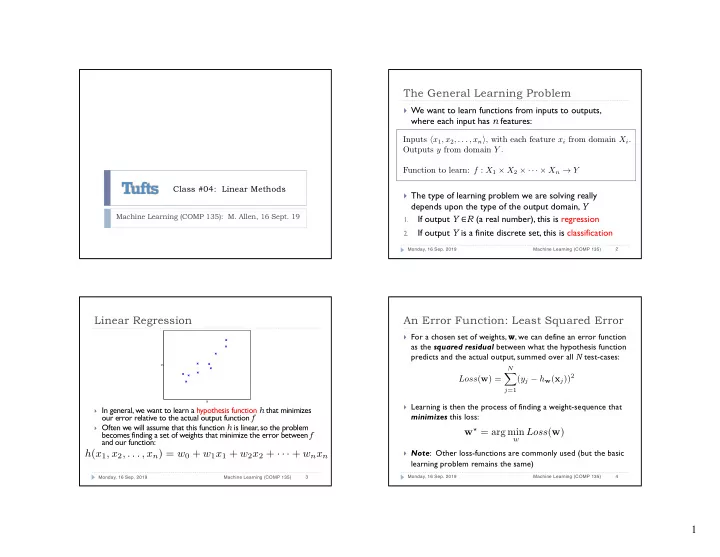
} In general, we want to learn a hypothesis function h that minimizes
- ur error relative to the actual output function f
} Often we will assume that this function h is linear, so the problem
becomes finding a set of weights that minimize the error between f and our function:
Monday, 16 Sep. 2019 Machine Learning (COMP 135) 3
x y
h(x1, x2, . . . , xn) = w0 + w1x1 + w2x2 + · · · + wnxn An Error Function: Least Squared Error
} For a chosen set of weights, w, we can define an error function
as the squared residual between what the hypothesis function predicts and the actual output, summed over all N test-cases:
} Learning is then the process of finding a weight-sequence that
minimizes this loss:
} Note: Other loss-functions are commonly used (but the basic
learning problem remains the same)
Monday, 16 Sep. 2019 Machine Learning (COMP 135) 4
Loss(w) =
N
X
j=1