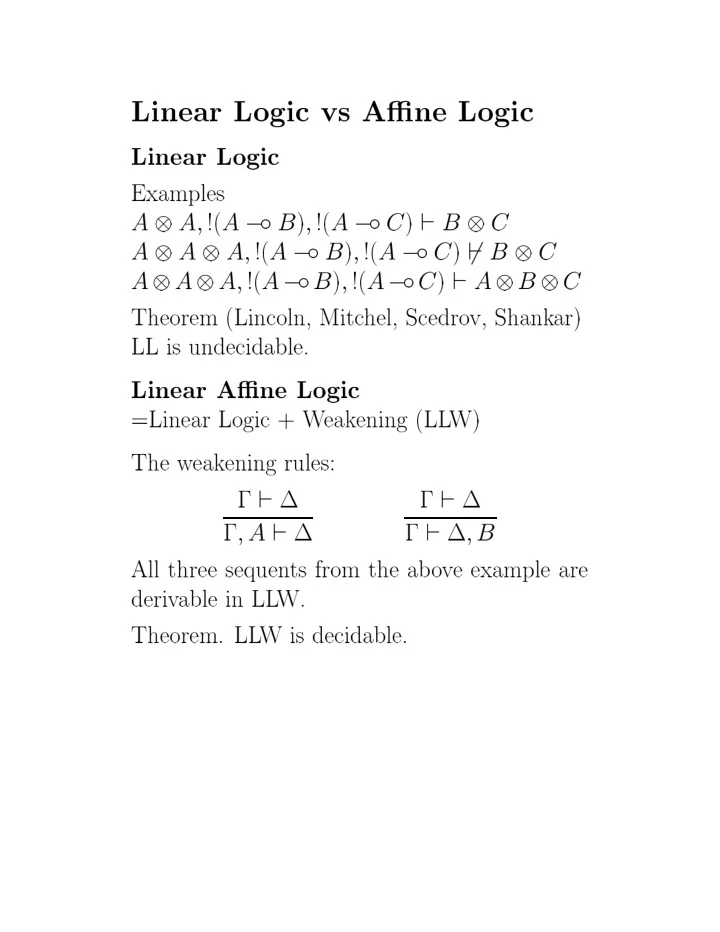
Linear Logi vs Ane Logi Linear Logi Examples A A; !( A - - PDF document

linear logi vs a ne logi linear logi examples a a a b a
SMART_READER_LITE
LIVE PREVIEW

Linear Logi vs Ane Logi Linear Logi Examples A A; !( A - - PDF document

Linear Logi vs Ane Logi Linear Logi Examples A A; !( A B ) ; !( A C ) ` B C A A A; !( A B ) ; !( A C ) 6` B C A A A; !( A B ) ; !( A


slide-1
SLIDE 1 Linear Logi vs AÆne Logi Linear Logi Examples A
  • A;
!(A
  • Æ
B ); !(A
  • Æ
C ) ` B
  • C
A
  • A
  • A;
!(A
  • Æ
B ); !(A
  • Æ
C ) 6` B
  • C
A
  • A
  • A;
!(A
  • Æ
B ); !(A
  • Æ
C ) ` A
  • B
  • C
Theorem (Lin oln, Mit hel, S edro v, Shank ar) LL is unde idable. Linear AÆne Logi =Linear Logi + W eak ening (LL W) The w eak ening rules:
  • `
  • ;
A `
  • `
  • `
; B All three sequen ts from the ab
  • v
e example are deriv able in LL W. Theorem. LL W is de idable.
slide-2
SLIDE 2 P etri Nets Def. A P etri net is a pair (P ; T ) where P is a nite set
  • f
pla es T
  • (!
P
  • !
P ) is a nite set
  • f
transa tions Def. A marking
  • f
a P etri net is a v e tor M 2 ! P Def. A transa tion t = (u; v ) is reable at M if 8p : P :M p
  • u
p Def. A transa tion t = (u; v ) res form M to M if M = M
  • u
+ v Def. A state M is rea hable from M if there is a sequen e M = M ; M 1 ; : : : ; M n = M su h that M i+1 is
  • btained
from M i after the ring
  • f
some transa tion. Theorem (Ma y er 1981, Kosara ju 1982). The rea habilit y problem is de idable.
slide-3
SLIDE 3 Horn fragmen t
  • f
LL A simple pr
  • du t
is a tensor pro du t
  • f
literals (e.g. p
  • p
  • q
). A Horn impli ation is an impli ation
  • f
the form: A
  • Æ
B , where A and B are simple pro d- u ts. A Horn se quent is a sequen t
  • f
the form W ; ! ` Z where W and Z are simple pro du ts and
  • is
a set
  • f
Horn impli ations.
slide-4
SLIDE 4 En o ding P etri nets in the Horn frag- men t Ea h pla e
  • rresp
  • nds
to a literal. V e tors (markings)
  • rresp
  • nds
to simple pro d- u ts. T ransa tion
  • rresp
  • nds
to Horn impli ations. P etri net R
  • rresp
  • nds
to the set
  • f
Horn im- pli ations
  • R
Theorem. M is rea hable from M in a P etri net R i the sequen t M ; ! R ` M is deriv able in LL. Theorem. The sequen t M ; ! R ` M is deriv- able in LL W i there is M 00
  • M
, su h that M 00 is rea hable from M in a P etri net R .
slide-5
SLIDE 5 Normal fragmen t A
  • Horn
impli ation is an impli ation
  • f
the form: A
  • Æ
(B
  • C
), where A, B and C are simple pro du ts. A simple disjun tion is a disjun tion
  • f
the form: B . . . . . . . . . . . . . . . . . . . . . . . . . . . . . . . . . . . . . . . . . . . . . . . . . . . . . . . . . . . . . . . . . . . . . . . . . . . . . . . . . . . . . . . . . . . . . . . C , where B and C are simple pro d- u ts. A normal se quent is a sequen t
  • f
the form W ; ! ` ? ; where W is a simple pro du t,
  • is
a m ultiset
  • f
Horn impli ations,
  • Horn
impli ations and simple disjun tions, and
  • is
a m ultiset
  • f
sim- ple pro du ts.
slide-6
SLIDE 6 Example L 1 = hal k bl a k boar dpaper
  • Æ
pr esentation L 2 = sl idespr
  • j
e tor paper
  • Æ
pr esentation L 3 = bl a k boar d
  • pr
  • j
e tor paper sl ides hal k ; !L 1 ; !L 2 ; !L 3 ` pr esentation L 3 = bl a k boar d . . . . . . . . . . . . . . . . . . . . . . . . . . . . . . . . . . . . . . . . . . . . . . . . . . . . . . . . . . . . . . . . . . . . . . . . . . . . . . . . . . . . . . . . . . . . . . . pr
  • j
e tor paper
  • paper
  • sl
ides
  • hal
k ; !L 1 ; !L 2 ; !L 3 ` pr esentation; pr esentation paper
  • paper
  • sl
ides
  • hal
k ; !L 1 ; !L 2 ; !L 3 ` ?pr esentation
slide-7
SLIDE 7 Let
  • =
(W ; ! ` ?). Game A
  • 1.
Initially , all v e tors from ~
  • are
written
  • n
the bla kb
  • ard.
2. W e ma y write new v e tors with natur al
  • r
dinates b y the follo wing rules: (a) If X
  • Æ
Y 2
  • and
a v e tor a + ~ Y has b een already written, then w e ma y write a + ~ X . (b) If X
  • Æ
(Y 1
  • Y
2 ) 2
  • and
v e tors a + ~ Y 1 and a + ~ Y 2 ha v e b een already written, then w e ma y write a + ~ X . ( ) If Y 1 . . . . . . . . . . . . . . . . . . . . . . . . . . . . . . . . . . . . . . . . . . . . . . . . . . . . . . . . . . . . . . . . . . . . . . . . . . . . . . . . . . . . . . . . . . . . . . . Y 2 2
  • and
v e tors a 1 + ~ Y 1 and a 2 + ~ Y 2 ha v e b een already written, then w e ma y write a 1 + a 2 . 3. The aim
  • f
the game is to
  • btain
~ W . Game B
  • 4.
If a v e tor a has b een written and a
  • then
w e ma y write .
slide-8
SLIDE 8 Theorem. (Computational in terpretation) 1. The normal sequen t
  • is
deriv able in LL i it is p
  • ssible
to rea h the aim in the game A
  • 2.
The normal sequen t
  • is
deriv able in LL W i it is p
  • ssible
to rea h the aim in the game B
  • Pro
  • f.
It is easy to pro v e it b y indu tion
  • n
deriv ation and
  • n
the n um b er
  • f
steps that w e needed to a hiev e the aim in the games.
slide-9
SLIDE 9 Redu tion to the normal fragmen t Theorem. F
  • r
an y sequen t
  • ne
an ee tiv ely
  • nstru t
a normal sequen t
  • su
h that LLW `
  • (
) LLW ` ; LL `
  • (
) LL ` : Lemma. Let
  • `
  • b
e a sequen t. Let x b e an atom in the sequen t. Let A b e an arbitrary form ula. Let
  • =
[x := A℄ and
  • =
[x := A℄. Then
  • `
  • is
deriv able i !(x
  • Æ
A); !(A
  • Æ
x);
  • `
  • is
deriv able.
slide-10
SLIDE 10 The de idabilit y
  • f
LL W Theorem. The problem whether w e an rea h the aim in the game B
  • is
de idable. Lemma. An y set
  • f
pairwise in omparable v e - tors from ! n is nite. Def. Let
  • b
e a set
  • f
normal sequen ts. Let A
  • !
n . W e sa y that A is
  • losed
when 1. If X
  • Æ
Y 2
  • then
8a 2 ! n a + ~ Y 2 A ) a + ~ X 2 A: 2. If X
  • Æ
(Y 1
  • Y
2 ) 2
  • then
8a 2 ! n a+ ~ Y 1 2 A; a+ ~ Y 2 2 A ) a+ ~ X 2 A: 3. If Y 1 . . . . . . . . . . . . . . . . . . . . . . . . . . . . . . . . . . . . . . . . . . . . . . . . . . . . . . . . . . . . . . . . . . . . . . . . . . . . . . . . . . . . . . . . . . . . . . . Y 2 2
  • then
8a 1 ; a 2 2 ! n a 1 + ~ Y 1 2 A; a 2 + ~ Y 2 2 A ) a 1 +a 2 2 A: W e sa y that A is w
  • losed
when 8a 2 A 8
  • a
2 A:
slide-11
SLIDE 11 The set
  • f
all rea hable v e tors in the game B
  • is
  • losed
and w
  • losed.
Lemma. It is p
  • ssible
to rea h the aim in the game B
  • if
and
  • nly
if the follo wing holds: F
  • r
an y A
  • !
n if A is
  • losed
and w
  • losed
and ~
  • A,
then ~ W 2 A. Lemma. If A is losed under the w eak ening then for some nite B A = [ z 2B K z ; where K z = fx j x
  • z
g. Lemma. The prop ert y
  • f
the set A = [ z 2B K z to b e
  • lose
is de idable. Corollary . The set
  • f
deriv able normal sequen ts is
  • en
umerable.