Limitations of current DCBs and The presenter has US 14/244126 - - PowerPoint PPT Presentation

limitations of current dcbs and
SMART_READER_LITE
LIVE PREVIEW

Limitations of current DCBs and The presenter has US 14/244126 - - PowerPoint PPT Presentation

4/15/2016 Disclosures Limitations of current DCBs and The presenter has US 14/244126 intellectual property filed US 15/57103 the future direction of vascular which can be associated with this local drug delivery presentation.


slide-1
SLIDE 1

4/15/2016 1

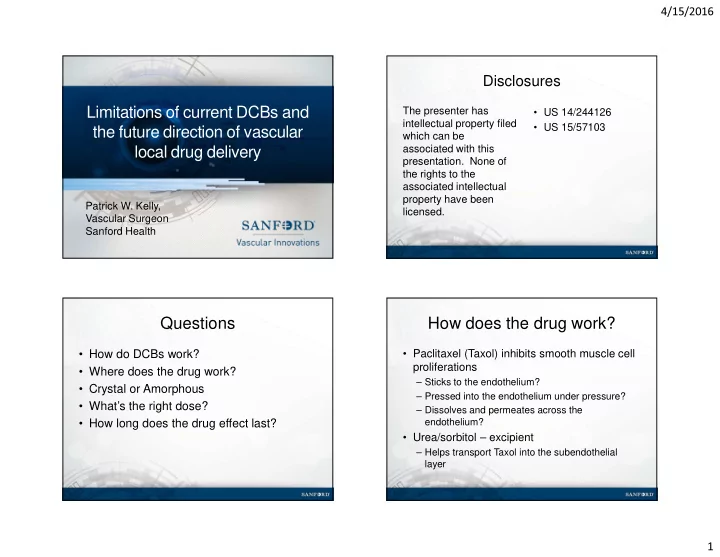
Limitations of current DCBs and the future direction of vascular local drug delivery

Patrick W. Kelly, Vascular Surgeon Sanford Health

Disclosures

  • US 14/244126
  • US 15/57103

The presenter has intellectual property filed which can be associated with this

  • presentation. None of

the rights to the associated intellectual property have been licensed.

Questions

  • How do DCBs work?
  • Where does the drug work?
  • Crystal or Amorphous
  • What’s the right dose?
  • How long does the drug effect last?

How does the drug work?

  • Paclitaxel (Taxol) inhibits smooth muscle cell

proliferations

– Sticks to the endothelium? – Pressed into the endothelium under pressure? – Dissolves and permeates across the endothelium?

  • Urea/sorbitol – excipient

– Helps transport Taxol into the subendothelial layer

slide-2
SLIDE 2

4/15/2016 2

What is the right dose?

  • 2.5 or 3 microgram per square mm of

Taxol on the balloon surface

  • 2 minute – 3 minute inflation
  • Number of treatments per balloon
  • Tissue concentrations and curves

Where does it work?

  • Sub-endothelial layer of the artery
  • Endothelium??

We’ve tried to answer some of these questions

  • Cell culture test

– Smooth muscle cells – Endothelial cells

  • Animal testing

– Infusion under pressure – Drug coated balloon

Cell Cultures

slide-3
SLIDE 3

4/15/2016 3

1 10 100 1000 Relative fluorescence units (RFUs)

Human aortic endothelial cells cultured in the presence of various taxol and/or excipient combinations

1 day 3 days 5 days 1 2 3 4 5 6 7 Aspect ratio (length/width)

Human aortic smooth muscle cells cultured in the presence of various combinations of taxol and/or excipients

1 day 3 days 5 days

Animal Drug Infusion Test

Tissue penetration

phase contrast microscopy

(drug infusion)

  • Taxol had minimal

penetration in a cremaphor solution

  • Taxol had moderate

penetration in a urea solution

  • Taxol had maximal

penetration in an albumin bound nanoparticle (Abraxane)

slide-4
SLIDE 4

4/15/2016 4

5 10 15 20 25 30 35 40 45 50 Cremaphor Abraxane Cremaphor and Urea Cremaphor and Contrast Agent Paclitaxel (ng) per mg of rabbit aorta

Concentrations of Paclitaxel in the aorta of Rabbits at time zero when infused in the presence of various excipients

Developing Next Generation DCB PEO/Taxol next generation DCBs

  • Require uniform

coating and thickness

  • Multiple use would

require coating adhesion through multiple stretch/relax cycles

PEO/Taxol next generation DCBs

  • Require minimal

crystal formation/even distribution throughout polymer to prevent particulate formation/distal embolization

  • Require uniform

material properties throughout

slide-5
SLIDE 5

4/15/2016 5

0.5 1 1.5 2 2.5 3 3.5 4 4.5 5 Amount of taxol released (ug per mm^2)

Timed release of taxol from various paclitaxel and PEO formulations

10% taxol 15% taxol 20% taxol 25% taxol

Particulate formation is at least theoretically important

  • Particulates could

embolize to distal micro vessels during tracking

  • Paclitaxel dissolves

slowly in aqueous environments

Endovascular Today Volume 2 number 6. 2015

Amount of drug needed in the arterial tissue

  • Each device has differing

levels of drug in the arterial tissue throughout the restenotic cascade period

  • Amount of drug present

at time zero is not as important as the amount

  • f drug present at day 7,

14, 21, and 28.

Endovascular Today Volume 2 number 6. 2015

0.5 1 1.5 2 2.5 3

Demonstration of a multi-use balloon being used for one inflation in a rabbit aorta

Drug loaded on balloon (ug per mm^2) drug released from balloon (ug per mm^2) drug left on balloon (ug per mm^2) 61.6 ng per mg tissue 414 ng per mg tissue 169.1 ng per mg tissue 414.4 ng per mg tissue 1921 ng per mg tissue

slide-6
SLIDE 6

4/15/2016 6

Closing thoughts

  • DCBs
  • DIBs
  • Are we targeting the right cellular process
  • Are we using the right drug or drugs?
  • Should it be Crystal or Amorphous

Thank you

Acknowledgements, Collaborator: Tyler Remund PhD and Kathryn Pohlson Gopi Mani, PhD and his team

[Jordan Anderson, Sujan Lamichhane, PhD]

Thank You