
SLIDE 1
18TH INTERNATIONAL CONFERENCE ON COMPOSITE MATERIALS
1 Introduction Lignin has Enormous potential as a raw material for polymer industries. However, lignin has not been utilized as a raw material in spite of its many advantages because of their brittleness and difficulty to process. Chemical modification of lignin is an important area of lignin research. Two types of polymers were used for the blending with chemically modified lignin. Lignin comes to be an Amphiphilic property due to its unique molecular structure. The Solubility Parameter of lignin is between hydrophilic polymers and hydrophobic polymers. Polymers that have similar Solubility Parameter can be blending well each other such as the relation of water and alcohol. On the other hand, Polymers have a different Solubility Parameter can’t be blending well such as the relation of water and oil. Thus phase separation would be happened Until today, two main problems exist in lignin research area. One of them is brittleness, due to the large amount hydroxyl functional group at the end of the lignin molecular structure. The other one is phase separation as same as explained above. However, it has been produced by several research groups to be able to make thermoplastics containing a large amount of lignin. Furthermore
modified lignin was prepared to increase the interfacial force with other synthetic polymers.
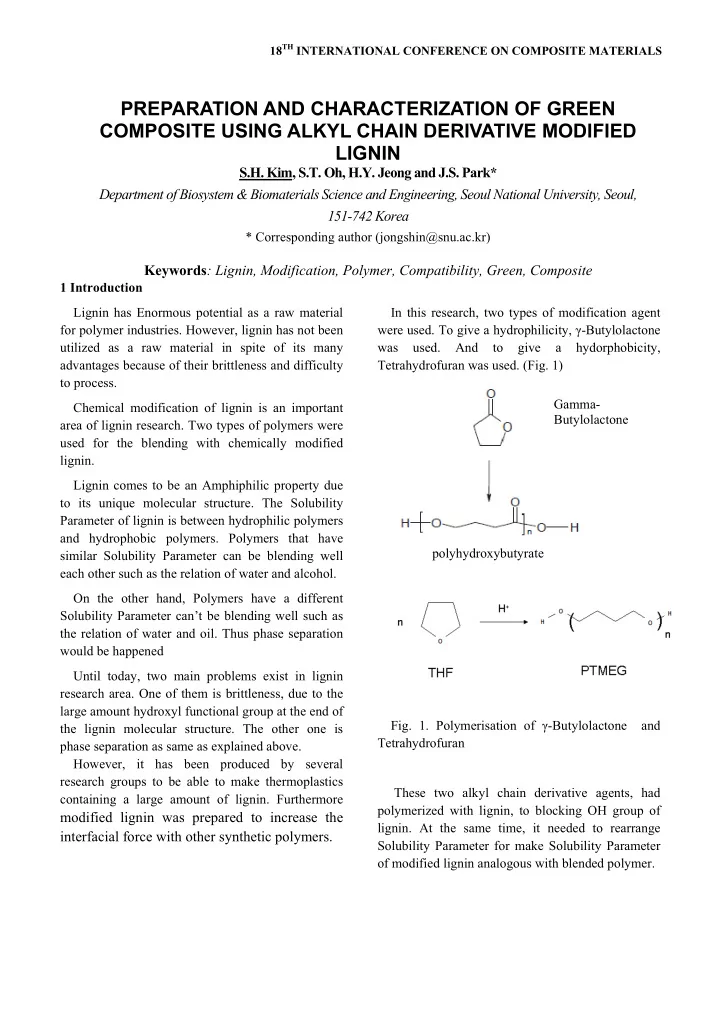
In this research, two types of modification agent were used. To give a hydrophilicity, γ-Butylolactone was used. And to give a hydorphobicity, Tetrahydrofuran was used. (Fig. 1)
- Fig. 1. Polymerisation of γ-Butylolactone and
Tetrahydrofuran These two alkyl chain derivative agents, had polymerized with lignin, to blocking OH group of
- lignin. At the same time, it needed to rearrange
Solubility Parameter for make Solubility Parameter
- f modified lignin analogous with blended polymer.