Life is Biological, but Biology is Also Alive A Renewal of - - PowerPoint PPT Presentation

life is biological but biology is also alive
SMART_READER_LITE
LIVE PREVIEW

Life is Biological, but Biology is Also Alive A Renewal of - - PowerPoint PPT Presentation

Life is Biological, but Biology is Also Alive A Renewal of Vitalism in Medicine by Dave Foster Inspired by the work of Raymond Peat, PhD and Hans Selye, CC About Me A New Paradigm of Coherence A Paradigm Shift You dont choose your


slide-1
SLIDE 1

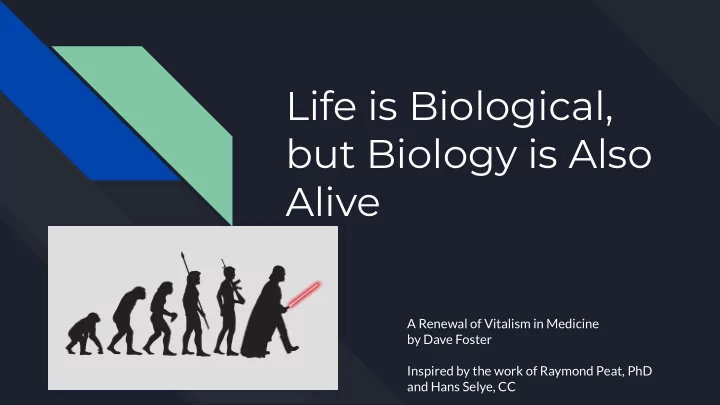
Life is Biological, but Biology is Also Alive

A Renewal of Vitalism in Medicine by Dave Foster Inspired by the work of Raymond Peat, PhD and Hans Selye, CC
slide-2
SLIDE 2

About Me

slide-3
SLIDE 3

A New Paradigm of Coherence

slide-4
SLIDE 4

A Paradigm Shift

  • You don’t choose your thoughts.

○ You experience them from your environment

  • ...but you’re not determined by your

environment. ○ You change your environment

  • ...and you’re not determined by your

genetics ○ Your epigenetics change.

slide-5
SLIDE 5
  • Healthy people live longer.
  • Healthy people have less disease.
  • Sick people work poorly.
  • Happy people work more productively.
  • Happiness births creativity. Creativity breeds efficiency.
  • Happy people live longer.
  • Sick people die young.
  • Sad people die young.
  • Sick people are sad.
  • Sad people are sick.

Health as the Center

slide-6
SLIDE 6

Health as the Center

slide-7
SLIDE 7

Biological Coherence and Parallel Therapies

  • Biological substance > artificial surrogate

○ T3 (thyroid hormone) treats depression ○ Fluoxetine (the drug Prozac) treats depression ■ Which should we prefer? (one’s patentable for $$$)

  • Evolutionarily...

○ Thyroid hormone - hundreds of millions of years old ○ Fluoxetine (Prozac) - Less than 50 years old ■ To which are we better adapted?

slide-8
SLIDE 8

Lifestyle

slide-9
SLIDE 9

The Inefficiency of Stress

  • Efficiency = function with an asymptotic minimization of damage

to structure

  • Stress places an energetic demand

○ If the person cannot meet that demand, catabolism ensues ■ The breakdown of the body’s structure

  • Therefore stress = inefficiency
slide-10
SLIDE 10
  • Happiness is biological
  • a maximization of regenerative, anabolic processes, and a

minimization of catabolic breakdown ○ High cortisol (the stress hormone)

  • Patients self-report health

more accurately than tests ○ Well-being = health

You Can Judge Your Health

slide-11
SLIDE 11
  • Grip strength as a marker for health
  • Long, intense exercise mimics shock
  • Marathon runners prematurely

Age due to... ○ chronic energy depletion

Breathless Exercise

slide-12
SLIDE 12
  • ADHD

○ Insufficient energy reserves to expend on a given task

  • Depression

○ Succumbing to overwhelming stress ■ Limited energy production ■ Maximal energy expenditure

  • Comorbidities and

commonalities of psychiatric disorders

Mental Illness as Energy Deficiency

slide-13
SLIDE 13

Light and Its Applications

slide-14
SLIDE 14

Light Opposes Stress

“Penetrating red light is possibly the fundamental anti-stress factor for all organisms. The chronic deficiency of such light is, I think, the best explanation for the deterioration which occurs with aging. Enzyme changes, free radical changes, structural and respiratory changes are all involved as consequences of darkness stress.”

  • Raymond Peat, PhD
slide-15
SLIDE 15
  • Stressful (downregulates thyroid)
  • Blocks melatonin secretion
  • Damaging to the eyes

Blue Light (400-440 nm)

slide-16
SLIDE 16

Red Light (610-700 nm)

  • Supports metabolism and stimulates energy production
  • Can also block melatonin secretion
  • Beneficial component of

sunlight

slide-17
SLIDE 17

Red Light (610-700 nm)

  • Pro-metabolic effects
  • Hair regrowth
  • Skin regeneration
  • Superior mood and well-being
slide-18
SLIDE 18
  • Sunlight supports metabolism

○ Vitamin D ■ Works like thyroid ○ The effects of red light > blue light ○ UV radiation damages skin and eyes

What About Sunlight?

slide-19
SLIDE 19
  • Light with high amount of

emitted lumens (~10k): ○ Alleviates depression ■ Must hit retina for at least 15 min

Bright Light (SAD Light)

slide-20
SLIDE 20
  • Circadian rhythm determined by:

○ Light exposure to the retina ○ Light exposure to skin ○ Riboflavin (B2) metabolite FAD ■ Increases glucose metabolism

  • High metabolic rate needed for proper

circadian rhythm regulation

  • Not just a light cycle

○ Hormonal cycle

Circadian Rhythm, Not Just Lighting

slide-21
SLIDE 21

Summary of Light

  • Avoid blue, pursue red
  • Avoid all light ~2-3 hrs before bed
  • Use bright incandescents for red light
  • Use f.lux or blue light minimization software
  • Wear blue-light blocking glasses
slide-22
SLIDE 22

Digestion and Mood: Overlapping Disease

slide-23
SLIDE 23

Serotonin as an Inflammatory Mediator

  • In the animal models:

○ Serotonin influences behavior by increasing excitation and aggression

  • Stress elevates the hormone CRH (responsible for anxiety)

○ Inflammation signals serotonin production ■ Serotonin acts on (ACTH) to produce cortisol

slide-24
SLIDE 24

Things that Raise Serotonin

  • Intestinal irritation
  • Endotoxin
  • Hypothyroidism

○ T3 degrades serotonin

  • Social or psychological stress
  • Endurance exercise
slide-25
SLIDE 25

“If we think biologically, starting with the role of serotonin as a damage-induced inflammatory mediator, we can speculate that an infinite number of irritating substances will be ‘serotonin reuptake inhibitors.’ The particular history of the ‘third generation antidepressants’ is one that should disturb our tranquility.”

  • Raymond Peat, PhD

Serotonin as Acute Adaptation

slide-26
SLIDE 26
  • Elevate neurosteroids (allopregnenolone)
  • Increase GABA
  • Other ways to increase neurosteroids

○ Thyroid hormone ○ Progesterone ○ Pregnenolone

  • Adaptogens with similar effects:

○ Caffeine (allopregnenolone) ○ Nicotine (allopregnenolone and GABA) ○ THC (allopregnenolone) ○ Alcohol (GABA)

Why Do Antidepressants Work?

slide-27
SLIDE 27
  • Easy to digest foods
  • Saturated fat

○ Anti-leaky gut; tight junction integrity!

  • Protein (for liver detoxification)
  • Salt (to taste)
  • Carbohydrate (sugars digest better than starches)

Dietary Things that Reduce Serotonin

slide-28
SLIDE 28

Drugs of Abuse

slide-29
SLIDE 29

Opioid Abuse, Cocaine, and (Alcoholism)

  • Blocks the short-term stress response

○ Increases it in the long-run ■ Similar to alcohol

  • Progesterone and DHEA prevent

cocaine addiction ○ Estrogen amplifies addiction

slide-30
SLIDE 30

Opioid Abuse (and Alcoholism)

"The fact that a taste of chocolate can provoke a wild lust for more chocolate, or that once cigarette renews the addiction, does not mean that the presence of chocolate or nicotine in the blood creates a craving. Rather, it is that an organism in an unstable state perceives the availability of something which promises to partially restore the desired stability."

  • Raymond Peat, PhD
slide-31
SLIDE 31

Adaptogens

slide-32
SLIDE 32

Novelty is Key; Parkinson’s as a Model

  • People with Parkinson’s have decreased ioie de vivre

○ What we’re after when we think “happiness”

  • Long train ride alleviates symptoms

○ Novelty is a need

slide-33
SLIDE 33

Coffee (Caffeine)

  • Promotes allopregnenolone

synthesis

  • Acts like thyroid hormone
  • Enhances bile secretion
  • Promotes serotonin uptake in

nerves ○ Shifts the dopamine/serotonin ratio favorably

slide-34
SLIDE 34
  • Thyromimetic

○ Lowers serotonin ○ Aromatase inhibitor (lowers estrogen) ○ Pro-metabolic ○ Increases DHT

  • Allopregnenolone and

progesterone prevent addiction

Tobacco (Nicotine)

slide-35
SLIDE 35

Alcohol

  • Lowers progesterone, raises

estrogen

  • Short-term gabergic effects

Can precipitate increased rebound anxiety if not taken in context

slide-36
SLIDE 36

Cannabis (THC)

  • Promotes allopregnenolone

and possibly progesterone ○ Also raises serotonin In higher concentrations

  • Antidepressant effect at smaller

dosages

slide-37
SLIDE 37

“I knew someone who had been addicted to morphine and alcohol for 30 years, who was drinking quarts of beer and wine daily when he didn't have morphine, who had an opportunity for a good job if he could get sober. Starting progesterone at bedtime (and stopping the wine), he said it was the first time he didn't have a hangover in the morning. He used enough progesterone to neuter most people, but said it didn't affect his sex function; he was taking a lot of Cytomel and magnesium, but wasn't drunk again as long as I knew him, and his general health improved.”

  • Raymond Peat, PhD

Alcoholism, An Anecdote

slide-38
SLIDE 38

Centenarians

  • Tobacco
  • Coffee (moderate)
  • Alcohol (moderate)
  • Saturated fat (ice cream,

chocolate, etc.)

  • Social lifestyle
  • Richard Overton (109)

○ Ice cream ○ Cigars, coffee, and whiskey ○ Soup ○ Church

slide-39
SLIDE 39
  • Concentric exercise (weight lifting)
  • Light
  • Progesterone
  • Pregnenolone
  • Thyroid hormone
  • Coffee
  • Eat delicious foods

○ Minimize PUFA, iron

  • Shift the calcium/phosphorous ratio to favor calcium

○ Dairy, fruits, stews, etc.

Coherence in Context

slide-40
SLIDE 40

References

  • Milivojevic V, Fox HC, Sofuoglu M, Covault J, Sinha R. Effects of progesterone stimulated

allopregnanolone on craving and stress response in cocaine dependent men and women.

  • Psychoneuroendocrinology. 2016 Mar;65:44–53.
  • Larson EB, Anker JJ, Gliddon LA, Fons KS, Carroll ME. Effects of estrogen and

progesterone on the escalation of cocaine self-administration in female rats during extended access. Exp Clin Psychopharmacol. 2007 Oct;15(5):461–71.

  • Valentino RJ, Van Bockstaele E. Endogenous opioids: opposing stress with a cost.

F1000Prime Rep [Internet]. 2015 May 12;7. Available from: https://www.ncbi.nlm.nih.gov/pmc/articles/PMC4447041/

slide-41
SLIDE 41

References

  • Intagliata C, Intagliata C. Extreme Exercise Can Poison the Blood [Internet]. Scientific
  • American. [cited 2017 Oct 27]. Available from:
  • Shephard R. Sepsis and mechanisms of inflammatory response: is exercise a good model?

Br J Sports Med. 2001 Aug;35(4):223–30.

  • Rezvani AH, Levin ED. Assessment of pregnenolone effects on alcohol intake and

preference in male alcohol preferring (P) rats. Eur J Pharmacol. 2014 Oct 5;740:53–7.

  • Maayan R, Lotan S, Doron R, Shabat-Simon M, Gispan-Herman I, Weizman A, et al.

Dehydroepiandrosterone (DHEA) attenuates cocaine-seeking behavior in the self-administration model in rats. Eur Neuropsychopharmacol. 2006 Jul;16(5):329–39.

  • Sarkola T, Mäkisalo H, Fukunaga T, Eriksson CJ. Acute effect of alcohol on estradiol,

estrone, progesterone, prolactin, cortisol, and luteinizing hormone in premenopausal

  • women. Alcohol Clin Exp Res. 1999 Jun;23(6):976–82.
slide-42
SLIDE 42

References

  • Sarkola T, Mäkisalo H, Fukunaga T, Eriksson CJ. Acute effect of alcohol on estradiol,

estrone, progesterone, prolactin, cortisol, and luteinizing hormone in premenopausal

  • women. Alcohol Clin Exp Res. 1999 Jun;23(6):976–82.
  • Joffe RT. Hormone treatment of depression. Dialogues Clin Neurosci. 2011

Mar;13(1):127–38.

  • Gore DC, Jahoor F, Wolfe RR, Herndon DN. Acute response of human muscle protein to

catabolic hormones. Ann Surg. 1993 Nov;218(5):679–84.

  • O’Keefe JH, Patil HR, Lavie CJ, Magalski A, Vogel RA, McCullough PA. Potential Adverse

Cardiovascular Effects From Excessive Endurance Exercise. Mayo Clin Proc. 2012 Jun;87(6):587–95.

slide-43
SLIDE 43

References

  • Blum K, Chen AL-C, Braverman ER, Comings DE, Chen TJ, Arcuri V, et al.

Attention-deficit-hyperactivity disorder and reward deficiency syndrome. Neuropsychiatr Dis Treat. 2008 Oct;4(5):893–918.

  • Blum K, Chen AL-C, Braverman ER, Comings DE, Chen TJ, Arcuri V, et al.

Attention-deficit-hyperactivity disorder and reward deficiency syndrome. Neuropsychiatr Dis Treat. 2008 Oct;4(5):893–918.

  • Sharma AM, Schorr U, Thiede HM, Distler A. Effect of dietary salt restriction on urinary

serotonin and 5-hydroxyindoleacetic acid excretion in man. J Hypertens. 1993 Dec;11(12):1381–6.

  • Goetz CG. The History of Parkinson’s Disease: Early Clinical Descriptions and

Neurological Therapies. Cold Spring Harb Perspect Med [Internet]. 2011 Sep;1(1). Available from: https://www.ncbi.nlm.nih.gov/pmc/articles/PMC3234454/

slide-44
SLIDE 44

References

  • Raymond Peat, PhD. Caffeine: A vitamin-like nutrient, or adaptogen. [Internet]. [cited

2017 Oct 28]. Available from: http://raypeat.com/articles/articles/caffeine.shtml

  • Semba J, Mataki C, Yamada S, Nankai M, Toru M. Antidepressantlike effects of chronic

nicotine on learned helplessness paradigm in rats. Biol Psychiatry. 1998 Mar 1;43(5):389–91.

  • Sun B, Sterling CR, Tank AW. Chronic nicotine treatment leads to sustained stimulation
  • f tyrosine hydroxylase gene transcription rate in rat adrenal medulla. J Pharmacol Exp
  • Ther. 2003 Feb;304(2):575–88.
  • Jang M-H, Shin M-C, Lee T-H, Kim Y-P, Jung S-B, Shin D-H, et al. Alcohol and nicotine

administration inhibits serotonin synthesis and tryptophan hydroxylase expression in dorsal and median raphe of young rats. Neurosci Lett. 2002 Aug 30;329(2):141–4.

slide-45
SLIDE 45

References

  • “Mr. Overton” [Internet]. Available from:

https://www.youtube.com/watch?v=bYc5XNfnYNs

slide-46
SLIDE 46

Acknowledgements

  • Information brought to my attention by

○ Danny Roddy, author of Hair Like a Fox ○ Georgi Dinkov, biochemist and founder of Idea Labs D.C. ○ Raymond Peat, PhD ○ Hans Selye, CC ○ ...and others who are tangentially important

  • “Living is stressful.” - Hans Selye, CC
  • “Living is good for you.” Raymond Peat, PhD
slide-47
SLIDE 47

Image Sources

  • http://www.complete-coherence.com/the-biological-basis-of-flow/
  • https://en.wikipedia.org/wiki/Coffee
  • https://www.eatrightontario.ca/en/Articles/Alcohol-and-smoking/Alcohol-and-Nutrition

.aspx

  • https://www.rayleighexpress.com/single-post/2017/02/16/CATCH-ME-IF-YOU-CAN-S

AY-MARATHON-RUNNERS

  • https://health.usnews.com/health-news/patient-advice/articles/2015/05/12/is-depressi
  • n-ever-just-depression
  • https://www.everydayhealth.com/depression/symptoms/biggest-antidepressant-proble

ms-solved/