Library Learning for Neurally-Guided Bayesian Program Induction Kevin - - PowerPoint PPT Presentation

library learning for neurally guided bayesian program
SMART_READER_LITE
LIVE PREVIEW

Library Learning for Neurally-Guided Bayesian Program Induction Kevin - - PowerPoint PPT Presentation

Library Learning for Neurally-Guided Bayesian Program Induction Kevin Ellis 1 , Lucas Morales 1 , Mathias Sabl e-Meyer 2 , Armando Solar-Lezama 1 , Joshua B. Tenenbaum 1 1 : MIT. 2 : ENS Paris-Saclay. Symbolic regression: List processing: Text


slide-1
SLIDE 1

Library Learning for Neurally-Guided Bayesian Program Induction

Kevin Ellis1, Lucas Morales1, Mathias Sabl´ e-Meyer2, Armando Solar-Lezama1, Joshua B. Tenenbaum1

1: MIT. 2: ENS Paris-Saclay.

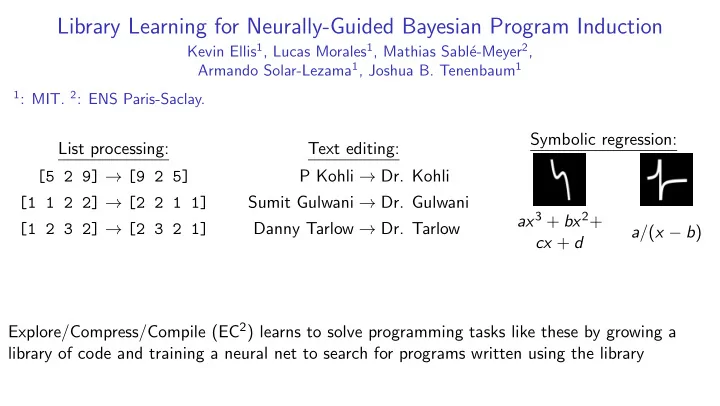
List processing: [5 2 9] → [9 2 5] [1 1 2 2] → [2 2 1 1] [1 2 3 2] → [2 3 2 1] Text editing: P Kohli → Dr. Kohli Sumit Gulwani → Dr. Gulwani Danny Tarlow → Dr. Tarlow Symbolic regression: ax3 + bx2+ cx + d a/(x − b) Explore/Compress/Compile (EC2) learns to solve programming tasks like these by growing a library of code and training a neural net to search for programs written using the library

slide-2
SLIDE 2

Library learning [7 2 3]→[7 3] [1 2 3 4]→[3 4] [4 3 2 1]→[4 3]

slide-3
SLIDE 3

Library learning [7 2 3]→[7 3] [1 2 3 4]→[3 4] [4 3 2 1]→[4 3] Library: f1(ℓ,p) = (foldr ℓ nil (λ (x a) (if (p x) (cons x a) a))) (f1: Higher-order filter function) (Get elements x from ℓ where (p x) returns true)

slide-4
SLIDE 4

Library learning [7 2 3]→[7 3] [1 2 3 4]→[3 4] [4 3 2 1]→[4 3] f (ℓ) =(f1 ℓ (λ (x) (> x 2))) Library: f1(ℓ,p) = (foldr ℓ nil (λ (x a) (if (p x) (cons x a) a))) (f1: Higher-order filter function) (Get elements x from ℓ where (p x) returns true)

slide-5
SLIDE 5

Subset of 38 learned library routines for list processing f0(ℓ,r) = (foldr r ℓ cons) f0: Append lists r and ℓ f1(ℓ,p) = (foldr ℓ nil (λ (x a) (if (p x) (cons x a) a))) f1: Higher-order filter function f2(ℓ) = (foldr ℓ 0 (λ (x a) (if (> a x) a x))) f2: Maximum element in list ℓ f3(ℓ,k) = (foldr ℓ (is-nil ℓ) (λ (x a) (if a a (= k x)))) f2: Whether ℓ contains k

slide-6
SLIDE 6

Explore/Compress/Compile as Bayesian Inference

DSL prog task prog task prog task

slide-7
SLIDE 7

Explore/Compress/Compile as Amortized Bayesian Inference

DSL prog task prog task prog task

is

slide-8
SLIDE 8

Explore/Compress/Compile as Amortized Bayesian Inference

Explore: Infer programs, fixing DSL and neural recognition model

DSL prog task prog task prog task

is

slide-9
SLIDE 9

Explore/Compress/Compile as Amortized Bayesian Inference

Explore: Infer programs, fixing DSL and neural recognition model DSL f1, f2, ... Task

[7 2 3]→[7 3] [1 2 3 4]→[3 4] [4 3 2 1]→[4 3]

Recog. model

Neurally-Guided Enumerative Search Programs:

(f1 ℓ (λ (x) (> x 2))) DSL prog task prog task prog task

is

slide-10
SLIDE 10

Explore/Compress/Compile as Amortized Bayesian Inference

Compress: Update DSL, fixing programs

DSL prog task prog task prog task

is

slide-11
SLIDE 11

Explore/Compress/Compile as Amortized Bayesian Inference

Compress: Update DSL, fixing programs

  • progs. for task1
  • progs. for task2

DSL DSL+ + 1 + 1 1 cons + 1 car z

DSL prog task prog task prog task

is

slide-12
SLIDE 12

Explore/Compress/Compile as Amortized Bayesian Inference

Compile: Train recognition model

DSL prog task prog task prog task

is

slide-13
SLIDE 13

Explore/Compress/Compile as Amortized Bayesian Inference

Compile: Train recognition model

DSL program

sample

task

run

DSL prog task prog task prog task

is

slide-14
SLIDE 14

Explore/Compress/Compile as Amortized Bayesian Inference

DSL prog task prog task prog task

is

DSL prog task prog task prog task DSL prog task prog task prog task

Explore Compile Compress

slide-15
SLIDE 15

Domain: Text Editing

In the style of FlashFill (Gulwani 2012). Starts with map, fold, etc. Input Output +106 769-438 106.769.438 +83 973-831 83.973.831 Temple Anna H TAH Lara Gregori LG

slide-16
SLIDE 16

Text editing: Library learning builds on itself

Learned DSL primitives over 3 iterations (3 columns). Learned primitives call each other (arrows).

slide-17
SLIDE 17

Programs with numerical parameters: Symbolic regression from visual input

Fits parameters by autograd-ing thru program Recognition model looks at picture of function’s graph Programs & Tasks DSL

f (x) =(f1 x) f (x) =(f5 x) f (x) =(f4 x) f (x) =(f3 x) f0(x) = (+ x real) f1(x) = (f0 (* real x)) f2(x) = (f1 (* x (f0 x))) f3(x) = (f0 (* x (f2 x))) f4(x) = (f0 (* x (f3 x))) (f4: 4th order polynomial) f5(x) = (/ real (f0 x)) (f5: rational function)

slide-18
SLIDE 18

New domain: Generative graphics programs (Turtle/LOGO)

Training tasks:

slide-19
SLIDE 19

Generative graphics programs: Samples from DSL

DSL samples before learning DSL samples after learning

slide-20
SLIDE 20

Generative graphics programs: Learned library contains parametric drawing routines

Semicircle: Spiral: Greek Spiral: S-Curves: Polygons & Stars: Circles:

slide-21
SLIDE 21

Learning to program: Poster AB #24