Leveraging Substantive Consolidation, Piercing the Veil and Alter Ego - - PowerPoint PPT Presentation

leveraging substantive consolidation piercing the veil
SMART_READER_LITE
LIVE PREVIEW

Leveraging Substantive Consolidation, Piercing the Veil and Alter Ego - - PowerPoint PPT Presentation

Presenting a live 90 minute webinar with interactive Q&A Leveraging Substantive Consolidation, Piercing the Veil and Alter Ego in Bankruptcy Proceedings h V il d Al E i B k P di Maximizing Creditor Recovery From or Asset Protection for


slide-1
SLIDE 1

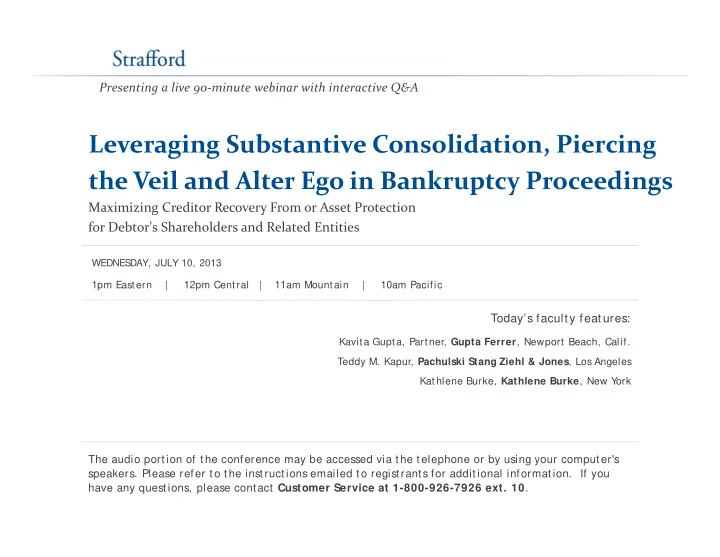
Presenting a live 90‐minute webinar with interactive Q&A

Leveraging Substantive Consolidation, Piercing h V il d Al E i B k P di the Veil and Alter Ego in Bankruptcy Proceedings

Maximizing Creditor Recovery From or Asset Protection for Debtor's Shareholders and Related Entities

T d ’ f l f

1pm Eastern | 12pm Central | 11am Mountain | 10am Pacific WEDNES DAY, JULY 10, 2013

Today’s faculty features:

Kavita Gupta, Partner, Gupta Ferrer, Newport Beach, Calif. Teddy M. Kapur, Pachulski Stang Ziehl & Jones, Los Angeles Kathlene Burke, Kathlene Burke, New Y

  • rk

Kathlene Burke, Kathlene Burke, New Y

  • rk

The audio portion of the conference may be accessed via the telephone or by using your computer's

  • speakers. Please refer to the instructions emailed to registrants for additional information. If you

have any questions, please contact Customer Service at 1-800-926-7926 ext. 10.

slide-2
SLIDE 2

Tips for Optimal Quality

S d Q lit S

  • und Quality

If you are listening via your computer speakers, please note that the quality of your sound will vary depending on the speed and quality of your internet connection. If the sound quality is not satisfactory and you are listening via your computer speakers, you may listen via the phone: dial 1-888-450-9970 and enter your PIN when prompted Otherwise please send us a chat or e mail when prompted. Otherwise, please send us a chat or e-mail sound@ straffordpub.com immediately so we can address the problem. If you dialed in and have any difficulties during the call, press *0 for assistance.

Viewing Qualit y

To maximize your screen, press the F11 key on your keyboard. To exit full screen, press the F11 key again press the F11 key again.

slide-3
SLIDE 3

Continuing Education Credits

FOR LIVE EVENT ONLY

For CLE purposes, please let us know how many people are listening at your location by completing each of the following steps:

  • In the chat box, type (1) your company name and (2) the number of

attendees at your location attendees at your location

  • Click the S

END button beside the box If you have purchased S trafford CLE processing services, you must confirm your participation by completing and submitting an Official Record of Attendance (CLE Form). Y

  • u may obtain your CLE form by going to the program page and selecting the

appropriate form in the PROGRAM MATERIALS box at the top right corner. If you'd like to purchase CLE credit processing, it is available for a fee. For additional information about CLE credit processing, go to our website or call us at 1-800-926-7926 ext. 35.

slide-4
SLIDE 4

Program Materials

If you have not printed the conference materials for this program, please complete the following steps:

  • Click on the + sign next to “ Conference Materials” in the middle of the left-

hand column on your screen hand column on your screen.

  • Click on the tab labeled “ Handouts” that appears, and there you will see a

PDF of the slides for today's program.

  • Double click on the PDF and a separate page will open.

Double click on the PDF and a separate page will open.

  • Print the slides by clicking on the printer icon.
slide-5
SLIDE 5

Leveraging Substantive Consolidation, Piercing the Veil and Alter Ego in Bankruptcy Proceedings

Maximizing Creditor Recovery From or Asset Protection Maximizing Creditor Recovery From or Asset Protection for Debtor’s Shareholders and Related Entities

Kavita Gupta, Gupta Ferrer LLP, Newport Beach, California Teddy M. Kapur, Pachulski Stang Ziehl & Jones LLP, Los Angeles, California Kathlene M. Burke, Restructuring Attorney, New York, New York

slide-6
SLIDE 6

O tli Outline

Alter Ego / Corporate Veil Piercing

Alter Ego / Corporate Veil Piercing

Theory

Factors

Reverse Veil Piercing

Pursuing Shareholders Under Alter Ego / Corporate Veil

Pursuing Shareholders Under Alter Ego / Corporate Veil Piercing Theories

Creation of the Bankruptcy Estate

The Automatic Stay Injunction

Standing g

Issues to Consider

Substantive Consolidation

Theory and Authority of the Court

Effects of Consolidation

Factors Considered and Methodologies Employed by Courts

Best Practices for Debtors and Creditors

Substantive Consolidation v. Alter Ego / Corporate Veil Piercing

6

slide-7
SLIDE 7

T dd M K Teddy M. Kapur

Pachulski Stang Ziehl & Jones LLP

Los Angeles, California tkapur@pszjlaw.com (310) 277-6910 (310) 277 6910

7

slide-8
SLIDE 8

Alter Ego / Corporate Veil Alter Ego / Corporate Veil Piercing

8

slide-9
SLIDE 9

D t i f Li it d Li bilit Doctrine of Limited Liability

 Generally a corporation’s

shareholders officers directors and shareholders, officers, directors and employees are not personally liable for actions taken on behalf of the corporation. corporation.

9

slide-10
SLIDE 10

Alt E / C t V il Pi i Alter Ego / Corporate Veil Piercing

C t i th t il f li it d

 Courts may pierce the corporate veil of limited

liability and disregard the corporate form to hold shareholders, officers and directors individually liable if they abuse the corporate privilege liable if they abuse the corporate privilege.

 “The purpose of alter ego liability and piercing the

t il i t t i d d t corporate veil is to prevent an independent corporation from being used to defeat the ends of justice, to perpetrate fraud, to accomplish a crime,

  • r otherwise to evade the law ” Bd of Trs v
  • r otherwise to evade the law. Bd. of Trs. v.

Foodtown, Inc., 296 F .3d 164, 171 (3d Cir. 2002) (citations omitted).

10

slide-11
SLIDE 11

Alt E / C t V il Pi i Alter Ego / Corporate Veil Piercing

Delaware: (1) companies operated as a single

 Delaware: (1) companies operated as a single

economic unit; and (2) the presence of an overall element of injustice or unfairness. In re Autobacs Strauss, Inc., 473 B.R. 525, 555 (Bankr. D. Del. , , , ( 2012).

 California: (1) there is such a unity of interest and

  • wnership that the individuality, or separateness, of

the said person and corporation has ceased, and (2) an adherence to the fiction of the separate existence

  • f the corporation would sanction a fraud or promote
  • f the corporation would sanction a fraud or promote
  • injustice. SEC v. Hickey, 322 F

.3d 1123, 1128 (9th

  • Cir. 2003).

11

slide-12
SLIDE 12

Alt E F t Alter Ego Factors

C t ill l t b f

 Courts will evaluate a number of

factors to determine whether an alter ego relationship exists alter ego relationship exists.

 Fact-driven inquiry. The factors are  Fact driven inquiry. The factors are

not exclusive or exhaustive, and courts consider the totality of the i circumstances.

12

slide-13
SLIDE 13

Alt E F t Alter Ego Factors

  • 1. Subsidiary was undercapitalized.

a)

Undercapitalization / unreasonably small capital is conceptually distinct from capital is conceptually distinct from insolvency.

b)

An entity has unreasonably small capital if it cannot generate enough cash flow to sustain operations standing alone.

c)

Courts consider whether the entity had

c)

Courts consider whether the entity had access to capital markets in order to raise money.

13

slide-14
SLIDE 14

Alt E F t Alter Ego Factors

  • 2. Subsidiary was insolvent.

a)

Per § 101(32), a corporation is “insolvent” when it’s in a “financial condition such that when it s in a financial condition such that the sum of such entity’s debts is greater than all of such entity’s property, at a fair valuation ” valuation . . . .

b)

“Fair valuation” - uses “a going concern basis unless the business is wholly i ti d f t d d it f t inoperative, defunct, or dead on its feet or if liquidation in bankruptcy was clearly imminent on the transfer date.” Autobacs, 3 3 ( i i i d) 473 B.R. at 553 (citations omitted).

14

slide-15
SLIDE 15

Alt E F t Alter Ego Factors

f

  • 3. Companies failed to observe

corporate formalities.

Did th tit k t d

a)

Did the entity keep corporate records, have properly functioning officers and directors, and observe other corporate , p formalities?

b)

Did the entity have formal board d ? meetings and minutes? Were corporate actions authorized by written consent without meeting? written consent without meeting?

15

slide-16
SLIDE 16

Alt E F t Alter Ego Factors

  • 4. Subsidiary did not pay dividends to

the parent. h f h b d ’

  • 5. A siphoning of the subsidiary’s

funds by the dominant stockholder.

I t ki f f d th t th

a)

Improper taking of funds that the

  • wner was not legally entitled to

receive.

  • 6. Absence of corporate records.

16

slide-17
SLIDE 17

Alt E F t Alter Ego Factors

f

  • 7. Corporation was merely a façade

for the operations of the dominant stockholder stockholder.

a)

Courts infer a façade when a parent corporation exercises significant control p g

  • ver a subsidiary’s operations and

finances.

b)

Commingled assets and operations use

b)

Commingled assets and operations - use

  • f common employees, bank accounts,

and facilities without arm’s-length i transactions.

17

slide-18
SLIDE 18

F d I j ti U f i Fraud, Injustice or Unfairness

Pi il t id i it bl lt

 Pierce veil to avoid an inequitable result.  Conduct amounting to bad faith makes it inequitable

for the corporate owner to hide behind the corporate form.

 Some courts focus on whether corporation’s very

purpose is to defraud an innocent party.

 Others focus less on bad faith of alleged alter ego,

and more on whether result would be unjust if veil is not pierced. p

18

slide-19
SLIDE 19

R V il Pi i Reverse Veil Piercing

N ll lt l i i t th i i l

 Normally alter ego claims are against the principal or

parent to hold the principal or parent liable for the corporation or subsidiary’s debt.

 Reverse veil piercing seeks to hold the subsidiary or

corporation liable for debts or conduct of the parent i i l

  • r principal.

 Often asserted in attempts to hold corporation liable

for judgment against individual shareholder(s) who controlled corporation.

19

slide-20
SLIDE 20

R V il Pi i Reverse Veil Piercing

Delaware: Not yet recognized but the U S District Court

Delaware: Not yet recognized, but the U.S. District Court for Southern District of Texas “predicted that in determining whether to reverse pierce a corporate veil, Delaware would use similar equitable considerations as it would under a traditional veil-piercing claim.” ASARCO LLC, 396 B.R. 278, 317 (S.D. Tex. 2008) (deciding alter ego issue under Delaware law).

California: Disfavored in corporate context. “[ A] third party creditor may not pierce the corporate veil to reach corporate assets to satisfy a shareholder’s personal p y p liability.” Postal Instant Press, 162 Cal.App.4th 1510 (2008); cf. In re Schwarzkopf, 626 F .3d 1032, 1038 (9th

  • Cir. 2010) (declining to extend the prohibition on reverse

piercing to the context of trusts) piercing to the context of trusts).

20

slide-21
SLIDE 21

C iti f R V il Pi i Critiques of Reverse Veil Piercing

S i d i P t l I t t P 162 C l A Summarized in Postal Instant Press, 162 Cal. App. 4th 1510, 1519-1524 (2008):

1.

“[ B] ypasses normal judgment-collection procedures, whereby judgment creditors attach the judgment debtor's shares in the corporation and not the corporation's assets.” Cascade Energy, 896 F .2d 1557, 1577 (10th Cir. 1990).

2.

Other traditional remedies are available, , including conversion, fraudulent conveyance of assets, respondeat superior, agency law and standard judgment collection procedures. Id.; j g p ; Floyd, 151 F .3d 1295, 1300 (10th Cir. 1998).

21

slide-22
SLIDE 22

C iti f R V il Pi i Critiques of Reverse Veil Piercing

“[ T] th t t th t th ti h th

3.

“[ T] o the extent that the corporation has other non-culpable shareholders, they obviously will be prejudiced if the corporation’s assets can be tt h d di tl I t t i di i i attached directly. In contrast, in ordinary piercing cases, only the assets of the particular shareholder who is determined to be the corporation’s alter ego are subject to corporation’s alter ego are subject to attachment.” Cascade Energy, 896 F .2d at 1577.

4.

Unsettles expectations of corporate creditors who understand their loans to be secured by corporate assets. Floyd, 151 F .3d at 1299-1300.

22

slide-23
SLIDE 23

K it G t Kavita Gupta

Gupta Ferrer, LLP Newport Beach, California www.guptaferrer.com k t @ t f (949) 387 4470 kgupta@guptaferrer.com; (949) 387-4470

slide-24
SLIDE 24

Pursuing a Debtor’s Shareholders Under an Alter- g Ego Liability Theory

A dit ti d it h h ld ti A creditor sues a corporation and its shareholders, asserting an theory of alter-ego liability. The corporation files a bankruptcy petition and the automatic stay enjoins the creditor’s action. What happens to the alter-ego action c ed to s act o at appe s to t e a te ego act o against the shareholders?

slide-25
SLIDE 25

The Creation of a Bankruptcy Estate and p y Appointment of a Trustee

Wh d bt fil titi b k t t t i t d 11

When a debtor files a petition, a bankruptcy estate is created. 11 U.S.C. § 541.

Property of the bankruptcy estate includes “all legal or equitable p y p y g q interests of the debtor in property as of the commencement of the case,” ... including a debtor's causes of action.; United States

  • v. Whiting Pools, Inc., 462 U.S. 198, 205 no. 9, 103 S. Ct. 2309,

76 L.Ed2d 515 (1983). ( )

In a Chapter 7 case, a trustee is always appointed. 11 U.S.C. § 704.

In a Chapter 11 case, a trustee is only appointed for “cause,” which includes post-petition fraud, misconduct or deadlock between major parties. 11 U.S.C. § 1104.

A trustee’s primary duty is to collect and liquidate property of the bankruptcy estate. 11 U.S.C. § 704.

25

slide-26
SLIDE 26

The Automatic Stay Does Not Enjoin Actions Against y j g Non-Debtor Entities

Th t ti t lf ti i j ti

  • The automatic stay – a self-executing injunction -

enjoins any action against a debtor corporation.

  • Generally, the automatic stay does not enjoin

actions against non-debtor parties such as the debtor corporation’s shareholder, officer or director.

  • Therefore, the alter-ego action may continue against

the shareholders of the debtor corporation.

26

slide-27
SLIDE 27

Who has Standing to Prosecute an Alter-Ego Action Against a Shareholder of a Debtor Corporation g p

  • Creditor or Trustee?

Wh th dit t t h t di t t lt

Whether a creditor or trustee has standing to prosecute an alter- ego action is critical because it affects who will receive the proceeds from such an action.

Moreover, in a Chapter 11 case, a debtor will stay in possession unless a trustee is appointed for cause. Therefore, in a closely held corporation, the debtor’s management may lack the motivation and/ or financial means to prosecute an alter ego p g action.

If a creditor does not have standing, then its recovery from the bankruptcy estate is limited to a pro-rata share of any bankruptcy estate is limited to a pro-rata share of any distribution made by a trustee or debtor-in-possession. Such a recovery could be minimal since secured, because administrative claims (e.g., the fees of a trustee and her professionals) and priority claims (e g tax claims) are paid before general priority claims (e.g., tax claims) are paid before general unsecured claims.

27

slide-28
SLIDE 28

The Trustee’s Standing to Pursue An Alter-Ego g g Action

Th l i t t ’ l i t di t t

The law governing a trustee’s exclusive standing to prosecute an alter-ego action is evolving.

The Supreme Court has held that a trustee is generally limited to p g y asserting claims owned by the debtor. Caplin v. Marine Midland Grace Trust Co., 406 U.S. 416 (1972).

Accordingly a trustee is a representative of the bankruptcy

Accordingly, a trustee is a representative of the bankruptcy estate, not individual creditors.

In California, courts have ruled that a trustee has standing to l d b ’ assert an alter-ego action against a debtor corporation’s shareholders if the trustee alleges that the shareholders engaged in conduct that injured the corporation – e.g., a fraudulent transfer or conversion of corporate assets. Stodd v. Goldberger, 3 C l 3d 82 833 ( 9 ) 73 Cal. App.3d 827, 833 (1977).

28

slide-29
SLIDE 29

A Trustee’s Standing to Pursue A Trustee s Standing to Pursue “General” Alter-Ego Claims

C t i th Fifth d Ni th Ci it i l l d th t

Courts in the Fifth and Ninth Circuit previously ruled that a trustee had exclusive standing if a shareholder’s misconduct injured the corporation in general. These courts essentially created a fiction of a “generalized injury” to a corporation to a oid a single c edito obtaining a indfall at the e pense of the avoid a single creditor obtaining a windfall at the expense of the bankruptcy estate.

For example, lower courts in the Ninth Circuit found that a trustee p had exclusive standing to prosecute an alter ego claim even when the cause of action was based on the breach of a contract claim between the corporation and creditor. See In re Davey Roofing Inc., 167 B.R. 604 (Bankr. C.D. Cal. 1994); In re Folks, 211 B.R. 378 (9th Cir. BAP 1997).

29

slide-30
SLIDE 30

The Shift Away from the Trustee’s Exclusive y Standing to Pursue “General” Alter-Ego Claims

The Fifth and Ninth Circuits have shifted away from the view that a trustee

The Fifth and Ninth Circuits have shifted away from the view that a trustee has exclusive standing to pursue “general” alter-ego claims.

In In re Seven Seas Petroleum Inc., 522 F .3d 575 (5th Cir. 2008), the Fifth Circuit rejected the notion that a claim belongs to the estate because it Circuit rejected the notion that a claim belongs to the estate because it could be brought by a number of creditors instead of just one. It distinguished between a creditor’s interest in the claims of the debtor against a third party which could be enforced by a trustee and a creditor’s

  • wn direct claims against a third party, which only a creditor could enforce.

In Ahcom Ltd. v. Smeding, 623 F .3d 1248 (9th Cir. 2010), the Ninth Circuit expressed rejected the “general” alter-ego claim espoused by Davey Roofing and Folks courts. It held that a creditor who was seeking to enfo ce an a bit ation a a d against a debto co po ation had standing to enforce an arbitration award against a debtor corporation had standing to prosecute an alter-ego action against the debtor corporation’s shareholders because the creditor – not the corporation – suffered an injury. See also, Shaoxing County Huayue Import & Export v. Bhaumik, 191 Cal.App.4th 1189 (2011)(creditor who asserted a breach of contract action against a ( )( g corporation had standing to assert an alter-ego claim).

30

slide-31
SLIDE 31

Issues for a Corporate Debtor to Consider with respect to Alter-Ego Claims

A corporate debtor should recognize that the automatic stay no longer bars

A corporate debtor should recognize that the automatic stay no longer bars certain categories of alter-ego claims against its shareholders, such as those asserted in a breach of contract action or in an action to enforce a

  • judgment. That could affect management’s ability to focus on its re-
  • rganizational efforts during the bankruptcy case.

g g p y

An officer or director who is a target of an alter-ego action may assert an indemnity claim against the corporate debtor under articles of incorporations, bylaws or D&O insurance. Depending on the size of the claim, this could also negatively impact the corporation’s bankruptcy claim.

Prior to filing bankruptcy, counsel for a corporate debtor should carefully review its corporate documents/ conduct to determine whether it might be lne able to an alte ego action vulnerable to an alter-ego action.

Depending on the circumstances, a shareholder may wish to consider filing his own petition to stay litigation and to ensure that a creditor’s claim is subject to the bankruptcy claims process subject to the bankruptcy claims process.

31

slide-32
SLIDE 32

Issues for a Creditor to Consider with respect to p Alter-Ego Claims

C dit ’ l h ld i it l i f ll t th t

Creditors’ counsel should review its claim carefully to ensure that it has standing to continue to prosecute an alter-ego action against a shareholder of the debtor corporation. If the bankruptcy court finds the creditor lacks standing, proceeding ith s ch action co ld be a iolation of the a tomatic sta with such action could be a violation of the automatic stay.

Counsel should file a proof of claim in the bankruptcy case if standing is uncertain to avoid missing a statutory deadline. g g y

If a creditor lacks standing to prosecute a alter-ego action, it should ensure that the DIP/ Trustee is prosecuting such action and/ or has a valid rationale for failing to do so Alternatively the and/ or has a valid rationale for failing to do so. Alternatively, the creditor could offer to purchase the action from the DIP/ Trustee.

A creditor who has standing to prosecute the alter-ego action d d h d b h may propound discovery on the debtor corporation without violating the stay. Groner v. Miller, 262 B.R. 499, 502 (9th Cir. BAP 2001).

32

slide-33
SLIDE 33

K thl B k Kathlene Burke

Bankruptcy Attorney Kathlene.burke@gmail.com (646) 752-1699 (646) 752 1699

slide-34
SLIDE 34

Substantive Consolidation

slide-35
SLIDE 35

Substantive Consolidation Th Theory

A it bl d t i th t it

 An equitable doctrine that permits a

bankruptcy court to disregard the legal separateness of a debtor and a related but distinct legal entity

 Redistribution of wealth among the

entities respective creditors entities respective creditors

 Affects substantive rights of creditors  May be requested by motion, requested

l l h h pursuant to a consensual plan, or through a compromise and settlement of SubCon claims approved pursuant to Rule 9019

35

slide-36
SLIDE 36

Substantive Consolidation A th it f th C t Authority of the Court

 Bankruptcy Court is a court of equity  Bankruptcy Court is a court of equity  Power of the Court under section 105

 “The court may issue any order, process, or

judgment that is necessary or appropriate to judgment that is necessary or appropriate to carry out the provisions of this title.” 11 U.S.C.

§ 105(a).

 Consolidation under a plan  Consolidation under a plan

 “Notwithstanding any otherwise applicable

nonbankruptcy law, a plan shall . . . provide adequate means for the plan's implementation, h lid ti f th such as . . . merger or consolidation of the debtor with one or more persons . . . .” 11

U.S.C. § 1123(a)(5)(C).

36

slide-37
SLIDE 37

Substantive Consolidation A th it f th C t (C t’d) Authority of the Court (Cont’d)

T f P t d E it bl

 Turnover of Property and Equitable

Reconsideration of Claims

“[ A] n entity, other than a custodian, in possession, custody or control during the case of property custody, or control, during the case, of property that the trustee may use, sell, or lease under section 363 . . . shall deliver to the trustee, and account for, such property or the value of such t l h t i f i ti l property, unless such property is of inconsequential value or benefit to the estate.” 11 U.S.C. § 542(a).

“A claim that has been allowed or disallowed may be reconsidered for cause. A reconsidered claim be reconsidered for cause. A reconsidered claim may be allowed or disallowed according to the equities of the case. . . .” 11 U.S.C. § 502(j).

37

slide-38
SLIDE 38

Substantive Consolidation Eff t f C lid ti Effects of Consolidation

P l th li biliti d t f th

 Pools the liabilities and assets of the

entities consolidated.

 Satisfies all creditor claims from the  Satisfies all creditor claims from the

resultant common fund of assets.

 Eliminates all duplicate and inter-

company claims.

 Courts claim it is a rare equitable

remedy but a 2008 report found it was remedy, but a 2008 report found it was extremely prevalent in large corporate restructurings.

38

slide-39
SLIDE 39

Substantive Consolidation C lid ti f E titi Consolidation of Entities

Whi h titi b lid t d?

 Which entities can be consolidated?

 All debtors  Only some debtors (De Facto SubCon)  Non-debtor entities  Non-corporate entities

 Partnerships

p

 Partners  Individual shareholders

 Consolidation may be deemed nunc pro  Consolidation may be deemed nunc pro

tunc to petition date to allow creditors to pursue fraudulent transfers.

39

slide-40
SLIDE 40

Substantive Consolidation C L E l ti Case Law Evolution

 Early cases applied a test nearly

identical to veil piercing in that it:

i d fi di f lt th t th

 required finding of alter-ego or that the

entity was the “instrumentality” of the debtor, and ,

 was used to hinder delay or defraud

creditors.

 Modern cases look to federal law

and equitable results for all parties.

40

slide-41
SLIDE 41

Substantive Consolidation F t C id d Factors Considered

 Courts weigh some or all of the following factors:  Courts weigh some or all of the following factors:

Common ownership or control

Identical or overlapping officers or directors

Consolidated tax returns or financial reporting

Inter-affiliate debts or guarantees g

Undercapitalization

Commingling of assets or business functions

Failure to maintain corporate and other formalities

Fraudulent or preferential transfers

Fraudulent or inequitable use of an affiliate

Fraudulent or inequitable use of an affiliate

Economic benefits of consolidation

Degree of difficulty in segregating assets and liabilities

Reliance on separate credit of entities to be consolidated

Prejudice or benefits to creditors j

Individual or non-debtor status of entities to be consolidated

41

slide-42
SLIDE 42

Substantive Consolidation M th d l i Methodologies

C t di h t i h th

 Courts disagree on how to weigh these

factors but generally employ a case-by- case factual analysis.

 Three main methodologies have emerged.

 Eastgroup Properties Test – In re Eastgroup

Props., 935 F .2d 245 (11th Cir. 1991). p , ( )

 - Court of Appeals, 3rd Circuit  Augie/ Restivo Test – In re Augie/ Restivo

Banking Co., 860 F .2d 515 (2d Cir. 1988). Banking Co., 860 F .2d 515 (2d Cir. 1988).

 Owens Corning Test – In re Owens Corning,

419 F . 3d 195 (3d Cir. 2005).

42

slide-43
SLIDE 43

Substantive Consolidation E t P ti T t Eastgroup Properties Test

 Proponent of substantive consolidation must  Proponent of substantive consolidation must

show that:

 there is substantial identity between the entities to

be consolidated (using some or all of the factors above); AND above); AND

 consolidation is necessary to avoid some harm or to

realize some benefit.

 When this showing is made, a presumption

arises "that creditors have not relied solely on arises that creditors have not relied solely on the credit of one of the entities involved”

 The burden then shifts to an objecting creditor

to show that:

 it has relied on the separate credit of one of the  it has relied on the separate credit of one of the

entities to be consolidated; AND

 it will be prejudiced by substantive consolidation.

43

slide-44
SLIDE 44

Substantive Consolidation A i /R ti T t Augie/Restivo Test

 Substantive Consolidation may be granted  Substantive Consolidation may be granted

upon a showing that:

 creditors dealt with the entities as a single

economic unit and “did not rely on their separate identity in extending credit” OR separate identity in extending credit , OR

 the affairs of the debtor are so entangled that

consolidation will benefit all creditors.

 First prong considers creditors’ perceptions

p g p p as relevant (opposed to alter-ego).

 Second prong appears to be a mostly

consensual remedy and “benefit all creditors” likely means “all reasonable creditors likely means all reasonable creditors would agree that consolidation is beneficial to all.”

44

slide-45
SLIDE 45

Substantive Consolidation O C i T t Owens Corning Test

 A proponent must establish that the entities:  A proponent must establish that the entities:

 disregarded separateness so significantly that their

creditors relied on the breakdown of entity borders and treated them as one indistinguishable legal entity, OR Post petition the their assets and liabilities are so

 Post-petition, the their assets and liabilities are so

scrambled that separating them is prohibitive and hurts all creditors.

 Proponents who are creditors must also show that,

in their prepetition course of dealing they actually in their prepetition course of dealing, they actually and reasonably relied on debtors' supposed unity.

 Creditor opponents of consolidation can defeat a

prima facie showing under the first rationale if they h d l ff d d ll can prove they are adversely affected and actually relied on debtors' separate existence.

45

slide-46
SLIDE 46

Substantive Consolidation Oth S lit f A th it Other Splits of Authority

 Consolidation of non debtor entities  Consolidation of non-debtor entities

 Several courts have permitted consolidation

where such entity is the alter-ego of the debtor

 Other courts have declined to order  Other courts have declined to order.

consolidation finding the non-debtor entity is “outside the scope” of the court’s jurisdiction.

 Initiation of proceeding

p g

 Motion v. Adversary proceeding.

 Standing

 Creditor may not have standing if Court  Creditor may not have standing if Court

analyzes substantive consolidation under sections 542(a) and 502(j) – In re Cyberco, 382 BR 118 (Bankr. W. D. Mich. 2008).

46

slide-47
SLIDE 47

Substantive Consolidation Best Practices for Creditors

Pre petition (lending stage)

Pre-petition (lending stage)

Conduct due diligence on separateness of entities and adequacy of capital of borrower entity.

Request first lien security interest.

Seek guarantees of payment upon default of debtor

Seek guarantees of payment upon default of debtor.

Loan documents should explicitly require the debtor to maintain corporate formalities, legal separateness, restrict transactions with affiliates, and prohibit inter-company mergers. P i l t t f t S bC i k

Price loan to account for exposure to SubCon risk.

Post-petition

Monitor the docket for motions to consolidate or 9019 settlements Actively engage in plan negotiations and inquire about SubCon and impact on creditor claims about SubCon and impact on creditor claims.

Carefully review the plan and disclosure statement to determine how your claims will be affected.

Object – Courts view lack of objections as consent to SubCon.

47

slide-48
SLIDE 48

Substantive Consolidation Best Practices for Debtors

Ob t f liti

 Observe corporate formalities.  Keep separate financial statements.

M i t i t ti

 Maintain separate accounting

systems.

 Avoid transfers of cash and other  Avoid transfers of cash and other

assets and intercompany

  • bligations.

g

 Avoid jointly owned assets and joint

liabilities.

48

slide-49
SLIDE 49

Substantive Consolidation Comparing Alter-Ego & Veil Piercing

 SubCon Ensures equitable

distribution to all creditors, while piercing the veil is a limited merger piercing the veil is a limited merger for the benefit of a particular creditor creditor.

 Showing of fraud not necessarily

required required.

 Federal law v. State law.

49

slide-50
SLIDE 50

Th k Thank you

 Teddy M. Kapur

Pachulski Stang Ziehl & Jones, Los Angeles, California

tkapur@pszjlaw.com

(310) 277-6910

 Kavita Gupta

Gupta Ferrer, Newport Beach, California

kgupta@guptaferrer.com

kgupta@guptaferrer.com

(949) 387-4470

 Kathlene M. Burke

Restructuring Attorney, New York, New York Kathlene Burke@gmail com

Kathlene.Burke@gmail.com

(646) 752-1699

50