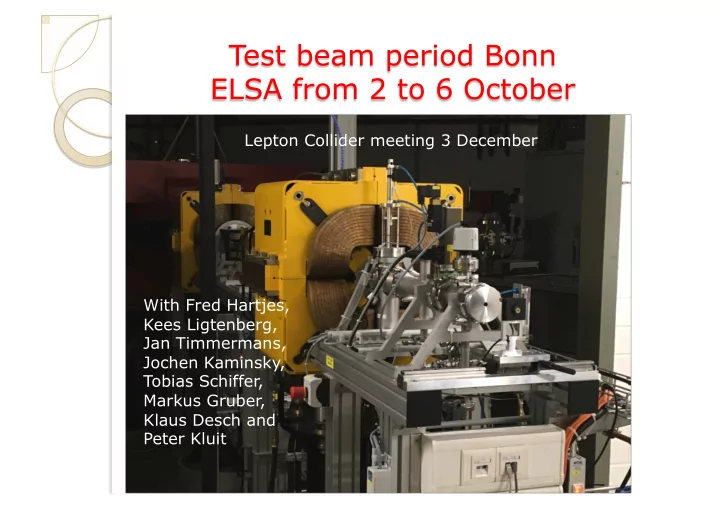
Lepton Collider meeting 3 December With Fred Hartjes, Kees - - PowerPoint PPT Presentation
2013 Lepton Collider meeting 3 December With Fred Hartjes, Kees Ligtenberg, Jan Timmermans, Jochen Kaminsky, Tobias Schiffer, Markus Gruber, Klaus Desch and Peter Kluit Last meeting 19 November Kees showed the issues with 2013 the Timepix
hits
N 100 200 300 400 500 600 700 800 900 1000 Entries 50 100 150 200 250 300
quad chip 0 (RMS = 54.26) quad chip 1 (RMS = 55.52) quad chip 2 (RMS = 80.85) quad chip 3 (RMS = 53.45) < 1000)
hits
single chip (RMS=180 for 20 < N
2013
Last meeting 19 November Kees showed the issues with the Timepix synchronisation. Here we report the progress in diagnosting and understanding this aspect. The basic idea (from Martin) is that due to the high rate the Timepix data is shifted and gets another Spider time stamp. By looking at different data sets we can diagnost this using the nr of hits per 409 microsec. Run668 Latest Quad The blue: published low rate test beam
2013
Run 667 with the new (second) quad was taken at a higher threshold. It is a bit better but still saturation at 550 hits per chip per 409 microsec. Run667 Latest Quad The blue: published low rate test beam
hits
N 100 200 300 400 500 600 700 800 900 1000 Entries 50 100 150 200 250 300 350 400
quad chip 0 (RMS = 29.17) quad chip 1 (RMS = 49.94) quad chip 2 (RMS = 20.46) quad chip 3 (RMS = 17.40) < 1000)
hits
single chip (RMS=180 for 20 < N
2013
Run 632 with the first quad was taken at a higher
- threshold. It is a bit better than the other runs.
It is however clear that run627 taken at a lower HV is in much better shape. So a lower hit rate. For the Conference results we decided to focus on run 627. Run632 first quad Run 627 at lower HV
hits
N 100 200 300 400 500 600 700 800 900 1000 Entries 50 100 150 200 250 300 350 400
quad chip 0 (RMS = 19.18) quad chip 1 (RMS = 17.60) quad chip 2 (RMS = 162.27) quad chip 3 (RMS = 66.78) < 1000)
hits
single chip (RMS=180 for 20 < N
hits
N 100 200 300 400 500 600 700 800 900 1000 Entries 50 100 150 200 250 300 350 400
quad chip 0 (RMS = 167.40) quad chip 1 (RMS = 162.11) quad chip 2 (RMS = 156.64) quad chip 3 (RMS = 160.46) < 1000)
hits
single chip (RMS=180 for 20 < N
2013
Can we recuperate the data that is trigger shifted? How far should we look “forward” (up to 200)? To study this we use the Telescope track and plot the residuals (in xy or drift) vs nr of shifted triggers. A difficult run Run 667
2013
Can we recuperate the data that is trigger shifted? Yes if we go up to 200 triggers (worst case) Chip 0 Chip 1 Chip 2 Chip 3 Different for every chip due to the rate For Chip 1
- ne does