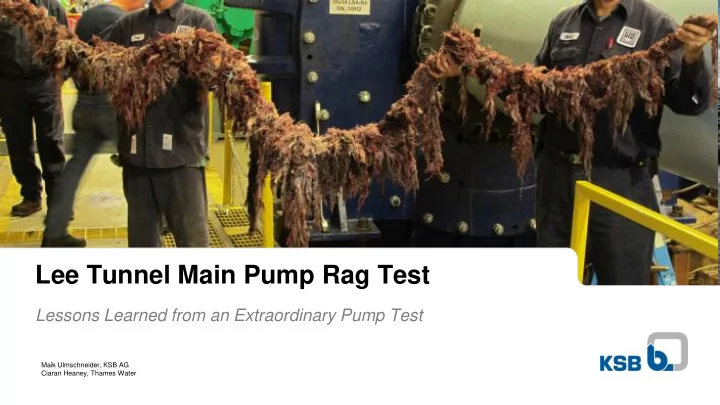
SLIDE 1 Lee Tunnel Main Pump Rag Test
Lessons Learned from an Extraordinary Pump Test
Maik Ulmschneider, KSB AG Ciaran Heaney, Thames Water
SLIDE 2
Lee Tunnel Rag Test
Agenda
1) About the Project 2) Rag Test Requirements 3) Test Facility 4) Rag Tests and Findings 5) Conclusion
SLIDE 3 Lee Tunnel Rag Test
About the Project
Source: www.waterprojectsonline.com/case_studies/2012/Thames_Lee_Tunnel_2012.pdf
SLIDE 4
Lee Tunnel Rag Test
About the Pump
Type: KSB GIW SVP-84 Operating Range: 3,050 l/s @ 87 m 1,950 l/s @ 17 m Weight: 54 t Rated Power: 3.5 MW
SLIDE 5 Lee Tunnel Rag Test
Requirements
Material: shredded cotton and polyester, rags and grit Concentration: 2 kg/m³ dry weight rags 400 mg/l grit Rag Dimensions: ≤ 1,000 mm x 75 mm Test Duration: 6 hrs
Source: www.riegellinen.com
SLIDE 6
Lee Tunnel Rag Test
Test Facility
Location: GIW Hydraulic Laboratory Grovetown, GA, USA
SLIDE 7
Lee Tunnel Rag Test
Test Facility
Location: GIW Hydraulic Laboratory Grovetown, GA, USA
SLIDE 8
Lee Tunnel Rag Test
Rag Tests
Test 0: Clear water test to create base pump curve under scaled conditions Test 1: Preliminary test to prove test rig and test criteria are fit for purpose Test 2: As Test 1 with altered loading sequence Test 3: Initial rag length 100 mm for test dynamic to be taken into account Test 4: Initial rag length 200 mm for test dynamic to be taken into account Test 5: Initial rag length 1,000 mm with altered loading sequence
SLIDE 9
Lee Tunnel Rag Test
Test 2
Loading Sequence: < 250 mm (1/3 of total) 250…500 mm (1/3 of total) 500… 1,000 mm (1/3 of total)
SLIDE 10 Lee Tunnel Rag Test
Test 2
Findings:
- No clogging in first 90
- mins. (first set)
- Losses 3% on head and
6% on efficiency
second set
SLIDE 11 Lee Tunnel Rag Test
Test 2
Findings:
- No clogging in first 90
- mins. (first set)
- Losses 3% on head and
6% on efficiency
second set
SLIDE 12 Lee Tunnel Rag Test
Test 2
Findings:
clumps were formed, exceeding 1,000 mm length by far.
- Ropes mainly consisted of
250 mm rag segments.
SLIDE 13
Lee Tunnel Rag Test
Test 3
Loading Sequence: Full concentration as fast as possible, but with initial length 100 mm
SLIDE 14 Lee Tunnel Rag Test
Test 3
Findings:
- No clogging during full test
period
efficiency within set limits
SLIDE 15 Lee Tunnel Rag Test
Test 3
Findings:
- No clogging during full test
period
efficiency within set limits
SLIDE 16 Lee Tunnel Rag Test
Test 3
Findings:
clumps were formed, mostly within the range of 500…1,000 mm.
length of 1,000 mm by far.
by fibres.
- A significant amount of rag
sludge was found in the system.
SLIDE 17 Lee Tunnel Rag Test
Test 3
Findings:
clumps were formed, mostly within the range of 500…1,000 mm.
length of 1,000 mm by far.
by fibres.
- A significant amount of rag
sludge was found in the system.
SLIDE 18
Lee Tunnel Rag Test
Test 4
Loading Sequence: Full concentration as fast as possible, but with initial length 200 mm
SLIDE 19 Lee Tunnel Rag Test
Test 4
Findings:
approximately 30 mins. after full concentration was loaded.
SLIDE 20 Lee Tunnel Rag Test
Test 4
Findings:
approximately 30 mins. after full concentration was loaded.
SLIDE 21 Lee Tunnel Rag Test
Test 4
Findings:
clumps were formed, exceeding 1,000 mm length by far reaching weights up to 80 kg.
- Ropes consisted of fibres.
SLIDE 22 Lee Tunnel Rag Test
Test 4
Findings:
clumps were formed, exceeding 1,000 mm length by far reaching weights up to 80 kg.
- Ropes consisted of fibres.
SLIDE 23 Lee Tunnel Rag Test
Conclusion
- The Lee Tunnel Main Pump can handle rags up to 1,000 mm
x 75 mm.
- The dynamic behavior in a closed loop system of
conglomeration of ropes that form and ultimately break down must be taken into account.
- The strategy of starting with smaller rags that will develop
into conglomerations of the required size over time is an effective strategy for addressing this dynamic.
- A ratio in the range of 1:10 (initial to final size) proved
effective in the present test set up.