SLIDE 1
Lecture notes for CS 433 - Chapter 2, part 2 9/26/18 Sarita Adve 1
Chapter 3 – Instruction-Level Parallelism and its Exploitation (Part 3)
ILP vs. Parallel Computers Dynamic Scheduling (Section 3.4, 3.5) Dynamic Branch Prediction (Section 3.3, 3.9, and Appendix C) Hardware Speculation and Precise Interrupts (Section 3.6) Multiple Issue (Section 3.7) Static Techniques (Section 3.2, Appendix H) Limitations of ILP Multithreading (Section 3.11) Putting it Together (Mini-projects)
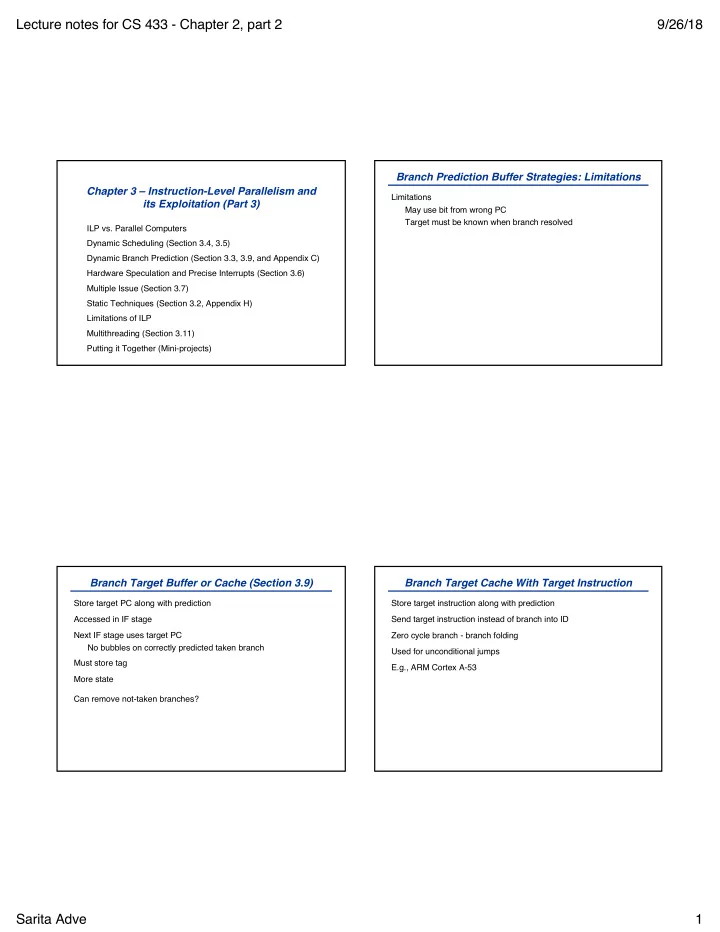
Branch Prediction Buffer Strategies: Limitations
Limitations May use bit from wrong PC Target must be known when branch resolved
Branch Target Buffer or Cache (Section 3.9)
Store target PC along with prediction Accessed in IF stage Next IF stage uses target PC No bubbles on correctly predicted taken branch Must store tag More state Can remove not-taken branches?
Branch Target Cache With Target Instruction
Store target instruction along with prediction Send target instruction instead of branch into ID Zero cycle branch - branch folding Used for unconditional jumps E.g., ARM Cortex A-53
SLIDE 2
Lecture notes for CS 433 - Chapter 2, part 2 9/26/18 Sarita Adve 2
Return Address Stack (Section 3.9)
Hardware stack for addresses for returns Call pushes return address in stack Return pops the address Perfect prediction if stack length ³ call depth
Speculative Execution
How far can we go with branch prediction? Speculative fetch? Speculative issue? Speculative execution? Speculative write?
Speculative Execution
Allows instructions after branch to execute before knowing if branch will be taken Must be able to undo if branch is not taken Often try to combine with dynamic scheduling Key insight: Split Write stage into Complete and Commit Complete out of order No state update Commit in order State updated (instruction no longer speculative) Use reorder buffer Overview Instructions complete out-of-order Reorder buffer reorganizes instructions Modify state in-order Instruction tag now is reorder buffer entry
Reorder Buffer
Entry Busy Type Dest Result State Excep 1 2 1 LD 4 Exec 3 1 BR Exec 4 1 ADD 6 75 Compl 0 5 N tail head
SLIDE 3
Lecture notes for CS 433 - Chapter 2, part 2 9/26/18 Sarita Adve 3
Re-order Buffer Pipeline
Issue: Execute: Complete: Commit:
Precise Interrupts Again
Precise interrupts hard with dynamic scheduling Consider our canonical code fragment: LF F6,34(R2) LF F2,45(R3) MULTF F0,F2,F4 SUBF F8,F6,F2 DIVF F10,F0,F6 ADDF F6,F8,F2 What happens if DIVF causes an interrupt? ADDF has already completed Out-of-order completion makes interrupts hard But reorder buffer can help!
Reorder Buffer for Precise Interrupts Re-order Buffer Drawback
Operands need to be read from reorder buffer or registers Alternative: Rename registers
SLIDE 4
Lecture notes for CS 433 - Chapter 2, part 2 9/26/18 Sarita Adve 4
Rename Registers + Reorder Buffer
Many current machines More physical registers than logical registers Reorder buffer does not have values Read all values from registers Rename mechanism Rename map stores mapping from logical to physical registers (Logical register Rl mapped to physical register Rp) On issue, Rl mapped to Rp-new On completion, write to Rp-new On commit, old mapping of Rl discarded (free Rp-old) On misprediction, new mapping of Rl discarded (free Rp-new)