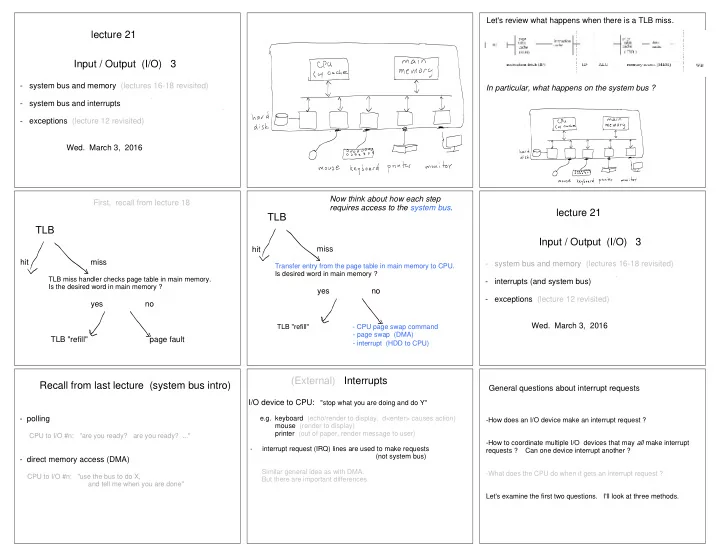

SLIDE 1
lecture 21 Input / Output (I/O) 3
- system bus and memory (lectures 16-18 revisited)
- system bus and interrupts
- exceptions (lecture 12 revisited)
- Wed. March 3, 2016
Let's review what happens when there is a TLB miss. In particular, what happens on the system bus ?
TLB
hit miss
TLB miss handler checks page table in main memory. Is the desired word in main memory ?
yes no TLB "refill" page fault First, recall from lecture 18
TLB
hit miss
Transfer entry from the page table in main memory to CPU. Is desired word in main memory ?
yes no
TLB "refill" - CPU page swap command
- page swap (DMA)
- interrupt (HDD to CPU)
Now think about how each step requires access to the system bus.
lecture 21 Input / Output (I/O) 3
- system bus and memory (lectures 16-18 revisited)
- interrupts (and system bus)
- exceptions (lecture 12 revisited)
- Wed. March 3, 2016
Recall from last lecture (system bus intro)
- polling
CPU to I/O #n: "are you ready? are you ready? ..."
- direct memory access (DMA)
CPU to I/O #n: "use the bus to do X, and tell me when you are done"
(External) Interrupts
I/O device to CPU: "stop what you are doing and do Y"
e.g. keyboard (echo/render to display, d<enter> causes action) mouse (render to display) printer (out of paper, render message to user)
- interrupt request (IRQ) lines are used to make requests
(not system bus) Similar general idea as with DMA. But there are important differences.
General questions about interrupt requests
- How does an I/O device make an interrupt request ?
- How to coordinate multiple I/O devices that may all make interrupt
requests ? Can one device interrupt another ?
- What does the CPU do when it gets an interrupt request ?