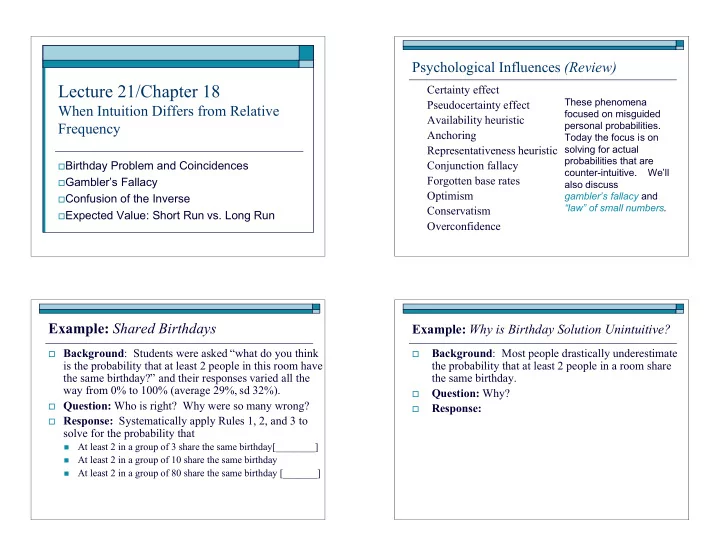
Lecture 21/Chapter 18 Certainty effect These phenomena - - PowerPoint PPT Presentation

lecture 21 chapter 18
SMART_READER_LITE
LIVE PREVIEW

Lecture 21/Chapter 18 Certainty effect These phenomena - - PowerPoint PPT Presentation

Psychological Influences (Review) Lecture 21/Chapter 18 Certainty effect These phenomena Pseudocertainty effect When Intuition Differs from Relative focused on misguided Availability heuristic personal probabilities. Frequency Anchoring


slide-1
SLIDE 1

Lecture 21/Chapter 18

When Intuition Differs from Relative Frequency

Birthday Problem and Coincidences Gambler’s Fallacy Confusion of the Inverse Expected Value: Short Run vs. Long Run

Psychological Influences (Review)

Certainty effect Pseudocertainty effect Availability heuristic Anchoring Representativeness heuristic Conjunction fallacy Forgotten base rates Optimism Conservatism Overconfidence

These phenomena focused on misguided personal probabilities. Today the focus is on solving for actual probabilities that are counter-intuitive. We’ll also discuss gambler’s fallacy and “law” of small numbers.

Example: Shared Birthdays

Background: Students were asked “what do you think

is the probability that at least 2 people in this room have the same birthday?” and their responses varied all the way from 0% to 100% (average 29%, sd 32%).

Question: Who is right? Why were so many wrong? Response: Systematically apply Rules 1, 2, and 3 to

solve for the probability that

  • At least 2 in a group of 3 share the same birthday[________]
  • At least 2 in a group of 10 share the same birthday
  • At least 2 in a group of 80 share the same birthday [_______]

Example: Why is Birthday Solution Unintuitive?

  • Background: Most people drastically underestimate

the probability that at least 2 people in a room share the same birthday.

  • Question: Why?
  • Response:
slide-2
SLIDE 2

Example: Coincidences

  • Background: We say it’s a coincidence when two

people in the room share the same birthday.

  • Question: How do we define “coincidence”?
  • Response: A coincidence is

Example: A Coincidence Story

  • Background: A really surprising coincidence

happened to me…

  • Questions: Should we be surprised by coincidences?

Do they defy the laws of probability?

  • Response:

Example: “With Love All Things Are Possible”

  • Background: A letter describes a variety of

coincidences…

  • Question: Are they surprising?
  • Response:

Example: What’s Likelier in 6 Coin Tosses?

  • Background: Students were asked: In 6 tosses of a

fair coin, circle which is the more likely outcome: (a) HHTHTT (b) HHHHHH (c) equally likely

  • Question: Why did 29/82=35% pick (a) and only

1/82=1% pick (b)? [Correct answer is (c): even though 3 heads and 3 tails in any order is likelier than all 6 heads, the probability of each specific sequence of heads and tails is .]

  • Response: (_________________) People believe

random events should be self-correcting; (_______________________) People believe that a population proportion must hold for small samples.

slide-3
SLIDE 3

Example: Boy or Girl Next Time?

  • Background: A couple has had 3 boys so far.
  • Question: What is the probability that their next child

is a girl… (a) if the genetic probability of a girl each time is 0.5? (b) if the couple has been picking children from a cabbage patch of 8 babies, which started with half each boys and girls?

  • Response: (a) ______ (b) ________

Example: Boy or Girl Next Time?

  • Background: People are inclined to believe that

(a) since 50% of all births are girls, close to 50% in a given family should be girls; and (b) if a couple has had many boys, they are “due” for a girl.

  • Questions: Which of these describes the gambler’s

fallacy (you’re more likely to win after many losses)? Which is belief in the “law” of small numbers (small samples should be highly representative of the larger population)?

  • Response: (__) is the gambler’s fallacy;

(__) is belief in the “law” of small numbers.

Example: Comparing Poker Probabilities

  • Background: Poker hands dealt from separate decks:

Case #1: I tell you that a student has an ace in his poker hand of 5 cards. Case #2: I tell you that a student has the ace of spades in her poker hand of 5 cards.

  • Question: In which case is the probability of another

ace higher (or are they the same)?

  • Response: ________

probability of one ace plus at least one more probability of at least one ace probability of ace of spades plus at least one more ace probability of the ace of spades

Example: Comparing Poker Probabilities

  • Background: Poker hands dealt from separate decks:

Case #1: I tell you that a student has an ace in his poker hand of 5 cards. Case #2: I tell you that a student has the ace of spades in her poker hand of 5 cards.

  • Question: Why do people think the probability of

another ace is higher in Case 1?

  • Response:
slide-4
SLIDE 4

Example: Chance of Disease If Tested Positive?

  • Background: Suppose 1 in 1000 people have a certain disease.

The chance of correctly testing positive when a person actually has the disease is 90%. The chance of incorrectly testing positive when a person does not have the disease is 10%. If someone tests positive for the disease, what is the chance of actually having it?

  • Question: Were students’ estimates (av 74%) close?
  • Response: Used a tree diagram to show…
  • Prob of diseased= 0.001
  • Given diseased, prob of testing positive=0.90
  • Given diseased, prob of testing negative=0.10
  • Prob of not diseased= 0.999
  • Given not diseased, prob of testing positive=0.10
  • Given not diseased, prob of testing negative=0.90

Example: Probability of A given B or B given A

  • Background: The probability of disease is 0.001; probability of

testing positive is 0.9 if you have the disease, 0.1 if you don’t.

  • Question: Are these probabilities the same? (a) testing positive,

given you have the disease; (b) having the disease, given you tested positive

  • Response: _____

disease no disease pos neg 0.001 0.999 0.9 0.1 0.1 neg pos 0.9 0.0009 0.0001 0.0999 0.8991

Example: Probability of A given B or B given A

  • Response: (a) The probability of testing positive, given you have

the disease, is 0.9 (b) The probability of having the disease, given you tested positive, is 0.0009/(0.0009+0.0999)=0.0089. (Class guesses averaged 74%, due to ___________________ or ____________________) disease no disease pos neg 0.001 0.999 0.9 0.1 0.1 neg pos 0.9 0.0009 0.0001 0.0999 0.8991

Definitions

base rate: probability of having the disease sensitivity: probability of a correct positive test specificity: probability of a correct negative test

slide-5
SLIDE 5

Example: Sensitivity and Specificity

Background: In a certain population, the probability

  • f HIV is 0.001. The probability of testing positive is

0.98 if you have HIV, 0.05 if you don’t.

Questions: What is the sensitivity of the test? What is

the specificity?

Responses:

Sensitivity is probability of correct positive: ______. Specificity is probability of correct negative: ______.

Example: Expected Value, Short Run & Long Run

  • Background: Respondents were asked to choose between (a)

and (b) in each case: #1. (a) guaranteed gift of $240 (b) 25% chance to win $1000 and 75% chance to win $0 #2. (a) sure loss of $740 (b) 75% chance to lose $1000 and 25% chance to lose $0 #3. (a) a 1 in 1000 chance to win $5000 (b) A sure gain of $6 #4. (a) a 1 in 1000 chance of losing $5000 (b) A sure loss of $6

  • Question: Which choices are preferred?
  • Response: #1(__), #2(__), #3(__), #4 (__)

Example: Expected Value, Short Run & Long Run

  • Background: Respondents were asked to choose between

(a) and (b) in each case: #1. (a) guaranteed gift of $240 (b) 25% chance to win $1000 and 75% chance to win $0

  • Questions: Which has a higher expected value? Why was the
  • ther choice preferred?
  • Response: (b) _______________________ is higher than $240

but 75/84=89% of students preferred (a) because ______________________________

Example: Expected Value, Short Run & Long Run

  • Background: Respondents were asked to choose between

(a) and (b) in each case: #2. (a) sure loss of $740 (b) 75% chance to lose $1000 and 25% chance to lose $0

  • Questions: Which has a higher expected value? Why was the
  • ther choice preferred?
  • Response:(a) -$740 is more than _______________________

but 61/84=73% of students preferred (b) because of _______________________________

slide-6
SLIDE 6

Example: Expected Value, Short Run & Long Run

  • Background: Respondents were asked to choose between

(a) and (b) in each case: #3. (a) a 1 in 1000 chance to win $5000 (b) A sure gain of $6

  • Questions: Which has a higher expected value? Why was the
  • ther choice preferred?
  • Response: (b) $6 is more than ________________________

but 60/84=71% of students preferred (a) because _________________________________

Example: Expected Value, Short Run & Long Run

  • Background: Respondents were asked to choose between

(a) and (b) in each case: #4. (a) a 1 in 1000 chance of losing $5000 (b) A sure loss of $6

  • Questions: Which has a higher expected value? Why was the
  • ther choice preferred?
  • Response: (a) _______________________ is more than -$6

but 56/84=79% of students preferred (b) because

Example: Expected Value, Short Run & Long Run

  • Background: Respondents were asked to choose between

(a) and (b) in each case: #1. (a) guaranteed gift of $240 (b) 25% chance to win $1000 and 75% chance to win $0 #2. (a) sure loss of $740 (b) 75% chance to lose $1000 and 25% chance to lose $0 #3. (a) a 1 in 1000 chance to win $5000 (b) A sure gain of $6 #4. (a) a 1 in 1000 chance of losing $5000 (b) A sure loss of $6

  • Question: Which has a higher expected value?
  • Response: #1(__), #2(__), #3(__), #4 (__)

Example: Expected Value, Short Run & Long Run

  • Background: Consider each pair of options.

#1. (a) guaranteed gift of $240 (b) 25% chance to win $1000 and 75% chance to win $0 #2. (a) sure loss of $740 (b) 75% chance to lose $1000 and 25% chance to lose $0 #3. (a) a 1 in 1000 chance to win $5000 (b) A sure gain of $6 #4. (a) a 1 in 1000 chance of losing $5000 (b) A sure loss of $6

  • Question: Which option is better if the offer is made

(A) once? (B) every day?

  • Response: (A) #1(__)#2(__)#3(__)#4(__)
  • (B) #1(__)#2(__)#3(__)#4(__)