Lecture 19/Chapter 16 Grade Pts. 4 3 2 1 0 Probability & - - PowerPoint PPT Presentation

lecture 19 chapter 16
SMART_READER_LITE
LIVE PREVIEW

Lecture 19/Chapter 16 Grade Pts. 4 3 2 1 0 Probability & - - PowerPoint PPT Presentation

Example: Intuiting Expected Value Background : Historically, Stat 800 grades have Lecture 19/Chapter 16 Grade Pts. 4 3 2 1 0 Probability & Long-Term Expectations Probability 0.25 0.40 0.20 0.10 0.05 Question: What is the


slide-1
SLIDE 1

Lecture 19/Chapter 16

Probability & Long-Term Expectations

Expected Value More Rules of Probability Tree Diagrams

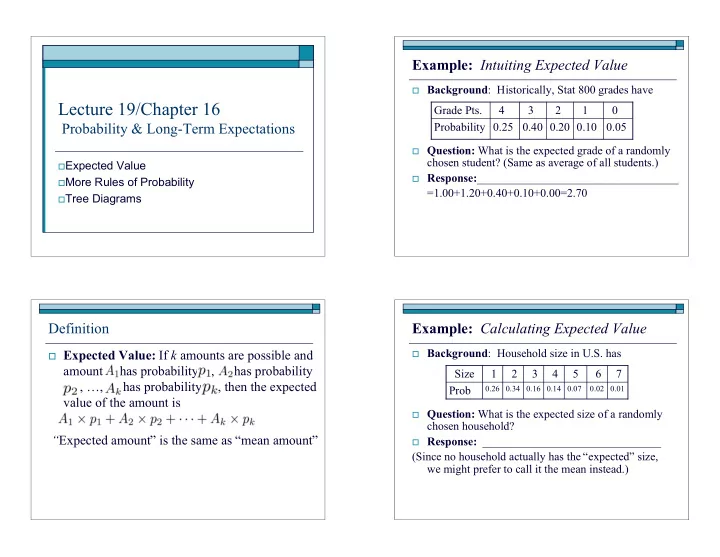
Example: Intuiting Expected Value

Background: Historically, Stat 800 grades have Question: What is the expected grade of a randomly

chosen student? (Same as average of all students.)

Response:___________________________________

=1.00+1.20+0.40+0.10+0.00=2.70 0.05 0.10 0.20 0.40 0.25 Probability 1 2 3 4 Grade Pts.

Definition

Expected Value: If k amounts are possible and

amount has probability , has probability . , …, has probability , then the expected value of the amount is “Expected amount” is the same as “mean amount”

Example: Calculating Expected Value

Background: Household size in U.S. has Question: What is the expected size of a randomly

chosen household?

Response: _______________________________

(Since no household actually has the “expected” size, we might prefer to call it the mean instead.)

0.01 0.02 0.07 0.14 0.16 0.34 0.26

Prob 7 6 5 4 3 2 1 Size

slide-2
SLIDE 2

Example: Calculating Expected Value

Background: Suppose you play a game in which

there is a 25% chance to win $1000 and a 75% chance to win nothing.

Question: What is your expected gain? Response: ________________________________

Note: Nevertheless, ___% of surveyed students said they’d prefer a guaranteed gift of $240. In Chapter 18, we’ll discuss this and other psychological influences.

Example: Calculating Expected Value

Background: Suppose a raffle ticket costs $5, and

there is a 1% chance of winning $400.

Question: What is your expected gain? Response: _______________________

Basic Probability Rules (Review)

We established rules for

  • 0. What probabilities values are permissible
  • 1. The probability of not happening
  • 2. The probability of one or the other of two

mutually exclusive events occurring

  • 3. The probability of one and the other of

two independent events occurring

  • 4. How probabilities compare if one event is

the subset of another We need more general “or” and “and” rules. Example: Parts of Table Showing “Or” and “And”

Background: Professor notes gender (female or

male) and grade (A or not A) for students in class.

Questions: What part of a two-way table shows…

Students who are female and get an A? Students who are female or get an A?

1.00 0.75 0.25 Total 0.40 0.30 0.10 Male 0.60 0.45 0.15 Femae Total not A A

slide-3
SLIDE 3

Example: Parts of Table Showing “Or” and “And”

Background: Professor notes gender (female or

male) and grade (A or not A) for students in class.

Responses:

  • Students who are female and get an A: table on ____
  • Students who are female or get an A: table on _____

Total Male 0.15 Female Total not A A Total 0.10 Male 0.45 0.15 Female Total not A A

Example: Intuiting Rule 5

Background: Professor says: probability of

being a female is 0.60; probability of getting an A is 0.25. Probability of both is 0.15.

Question: What is the probability of being a

female or getting an A?

Response:

Example: Intuiting Rule 5

Response: Illustration with two-way tables:

Total Male Female Total not A A Total Male Female Total not A A Total Male Female Total not A A Total Male Female Total not A A

+ _ = Rule 5 (General “Or” Rule)

For any two events, the probability of one or the other happening is the sum of their individual probabilities, minus the probability that both occur. Note: The word “or” still entails addition.

slide-4
SLIDE 4

Example: Applying Rule 5

Background: In a list of potential roommates,

the probability of being a smoker is 0.20. The probability of being a non-student is 0.10. The probability of both is 0.03.

Question: What’s the probability of being a

smoker or a non-student?

Response:

Definitions (Review)

For some pairs of events, whether or not one

  • ccurs impacts the probability of the other
  • ccurring, and vice versa: the events are

said to be dependent. If two events are independent, they do not influence each other; whether or not one

  • ccurs has no effect on the probability of

the other occurring.

Rule 3 (Independent “And” Rule) (Review)

For any two independent events, the probability

  • f one and the other happening is the product
  • f their individual probabilities.

We need a rule that works even if two events are dependent.

Sampling with replacement is associated with

events being independent.

Sampling without replacement is associated

with events being dependent.

Example: When Probabilities Can’t Simply be Multiplied (Review)

Background: In a child’s pocket are 2 quarters and

2 nickels. He randomly picks a coin, does not replace it, and picks another.

Question: What is probability that both are quarters? Response: To find the probability of the first and

the second coin being quarters, we can’t multiply 0.5 by 0.5 because after the first coin has been removed, the probability of the second coin being a quarter is not 0.5: it is 1/3 if the first coin was a quarter, 2/3 if the first was a nickel.

slide-5
SLIDE 5

Example: When Probabilities Can’t Simply be Multiplied Rule 6 (General “And” Rule)

The conditional probability of a second event, given a first event, is the probability of the second event occurring, assuming that the first event has occurred. The probability of one event and another

  • ccurring is the product of the first and the

(conditional) probability of the second, given that the first has occurred.

Example: Intuiting the General “And” Rule

Background: In a child’s pocket are 2

quarters and 2 nickels. He randomly picks a coin, does not replace it, and picks another.

Question: What is the probability that the

first and the second coin are quarters?

Response: probability of first a quarter (___),

times (conditional) probability that second is a quarter, given first was a quarter (___): _______________

Example: Intuiting the General “And” Rule

Response: Illustration of probability of getting two

quarters:

slide-6
SLIDE 6

Rule 6 (alternate formulation)

The conditional probability of a second event, given a first event, is the probability of both happening, divided by the probability

  • f the first event.

Example: Applying Rule for Conditional Probability

Background: In a list of potential roommates,

the probability of being both a smoker and a non-student is 0.03. The probability of being a non-student is 0.10.

Question: What’s the probability of being a

smoker, given that a potential roommate is a non-student?

Response: _______________

[Note that the probability of being a smoker is higher if we know a person is not a student.]

Tree Diagrams

These displays are useful for events that occur in stages, when probabilities at the 2nd stage depend on what happened at the 1st stage.

Ist stage 2nd stage

Example: A Tree Diagram for HIV Test

Background: In a certain population, the probability

  • f HIV is 0.001. The probability of testing positive is

0.98 if you have HIV, 0.05 if you don’t.

Questions: What is the probability of having HIV

and testing positive? Overall prob of testing positive? Probability of having HIV, given you test positive?

Response: To complete the tree diagram, note that

probability of not having HIV is ______. The probability of testing negative is ______ if you have HIV, ______ if you don’t.

slide-7
SLIDE 7

Example: A Tree Diagram for HIV Test

  • Background: The probability of HIV is 0.001; probability of

testing positive is 0.98 if you have HIV, 0.05 if you don’t. (So probability of not having HIV is ______. The probability of testing negative is _____ if you have HIV, _____ if you don’t.) HIV no HIV pos neg neg pos

Example: A Tree Diagram for HIV Test

  • Background: The probability of having HIV and testing

positive is ___________________. The overall probability of testing positive is ______________________.The probability of having HIV, given you test positive, is ____________________ HIV no HIV pos neg neg pos EXTRA CREDIT (Max. 5 pts.) Choose 2 categorical variables from the survey data (available on the course website) and use a two-way table to display counts in the various category

  • combinations. Report the probability of a student in the class

being in one or the other of two categories; report the probability

  • f being in one and the other of two categories.