Lecture 17: Wrapup & Questions . Runtime-Verification . - - PowerPoint PPT Presentation

lecture 17 wrapup questions
SMART_READER_LITE
LIVE PREVIEW

Lecture 17: Wrapup & Questions . Runtime-Verification . - - PowerPoint PPT Presentation

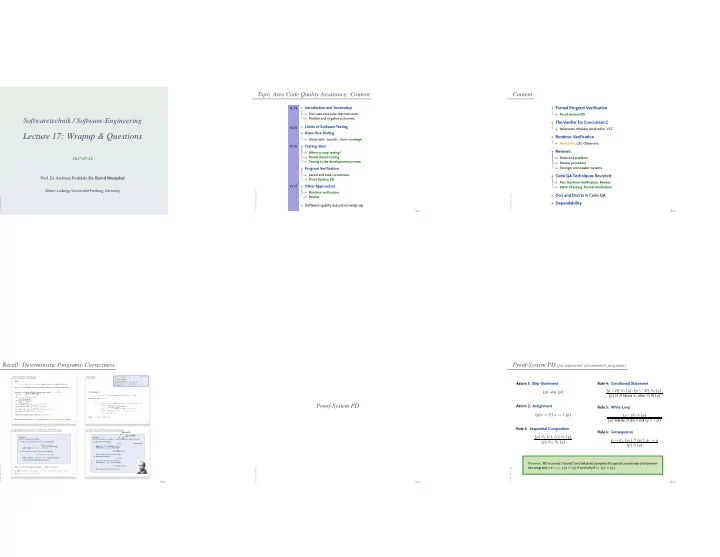
Topic Area Code Quality Assurance: Content Content Introduction and Vocabulary Formal Program Verification VL 14 Test case, test suite, test execution. Proof System PD . . Positive and negative outcomes. Softwaretechnik /


slide-1
SLIDE 1 – 17 – 2017-07-24 – main –

Softwaretechnik / Software-Engineering

Lecture 17: Wrapup & Questions

2017-07-24

  • Prof. Dr. Andreas Podelski, Dr. Bernd Westphal

Albert-Ludwigs-Universität Freiburg, Germany

Topic Area Code Quality Assurance: Content

– 17 – 2017-07-24 – Sblockcontent – 2/69
  • Introduction and Vocabulary
  • Test case, test suite, test execution.
  • Positive and negative outcomes.
  • Limits of Software Testing
  • Glass-Box Testing
  • Statement-, branch-, term-coverage.
  • Testing: Rest
  • When to stop testing?
  • Model-based testing
  • Testing in the development process
  • Program Verification
  • partial and total correctness,
  • Proof System PD.
  • Other Approaches
  • Runtime verification.
  • Review
  • Software quality assurance wrap-up
VL 14 . . . VL 15 . . . VL 16 . . . VL 17 . . .

Content

– 17 – 2017-07-24 – Scontent – 3/69
  • Formal Program Verification
  • Proof System PD
  • The Verifier for Concurrent C
  • Assertions, Modular Verification, VCC
  • Runtime-Verification
  • Assertions, LSC-Observers
  • Reviews
  • Roles and artefacts
  • Review procedure
  • Stronger and weaker variants
  • Code QA Techniques Revisited
  • Test, Runtime-Verification, Review,
  • Static Checking, Formal Verification
  • Do’s and Don’ts in Code QA
  • Dependability

Recall: Deterministic Programs, Correctness

– 17 – 2017-07-24 – Srecall – 4/69 Deterministic Programs – 16 – 2017-07-20 – Swhile – 21/54 Syntax: S := skip | u := t | S1; S2 | if B then S1 else S2 | while B do S1 od where u V is a variable, t is a type-compatible expression, B is a Boolean expression. Semantics: (is induced by the following transition relation) — : V D(V ) (i) hskip, i hE, i (ii) hu := t, i hE, [u := (t)]i (iii) hS1, i hS2, i hS1; S, i hS2; S, i (iv) hif B then S1 else S2 , i hS1, i, if | = B, (v) hif B then S1 else S2 , i hS2, i, if 6| = B, (vi) hwhile B do S od, i hS; while B do S od, i, if | = B, (vii) hwhile B do S od, i hE, i, if 6| = B, E denotes the empty program; define E; S S; E S. Note: the first component of hS, i is a program (structural operational semantics (SOS)). Example – 16 – 2017-07-20 – Swhile – 22/54 (i) hskip, i hE, i E; S S; E S (ii) hu := t, i hE, [u := (t)]i (iii) hS1, i hS2, i hS1; S, i hS2; S, i (iv) hif B then S1 else S2 , i hS1, i, if | = B, (v) hif B then S1 else S2 , i hS2, i, if 6| = B, (vi) hwhile B do S od, i hS; while B do S od, i, if | = B, (vii) hwhile B do S od, i hE, i, if 6| = B, Consider program S a[0] := 1; a[1] := 0; while a[x] 6= 0 do x := x + 1 od and a state with | = x = 0. hS, i (ii),(iii)
  • ha[1] := 0; while a[x] 6= 0 do x := x + 1 od, [a[0] := 1]i
(ii),(iii)
  • hwhile a[x] 6= 0 do x := x + 1 od, i
(vi)
  • hx := x + 1; while a[x] 6= 0 do x := x + 1 od, i
(ii),(iii)
  • hwhile a[x] 6= 0 do x := x + 1 od, [x := 1]i
(vii)
  • hE, [x := 1]i
where = [a[0] := 1][a[1] := 0]. Input/Output Semantics of Deterministic Programs – 16 – 2017-07-20 – Swhile – 25/54 Definition. Let S be a deterministic program. (i) The semantics of partial correctness is the function MS : 2 with MS() = { | hS, i hE, i}. (ii) The semantics of total correctness is the function MtotS : 2 {} with MtotS() = MS() { | S can diverge from }. is an error state representing divergence. Note: MtotS() has exactly one element, MS() at most one. Example: MS1() = MtotS1() = { | (x) = (x) (y) = (x)2}, . (Recall: S1 y := x; y := (x 1) · x + y) Correctness of Deterministic Programs – 16 – 2017-07-20 – Scorrectness – 27/54 Definition. Let S be a program over variables V , and p and q Boolean expressions over V . (i) The correctness formula {p} S {q} (“Hoare triple”) holds in the sense of partial correctness, denoted by | = {p} S {q}, if and only if MS(p) q. We say S is partially correct wrt. p and q. (ii) A correctness formula {p} S {q} holds in the sense of total correctness, denoted by | =tot {p} S {q}, if and only if MtotS(p) q. We say S is totally correct wrt. p and q.

Proof-System PD

– 17 – 2017-07-24 – main – 5/69

Proof-System PD (for sequential, deterministic programs)

– 17 – 2017-07-24 – Spd – 6/69 Axiom 1: Skip-Statement {p} skip {p} Axiom 2: Assignment {p[u := t]} u := t {p} Rule 3: Sequential Composition {p} S1 {r}, {r} S2 {q} {p} S1; S2 {q} Rule 4: Conditional Statement {p ∧ B} S1 {q}, {p ∧ ¬B} S2 {q}, {p} if B then S1 else S2 fi {q} Rule 5: While-Loop {p ∧ B} S {p} {p} while B do S od {p ∧ ¬B} Rule 6: Consequence p → p1, {p1} S {q1}, q1 → q {p} S {q}
  • Theorem. PD is correct (“sound”) and (relative) complete for partial correctness of determin-
istic programs, i.e. ⊢PD {p} S {q} if and only if | = {p} S {q}.
slide-2
SLIDE 2

Example Proof

– 17 – 2017-07-24 – Spd – 7/69

DIV ≡

=:SD
  • a := 0; b := x; while
=:BD

b ≥ y do

=:SD 1
  • b := b − y; a := a + 1 od
(The first (textually represented) program that has been formally verified (?). We can prove | = {x ≥ 0 ∧ y ≥ 0} DIV {a · y + b = x ∧ b < y} by showing ⊢PD {x ≥ 0 ∧ y ≥ 0
  • =:pD
} DIV {a · y + b = x ∧ b < y
  • =:qD
}, i.e., derivability in PD: (1) {pD} SD 0 {P}, P → P, (2) {P ∧ (BD)} SD 1 {P} {P} while BD do SD 1 od {P ∧ ¬(BD)}, (R5) (3) P ∧ ¬(BD) → qD {P} while BD do SD 1 od {qD} (R6) {pD} SD 0 ; while BD do SD 1 od {qD} (R3) (A1) {p} skip {p} (R3) {p} S1 {r}, {r} S2 {q} {p} S1; S2 {q} (R5) {p ∧ B} S {p} {p} while B do S od {p ∧ ¬B} (A2) {p[u := t]} u := t {p} (R4) {p ∧ B} S1 {q}, {p ∧ ¬B} S2 {q} {p} if B then S1 else S2 fi {q} (R6) p → p1, {p1} S {q1}, q1 → q {p} S {q}

Example Proof Cont’d

– 17 – 2017-07-24 – Spd – 8/69 (1) {x ≥ 0 ∧ y ≥ 0} a := 0; b := x {P}, P → P, (2) {P ∧ (b ≥ y)} b := b − y; a := a + 1 {P} {P} while b ≥ y do b := b − y; a := a + 1 od {P ∧ ¬(b ≥ y)}, (R5) (3) P ∧ ¬(b ≥ y) → a · y + b = x ∧ b < y {P} while b ≥ y do b := b − y; a := a + 1 od {a · y + b = x ∧ b < y} (R6) {x ≥ 0 ∧ y ≥ 0} a := 0; b := x; while b ≥ y do b := b − y; a := a + 1 od {a · y + b = x ∧ b < y} (R3)

In the following, we show (1) ⊢PD {x ≥ 0 ∧ y ≥ 0} a := 0; b := x {P}, (2) ⊢PD {P ∧ b ≥ y} b := b − y; a := a + 1 {P}, (3) | = P ∧ ¬(b ≥ y) → a · y + b = x ∧ b < y. As loop invariant, we choose (creative act!): P ≡ a · y + b = x ∧ b ≥ 0

Proof of (1)

– 17 – 2017-07-24 – Spd – 9/69 (A1) {p} skip {p} (R4) {p ∧ B} S1 {q}, {p ∧ ¬B} S2 {q} {p} if B then S1 else S2 fi {q} (A2) {p[u := t]} u := t {p} (R5) {p ∧ B} S {p} {p} while B do S od {p ∧ ¬B} (R3) {p} S1 {r}, {r} S2 {q} {p} S1; S2 {q} (R6) p → p1, {p1} S {q1}, q1 → q {p} S {q}
  • (1) claims:

⊢PD {x ≥ 0 ∧ y ≥ 0} a := 0; b := x {P} where P ≡ a · y + b = x ∧ b ≥ 0.

  • ⊢PD {0 · y + x = x ∧ x ≥ 0} a := 0 {a · y + x = x ∧ x ≥ 0}
by (A2),

Proof of (1)

– 17 – 2017-07-24 – Spd – 9/69 (A1) {p} skip {p} (R4) {p ∧ B} S1 {q}, {p ∧ ¬B} S2 {q} {p} if B then S1 else S2 fi {q} (A2) {p[u := t]} u := t {p} (R5) {p ∧ B} S {p} {p} while B do S od {p ∧ ¬B} (R3) {p} S1 {r}, {r} S2 {q} {p} S1; S2 {q} (R6) p → p1, {p1} S {q1}, q1 → q {p} S {q}
  • (1) claims:

⊢PD {x ≥ 0 ∧ y ≥ 0} a := 0; b := x {P} where P ≡ a · y + b = x ∧ b ≥ 0.

  • ⊢PD {0 · y + x = x ∧ x ≥ 0} a := 0 {a · y + x = x ∧ x ≥ 0}
by (A2),
  • ⊢PD {a · y + x = x ∧ x ≥ 0} b := x {a · y + b = x ∧ b ≥ 0
  • ≡P

} by (A2),

Proof of (1)

– 17 – 2017-07-24 – Spd – 9/69 (A1) {p} skip {p} (R4) {p ∧ B} S1 {q}, {p ∧ ¬B} S2 {q} {p} if B then S1 else S2 fi {q} (A2) {p[u := t]} u := t {p} (R5) {p ∧ B} S {p} {p} while B do S od {p ∧ ¬B} (R3) {p} S1 {r}, {r} S2 {q} {p} S1; S2 {q} (R6) p → p1, {p1} S {q1}, q1 → q {p} S {q}
  • (1) claims:

⊢PD {x ≥ 0 ∧ y ≥ 0} a := 0; b := x {P} where P ≡ a · y + b = x ∧ b ≥ 0.

  • ⊢PD {0 · y + x = x ∧ x ≥ 0} a := 0 {a · y + x = x ∧ x ≥ 0}
by (A2),
  • ⊢PD {a · y + x = x ∧ x ≥ 0} b := x {a · y + b = x ∧ b ≥ 0
  • ≡P

} by (A2),

  • thus, ⊢PD {0 · y + x = x ∧ x ≥ 0} a := 0; b := x {P}
by (R3),

Proof of (1)

– 17 – 2017-07-24 – Spd – 9/69 (A1) {p} skip {p} (R4) {p ∧ B} S1 {q}, {p ∧ ¬B} S2 {q} {p} if B then S1 else S2 fi {q} (A2) {p[u := t]} u := t {p} (R5) {p ∧ B} S {p} {p} while B do S od {p ∧ ¬B} (R3) {p} S1 {r}, {r} S2 {q} {p} S1; S2 {q} (R6) p → p1, {p1} S {q1}, q1 → q {p} S {q}
  • (1) claims:

⊢PD {x ≥ 0 ∧ y ≥ 0} a := 0; b := x {P} where P ≡ a · y + b = x ∧ b ≥ 0.

  • ⊢PD {0 · y + x = x ∧ x ≥ 0} a := 0 {a · y + x = x ∧ x ≥ 0}
by (A2),
  • ⊢PD {a · y + x = x ∧ x ≥ 0} b := x {a · y + b = x ∧ b ≥ 0
  • ≡P

} by (A2),

  • thus, ⊢PD {0 · y + x = x ∧ x ≥ 0} a := 0; b := x {P}
by (R3),
  • using x ≥ 0 ∧ y ≥ 0 → 0 · y + x = x ∧ x ≥ 0 and P → P, we obtain

⊢PD {x ≥ 0 ∧ y ≥ 0} a := 0; b := x {P} by (R6).

slide-3
SLIDE 3

Substitution

– 17 – 2017-07-24 – Spd – 10/69 The rule ‘Assignment’ uses (syntactical) substitution: {p[u := t]} u := t {p} (In formula p, replace all (free) occurences of (program or logical) variable u by term t.) Defined as usual, only indexed and bound variables need to be treated specially:

Substitution

– 17 – 2017-07-24 – Spd – 10/69 The rule ‘Assignment’ uses (syntactical) substitution: {p[u := t]} u := t {p} (In formula p, replace all (free) occurences of (program or logical) variable u by term t.) Defined as usual, only indexed and bound variables need to be treated specially: Expressions:
  • plain variable x: x[u := t] ≡
  • t
, if x = u x , otherwise
  • constant c:
c[u := t] ≡ c.
  • constant op, terms si:
  • p(s1, . . . , sn)[u := t]
≡ op(s1[u := t], . . . , sn[u := t]).
  • conditional expression:
(B ? s1 : s2)[u := t] ≡ (B[u := t] ? s1[u := t] : s2[u := t]) Formulae:
  • boolean expression p ≡ s:
p[u := t] ≡ s[u := t]
  • negation:
(¬q)[u := t] ≡ ¬(q[u := t])
  • conjunction etc.:
(q ∧ r)[u := t] ≡ q[u := t] ∧ r[u := t]
  • quantifier:
(∀ x : q)[u := t] ≡ ∀ y : q[x := y][u := t] y fresh (not in q, t, u), same type as x.
  • indexed variable, u plain or u ≡ b[t1, . . . , tm] and a = b:
(a[s1, . . . , sn])[u := t] ≡ a[s1[u := t], . . . , sn[u := t]])
  • indexed variable, u ≡ a[t1, . . . , tm]:
(a[s1, . . . , sn])[u := t] ≡ (n i=1 si[u := t] = ti ? t : a[s1[u := t], . . . , sn[u := t]])

Example Proof Cont’d

– 17 – 2017-07-24 – Spd – 11/69 (1) {x ≥ 0 ∧ y ≥ 0} a := 0; b := x {P}, P → P, (2) {P ∧ (b ≥ y)} b := b − y; a := a + 1 {P} {P} while b ≥ y do b := b − y; a := a + 1 od {P ∧ ¬(b ≥ y)}, (R5) (3) P ∧ ¬(b ≥ y) → a · y + b = x ∧ b < y {P} while b ≥ y do b := b − y; a := a + 1 od {a · y + b = x ∧ b < y} (R6) {x ≥ 0 ∧ y ≥ 0} a := 0; b := x; while b ≥ y do b := b − y; a := a + 1 od {a · y + b = x ∧ b < y} (R3)

In the following, we show (1) ⊢PD {x ≥ 0 ∧ y ≥ 0} a := 0; b := x {P}, (2) ⊢PD {P ∧ b ≥ y} b := b − y; a := a + 1 {P}, (3) | = P ∧ ¬(b ≥ y) → a · y + b = x ∧ b < y. As loop invariant, we choose (creative act!): P ≡ a · y + b = x ∧ b ≥ 0

(A1) {p} skip {p} (R3) {p} S1 {r}, {r} S2 {q} {p} S1; S2 {q} (R5) {p ∧ B} S {p} {p} while B do S od {p ∧ ¬B} (A2) {p[u := t]} u := t {p} (R4) {p ∧ B} S1 {q}, {p ∧ ¬B} S2 {q} {p} if B then S1 else S2 fi {q} (R6) p → p1, {p1} S {q1}, q1 → q {p} S {q}

Proof of (2)

– 17 – 2017-07-24 – Spd – 12/69 (A1) {p} skip {p} (R4) {p ∧ B} S1 {q}, {p ∧ ¬B} S2 {q} {p} if B then S1 else S2 fi {q} (A2) {p[u := t]} u := t {p} (R5) {p ∧ B} S {p} {p} while B do S od {p ∧ ¬B} (R3) {p} S1 {r}, {r} S2 {q} {p} S1; S2 {q} (R6) p → p1, {p1} S {q1}, q1 → q {p} S {q}
  • (2) claims:

⊢PD {P ∧ b ≥ y} b := b − y; a := a + 1 {P} where P ≡ a · y + b = x ∧ b ≥ 0.

  • ⊢PD {(a + 1) · y + (b − y) = x ∧ (b − y) ≥ 0} b := b − y {(a + 1) · y + b = x ∧ b ≥ 0}
by (A2),
  • ⊢PD {(a + 1) · y + b = x ∧ b ≥ 0} a := a + 1 {a · y + b = x ∧ b ≥ 0
  • ≡P

} by (A2),

  • ⊢PD {(a + 1) · y + (b − y) = x ∧ (b − y) ≥ 0} b := b − y; a := a + 1 {P}
by (R3),

Proof of (2)

– 17 – 2017-07-24 – Spd – 12/69 (A1) {p} skip {p} (R4) {p ∧ B} S1 {q}, {p ∧ ¬B} S2 {q} {p} if B then S1 else S2 fi {q} (A2) {p[u := t]} u := t {p} (R5) {p ∧ B} S {p} {p} while B do S od {p ∧ ¬B} (R3) {p} S1 {r}, {r} S2 {q} {p} S1; S2 {q} (R6) p → p1, {p1} S {q1}, q1 → q {p} S {q}
  • (2) claims:

⊢PD {P ∧ b ≥ y} b := b − y; a := a + 1 {P} where P ≡ a · y + b = x ∧ b ≥ 0.

  • ⊢PD {(a + 1) · y + (b − y) = x ∧ (b − y) ≥ 0} b := b − y {(a + 1) · y + b = x ∧ b ≥ 0}
by (A2),
  • ⊢PD {(a + 1) · y + b = x ∧ b ≥ 0} a := a + 1 {a · y + b = x ∧ b ≥ 0
  • ≡P

} by (A2),

  • ⊢PD {(a + 1) · y + (b − y) = x ∧ (b − y) ≥ 0} b := b − y; a := a + 1 {P}
by (R3),
  • using P ∧ b ≥ y → (a + 1) · y + (b − y) = x ∧ (b − y) ≥ 0 and P → P we obtain,

⊢PD {P ∧ b ≥ y} b := b − y; a := a + 1 {P} by (R6).

Example Proof Cont’d

– 17 – 2017-07-24 – Spd – 13/69 (1) {x ≥ 0 ∧ y ≥ 0} a := 0; b := x {P}, P → P, (2) {P ∧ (b ≥ y)} b := b − y; a := a + 1 {P} {P} while b ≥ y do b := b − y; a := a + 1 od {P ∧ ¬(b ≥ y)}, (R5) (3) P ∧ ¬(b ≥ y) → a · y + b = x ∧ b < y {P} while b ≥ y do b := b − y; a := a + 1 od {a · y + b = x ∧ b < y} (R6) {x ≥ 0 ∧ y ≥ 0} a := 0; b := x; while b ≥ y do b := b − y; a := a + 1 od {a · y + b = x ∧ b < y} (R3)

In the following, we show (1) ⊢PD {x ≥ 0 ∧ y ≥ 0} a := 0; b := x {P}, (2) ⊢PD {P ∧ b ≥ y} b := b − y; a := a + 1 {P}, (3) | = P ∧ ¬(b ≥ y) → a · y + b = x ∧ b < y. As loop invariant, we choose (creative act!): P ≡ a · y + b = x ∧ b ≥ 0

(A1) {p} skip {p} (R3) {p} S1 {r}, {r} S2 {q} {p} S1; S2 {q} (R5) {p ∧ B} S {p} {p} while B do S od {p ∧ ¬B} (A2) {p[u := t]} u := t {p} (R4) {p ∧ B} S1 {q}, {p ∧ ¬B} S2 {q} {p} if B then S1 else S2 fi {q} (R6) p → p1, {p1} S {q1}, q1 → q {p} S {q}
slide-4
SLIDE 4

Proof of (3)

– 17 – 2017-07-24 – Spd – 14/69 (3) claims | = P ∧ ¬(b ≥ y) → a · y + b = x ∧ b < y. where P ≡ a · y + b = x ∧ b ≥ 0. Proof: easy.

Back to the Example Proof

– 17 – 2017-07-24 – Spd – 15/69 We have shown: (1) ⊢PD {x ≥ 0 ∧ y ≥ 0} a := 0; b := x {P}, (2) ⊢PD {P ∧ b ≥ y} b := b − y; a := a + 1 {P}, (3) | = P ∧ ¬(b ≥ y) → a · y + b = x ∧ b < y. and (1) {x ≥ 0 ∧ y ≥ 0} a := 0; b := x {P}, P → P, (2) {P ∧ (b ≥ y)} b := b − y; a := a + 1 {P} {P} while b ≥ y do b := b − y; a := a + 1 od {P ∧ ¬(b ≥ y)}, (R5) (3) P ∧ ¬(b ≥ y) → a · y + b = x ∧ b < y {P} while b ≥ y do b := b − y; a := a + 1 od {a · y + b = x ∧ b < y} (R6) {x ≥ 0 ∧ y ≥ 0} a := 0; b := x; while b ≥ y do b := b − y; a := a + 1 od {a · y + b = x ∧ b < y} (R3)

thus ⊢PD {x ≥ 0∧y ≥ 0} a := 0; b := x; while b ≥ y do b := b − y; a := a + 1 od

  • ≡DIV
{a·y+b = x∧b < y} and thus (since PD is sound) DIV is partially correct wrt.
  • pre-condition: x ≥ 0 ∧ y ≥ 0,
  • post-condition: a · y + b = x ∧ b < y.
IOW: whenever DIV is called with x and y such that x ≥ 0 ∧ y ≥ 0, then (if DIV terminates) a · y + b = x ∧ b < y will hold.

Once Again

– 17 – 2017-07-24 – Spd – 16/69 (A1) {p} skip {p} (A2) {p[u := t]} u := t {p} (R3) {p} S1 {r}, {r} S2 {q} {p} S1; S2 {q} (R4) {p ∧ B} S1 {q}, {p ∧ ¬B} S2 {q} {p} if B then S1 else S2 fi {q} (R5) {p ∧ B} S {p} {p} while B do S od {p ∧ ¬B} (R6) p → p1, {p1} S {q1}, q1 → q {p} S {q}
  • P ≡ a · y + b = x ∧ b ≥ 0
{x ≥ 0 ∧ y ≥ 0} {0 · y + x = x ∧ x ≥ 0}
  • a := 0;
{a · y + x = x ∧ x ≥ 0}
  • b := x;
{a · y + b = x ∧ b ≥ 0} {P}
  • while b ≥ y do
{P ∧ b ≥ y} {(a + 1) · y + (b − y) = x ∧ (b − y) ≥ 0}
  • b := b − y;
{(a + 1) · y + b = x ∧ b ≥ 0}
  • a := a + 1
{a · y + b = x ∧ b ≥ 0} {P}
  • od
{P ∧ ¬(b ≥ y)} {a · y + b = x ∧ b < y}

Literature Recommendation

– 17 – 2017-07-24 – Spd – 17/69

Content

– 17 – 2017-07-24 – Scontent – 18/69
  • Formal Program Verification
  • Proof System PD
  • The Verifier for Concurrent C
  • Assertions, Modular Verification, VCC
  • Runtime-Verification
  • Assertions, LSC-Observers
  • Reviews
  • Roles and artefacts
  • Review procedure
  • Stronger and weaker variants
  • Code QA Techniques Revisited
  • Test, Runtime-Verification, Review,
  • Static Checking, Formal Verification
  • Do’s and Don’ts in Code QA
  • Dependability

Assertions

– 17 – 2017-07-24 – main – 19/69
slide-5
SLIDE 5

Assertions

– 17 – 2017-07-24 – Sassert – 20/69
  • Extend the syntax of deterministic programs by

S := · · · | assert(B)

  • and the semantics by rule

assert(B), σ → E, σ if σ | = B. (If the asserted boolean expression B does not hold in state σ, the empty program is not reached;

  • therwise the assertion remains in the first component: abnormal program termination).

Extend PD by axiom: (A7) {p} assert(p) {p}

  • That is, if p holds before the assertion, then we can continue with the derivation in PD.

If p does not hold, we “get stuck” (and cannot complete the derivation).

  • So we cannot derive {true} x := 0; assert(x = 27) {true} in PD.

Modular Reasoning

– 17 – 2017-07-24 – main – 21/69

Modular Reasoning

– 17 – 2017-07-24 – Smodular – 22/69 We can add another rule for calls of functions f : F (simplest case: only global variables): (R7) {p} F {q} {p} f() {q} “If we have ⊢ {p} F {q} for the implementation of function f, then if f is called in a state satisfying p, the state after return of f will satisfy q.” p is called pre-condition and q is called post-condition of f. Example: if we have
  • {true} read_number {0 ≤ result < 108}
  • {0 ≤ x ∧ 0 ≤ y} add {(old(x) + old(y) < 108 ∧ result = old(x) + old(y)) ∨ result < 0}
  • {true} display {(0 ≤ old(sum) < 108 =
⇒ ”old(sum)”) ∧ (old(sum) < 0 = ⇒ ”-E-”)} we may be able to prove our pocket calculator correct. 12345678 + 27 7 8 9 4 5 6 + 1 2 3 = 1 int x , y , sum ; 2 3 int main ( ) { 4 5 while ( true ) { 6 x = read_number ( ) ; 7 y = read_number ( ) ; 8 9 sum = add ( ) ; // add ’ x ’ and ’ y ’ 10 11 d i s p l a y ( ) ; // d i s p l a y ’ sum ’ 12 } 13 }

Return Values and Old Values

– 17 – 2017-07-24 – Smodular – 23/69
  • For modular reasoning, it’s often useful to refer in the post-condition to
  • the return value as result,
  • the values of variable x at calling time as old(x).
  • Can be defined using auxiliary variables:
  • Transform function
T f() {. . . ; return expr; } (over variables V = {v1, . . . , vn}; where result, vold i

/ ∈ V ) into T f() { vold

1 := v1; . . . ; vold n := vn; . . . ; result :=expr; return result; }
  • ver V ′ = V ∪ {vold | v ∈ V } ∪ {result}.
  • Then old(x) is just an abbreviation for xold.

The Verifier for Concurrent C

– 17 – 2017-07-24 – main – 24/69

VCC

– 17 – 2017-07-24 – Svcc – 25/69
  • The Verifier for Concurrent C (VCC) basically implements Hoare-style reasoning.
  • Special syntax:
  • #include <vcc.h>
  • _(requires p) — pre-condition, p is (basically) a C expression
  • _(ensures q) — post-condition, q is (basically) a C expression
  • _(invariant expr) — loop invariant, expr is (basically) a C expression
  • _(assert p) — intermediate invariant, p is (basically) a C expression
  • _(writes &v) — VCC considers concurrent C programs; we need to declare for each procedure
which global variables it is allowed to write to (also checked by VCC)
  • Special expressions:
  • \thread_local(&v) — no other thread writes to variable v (in pre-conditions)
  • \old(v) — the value of v when procedure was called (useful for post-conditions)
  • \result — return value of procedure (useful for post-conditions)
slide-6
SLIDE 6

VCC Syntax Example

– 17 – 2017-07-24 – Svcc – 26/69 1 #include < vcc . h> 2 3 int a , b ; 4 5 void div ( int x , int y ) 6 _ ( r e q u i r e s x >= 0 && y >= 0) 7 _ ( ensures a * y + b == x && b < y ) 8 _ ( w r i t e s &a ) 9 _ ( w r i t e s &b ) 10 { 11 a = 0; 12 b = x ; 13 while ( b >= y ) 14 _ ( i n v a r i a n t a * y + b == x && b >= 0) 15 { 16 b = b − y ; 17 a = a + 1 ; 18 } 19 } DIV ≡ a := 0; b := x; while b ≥ y do b := b − y; a := a + 1 od {x ≥ 0 ∧ y ≥ 0} DIV {x ≥ 0 ∧ y ≥ 0}

VCC Web-Interface

– 17 – 2017-07-24 – Svcc – 27/69 Example program DIV : http://rise4fun.com/Vcc/4Kqe

Interpretation of Results

– 17 – 2017-07-24 – Svcc – 28/69
  • VCC result: “verification succeeded”
  • We can only conclude that the tool
— under its interpretation of the C-standard, under its platform assumptions (32-bit), etc. — claims that there is a proof for | = {p} DIV {q}.
  • May be due to an error in the tool! (That’s a false negative then.)
Yet we can ask for a printout of the proof and check it manually (hardly possible in practice) or with other tools like interactive theorem provers.
  • Note: |

= {false} f {q} always holds. That is, a mistake in writing down the pre-condition can make errors in the program go undetected!

  • VCC result: “verification failed”
  • May be a false positive (wrt. the goal of finding errors).
The tool does not provide counter-examples in the form of a computation path, it (only) gives hints on input values satisfying p and causing a violation of q.
  • → try to construct a (true) counter-example from the hints.
  • r: make loop-invariant(s) (or pre-condition p) stronger, and try again.
  • Other case: “timeout” etc. — completely inconclusive outcome.

VCC Features

– 17 – 2017-07-24 – Svcc – 29/69
  • For the exercises, we use VCC only for sequential, single-thread programs.
  • VCC checks a number of implicit assertions:
  • no arithmetic overflow in expressions (according to C-standard),
  • array-out-of-bounds access,
  • NULL-pointer dereference,
  • and many more.
  • Verification does not always succeed:
  • The backend SMT-solver may not be able to discharge proof-obligations
(in particular non-linear multiplication and division are challenging);
  • In many cases, we need to provide loop invariants manually.
  • VCC also supports:
  • concurrency:
different threads may write to shared global variables; VCC can check whether concurrent access to shared variables is properly managed;
  • data structure invariants:
we may declare invariants that have to hold for, e.g., records (e.g. the length field l is always equal to the length of the string field str); those invariants may temporarily be violated when updating the data structure.
  • and much more.

Tell Them What You’ve Told Them. . .

– 17 – 2017-07-24 – Sttwytt – 30/69 Testing:
  • Define criteria for “testing done” (like coverage, or cost per error).
  • Process: tester and developer should be different persons.

Formal Verification:

  • There are more approaches to software quality assurance

than just testing.

  • For example, program verification.
  • Proof System PD can be used
  • to prove
  • that a given program is
  • correct wrt. its specification.
This approach considers all inputs inside the specification!
  • Tools like VCC implement this approach.

Content

– 17 – 2017-07-24 – Scontent – 31/69
  • Formal Program Verification
  • Proof System PD
  • The Verifier for Concurrent C
  • Assertions, Modular Verification, VCC
  • Runtime-Verification
  • Assertions, LSC-Observers
  • Reviews
  • Roles and artefacts
  • Review procedure
  • Stronger and weaker variants
  • Code QA Techniques Revisited
  • Test, Runtime-Verification, Review,
  • Static Checking, Formal Verification
  • Do’s and Don’ts in Code QA
  • Dependability
slide-7
SLIDE 7

Run-Time Verification

– 17 – 2017-07-24 – main – 32/69

Run-Time Verification: Idea

– 17 – 2017-07-24 – Sruntime – 33/69 Software S
  • Assume, there is a function f in software S with the following specification:
  • pre-condition: p,
post-condition: q.
  • Computation paths of S may look like this:

σ0

α1

− − → σ1

α2

− − → σ2 · · ·

αn−1

− − − → σn

call f

− − − → σn+1 · · · σm

f returns

− − − − − → σm+1 · · ·

  • Assume there are functions check p and check q,

which check whether p and q hold at the current program state, and which do not modify the program state (except for program counter.

  • Idea: create software S′ by
(i) extending S by implementations
  • f checkp and checkq,
(ii) call checkp right after entering f, (iii) call checkq right before returning from f.
  • For S′, obtain computation paths like:

σ0

α1

− − → σ1

α2

− − → σ2 · · ·

αn−1

− − − → σn

call f

− − − → σn+1

checkp

− − − − → σ′

n+1 · · · σm checkq

− − − − → σ′

m f returns

− − − − − → σm+1 · · ·

  • If check p and check q notify us of violations of p or q,

then we are notified of f violating its specification when running S′ (= at run-time).

Run-Time Verification: Example

– 17 – 2017-07-24 – Sruntime – 34/69 12345678 + 27 7 8 9 4 5 6 + 1 2 3 = 1 int x , y , sum ; 2 3 int main ( ) { 4 5 while ( true ) { 6 x = read_number ( ) ; 7 y = read_number ( ) ; 8 9 sum = add ( x , y ) ; 10 11 verify_sum ( x , y , sum ) ; 12 13 d i s p l a y ( ) ; 14 } 15 } 1 void verify_sum ( int x , int y , 2 int sum ) 3 { 4 i f ( sum ! = ( x+y ) 5 | | ( x + y > 99999999 6 && ! ( sum < 0 ) ) ) 7 { 8 f p r i n t f ( stderr , 9 " verify_sum : e r r o r \n" ) ; 10 abort ( ) ; 11 } 12 }

A Very Useful Special Case: Assertions

– 17 – 2017-07-24 – Sruntime – 35/69
  • Maybe the simplest instance of runtime verification: Assertions.
  • Available in standard libraries of many programming languages (C, C++, Java, ...).
  • For example, the C standard library manual reads:
1 ASSERT(3) Linux Programmer’s Manual ASSERT(3) 2 3 NAME 4 assert − abort the program if assertion is false 5 6 SYNOPSIS 7 #include <assert.h> 8 9 void assert(scalar expression); 10 11 DESCRIPTION 12 [...] the macro assert() prints an error message to stan− 13 dard error and terminates the program by calling abort(3) if expression 14 is false (i.e., compares equal to zero). 15 16 The purpose of this macro is to help the programmer find bugs in his 17
  • program. The message "assertion failed in file foo.c, function
18 do_bar(), line 1287" is of no help at all to a user.
  • In C code, assert can be disabled in production code (-D NDEBUG).
  • Use java -ea ... to enable assertion checking (disabled by default).
(cf. https://docs.oracle.com/javase/8/docs/technotes/guides/language/assert.html)

Assertions At Work

– 17 – 2017-07-24 – Sruntime – 36/69 1 ASSERT(3) Linux Programmer’s Manual ASSERT(3) 2 3 NAME 4 assert − abort the program if assertion is false 5 6 SYNOPSIS 7 #include <assert.h> 8 9 void assert(scalar expression); 10 11 DESCRIPTION 12 [...] the macro assert() prints an error message to stan− 13 dard error and terminates the program by calling abort(3) if expression 14 is false (i.e., compares equal to zero). 15 16 The purpose of this macro is to help the programmer find bugs in his 17
  • program. The message "assertion failed in file foo.c, function
18 do_bar(), line 1287" is of no help at all to a user.
  • The abstract f-example from run-time verification:

(specification: {p} f {q})

1 void f ( . . . ) { 2 assert( p ); 3 . . . 4 assert( q ); 5 }
  • Compute the width of a progress bar:
1 2 int progress_bar_width ( int progress , int window_left , int window_right ) 3 { 4 assert( window_left <= window_right ); /* pre−c o n d i t i o n */ 5 . . . 6 /* t r e a t s p e c i a l cases 0 and 100 */ 7 . . . 8 assert( 0 < progress && progress < 100); // extremal cases already t r e a t e d 9 . . . 10 assert( window_left <= r && r <= window_right ); /* post−c o n d i t i o n */ 11 return r ; 12 }

Assertions At Work II

– 17 – 2017-07-24 – Sruntime – 37/69 TreeNode
  • key : int
leftChild rightChild parent 0,1 0,1 0,1 Object value * inv: self.key <= rightChild.key && self.key >= leftChild.key
  • Recall the structure model with Proto-OCL constraint from Exercise Sheet 4.
  • Assume, we add a method set_key() to class TreeNode:
1 c lass TreeNode { 2 3 private int key ; 4 TreeNode parent , l e f t C h i l d , r i g h t C h i l d ; 5 6 public int get_key ( ) { return key ; } 7 8 public void set_key ( int new_key ) { 9 key = new_key ; 10 } 11 }
  • We can check consistency with the Proto-OCL constraint at runtime by using assertions:
1 public void set_key ( int new_key ) { 2 a s s e r t ( parent == null | | parent . get_key ( ) <= new_key ) ; 3 a s s e r t ( l e f t C h i l d == null | | new_key <= l e f t C h i l d . get_key ( ) ) ; 4 a s s e r t ( r i g h t C h i l d == null | | new_key <= r i g h t C h i l d . get_key ( ) ) ; 5 6 key = new_key ; 7 }
slide-8
SLIDE 8

More Complex Run-Time Verification: LSC Observers

– 17 – 2017-07-24 – Sruntime – 38/69 half_idle request_sent tea_selected soft_selected water_selected idle DOK? OK! water_enabled := false, soft_enabled := false, tea_enabled := false DTEA! DWATER! DSOFT! tea_enabled TEA? soft_enabled SOFT? water_enabled WATER? ChoicePanel: LSC: buy water AC: true AM: invariant I: strict User CoinValidator ChoicePanel Dispenser C 5 pWATER ¬(C50! ∨ E1! ∨ pSOFT! ∨ pTEA! ∨ pFILLUP!) water_in_stock d W A T E R O K ¬(dSoft! ∨ dTEA!)
  • st :
{ idle, wsel, ssel, tsel, reqs, half }; take_event( E : { TAU, WATER, SOFT, TEA, ... } ) { bool stable = 1; switch (st) { case idle : switch (E) { case WATER : if (water_enabled) { st := wsel; stable := 0; } ;; case SOFT : ... } case wsel: switch (E) { case TAU : send_DWATER(); st := reqs; hey_observer_I_just_sent_DWATER(); ;; } } hey_observer_I_just_sent_DWATER();
  • q1
q2 q3 q4 q5 q6 ¬C50! C50! ¬C50? ∧ ϕ1 ∧ ¬WATER! C50? ∧ϕ1 ∧ ¬WATER! ¬C50? ∧ WATER!∧ ϕ1 ¬C50? ∧ϕ1 C50? ∧ ϕ1 C50? ∧ WATER!∧ ϕ1 ¬WATER! ∧ϕ1 WATER! ∧ ϕ1 ¬WATER? ∧ ϕ1 WATER?∧ ϕ1 ∧ water_in_stock q1 q2 q3 q4 ¬dWATER!∧ ϕ2 dWATER! ∧ ϕ2 ¬dWATER?∧ ¬OK! ∧ ϕ2 dWATER?∧ OK! ∧ ϕ2 ∧ ¬output_blocked ¬OK?∧ ϕ2 OK? ∧ ϕ2 true dWATER? ∧ OK! ∧ ϕ2 ∧
  • utput_blocked

Run-Time Verification: Discussion

– 17 – 2017-07-24 – Sruntime – 39/69
  • Experience:

During development, assertions for pre/post conditions and intermediate invariants are an extremely powerful tool with a very attractive gain/effort ratio (low effort, high gain).

  • Assertions effectively work as safe-guard against unexpected use of functions and regression,
e.g. during later maintenance or efficiency improvement.
  • Can serve as formal (support of) documentation:
“Dear reader, at this point in the program, I expect condition expr to hold, because...”.

By the Way: Development vs. Release Versions

– 17 – 2017-07-24 – Sruntime – 40/69
  • Development- vs. Release Versions:
  • Common practice:
  • development version with run-time verification enabled (cf. assert(3)),
  • release version without run-time verification.
If run-time verification is enabled in a release version,
  • software should terminate as gracefully as possible (e.g. try to save data),
  • save information from assertion failure if possible for future analysis.
Risk: with bad luck, the software only behaves well because of the run-time verification code... Then disabling run-time verification “breaks” the software. Yet very complex run-time verification may significantly slow down the software, so needs to be disabled...

Content

– 17 – 2017-07-24 – Scontent – 41/69
  • Formal Program Verification
  • Proof System PD
  • The Verifier for Concurrent C
  • Assertions, Modular Verification, VCC
  • Runtime-Verification
  • Assertions, LSC-Observers
  • Reviews
  • Roles and artefacts
  • Review procedure
  • Stronger and weaker variants
  • Code QA Techniques Revisited
  • Test, Runtime-Verification, Review,
  • Static Checking, Formal Verification
  • Do’s and Don’ts in Code QA
  • Dependability

Review

– 17 – 2017-07-24 – main – 42/69
slide-9
SLIDE 9

Reviews

– 17 – 2017-07-24 – Sreview – 44/69
  • rev. item
  • ref. docs
review session review session protocol moderator author reviewer transcript
  • Input to Review Session:
  • Review item: can be every closed,
human-readable part of software (documentation, module, test data, installation manual, etc.) Social aspect: it is an artefact which is examined, not the human (who created it).
  • Reference documents: need to
enable an assessment (requirements specification, guidelines (e.g. coding conventions), catalogue of questions (“all variables initialised?”), etc.)
  • Roles:
Moderator: leads session, responsible for properly conducted procedure. Author: (representative of the) creator(s) of the artefact under review; is present to listen to the discussions; can answer questions; does not speak up if not asked. Reviewer(s): person who is able to judge the artefact under review; maybe different reviewers for different aspects (programming, tool usage, etc.), at best experienced in detecting inconsistencies or incompleteness. Transcript Writer: keeps minutes of review session, can be assumed by author.
  • The review team consists of everybody but the author(s).

Review Procedure Over Time

– 17 – 2017-07-24 – Sreview – 45/69 t Planning Analysis Preparation (2 w) Review Session (2 h) “3rd hour” (1 h) Postparation (2 w) Initiation Review
  • rganisation
under guidance
  • f moderator
Approval of review item planning: reviews need time in the project plan. a review is triggered, e.g., by a submission to the revision control system: the moderator invites (include review item in invitation), and states review missions. preparation: reviewers investigate review item. review session: reviewers report, evaluate, and document issues; resolve open questions. “3rd hour”: time for informal chat, reviewers may state proposals for solutions or improvements. postparation: rework review item; responsibility of the author(s). analysis: improve development and review process.
  • Reviewers re-assess reworked review item (until approval is declared).

Review Rules (?)

– 17 – 2017-07-24 – Sreview – 46/69 (i) The moderator organises the review, issues invitations, supervises the review session. (ii) The moderator may terminate the review if conduction is not possible, e.g., due to in- puts, preparation, or people missing. (iii) The review session is limited to 2 hours. If needed: organise more sessions. (iv) The review item is under review, not the author(s). Reviewers choose their words accordingly. Authors neither defend themselves nor the review item. (v) Roles are not mixed up, e.g., the moderator does not act as reviewer. (Exception: author may write transcript.) (vi) Style issues (outside fixed conventions) are not discussed. (vii) The review team is not supposed to de- velop solutions. Issues are not noted down in form of tasks for the author(s). (viii) Each reviewer gets the opportunity to present her/his findings appropriately. (ix) Reviewers need to reach consensus on is- sues, consensus is noted down. (x) Issues are classified as:
  • critical (review unusable for purpose),
  • major (usability severely affected),
  • minor (usability hardly affected),
  • good (no problem).
(xi) The review team declares:
  • accept without changes,
  • accept with changes,
  • do not accept.
(xii) The protocol is signed by all participants.

Stronger and Weaker Review Variants

– 17 – 2017-07-24 – Sreview – 47/69
  • Design and Code Inspection (??)
  • deluxe variant of review,
  • approx. 50% more time, approx. 50% more errors found.
  • Review
  • Structured Walkthrough
  • simple variant of review:
  • developer moderates walkthrough-session,
XP’s pair programming (“on-the-fly review”?) ... ✘ coding coding ... tests for . . .
  • spec. of . . .
programmer programmer
  • developer presents artefact(s),
  • reviewer poses (prepared or spontaneous) questions,
  • issues are noted down,
  • Variation point: do reviewers see the artefact before the session?
  • less effort, less effective.
→ disadvantages: unclear reponsibilities; “salesman”-developer may trick reviewers.
  • Comment (‘Stellungnahme’)
  • colleague(s) of developer read artefacts,
  • developer considers feedback.
→ advantage: low organisational effort; → disadvantages: choice of colleagues may be biased; no protocol; consideration of comments at discretion of developer.
  • Careful Reading (‘Durchsicht’)
  • done by developer,
  • recommendation: “away from screen” (use print-out or different device and situation)
more effort more effect less effort, less effect

Content

– 17 – 2017-07-24 – Scontent – 48/69
  • Formal Program Verification
  • Proof System PD
  • The Verifier for Concurrent C
  • Assertions, Modular Verification, VCC
  • Runtime-Verification
  • Assertions, LSC-Observers
  • Reviews
  • Roles and artefacts
  • Review procedure
  • Stronger and weaker variants
  • Code QA Techniques Revisited
  • Test, Runtime-Verification, Review,
  • Static Checking, Formal Verification
  • Do’s and Don’ts in Code QA
  • Dependability

Code Quality Assurance Techniques Revisited

– 17 – 2017-07-24 – main – 49/69
slide-10
SLIDE 10

Techniques Revisited

– 17 – 2017-07-24 – Sqawrapup – 50/69 auto- matic prove “can run” toolchain considered exhaus- tive prove correct partial results entry cost Test (✔) ✔ ✔ ✘ ✘ ✔ ✔ Runtime- Verification Review Static Checking Verification Strengths:
  • can be fully automatic (yet not easy for GUI programs);
  • negative test proves “program not completely broken”, “can run” (or positive scenarios);
  • final product is examined, thus toolchain and platform considered;
  • one can stop at any time and take partial results;
  • few, simple test cases are usually easy to obtain;
  • provides reproducible counter-examples (good starting point for repair).
Weaknesses:
  • (in most cases) vastly incomplete, thus no proofs of correctness;
  • creating test cases for complex functions (or complex conditions) can be difficult;
  • maintenance of many, complex test cases be challenging.
  • executing many tests may need substantial time (but: can sometimes be run in parallel);

Techniques Revisited

– 17 – 2017-07-24 – Sqawrapup – 50/69 auto- matic prove “can run” toolchain considered exhaus- tive prove correct partial results entry cost Test (✔) ✔ ✔ ✘ ✘ ✔ ✔ Runtime- Verification ✔ (✔) ✔ (✘) ✘ ✔ (✔) Review Static Checking Verification Strengths:
  • fully automatic (once observers are in place);
  • provides counter-example;
  • (nearly) final product is examined, thus toolchain and platform considered;
  • one can stop at any time and take partial results;
  • assert-statements have a very good effort/effect ratio.
Weaknesses:
  • counter-examples not necessarily reproducible;
  • may negatively affect performance;
  • code is changed, program may only run because of the observers;
  • completeness depends on usage,
may also be vastly incomplete, so no correctness proofs;
  • constructing observers for complex properties may be difficult,
  • ne needs to learn how to construct observers.

Techniques Revisited

– 17 – 2017-07-24 – Sqawrapup – 50/69 auto- matic prove “can run” toolchain considered exhaus- tive prove correct partial results entry cost Test (✔) ✔ ✔ ✘ ✘ ✔ ✔ Runtime- Verification ✔ (✔) ✔ (✘) ✘ ✔ (✔) Review ✘ ✘ ✘ (✔) (✔) ✔ (✔) Static Checking Verification Strengths:
  • human readers can understand the code, may spot point errors;
  • reported to be highly effective;
  • one can stop at any time and take partial results;
  • intermediate entry costs;
good effort/effect ratio achievable. Weaknesses:
  • no tool support;
  • no results on actual execution, toolchain not reviewed;
  • human readers may overlook errors; usually not aiming at proofs.
  • does (in general) not provide counter-examples,
developers may deny existence of error.

Techniques Revisited

– 17 – 2017-07-24 – Sqawrapup – 50/69 auto- matic prove “can run” toolchain considered exhaus- tive prove correct partial results entry cost Test (✔) ✔ ✔ ✘ ✘ ✔ ✔ Runtime- Verification ✔ (✔) ✔ (✘) ✘ ✔ (✔) Review ✘ ✘ ✘ (✔) (✔) ✔ (✔) Static Checking ✔ (✘) ✘ ✔ (✔) ✔ (✘) Verification Strengths:
  • there are (commercial), fully automatic tools (lint, Coverity, Polyspace, etc.);
  • some tools are complete (relative to assumptions on language semantics, platform, etc.);
  • can be faster than testing;
  • one can stop at any time and take partial results.
Weaknesses:
  • no results on actual execution, toolchain not reviewed;
  • can be very resource consuming (if few false positives wanted),
e.g., code may need to be “designed for static analysis”.
  • many false positives can be very annoying to developers (if fast checks wanted);
  • distinguish false from true positives can be challenging;
  • configuring the tools (to limit false positives) can be challenging.

Techniques Revisited

– 17 – 2017-07-24 – Sqawrapup – 50/69 auto- matic prove “can run” toolchain considered exhaus- tive prove correct partial results entry cost Test (✔) ✔ ✔ ✘ ✘ ✔ ✔ Runtime- Verification ✔ (✔) ✔ (✘) ✘ ✔ (✔) Review ✘ ✘ ✘ (✔) (✔) ✔ (✔) Static Checking ✔ (✘) ✘ ✔ (✔) ✔ (✘) Verification (✔) ✘ ✘ ✔ ✔ (✘) ✘ Strengths:
  • some tool support available (few commercial tools);
  • complete (relative to assumptions on language semantics, platform, etc.);
  • thus can provide correctness proofs;
  • can prove correctness for multiple language semantics and platforms at a time;
  • can be more efficient than other techniques.
Weaknesses:
  • no results on actual execution, toolchain not reviewed;
  • not many intermediate results: “half of a proof” may not allow any useful conclusions;
  • entry cost high: significant training is useful to know how to deal with tool limitations;
  • proving things is challenging: failing to find a proof does not allow any useful conclusion;
  • false negatives (broken program “proved” correct) hard to detect.

Techniques Revisited

– 17 – 2017-07-24 – Sqawrapup – 50/69 auto- matic prove “can run” toolchain considered exhaus- tive prove correct partial results entry cost Test (✔) ✔ ✔ ✘ ✘ ✔ ✔ Runtime- Verification ✔ (✔) ✔ (✘) ✘ ✔ (✔) Review ✘ ✘ ✘ (✔) (✔) ✔ (✔) Static Checking ✔ (✘) ✘ ✔ (✔) ✔ (✘) Verification (✔) ✘ ✘ ✔ ✔ (✘) ✘
slide-11
SLIDE 11

Dependability Case

– 17 – 2017-07-24 – main – 51/69

Proposal: Dependability Cases (?)

– 17 – 2017-07-24 – Sdepend – 52/69
  • A dependable system is one you can depend on — that is, you can place your trust in it.

“Developers [should] express the critical properties and make an explicit argument that the system satisfies them.” Proposed Approach:

  • Identify the critical requirements,
and determine what level of confidence is needed. (Most systems do also have non-critical requirements.)
  • Construct a dependability case, i.e.
an argument, that the software, in concert with other components, establishes the critical properties.
  • The dependability case should be
  • auditable: can (easily) be evaluated by third-party certifier.
  • complete: no holes in the argument;
any assumptions that are not justified should be noted (e.g. assumptions on compiler, on protocol obeyed by users, etc.)
  • sound: e.g. should not claim full correctness [...] based on nonexhaustive testing;
should not make unwarranted assumptions on independence of component failures; etc.

Tell Them What You’ve Told Them. . .

– 17 – 2017-07-24 – Sttwytt2 – 53/69
  • Runtime Verification
  • (as the name suggests) checks properties at program run-time,
  • generous use of assert’s can be a valuable safe-guard against
  • regressions, usage outside specification, etc.
and serve as formal documentation of (intermediate) assumptions. Very attractive effort / effect ratio.
  • Review (structured examination of artefacts by humans)
  • (mild variant) advocated in the XP approach,
  • not uncommon:
lead programmer reviews all commits from team members,
  • literature reports good effort/effect ratio achievable.
  • All approaches to code quality assurance have their
  • advantages and drawbacks.
  • Which to use? It depends!
  • Overall: Consider Dependability Cases
  • an (auditable, complete, sound) argument,
that a software has the critical properties.

Looking Back: 17 Lectures on Software Engineering

– 17 – 2017-07-24 – main – 54/69

What Did We Do?

– 17 – 2017-07-24 – Sresume – 56/69 Some Empirical Findings (Buschermöhle et al. (2006)) – 1 – 2016-04-18 – Ssuccess – 14/36 3.17 30.16 6.88 5.03 25.66 29.1 1-9,999 10,000-99,999 100,000-499,999 500,000-999,999 ≥ 1,000,000 not specified budget in e (378 responses) 33.07 2.91 10.05 22.49 25.13 ≤ 3 > 3-6 > 6-12 > 12-24 > 24 planned duration in months (378 responses) 0 % 10 % 20 % 30 % 40 % 50 % 60 % 70 % business critical mission critical safety critical Criticality (378 responses, 30 ’not spec.’) 97.35 2.65 completed cancelled project completion (378 responses) 72.01 24.73 2.45 kept early late deadline (368 responses) 0.27 82.61 4.89 4.89 5.16 1.9 25-49 % 50-74 % 75-89 % 90-94 % 95-99 % 100 % main functionality realised (368 responses) 81.52 11.14 3.26 kept below above budget (368 responses) 29.67 15.38 5.49 9.89 20.88 < 20 % 20-49 % 50-99 % 100-199 % ≥ 200 % deadline missed by (91 responses) 4.89 57.61 8.15 7.61 13.04 4.89 2.99 < 25 % 25-49 % 50-74 % 75-89 % 90-94 % 95-99 % 100 % secondary functionality realised (368 responses) From Abstract to Concrete Syntax – 12 – 2016-06-20 – Sumlsig – 10/48 C D x : Int f(Int) : Bool get_x() : Int p 0..1 p 0..1 n 0..∗ S = (T, C, V, atr , F, mth)
  • T ={Int, Bool}
  • C ={C, D}
  • V ={x : Int, p : C0,1, n : C∗}
  • atr ={C → {p, n}, D → {p, x}}
  • F ={f : Int → Bool, get_x : Int}
  • mth ={C → ∅, D → {f, get_x}}
More Interesting Example – 12 – 2016-06-20 – Socl – 38/48 σ : 1C : C x = 13 | n C x : Int n 0..1 ∀ c : C • x(n(c)) = 27
  • Similar to the previous slide, we need the value of
σ ( σ( Ic(σ, β) )(n) ) (x)
  • Ic(σ, β) = β(c) = 1C
  • σ( Ic(σ, β) )(n) = σ( 1C )(n) = ∅
  • σ ( σ( Ic(σ, β) )(n) ) (x) = ⊥
by the following rule: Iv(F)(σ, β) =
  • σ(u′)(v)
, if IF(σ, β) = {u′} ⊆ dom(σ) ⊥ , otherwise (if v : C0,1) Example – 14 – 2016-06-30 – Sumlstm – 30/38 Idle waitOK have_c100_or_e1> have_c100 have_e1 have_c150> have_c50> drinkReady Idle waitOK have_c100_or_e1> have_c100 have_e1 have_c150> have_c50> drinkReady E1/itsChanger
  • >giveback_100()
C50/itsChoicePanel
  • >enable_Water();
E1/ itsChanger
  • >giveback_100()
C50 C50/ itsChanger
  • >giveback_50()
C50 E1/itsChoicePanel->enableSoft(); E1 C50 OK Entry Action: itsChoicePanel
  • >enable_Water();
Entry Action: itsChoicePanel
  • >enable_Soft();
Entry Action: itsChoicePanel
  • >enable_Tea();
Tea_selected Inactive Soft_selected Water_selected Request_sent Tea_selected Inactive Soft_selected Water_selected Request_sent TEA[Tea_enabled] /itsDrinkDispenser
  • >GEN(DTEA)
/itsDrinkDispenser
  • >GEN(DSOFT);
if (itsCoinValidator
  • >IS_IN(have_c150))
itsChanger->giveback_50(); WATER[Water_enabled] /disable_all(); SOFT[Soft_enabled] /itsDrinkDispenser
  • >GEN(DWATER);
if (itsCoinValidator->IS_IN(have_c150)) itsChanger->giveback_100(); else if (itsCoinValidator->IS_IN(have_c100)) itsChanger->giveback_50();
  • n
  • n
T2 Tea_out T1 T3 S2 Soft_out S1 S3 W2 Water_out W1 W3 FillingUp
  • n
T2 Tea_out T1 T3 S2 Soft_out S1 S3 W2 Water_out W1 W3 FillingUp DTEA/ Prepare_Tea(); itsCoinValidator
  • >GEN(OK);
DTEA/ Prepare_Tea(); itsCoinValidator
  • >GEN(OK);
DTEA/ Prepare_Tea(); itsCoinValidator
  • >GEN(OK);
DSOFT/ Prepare_Soft(); itsCoinValidator
  • >GEN(OK);
DSOFT/ Prepare_Soft(); itsCoinValidator
  • >GEN(OK);
DSOFT/ Prepare_Soft(); itsCoinValidator
  • >GEN(OK);
DWATER/ Prepare_Water(); itsCoinValidator
  • >GEN(OK);
DWATER/ Prepare_Water(); itsCoinValidator
  • >GEN(OK);
DWATER/ Prepare_Water(); itsCoinValidator
  • >GEN(OK);
FILLUP/itsCoinValidator
  • >update_ChoicePanel();
VCC Web-Interface – 17 – 2016-07-14 – Svcc – 39/44 Example program DIV : http://rise4fun.com/Vcc/4Kqe V-Modell XT: Decision Points – 5 – 2016-05-09 – Svxt – 34/62 Example: Illustrative Object Diagram (Schumann et al., 2008) – 12 – 2016-06-20 – Sodatwork – 30/48 : Iterator : Forest : Iterator A : Node E : Node end : BaseNode B : Node C : Node F : Node D : Node begin_it end_it node node firstChild parent firstChild parent nextSib prevSib lastChild firstChild parent nextSib prevSib lastChild firstChild parent nextSib prevSib BaseNode parent : BaseNode∗ prevSibling : BaseNode∗ nextSibling : BaseNode∗ firstChild : BaseNode∗ lastChild : BaseNode∗ Node data : T Node( data : T) Iterator
  • perator++() : Iterator
  • perator−−() : Iterator
  • perator∗() : BaseNode0,1
Forest appendTopLevel( data: T ) appendChild( parent : Iterator, data : T ) remove( it : Iterator ) depth( it : Iterator ) : int end() : Iterator begin() : Iterator empty() : bool size() : int node begin_it end_it Example – 14 – 2016-06-30 – Simpl – 18/38 W0 dispense Wi FILLUP? w := 3 FILLUP? w := 3 w == 0 DOK! w > 0 DOK! DWATER? w := w - 1 int w := 3; typedef {Wi, dispense, W0} st_T; st_T st := Wi; SetAct take_action( Act α ) { SetAct R := ∅; if st = Wi : if α = DWATER? : w := w − 1; st := dispense; if (w = 0) R := R ∪ {DOK!}; if (w > 0) R := R ∪ {DOK!}; α = FILLUP? : w := 3; st := Wi; R := R ∪ {FILLUP?, DWATER?}; fi; st = dispense : if α = DOK! ∧ w = 0 : st := W0; R := R ∪ {FILLUP?}; α = DOK! ∧ w > 0 : st := Wi; R := R ∪ {FILLUP?}; fi; st = W0 : if α = FILLUP? : w := 3; st := Wi; R := R ∪ {FILLUP?, DWATER?}; fi; fi; return R; } Coverage Example – 16 – 2016-07-11 – Scover – 26/44 int f( int x, int y, int z ) { i1: if (x > 100 ∧ y > 10) s1: z = z ∗ 2; else s2: z = z/2; i2: if (x > 500 ∨ y > 50) s3: z = z ∗ 5; s4: ; } i1 s1 s2 i2 s3 s4 true false true false
  • Requirement: {true} f {true} (no abnormal termination), i.e. Soll = Σ∗ ∪ Σω.
In % % i2/% x, y, z i1/t i1/f s1 s2 i2/t i2/f c1 c2 s3 s4 stm cnd term 501, 11, 0 ✔ ✔ ✔ ✔ ✔ ✔ 75 50 25 501, 0, 0 ✔ ✔ ✔ ✔ ✔ ✔ 100 75 25 0, 0, 0 ✔ ✔ ✔ ✔ 100 100 75 0, 51, 0 ✔ ✔ ✔ ✔ ✔ 100 100 100 test suite coverage e m p i r i c a l d a t a i n f
  • r
m a l / f
  • r
m a l s c a l e s m e t r i c s M c C a b e c
  • m
p l e x i t y c
  • s
t s D e l p h i m e t h
  • d
C O C O M O p r
  • j
e c t p l a n n i n g r
  • l
e , a r t e f a c t , a c t i v i t y w a t e r f a l l m
  • d
e l s p i r a l m
  • d
e l V
  • m
  • d
e l X T X P , S c r u m r e q u i r e m e n t s
  • n
r e q u i r e m e n t s d i c t i
  • n
a r y e t c . l a n g u a g e p a t t e r n s D e c i s i
  • n
T a b l e s c
  • m
p l e t e n e s s e t c . c
  • n
f l i c t a x i
  • m
s F M a n d c u s t
  • m
e r s u s e c a s e s & d i a g r a m s s e q u e n c e d i a g r a m s L S C s y n t a x T B A c u t s , f i r e d s e t s a u t
  • m
a t
  • n
c
  • n
s t r u c t i
  • n
p r e c h a r t s R E w i t h s c e n a r i
  • s
d e f i n i t i
  • n
S W L S C v s . s
  • f
t w a r e d e s i g n , a r c h i t e c t u r e m
  • d
u l a r i t y , i n f
  • r
m a t i
  • n
h i d i n g m
  • d
e l v i e w s a n d v i e w p
  • i
n t s C l a s s D i a g r a m s s y s t e m s t a t e s , O D s ( P r
  • t
  • )
O C L C F A U p p a a l q u e r y l a n g u a g e d e s i g n c h e c k s i m p l e m e n t i n g C F A U M L s t a t e m a c h i n e s R h a p s
  • d
y a r c h i t e c t u r e / d e s i g n p a t t e r n s t e s t c a s e t h e c r u x
  • f
t e s t i n g c h
  • s
i n g t e s t c a s e s c
  • v
e r a g e m
  • d
e l
  • b
a s e d t e s t i n g w h i l e p r
  • g
r a m s H
  • a
r e t r i p l e s c a l c u l u s P D V C C r u n t i m e v e r i f i c a t i
  • n
R e v i e w Q A s u m m a r y Intro. Process Management Requirements Engineering Architecture & Design Code Quality Assurance VL 1 VL 2 VL 3 VL 4 VL 5 VL 6 VL 7 VL 8 VL 9 VL 10 VL 11 VL 12 VL 13 VL 14 VL 15 VL 16 VL 17 VL 18
slide-12
SLIDE 12

That’s Today’s Software Engineering — More or Less. . .

– 17 – 2017-07-24 – main – 57/69 – 17 – 2017-07-24 – main – 58/69

Questions?

– 17 – 2017-07-24 – main – 59/69

Advertisements

– 17 – 2017-07-24 – main – 60/69

Advertisement

– 17 – 2017-07-24 – main – 61/69
  • Further studies:
  • Real-Time Systems → Winter 2017/18
(specification and verification of real-time systems)
  • Software Design, Modelling, and Analysis in UML
(not in 2017/18) (a formal, in-depth view on structural and behavioural modelling)
  • Cyber-Physical Systems I - Discrete Models
(more on variants of CFA and queries (LTL, CTL, CTL∗)
  • Cyber-Physical Systems - Hybrid Models
(Modelling and analysis of cyber-physical systems with hybrid automata)
  • Program Verification
(the theory behind tools like VCC)
  • Formal Methods for Java
(JML and “VCC for Java”)
  • Decision Procedures
(the basis for program verification)

→ https://swt.informatik.uni-freiburg.de/teaching

Advertisement

– 17 – 2017-07-24 – main – 62/69
  • Individual Projects

(BSc/MSc project, Lab Project, BSc/MSc thesis)

  • formal modelling of industrial case studies
  • improving analysis techniques
  • own topics

→ contact us (3–6 months before planned start).

  • Want to be a tutor, e.g. Software Engineering 2018?

→ contact us (around September / March).

slide-13
SLIDE 13 – 17 – 2017-07-24 – main – 63/69

Thanks For Your Participation. . . References

– 17 – 2017-07-24 – main – 70/71

References

– 17 – 2017-07-24 – main – 71/71 Fagan, M. (1976). Design and code inspections to reduce errors in program development. IBM Systems Journal, 15(3):182–211. Fagan, M. (1986). Advances in software inspections. IEEE Transactions On Software Engineering, 12(7):744–751. Hoare, C. A. R. (1969). An axiomatic basis for computer programming. Commun. ACM, 12(10):576–580. Jackson, D. (2009). A direct path to dependable software. Comm. ACM, 52(4). Ludewig, J. and Lichter, H. (2013). Software Engineering. dpunkt.verlag, 3. edition.