
SLIDE 1
𝑱 𝒚, 𝒚′ = 𝒉(𝒚, 𝒚′) 𝝑 𝒚, 𝒚′ + න
𝑻
𝝇 𝒚, 𝒚′, 𝒚′′ 𝑱 𝒚′, 𝒚′′ 𝒆𝒚′′
INFOMAGR – Advanced Graphics
Jacco Bikker - November 2019 - February 2020
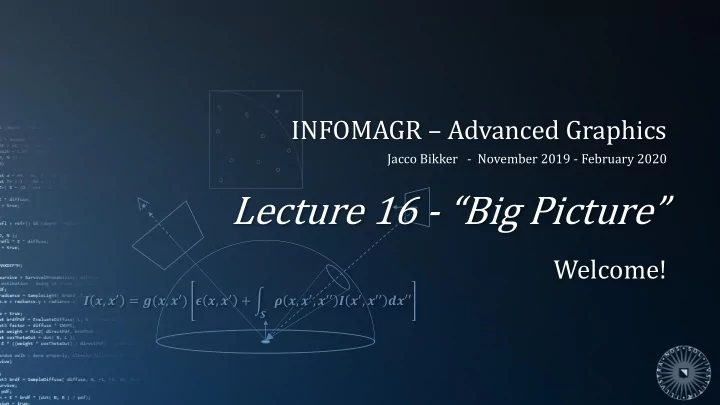
Lecture 16 - Big Picture Welcome! , = (, ) , - - PowerPoint PPT Presentation
INFOMAGR Advanced Graphics Jacco Bikker - November 2019 - February 2020 Lecture 16 - Big Picture Welcome! , = (, ) , + , , ,
𝑱 𝒚, 𝒚′ = 𝒉(𝒚, 𝒚′) 𝝑 𝒚, 𝒚′ + න
𝑻
𝝇 𝒚, 𝒚′, 𝒚′′ 𝑱 𝒚′, 𝒚′′ 𝒆𝒚′′
Jacco Bikker - November 2019 - February 2020
▪ Sampling an Area Light with One Ray ▪ Sampling Multiple Area Lights with One Ray ▪ Difficult Cases: Spherical Lights, Occluded Lights ▪ The Random Walk ▪ Random Walk with Next Event Estimation ▪ Russian Roulette ▪ Example Exam Questions
Advanced Graphics – Grand Recap 3
Case 1: Point Light
Situation: ▪ surface point: location 𝒒, normal 𝑶; ▪ point light: location 𝒇, intensity 𝑱 (in Watt, or joule per second); ▪ distance between 𝒒 and 𝒇: 𝑒. ▪ unit vector from 𝒒 to 𝑓: 𝑴. Flux leaving 𝒇: 𝑱 joules per second. Flux arriving at a sphere, radius 𝑠, surface 4𝜌𝑠2 around 𝒇: 𝑱 Irradiance arriving on that sphere:
𝑱 4𝜌𝑠2 (𝑋/𝑛2)
Flux arriving per steradian:
𝑱 4𝜌
Steradians for a unit area surface patch at location 𝒒: ~ 𝑂∙𝑀
𝑒2
This is the solid angle of the unit area surface patch as seen from 𝒇, or: The area of the patch projected on the unit sphere around 𝒇.
𝒇
𝒒
𝑶 𝑴
Light arriving at 𝑞 from a point light at distance 𝑒:
𝐽
𝑂∙𝑀 4π𝑒2 per unit surface area.
This is the irradiance from the light at 𝑓 arriving at point 𝑞. The contribution
is summed.
Advanced Graphics – Grand Recap 4
Case 2: Area Light
Situation: ▪ surface point, location 𝒒, normal 𝑶𝒒; ▪ single-sided area light, intensity 𝑱, area A, normal 𝑶𝒇. Steradians for the area light, as seen from 𝒒:
𝐵 𝑂𝑓∙−𝑀 𝑒2
(approximately). The energy arriving at 𝒒 is: 𝑱 𝑻𝑩, 𝑻𝑩 ≈
𝐵 𝑂𝑓∙−𝑀 𝑒2
The irradiance (joules per second per unit area) is: 𝑱
𝐵 𝑂𝑓∙−𝑀 𝑂𝑞∙𝑀 𝑒2
.
𝒇
𝒒
𝑶𝒒 𝑴 𝑶𝒇
Advanced Graphics – Grand Recap 5
Sampling an Area Light
The irradiance (joules per second per unit area) is: 𝑱
𝐵𝑤𝑗𝑡𝑗𝑐𝑚𝑓 𝑂𝑓∙−𝑀 𝑂𝑞∙𝑀 𝑒2
. Here, 𝐵𝑤𝑗𝑡𝑗𝑐𝑚𝑓 is the visible area of the light source. 𝐵𝑤𝑗𝑡𝑗𝑐𝑚𝑓 may be smaller than 𝐵 in the presence of occluders. We send 1 million rays to the light source. 𝑂 rays reach the light source. The visible area is estimated as 𝐵𝑤𝑗𝑡𝑗𝑐𝑚𝑓 = 𝐵
𝑂 1,000,000.
Now, we send a single ray to the light source. The probability of a ray reaching the light source is 𝜍. Now, 𝐵𝑤𝑗𝑡𝑗𝑐𝑚𝑓 = 𝐵 𝜍.
For this single ray, the answer is usually wrong. However, on average the answer is correct.
𝒇
𝒒
𝑶𝒒 𝑴 𝑶𝒇
▪ Sampling an Area Light with One Ray ▪ Sampling Multiple Area Lights with One Ray ▪ Difficult Cases: Spherical Lights, Occluded Lights ▪ The Random Walk ▪ Random Walk with Next Event Estimation ▪ Russian Roulette ▪ Example Exam Questions
Advanced Graphics – Grand Recap 7
Sampling Multiple Lights
“To sample 𝑂 lights with a single ray, chose a random light, and multiply whatever the ray returns by 𝑂”. Situation: two lights.
𝒒
Mental steps:
▪ If the lights would have been point lights, we would have sampled both and summed the results. ▪ We can sample an area light with a single ray. So, we sample both using a single ray, and sum the results. ▪ Using one ray, we could sample alternating lights. Since each light is now sampled in half the cases, we should increase the result we get each time by 2. ▪ Or, we can sample a randomly selected light. On average, each light is again sampled in half of the cases, so we scale by 2. ▪ In other words, we scale by 1/50%=2, where 50% is the probability of selecting a light.
Generalized: If we have 𝑂 lights, and we sample each with a probability 𝜍𝑗, we scale the contribution by
1 𝜍𝑗 to
get an unbiased sample of the set of 𝑂 lights. Any 𝜍𝑗 is valid, as long as σ 𝜍𝑗 = 1 and 𝜍𝑗 > 0 unless we know the sample will yield 0.
▪ Sampling an Area Light with One Ray ▪ Sampling Multiple Area Lights with One Ray ▪ Difficult Cases: Spherical Lights, Occluded Lights ▪ The Random Walk ▪ Random Walk with Next Event Estimation ▪ Russian Roulette ▪ Example Exam Questions
Advanced Graphics – Grand Recap 9
Sampling a Spherical Light
“Any 𝜍𝑗 is valid, as long as σ 𝜍𝑗 = 1 and 𝜍𝑗 > 0 unless we know that the sample will yield 0.” Situation: spherical light source. Selecting points on the sphere: ▪ We can skip points on one hemisphere (i.e., 𝜍 = 0) ▪ This does not affect σ 𝜍𝑗 ▪ Therefore it doesn’t affect the other probabilities Similar situation: when evaluating the Lambertian BRDF, we the hemisphere below the surface without accounting for the omission in any way.
𝒒
Advanced Graphics – Grand Recap 10
Sampling Occluded Lights
Situation 1: We have no information about occlusion. NEE probes each light with 50% probability. ▪ samples are scaled up by 1/50%=2; ▪ rays to light 2 always yields 0; ➔ poi
energy from li light 1 1 in in 50 50%
the cas cases, bu but th the li light is is mult ultiplied by 2. 2. Situation 2: We know light 2 is occluded. NEE probes light 1 with 100% probability. ▪ samples are scaled by 1; ➔ poi point 𝒒 receives ene energy from li light 1 1 in in 10 100% of
the ca cases, , mul ultiplier is is 1. 1.
𝒒
The only difference between situation 1 and 2 is variance: in situation 1, we get twice the energy each time we sample light 1, but it gets sampled in only 50% of the cases. In situation 2, we get a much more even amount of energy for each sample.
▪ Sampling an Area Light with One Ray ▪ Sampling Multiple Area Lights with One Ray ▪ Difficult Cases: Spherical Lights, Occluded Lights ▪ The Random Walk ▪ Random Walk with Next Event Estimation ▪ Russian Roulette ▪ Example Exam Questions
Advanced Graphics – Grand Recap 12
The Random Walk
How much light gets transported to the eye?
BRDF: 𝑔
𝑠(𝑞, 𝑀, 𝑊)
The answer to 2: Light (irradiance) coming from all directions, reflected in a single direction; i.e: න
𝛻
𝑔
𝑠 𝑞, 𝜄𝑝, 𝜄𝑗 cos 𝜄𝑗
𝒒
Advanced Graphics – Grand Recap 13
The Random Walk
How much light gets transported to the eye?
a) That is: the light that q, r, s emit towards p, plus b) The light that q, r, s (and all other scene surface points) reflect towards p. 𝒒 𝒓 𝒔 𝒕 Regarding 2b: ▪ The further away a point, the lower the probability that a random ray from 𝑞 strikes it. ▪ The probability is also proportional to 𝑂𝑡,𝑞,𝑟 ∙ −𝑀. ▪ At 𝑞, we scale by 𝑂𝑞 ∙ 𝑀 to compensate for the fact that we sample radiance, while in fact we gather irradiance.
Advanced Graphics – Grand Recap 14
Sampling the Hemisphere using a Single Ray
The light being reflected towards the eye is the light arriving from all directions over the hemisphere, scaled by the BRDF:
𝛻 𝑔 𝑠 𝑞, 𝜄𝑝, 𝜄𝑗 .
Sampling the integral using a single random ray: Scale up by 2𝜌.
𝒒
Advanced Graphics – Grand Recap 15
Random Walk
Point 𝒒 reflects what point 𝒓 reflects, which is what point 𝒔 emits.
𝒒
𝒇 𝑶𝒇
𝒓 𝒔
Advanced Graphics – Grand Recap 16
Random Walk
If we leave the scene, the path returns no energy.
𝒒
𝒇 𝑶𝒇
▪ Sampling an Area Light with One Ray ▪ Sampling Multiple Area Lights with One Ray ▪ Difficult Cases: Spherical Lights, Occluded Lights ▪ The Random Walk ▪ Random Walk with Next Event Estimation ▪ Russian Roulette ▪ Example Exam Questions
Advanced Graphics – Grand Recap 18
Next Event Estimation
At each vertex, we sample the light source using an explicit light ray.
𝒒
𝒇 𝑶𝒇
Advanced Graphics – Grand Recap 19
Next Event Estimation
Why does this work? “The light arriving via point 𝒒 is the light reflected by point 𝒒, plus the light emitted by point 𝒒.” And thus: The light reflected by point 𝒒 is the light arriving at 𝒒 originating from light sources (1), plus the light reflected towards 𝒒 (2). 1: Direct light at point 𝒒. 2: Indirect light at point 𝒒.
Advanced Graphics – Grand Recap 20
Next Event Estimation
If we send out a ray in a random direction over the hemisphere of 𝒒, this ray may return two types of illumination: 1: Direct: the ray hit the light source; 2: Indirect: the ray missed the light source. If we ignore all random rays that hit a light source (as in: terminate them, return 0), we remove the direct light arriving at 𝒒. If we sample just the lights, we remove the indirect light arriving at 𝒒. Since the contributions show no overlap, we can sample them individually, using two rays, and sum the result.
𝒒
𝒇
1 2
Advanced Graphics – Grand Recap 21
Next Event Estimation
Direct and indirect illumination can be sampled separately, as long as we guarantee that there will not be overlap. This works for any point, not just the primary hit: E.g., the light that point 𝒓 reflects towards point 𝒒 is the direct lighting reflected by 𝒓 towards 𝒒, plus the indirect lighting reflected by 𝒓.
𝒒
𝒇
Advanced Graphics – Grand Recap 22
Next Event Estimation
Explicit light sampling still requires evaluation of the BRDF. For a specular surface, the BRDF for 𝜄𝑝 is ∞ for a single 𝜄𝑗, which is why we continue the (not so) random walk in that direction. All other directions yield 0. Consequence: Since we do not send out an explicit light ray in this case, the random walk may now return direct illumination: there is no overlap. In fact, if we didn’t accept direct illumination, we would be missing energy.
𝒒
𝒇
Advanced Graphics – Grand Recap 23
Next Event Estimation
The eye vertex did not send out an explicit light ray. Since direct illumination is not sampled separately, the random walk may return this illumination. The eye is thus considered a specular vertex.
𝒒
𝒇
Advanced Graphics – Grand Recap 24
Next Event Estimation
Also think about it like this: The eye looks directly at a light source.
If we terminate those paths, the light will look black.
The eye looks at a light in a mirror.
If we terminate those paths, we see a black light in the mirror.
In all other cases, we send out an explicit light ray. To compensate for that extra ray: ▪ The extra ray may only sample direct illumination. It doesn’t bounce. ▪ Any other way of sampling direct illumination is blocked.
Advanced Graphics – Grand Recap 25
Next Event Estimation
Important: Earlier slides discussed the mathematical foundation of NEE. Make sure you understand it from the theoretical point of view as well.
▪ Sampling an Area Light with One Ray ▪ Sampling Multiple Area Lights with One Ray ▪ Difficult Cases: Spherical Lights, Occluded Lights ▪ The Random Walk ▪ Random Walk with Next Event Estimation ▪ Russian Roulette ▪ Example Exam Questions
Advanced Graphics – Grand Recap 27
Important Notice
In a path tracer, every technique works independently from others. E.g.: Importance sampling works with and without next event estimation; Russian roulette works with every BRDF, and also with Next Event Estimation. Hint: Try a new algorithm in the simplest case possible, after that enable more advanced features.
Advanced Graphics – Grand Recap 28
Russian Roulette
Core idea: The longer a path becomes, the less energy it transports. Killing half of 16 rays is easy; what do we do with a single path? ➔ Kill it with a probability of 50%.
8 rays, returning 16 Watts of radiance each, 128 Watts in total. = 4 rays, returning 32 Watts of radiance each, 128 Watts in total.
Advanced Graphics – Grand Recap 29
Russian Roulette
Russian roulette is applied to the random walk. Most basic implementation: just before you start calculating the next random direction, you decide if the path lives or dies.
8 rays, returning 16 Watts of radiance each, 128 Watts in total. = 4 rays, returning 32 Watts of radiance each, 128 Watts in total.
Advanced Graphics – Grand Recap 30
Better Russian Roulette
The termination probability of 50% is arbitrary. Any probability is statistically correct. However: for 50% survival rate, survivors scale up by 2 =
1 50% .
➔ In general, for a survival probability 𝜍, survivors scale up by
1 𝜍.
We can chose the survival probability per path. It is typically linked to albedo: the color of the last vertex. A good survival probability is: 𝜍𝑡𝑣𝑠𝑤𝑗𝑤𝑓 = 𝑑𝑚𝑏𝑛𝑞 𝑠𝑓𝑒 + 𝑠𝑓𝑓𝑜 + 𝑐𝑚𝑣𝑓 3 , 0.1, 0.9 Note that 𝜍𝑡𝑣𝑠𝑤𝑗𝑤𝑓 > 0 to prevent bias. Also note that 𝜍 = 1 is never a good idea.
Better: 𝜍𝑡𝑣𝑠𝑤𝑗𝑤𝑓 = 𝑑𝑚𝑏𝑛𝑞(max 𝑠𝑓𝑒, 𝑠𝑓𝑓𝑛, 𝑐𝑚𝑣𝑓 , 0,1)
Advanced Graphics – Grand Recap 31
RR and Next Event Estimation
A path that gets terminated gets to keep the energy accumulated with Next Event Estimation. We are applying Russian roulette to indirect illumination only.
𝒒
▪ Sampling an Area Light with One Ray ▪ Sampling Multiple Area Lights with One Ray ▪ Difficult Cases: Spherical Lights, Occluded Lights ▪ The Random Walk ▪ Random Walk with Next Event Estimation ▪ Russian Roulette ▪ Example Exam Questions
Advanced Graphics – Grand Recap 33
1. In streaming path tracing (or wavefront path tracing) we split the path tracing process in multiple kernels. Why? 2. How is the stencil buffer used in early GPU ray tracers for flow control? 3. Why did early work on GPU ray tracing focus on stackless traversal? 4. Stackless methods visit more nodes in the acceleration
5. Why did the first BVH GPU ray tracing paper use a ray packet?
Advanced Graphics – Grand Recap 34
1. In streaming path tracing (or wavefront path tracing) we split the path tracing process in multiple kernels. Why? 2. How is the stencil buffer used in early GPU ray tracers for flow control? 3. Why did early work on GPU ray tracing focus on stackless traversal? 4. Stackless methods visit more nodes in the acceleration
5. Why did the first BVH GPU ray tracing paper use a ray packet?
Two reasons: the first and most important is that (thanks to compaction) at the start of each kernel the hardware is utilized optimally. The second is that complex code blocks no longer affect the simpler blocks in terms of register pressure. The stencil determines which pixels are active, and thus for which pixels the pixel shader is executed. We run the desired shader for all enabled pixels by drawing a screen-filling quad. The stencil only allows to do or not do all work; repeating the process with different shaders allows us to run specific functionality conditionally. A stack requires a significant amount of space for each ray. When thousands of rays are processed concurrently, this exceeds the memory available on early GPUs. Stackless methods typically restart traversal, and thus revisit nodes until they reach the point where a different decision is made then before. A packet requires a single stack for the entire packet, instead of a stack per ray. Also, on the CPU packets have been effective in reducing bandwidth; it was expected that GPUs would also benefit from this.
Advanced Graphics – Grand Recap 35
6. Why did 5-faces use a brickmap instead of e.g. a BVH? Under what circumstances is this a good idea / not a good idea? 7. In the paper “Understanding the Efficiency of Ray Traversal on GPUs”, Aila and Laine conclude that memory bandwidth is not the main bottleneck in GPU ray tracing. What is the bottleneck? 8. Explain speculative traversal. 9. How do we convert a 2-way BVH to a 4-way BVH?
inefficient on the GPU? In other words: which problem is solved by streaming path tracing?
Advanced Graphics – Grand Recap 36
6. Why did 5-faces use a brickmap instead of e.g. a BVH? Under what circumstances is this a good idea / not a good idea? 7. In the paper “Understanding the Efficiency of Ray Traversal on GPUs”, Aila and Laine conclude that memory bandwidth is not the main bottleneck in GPU ray tracing. What is the bottleneck? 8. Explain speculative traversal. 9. How do we convert a 2-way BVH to a 4-way BVH?
inefficient on the GPU? In other words: which problem is solved by streaming path tracing?
A BVH builds in O(n log n) time; a grid builds in O(n) time. This is also true for a nested grid. Also, the construction can be done using rasterization hardware. The brickmap is great if all triangles (can) change every frame. Traversal is not fully robust to varying local scene detail, so this is only practical for demos. The bottleneck is the hardware thread scheduler. They solved this using persistent threads. For this, N threads are spawned, where N is related to HW capabilities; the N threads then claim work until all work is done. Thread count is thus independent from ray count. Threads that need to intersect primitives before (potentially) resuming traversal do this traversal speculatively together with other threads when traversal steps are executed for a warp anyway. We replace a node with one or two siblings by its two children. The node for which this is done is the one that has the greatest area after the merge. Low hardware utilization due to flow divergence. E.g. Russian roulette tends to lead to many inactive threads in a warp.
Advanced Graphics – Grand Recap 37
physically plausible. Why not?
do?
normal 𝑂𝑀 located at distance 𝑒 from a shading point with normal 𝑂?
Advanced Graphics – Grand Recap 38
physically plausible. Why not?
do?
normal 𝑂𝑀 located at distance 𝑒 from a shading point with normal 𝑂?
It doesn’t normalize the diffuse and the specular terms, it doesn’t take distance attenuation into account, and the brightness of the reflection is reduced when the specular exponent increases. It accounts for self-shadowing of the microfacets for both incoming and outgoing light. This vector is the normalized average of a vector to the eye and a vector to the light, and thus the only possible normal that yields a specular reflection of the light to the eye. The probability density of a particular halfway vector is the amount of light transport via the microfacet material.
𝐵 𝑂𝑀∙𝑀 𝑒2 , where L is the normalized vector from the light to the shading point.
Note that normal N at the shading point is irrelevant here.
Advanced Graphics – Grand Recap 39
in the stochastic experiment. What is bias?
Advanced Graphics – Grand Recap 40
in the stochastic experiment. What is bias?
It focuses on the parts of the integral that are expected to yield most energy, i.e. the direct illumination. It does this by spending 50% of all rays on this illumination, even though direct illumination typically represents only a small part of the hemisphere. Yes: if we separate direct and indirect illumination correctly, NEE does not change the expected value. No: the way we typically calculate the solid angle of a light source is an approximation and thus introduces bias. Strictly speaking this is not a problem of NEE but of the calculation of the solid angle. Bias is any deviation of the expected value from the correct integral.
▪ Sampling an Area Light with One Ray ▪ Sampling Multiple Area Lights with One Ray ▪ Difficult Cases: Spherical Lights, Occluded Lights ▪ The Random Walk ▪ Random Walk with Next Event Estimation ▪ Russian Roulette ▪ Example Exam Questions
Advanced Graphics – Grand Recap 42
Upcoming attractions: ▪ Working college (Thursday) ▪ Assignment 3: January 27th, 23.59 ▪ Exam: January 30th, 17.00, RUPPERT-BLAUW (Dis)Liked the course? Suggestions?
Jacco Bikker - November 2019 - February 2020
next up: “Big Exam”