Lecture 10: FP, Performance Metrics Todays topics: IEEE 754 - - PowerPoint PPT Presentation

lecture 10 fp performance metrics
SMART_READER_LITE
LIVE PREVIEW

Lecture 10: FP, Performance Metrics Todays topics: IEEE 754 - - PowerPoint PPT Presentation

Lecture 10: FP, Performance Metrics Todays topics: IEEE 754 representations FP arithmetic Evaluating a system Reminder: assignment 4 due in a week start early! 1 Examples Final representation: (-1) S x (1 + Fraction) x


slide-1
SLIDE 1

1

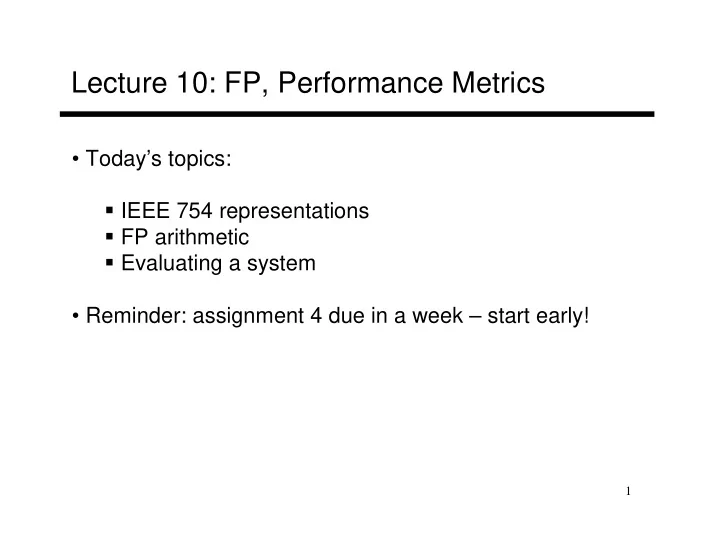
Lecture 10: FP, Performance Metrics

  • Today’s topics:

IEEE 754 representations FP arithmetic Evaluating a system

  • Reminder: assignment 4 due in a week – start early!
slide-2
SLIDE 2

2

Examples

Final representation: (-1)S x (1 + Fraction) x 2(Exponent – Bias)

  • Represent -0.75ten in single and double-precision formats

Single: (1 + 8 + 23) Double: (1 + 11 + 52)

  • What decimal number is represented by the following

single-precision number? 1 1000 0001 01000…0000

slide-3
SLIDE 3

3

Examples

Final representation: (-1)S x (1 + Fraction) x 2(Exponent – Bias)

  • Represent -0.75ten in single and double-precision formats

Single: (1 + 8 + 23) 1 0111 1110 1000…000 Double: (1 + 11 + 52) 1 0111 1111 110 1000…000

  • What decimal number is represented by the following

single-precision number? 1 1000 0001 01000…0000

  • 5.0
slide-4
SLIDE 4

4

FP Addition

  • Consider the following decimal example (can maintain
  • nly 4 decimal digits and 2 exponent digits)

9.999 x 101 + 1.610 x 10⁻¹

Convert to the larger exponent:

9.999 x 101 + 0.016 x 101

Add

10.015 x 101

Normalize

1.0015 x 10²

Check for overflow/underflow Round

1.002 x 10²

Re-normalize

slide-5
SLIDE 5

5

FP Addition

  • Consider the following decimal example (can maintain
  • nly 4 decimal digits and 2 exponent digits)

9.999 x 101 + 1.610 x 10⁻¹

Convert to the larger exponent:

9.999 x 101 + 0.016 x 101

Add

10.015 x 101

Normalize

1.0015 x 10²

Check for overflow/underflow Round

1.002 x 10²

Re-normalize If we had more fraction bits, these errors would be minimized

slide-6
SLIDE 6

6

FP Multiplication

  • Similar steps:

Compute exponent (careful!) Multiply significands (set the binary point correctly) Normalize Round (potentially re-normalize) Assign sign

slide-7
SLIDE 7

7

MIPS Instructions

  • The usual add.s, add.d, sub, mul, div
  • Comparison instructions: c.eq.s, c.neq.s, c.lt.s….

These comparisons set an internal bit in hardware that is then inspected by branch instructions: bc1t, bc1f

  • Separate register file $f0 - $f31 : a double-precision

value is stored in (say) $f4-$f5 and is referred to by $f4

  • Load/store instructions (lwc1, swc1) must still use

integer registers for address computation

slide-8
SLIDE 8

8

Code Example

float f2c (float fahr) { return ((5.0/9.0) * (fahr – 32.0)); } (argument fahr is stored in $f12) lwc1 $f16, const5($gp) lwc1 $f18, const9($gp) div.s $f16, $f16, $f18 lwc1 $f18, const32($gp) sub.s $f18, $f12, $f18 mul.s $f0, $f16, $f18 jr $ra

slide-9
SLIDE 9

9

Performance Metrics

  • Possible measures:

response time – time elapsed between start and end

  • f a program

throughput – amount of work done in a fixed time

  • The two measures are usually linked

A faster processor will improve both More processors will likely only improve throughput

  • What influences performance?
slide-10
SLIDE 10

10

Execution Time

Consider a system X executing a fixed workload W PerformanceX = 1 / Execution timeX Execution time = response time = wall clock time

  • Note that this includes time to execute the workload

as well as time spent by the operating system co-ordinating various events The UNIX “time” command breaks up the wall clock time as user and system time

slide-11
SLIDE 11

11

Speedup and Improvement

  • System X executes a program in 10 seconds, system Y

executes the same program in 15 seconds

  • System X is 1.5 times faster than system Y
  • The speedup of system X over system Y is 1.5 (the ratio)
  • The performance improvement of X over Y is

1.5 -1 = 0.5 = 50%

  • The execution time reduction for the program, compared to

Y is (15-10) / 15 = 33% The execution time increase, compared to X is (15-10) / 10 = 50%

slide-12
SLIDE 12

12

Performance Equation - I

CPU execution time = CPU clock cycles x Clock cycle time Clock cycle time = 1 / Clock speed If a processor has a frequency of 3 GHz, the clock ticks 3 billion times in a second – as we’ll soon see, with each clock tick, one or more/less instructions may complete If a program runs for 10 seconds on a 3 GHz processor, how many clock cycles did it run for? If a program runs for 2 billion clock cycles on a 1.5 GHz processor, what is the execution time in seconds?

slide-13
SLIDE 13

13

Performance Equation - II

CPU clock cycles = number of instrs x avg clock cycles per instruction (CPI) Substituting in previous equation, Execution time = clock cycle time x number of instrs x avg CPI If a 2 GHz processor graduates an instruction every third cycle, how many instructions are there in a program that runs for 10 seconds?

slide-14
SLIDE 14

14

Factors Influencing Performance

Execution time = clock cycle time x number of instrs x avg CPI

  • Clock cycle time: manufacturing process (how fast is each

transistor), how much work gets done in each pipeline stage (more on this later)

  • Number of instrs: the quality of the compiler and the

instruction set architecture

  • CPI: the nature of each instruction and the quality of the

architecture implementation

slide-15
SLIDE 15

15

Example

Execution time = clock cycle time x number of instrs x avg CPI Which of the following two systems is better?

  • A program is converted into 4 billion MIPS instructions by a

compiler ; the MIPS processor is implemented such that each instruction completes in an average of 1.5 cycles and the clock speed is 1 GHz

  • The same program is converted into 2 billion x86 instructions;

the x86 processor is implemented such that each instruction completes in an average of 6 cycles and the clock speed is 1.5 GHz

slide-16
SLIDE 16

16

Benchmark Suites

  • Measuring performance components is difficult for most

users: average CPI requires simulation/hardware counters, instruction count requires profiling tools/hardware counters, OS interference is hard to quantify, etc.

  • Each vendor announces a SPEC rating for their system

a measure of execution time for a fixed collection of programs is a function of a specific CPU, memory system, IO system, operating system, compiler enables easy comparison of different systems The key is coming up with a collection of relevant programs

slide-17
SLIDE 17

17

SPEC CPU

  • SPEC: System Performance Evaluation Corporation, an industry

consortium that creates a collection of relevant programs

  • The 2006 version includes 12 integer and 17 floating-point applications
  • The SPEC rating specifies how much faster a system is, compared to

a baseline machine – a system with SPEC rating 600 is 1.5 times faster than a system with SPEC rating 400

  • Note that this rating incorporates the behavior of all 29 programs – this

may not necessarily predict performance for your favorite program!

slide-18
SLIDE 18

18

Deriving a Single Performance Number

How is the performance of 29 different apps compressed into a single performance number?

  • SPEC uses geometric mean (GM) – the execution time
  • f each program is multiplied and the Nth root is derived
  • Another popular metric is arithmetic mean (AM) – the

average of each program’s execution time

  • Weighted arithmetic mean – the execution times of some

programs are weighted to balance priorities

slide-19
SLIDE 19

19

Amdahl’s Law

  • Architecture design is very bottleneck-driven – make the

common case fast, do not waste resources on a component that has little impact on overall performance/power

  • Amdahl’s Law: performance improvements through an

enhancement is limited by the fraction of time the enhancement comes into play

  • Example: a web server spends 40% of time in the CPU

and 60% of time doing I/O – a new processor that is ten times faster results in a 36% reduction in execution time (speedup of 1.56) – Amdahl’s Law states that maximum execution time reduction is 40% (max speedup of 1.66)

slide-20
SLIDE 20

20

Title

  • Bullet