Lec Lectur ure 3: e 3: 2. What are the limits of magnetocaloric - - PowerPoint PPT Presentation

lec lectur ure 3 e 3
SMART_READER_LITE
LIVE PREVIEW

Lec Lectur ure 3: e 3: 2. What are the limits of magnetocaloric - - PowerPoint PPT Presentation

Overview of Lecture 3 1. Examples of tricritical materials Lec Lectur ure 3: e 3: 2. What are the limits of magnetocaloric performance? Magnetocaloric ma materials 3. An introduction to several room temperature magnetocaloric materials 4. Some


slide-1
SLIDE 1

Lec Lectur ure 3: e 3: Magnetocaloric ma materials

Karl G. Sandeman ESM 2013

Overview of Lecture 3

  • 1. Examples of tricritical materials
  • 2. What are the limits of magnetocaloric performance?
  • 3. An introduction to several room temperature magnetocaloric materials
  • 4. Some words on measurement
  • 5. An example of material-device integration: the SSEEC project
  • 6. Where else to look for caloric effects?
  • 7. Conclusion

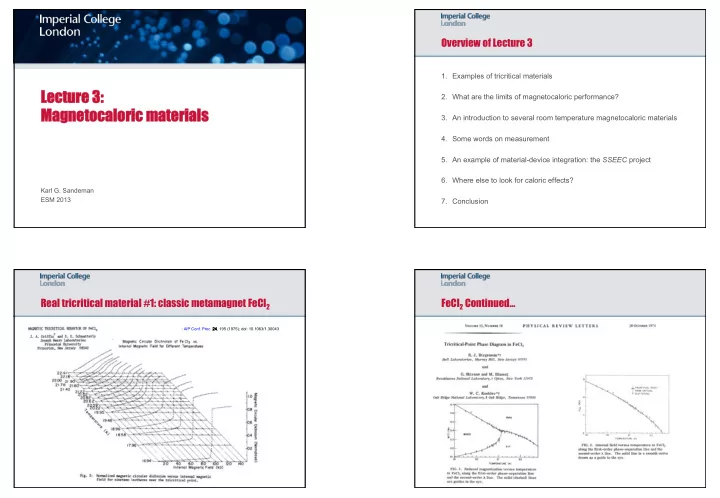
Real tricritical material #1: classic metamagnet FeCl2

197 the first order transition. The second order transi- tion is located by a maximt~ in the susceptibility at the critical external field. The behavior depicted in Fig. 2 is accentuated in

  • Fig. 3, which illustrates the dichroism as a function
  • f internal magnetic field for the same nineteen iso-
  • therms. The transformation to internal magnetic field

was accomplished by least squares fitting the dichroism in the mixed phase in Fig. 2 to determine the demagne- tization factor, and ntmlerically computing the internal magnetic field at each data point according to where H is the internal magnetic field, and H E is the external magnetic field. The demagnetization factor was determined for eleven temperatures between 9.95 K and 19.48 K, and was found to deviate from the average by at most 2%, thus illustrating that the factor of proportionality between dichroism and magnetization is temperature independent. As a function of temperature the internal field dependence of the dichroism illus- trates the physical behavior of the tricritical system. At 16.94 K the simultaneous spin-flip of the large blocks of magnetic moments in the antiparallel layers is manifested by a discontinuity in the dichroism at the critical internal field. As the temperature is increased, thus reducing the ferromagnetic coupling within the layers, the discontinuity in the dichroism becomes smaller. This behavior is illustrated by iso- therms at 18.58K, 19.48K, and 20.22K. At tempera- tures beginning with 20.82 K the transition is second

  • rder,

for the finite discontinuity occurring at the critical field at low temperatures is replaced by a continuous dichroism. This continuous behavior above T t is associated with the flipping one-by-one of the magnetic moments in the antiparallel layers. The line of these second order transitions is traced out by the susceptibility maximt~ at the critical internal field.

  • Fig. 4 illustrates the normalized critical magne-

tic circular dichroism versus temperature. In the

., bbO,Q 10 i~ 6im ID

22.41 2200 21 .906~ C 21.78 21. 21.42 21 °,,.,*"

III first order region the two data points for each temp- erature depict the dichroiam at the onset and termina- tion of the vertical discontinuity depicted in Fig. 3. The two branches are denoted by M' and M-. In the second order region the single data point at each temp- erature denotes the value of the dichreism on the line, and this branch is labeled by M

  • I. The tricriti-

cal point occurs at T~ -- 20.79 -+ 0. ii K and )4 _ = 0.38 _+ 0.01. There are several interesting feature~ of the data in Fig. 4. First, both branches in the first

  • rder region appear to approach the tricritical point
  • linearly. The tricritical point exponents associated

with the total magnetization are described by : A+(cr

t -T)/Tt) B÷ and : ((T t -T)/T~8-. I0 From the data in Fig. 4 we obtain 8+ = 1.03+0.05 for 8.3xi0

  • s <- (Tt-T)/T

t < 1.06x10

  • l

and 8_ = 1.13+0.14 for 8.3x10 "3 < (T t -~)/T t < 6.3 x 10 "z . According to a Landau analysis these expo- nents are given by B+ = B. = 1.00. Secondly, the slopes of the branches M + and Ml at the tricritical point are not equal. W e

  • btain dCM+/N~/d(T/Tt) --

7.0 +0.3 and d(M~/Mt)/dCr/Tt) = 4.1 -+0.2, whereas a Landau analysis predicts that the slope of the total magnetization on the upper branch of the first order transition should be equal to that on the ~ line at the tricritical point. The internal critical magnetic field versus temp- erature phase diagram is illustrated in Fig. S. This figure is a plot of the critical internal field at each temperature at which the spin-flip transition occurs in

  • Fig. 3. This data illustrates that at the tricritical

point the first order branch of this phase diagram intersects the I branch with a continuous slope. A Landau description predicts that the slope and magni- tude of these branches should be continuous at the tri- critical point, and such behavior appears to be the case in Fig. 5. Megnetic Circular Dichroism of Fe CI~ vs. Internol Megnetic Field for Different Temperatures

~10 OD

20.6 2 .... >o,~ 19.9~ \ ~°e" 19.4

%.

t~ %

,8.96

1856

. \ ~ ...A....~.-. "" "\ \\ \

OIIO O I~O1010 1QOOOIOIOQ 00Q00119 jOIO O01~lOIDI~atl igll

2.0 40 6.0 80 I00 12D Internal Mognetic Field (kG) 10 08 o

O Q

06" N 0.4 ~ B

  • .2
N ¢D

14.0

  • Fig. 3: Normalized magnetic circular dichroism versus internal magnetic

field for nineteen isotherms near the tricritical point. 195 ABSTRACT Magneto-optic measurements of the tricritical behavior of FeCI2 are presented. These measurements utilize the magnetic circular dichroism of a near infrared absorption of the Fe ++ ions in order to deter- mine the total magnetization as a function of tempera- ture and magnetic field near the tricritical point. The resultant description of the magnetic tricritical behavior is consistent with most predictions of a classical Landau analysis, and is found to exhibit a remarkable similarity with the tricritical behavior of 3He-~He mixtures. INTRODUCTION MAGNETIC TRICRITICAL BEHAVIOR OF FeCl 2

  • J. A. Griffin* and S. E. Schnatterly

Joseph Henry Laboratories Princeton University Princeton, New Jersey 08540 critical temperature Tt, above which the transition is second order up to the Neel temperature T

  • N. The point

in the metamagnetic phase diagram at which this field- induced transition chsnges from first to second order has been labeled a tricritical point3, and it is the cooperative behavior associated with this special point that is responsible for the current interest in meta- magnetic systems. Optical techniques have frequently been utilized as a probe for studying many aspects of magnetism and magnetic materials. One aspect which has recently received considerable interest is the field-dependent behavior of highly anisotropic antiferromagnetic sys- tems and their resultant tricritical cooperative phe- nomena. In this paper we will describe the applica- tion of magneto-optic techniques to the study of the magnetic tricritical behavior in FeCl 2 . Although we have observed the effects of magnetic ordering in measurements of optical absorption and of magnetic circular dichroism from the near ultraviolet to the near infrared, we will concentrate here only on the infrared circular dichroism I . These measurements, which utilized the dichroism of an absorption band of the Fe ++ ion, are used to monitor the temperature and magnetic field dependence of the total magnetization. The optical data is then used to construct magnetic phase diagrams of total magnetization versus tempera- ture and of internal magnetic field versus temperature, and to extract tricritical point exponents associated with the total magnetization. The resultant tricriti- cal behavior of FeCI 2 exhibits a striking similarity with that of 3He-~He mixtures, and is found to agree in most respects with the predictions of a classical Landau analysis. METAMAQ~TIC BEHAVIOR Metamagnetic FeCI_ is a highly anisotropic anti- . ferromagnet which conslsts of hexagonal layers of Fe ++ magnetic moments. 2 Within these layers there is a strong ferromagnetic exchange coupling which aligns the magnetic moments in a parallel arrangement, and between the layers there is an antiferromagnetic coupling. The

  • verall magnetic order is that of antiferromagnetically

aligned ferromagnetic layers. The magnetic moments are strongly confined to the hexagonal c axis (perpendicu- lar to the layers) by an anisotropy energy that exceeds both the ferromagnetic and antiferromagnetic exchange

  • energies. The fact that this anisotropy exceeds the

antiferrc~mgnetic exchange and that there is ferromag- netic coupling within the layers results in the rather interesting field-dependent behavior. In the presence of a sufficiently strong magnetic field applied perpendicular to the layers, there is an antiferromagnetic to paramagnetic phase transition. Due to the strong anisotropy this field-induced transi- tion involves a spin-flip in which the initially anti- parallel planes flip directly to the paramagnetic con- figuration, without the spin-flop phase present in many antiferromagnets. Due to the ferromagnetic coupling within the layers this spin-flip transition is first

  • rder at finite temperature, and it results in a finite

discontinuity in the total magnetization. The first

  • rder nature of the transition persists up to the tri-

EXPERIMENTAL TE[}]NIQUE Magnetic circular dichroism is the field-induced difference in absorption coefficients for left and right circularly-polarized light for a geometry in whic~ the magnetic field and incident beam are paral- lel.~ Measurements of the infrared dichroism of FeCl2 were made by placing the sample in the bore of a super- conducting solenoid with optical access parallel to the magnetic field. The sample, a flat plate, was mounted so that its hexagonal c axis was parallel to the mag- netic field and was masked in order that the incident beam was limited to the central portion of the plate, across which the internal magnetic field is homogeneous. The incident monochromatic beam was passed first through a linear polarizer, next through a rotating phase plate, next through a mechanical chopper, and finally through the sample. The suitably analyzed intensity at the detector is proportional to

  • 2~Ld
  • 2~Rd
e
  • e
  • 2%d
  • 2C~.Rd

(i)

e + e

from which the circular dichroism MCD(X,T,~ - %- % (z) is obtained. The resolution of the optical system used in the experiment was approximately 0.2% of the satu- rated paramagnetic dichroism, and this resolution has been extended to approximately 0.05% using optical bridge techniques. The temperature of the sample was carefully con- trolled. For this purpose the sample was placed in a cylindrical holder equipped with optical windows on each end and which was filled with ~He exchange gas. No effects due to sample heating by the incident beam were found to occur. The temperature of the holder was measured by a calibrated four-wire germanit~n resistance thermometer and an ac resistance bridges before and after each magnetic field scan. In order to control the sample holder temperature during the field scan, a magnetic field-independent SrTiO 3 capacitance thermo- meter was used in an ac capacitance bridge temperature

  • controller. 6 This technique eliminates the coupling of

temperature and magnetic field which occurs due to the magnetoresistance present in germanit~a or carbon resis- tance thermometers. Using this scheme, the sample temperature was constant to approximately 3 mK along each isothermal field scan. EXPERIMF2CrAL RESULTS

  • Fig. 1 illustrates the optical absorption of FeCI

2 in zero magnetic field at four temperatures. The low- est optical transition occurs at approximately 1.45 microns, and is a phonon-assisted electric dipole tran- sition between the cubic field split components, the lower ST2g and the upper 5E~, of the free ion SD term. The doublet structure arise~ from the Jahn-Teller effect in which the two-fold orbital degeneracy of the SE level is lifted by even-parity phonons.7 This tra~si-

  • FeCl2 Continued…

Vox.UMs 55, NUMszR 18 28 Qcrosza 1974

  • Chem. Hev. 55, 745 {1955). In their work with the Mul-

liken electronegativity scale, Pritchard and Skinner also defined s- and p-orbital contributions to the elec- tronegativity.

  • H. Jagodzinski,

Neues Jahrb. Mineral. , Monatsh.

XO, 49 {Z954).

  • 6P. Lawaetz,
  • Phys. Hev. B 5, 4039 {1972).

~E. Mooser and W. B.Pearson, Acta Crystallogr. 12, 1015 (1959).

J.A. Van Vechten,

  • Phys. Hev. F87, 1007 {1969).

We are grateful to J. C. Phillips

for pointing this

  • ut to us.

Tncntical-Point Phase Diagram in FeCI, R, J. Birgeneau*g

Bell Laboratories, Murray

Hi&l, Nezo Jersey 07974

  • G. Shirane

and M. Blumef, Brookhaven National I. aboratory,

g Upton, New Fork 2'1973

  • W. C. Koehler*g

Oak Ridge ¹tional I. aboxatoxy, 5 Oalz Ridge, Tennessee

37830 (Received 15 July 1974) Detailed measurements

  • f the magnetization

and sublattice magnetization

  • f I"eCl& in a

magnetic field have been performed by use of polarized- and unpolarized-neutron-diffrac- tion techniques. The phase diagram so determined is found to bear a close resemblance to that of 3He- He mixtures near the tricritical point although there are a number

  • f im-

portant differences which seem to require, at the minimum, an extension of present theo- ries of tricritical phenomena. In 1935 and 193V Landau' gave a phenomenolog-

ical theory for thermodynamic systems exhibit-

ing a line of first-order transitions going over continuously into a line of second-order

transi- tions. Three decades later, Graf, Lee, and Rep-

py' showed that just such a situation

  • ccurs in

'He-4He mixtures where, at the junction point, the superfluid

  • A. line goes continuously

into the phase-separation line. Shortly thereafter, Grif- fiths' considered in more detail the general 'He- 4He phase diagram and he showed that the junc- tion point actually occurs at the intersection

  • f

three lines of second-order transitions.

He thence proposed the name trinitica/point

for this special point on the phase diagram. Grif- fiths further suggested that tricritical points

might occur in a wide variety

  • f physical

sys- tems and,

in particular, in metamagnets such as FeCl,." In this case it is proposed that one has a simple isomorphism between thermodyna- mic variables with,

for example, magnetization

M(H, T)- X, the 'He concentration, and sublat-

tice magnetization

M, (H, T)- i/I, the superfluid

  • rder parameter.

In this Letter we report a de- tailed neutron-diffraction study of FeCL, in a magnetic field. As we shall show, FeC1, does indeed exhibit tricritical behavior and, further- more, the phase diagram around the tricritieal point bears a close resemblance to that of 'He- 4He mixtures. There are, however, a number

  • f quantitative

discrepancies with theory which necessitate both an extension

  • f the existing

theories together with further experiments. %e consider first the magnetic properties

  • f

FeC1„ the experimental

technique, and the sali- ent results. We shall then discuss the current theoretical predictions in the context of the re- sults. The crystal structure, magnetic proper- ties, and critical behavior

  • f FeC1, in zero mag-

netic field have been extensively discussed by Birgeneau, Yelon, Cohen, and Makovsky. ' From the vantage point of critical phenomena, FeCl, may be viewed as being composed

  • f hexagonal

sheets of ferromagnetically coupled 5 =1 Ising spins with successive planes weakly coupled anti- ferromagnetically. At low temperatures as a function

  • f increasing

internal field H , (we shall. assume that all fields are applied along the crys- talline e axis), FeC1, undergoes a first-order transition from an antiferromagnetic (A/f) to a

Vox.UMs 55, NUMszR 18 28 Qcrosza 1974

  • Chem. Hev. 55, 745 {1955). In their work with the Mul-

liken electronegativity scale, Pritchard and Skinner also defined s- and p-orbital contributions to the elec- tronegativity.

  • H. Jagodzinski,

Neues Jahrb. Mineral. , Monatsh.

XO, 49 {Z954).

  • 6P. Lawaetz,
  • Phys. Hev. B 5, 4039 {1972).

~E. Mooser and W. B.Pearson, Acta Crystallogr. 12, 1015 (1959).

J.A. Van Vechten,

  • Phys. Hev. F87, 1007 {1969).

We are grateful to J. C. Phillips

for pointing this

  • ut to us.

Tncntical-Point Phase Diagram in FeCI, R, J. Birgeneau*g

Bell Laboratories, Murray

Hi&l, Nezo Jersey 07974

  • G. Shirane

and M. Blumef, Brookhaven National I. aboratory,

g Upton, New Fork 2'1973

  • W. C. Koehler*g

Oak Ridge ¹tional I. aboxatoxy, 5 Oalz Ridge, Tennessee

37830 (Received 15 July 1974) Detailed measurements

  • f the magnetization

and sublattice magnetization

  • f I"eCl& in a

magnetic field have been performed by use of polarized- and unpolarized-neutron-diffrac- tion techniques. The phase diagram so determined is found to bear a close resemblance to that of 3He- He mixtures near the tricritical point although there are a number

  • f im-

portant differences which seem to require, at the minimum, an extension of present theo- ries of tricritical phenomena. In 1935 and 193V Landau' gave a phenomenolog-

ical theory for thermodynamic systems exhibit-

ing a line of first-order transitions going over continuously into a line of second-order

transi- tions. Three decades later, Graf, Lee,

and Rep- py' showed that just such a situation

  • ccurs in

'He-4He mixtures where, at the junction point, the superfluid

  • A. line goes continuously

into the phase-separation line. Shortly thereafter, Grif- fiths' considered in more detail the general 'He- 4He phase diagram and he showed that the junc- tion point actually occurs at the intersection

  • f

three lines of second-order transitions.

He thence proposed the name trinitica/point

for this special point on the phase diagram. Grif- fiths further suggested that tricritical points

might occur in a wide variety

  • f physical

sys- tems and,

in particular, in metamagnets such as FeCl,." In this case it is proposed that one has a simple isomorphism between thermodyna- mic variables with,

for example, magnetization

M(H, T)- X, the 'He concentration, and sublat-

tice magnetization

M, (H, T)- i/I, the superfluid

  • rder parameter.

In this Letter we report a de- tailed neutron-diffraction study of FeCL, in a magnetic field. As we shall show, FeC1, does indeed exhibit tricritical behavior and, further- more, the phase diagram around the tricritieal point bears a close resemblance to that of 'He- 4He mixtures. There are, however, a number

  • f quantitative

discrepancies with theory which necessitate both an extension

  • f the existing

theories together with further experiments. %e consider first the magnetic properties

  • f

FeC1„ the experimental

technique, and the sali- ent results. We shall then discuss the current theoretical predictions in the context of the re- sults. The crystal structure, magnetic proper- ties, and critical behavior

  • f FeC1, in zero mag-

netic field have been extensively discussed by Birgeneau, Yelon, Cohen, and Makovsky. ' From the vantage point of critical phenomena, FeCl, may be viewed as being composed

  • f hexagonal

sheets of ferromagnetically coupled 5 =1 Ising spins with successive planes weakly coupled anti- ferromagnetically. At low temperatures as a function

  • f increasing

internal field H , (we shall. assume that all fields are applied along the crys- talline e axis), FeC1, undergoes a first-order transition from an antiferromagnetic (A/f) to a

VOLUME 33, NUMBER 18

PHYSICAL REVIEW LETTERS

28 OCTOBER 1/74 paramagnetic

(para) state. Above a critical tem- perature

  • f -21 K, however,

the A/f-para tran- sition appears to become continuous.

4 The Noel

temperature in zero field is -23.6 K. ln a real experiment, it is, of course, the applied field, H pp 9 which is varied.

Hill, and Hpp

are rel ated by"

  • H. ,=H„, -4~mS(H. „r),

where M(H „T)is the magnetization and N is the demagnetizing

factor.

Unfortunately, in ex- periments reported to date' the samples have been highly nonellipsoidal in shape thence giving

rise to a large distribution

in internal fields. Hence, no detailed information could be obtained about the tricritical behavior. The experiments reported here were performed

  • n a triple-axis

spectrometer at the Brookhaven National Laboratory high-flux beam reactor. The sample was an ellipsoidal platelet

  • f dimen-

sions 2.4x1.1&&0.09 cm' with the crystalline c axis perpendicular to the flat face. The crystal was masked with cadmium so that only the cen- ter 25% was illuminated with neutrons. The es- timated spread in the demagnetizing field from geometrical effects was thus less than 10 0 at the tricritical point. The crystal was mounted with its (010) axis vertical in a variable-tem- perature cryostat and the cryostat in turn was mounted

  • n a conventional

magnet with the field in the horizontal plane directed along the sample (00l) direction. The sublattice magnetization could be determined in the usual fashion from the intensity at the (201) superlattice position while the magnetization was determined from the flipping ratio of polarized neutrons at the (300) nuclear reflection. This simultaneous

access to

both the ordering and nonordering densities

rep- resents a considerable advantage

  • f the neutron-

scatte ring technique. The experiments consist mainly

  • f a series of

scans either in H, at a fixed temperature

  • r

vice versa.

At low temperatures as H,

is in- creased the superlattice intensity I(2013 decreas- es gradually

up to a critical field H,

(1) at which point there is a discontinuity in dI/dH, signal-

ing a first-order transition into the mixed A/f- para state. The intensity,

I(201), then decreas- es linearly

with increasing H, up to a critical field, H,P&(2), at which point I(201) vanishes and the crystal enters a homogeneous paramagnetic

state. The field difference, H, (2) — H, (1), is just the demagnetizing-field difference

4m% &&[1II(H,(2), T) —

M(H. ,(l), T)] for the two states.

0.7 0. 6 0.5 %04 0.3 0.2 0.

1 i

20

TEMPERATURE (Kj

22

  • FIG. 1. Reduced magnetization

versus temperature in FeCl2 along the first-order phase-separation line

and the second-order

  • A. line.

The solid (dashed) lines are guides to the eye. As the temperature

is increased

the mixed- phase region decreases in size until beyond about

21.15 K the transition

appears to be of second or- der. Measurements

  • f the magnetization

along the phase boundaries so determined may then be carried

  • ut with the use of polarized

neutrons. We consider here only the results around the tri- critical point/

Happ

10 200 0, T, = 21.15 K. The normalized magnetization as a function

  • f tem-

perature along the phase boundaries is shown in

  • Fig. 1. It is immediately

evident that the Feel, phase diagram does indeed bear a striking re- semblance to the X-T phase diagram in 'He- He mixtures. We shall discuss this correspondence in detail below. The thermodynamic variable conjugate to the magnetization M(H „T)is the. internal field H, Using Eq. (1) and the results shown in Fig. 1 one may immediately construct the H. ,-T diagram. By definition, the upper and lower lines of the phase-separation curve must collapse

  • nto a single line.

The resultant

  • H. ,-T

phase diagram is given in Fig. 2. The phase- separation line is seen to be continuous with the

  • A. line through

the tricritical point. As an additional check, we also monitored the strength

  • f the A/f critical fluctuations

along the upper phase boundary, at the position (1.98, 0,

0.99), just off the (2, 0, 1) Bragg peak.

The criti- cal-scattering intensity is found to decrease gradually as one moves up the

  • A. line.

However at T =21.15+0.1 K there is a distinct break in the slope with the critical scattering then decreas- ing rapidly in intensity with further decrease in temperature. This is a clear signature

  • f the

crossover from a second- to a first-order tran- 1099

Vox,UME 33, NUMssR 18

P8YSI GAI, RK VI K W I.KITER S

28 OcroazR 19?4

1.0 0.7 cU

04

O

0.2

&i

0.1 0.07

I

0.002 0.004 0.007 0.01 0.02 0.04 0.07 0.

1

0.2

1 —T/ Tt l

0.4 0.7

3.0 6 19

20

21 TEMPERATURE (K)

22

  • FIG. 3. Square of the normalized

sublattice magneti- zation versus reduced temperature along the A/f side

  • f the first-order

line. Here

T& —

21.15 K. The solid

line corresponds to the power law, Eq. (2) .

  • FIG. 2. Internal

field versus temperature in FeC12 along the first-order phase-separation line and the second-order

  • A. line.

The solid line is a smooth curve drawn as a guide to the eye. sition and it thus serves to locate independently the tricritical point at T=21.15 K, II,

=10200

0 for our sample.

We have also carried

  • ut a wide variety
  • f

measurements

  • f the staggered

magnetization M, (H, T) along various paths in the H, -T plane in order to test the concept of smoothness. These results are discussed in detail in a separate pub-

  • lication. ' We consider here explicitly,

however, the discontinuity in the sublattice magnetization,

DM„across the first-order

phase-transition line. This should exhibit characteristic

tricriti- cal behavior

with respect to the tricritical tem- perature

T,. The results

  • f these measurements

are shown

in log-log form in Fig. 3. Here we take T, =21.15 K, the value deduced both from

  • Fig. 1 and from the critical-scattering

measure- ments discussed above. Over the reduced-tem- perature range 4x10 '&1 —T/21. 15&2x10 ' the square of the normalized sublattice magnetiza- tion is found to follow the simple power law (SM,/M, )' = 1.5(1 —T/21. 15)'". (2) We now discuss the results given in Figs. 1-3 in the context of the current theories

  • f tricriti-

cal phenomena. It has been demonstrated'

by

Riedel and Wegner and by Bausch that for lattice dimensionality

d& 3 the tricritical point ought to be characterized by classical critical exponents.

For d =3 the classical power laws should be modi- fied by logarithmic correction terms.

In the M-

T plane the Landau theory predicts that the three phase-boundary lines will approach the tricriti- cal point linearly, that is, P=1, with the second-

  • rder
  • A. line joining onto the paramagnetic-phase-

separation line with no discontinuity in slope. From Fig. 1 it is evident that this latter predic- tion is explicitly contradicted in FeCL„a similar result is found in 'He-'He mixtures. The upper two lines in Fig. 1 do seem to approach the tri- critical point linearly; however, the A/f first-

  • rder line deviates

considerably from linearity up to at least 20.9 K, that is 1 —T/T, =0.01. In- deed over the reduced-temperature range 0.1

& 1 —T/T, & 0.01 an exponent P„-0.

36 rather than 1 seems to be appropriate. Along the first-

  • rder line the Landau theory also predicts

that the discontinuity in the sublattice magnetization should

  • bey the power law hM, 'cc 1 —

T/T„ that is 2P, =1, compared

to our result,

  • Eq. (2), 2P,

=0.38. These exponents are accurate,

  • ver the

temPerature range covered, to about

10%%uc. There

appears, therefore, to be a serious conflict be- tween the classical theory

and experiment along the A/f first-order line for both the magnetiza- tion and the sublattice magnetization, unlike the

case of He'-He' mixtures. ' There is, of course,

always the possibility that for some as yet un- known reason the asymptotic behavior is only at- tained very close to T, along this particular

  • path. '

We should note, however, that along all other paths across the

  • A. line the sublattice

magnetiza- tion exhibits the predicted power-law behavior for 1 — T/T, or 1-H/H,

& 10 ', whereas

here we have a significant discrepancy at 1 —T/T, -4 &10 '. Clearly, this requires further experimen- tal and theoretical study. Unfortunately,

any significant improvement

  • f our neutron

measure- ments of the phase-separation line near T, is un- likely; the first-order transition manifests it- self as a discontinuity in dI(201)/dH,

and this point becomes very difficult to locate accurately beyond 21.0 K. However,

it may be possible to

slide-2
SLIDE 2

Real tricritical material #2: La-Fe-Si

Mechanism of the strong magnetic refrigerant performance of LaFe13−xSix

Michael D. Kuz’min and Manuel Richter Leibniz-Institut für Festkörper-und Werkstoffforschung, IFW Dresden, PF 270116, D-01171 Dresden, Germany Received 21 June 2007; published 5 September 2007 Electronic structure calculations reveal the presence of several shallow minima and maxima in the energy- vs-magnetization curves, which otherwise are surprisingly flat. The main implication—a fast magnetization and/or demagnetization process with little hysteresis—is of primary importance for the performance of LaFe13−xSix in magnetic cooling devices. PHYSICAL REVIEW B 76, 092401 2007

5 10 15 20 25 30

  • 1

1

spin moment (µB/f.u.) a

4 1 2 3

LaFe12Si .)

Real tricritical material #2, continued: La-Fe-Si

A candidate magnetic refrigerant at room temperature: La(Fe,Si)13 Fujita et al., 2003 La(Fe,Si)13 cubic crystal structure ~11.6 Å

Real tricritical material #3: Fe2P

Similar effects modeled and seen

FIGURE 3 Calculated values for EðMÞ ¼ Eð0Þ EðMÞ in mRy per unit cell as a function of the total moment M (in B/unit cell) for lattice constants a ¼ 5:8, 5.825, 5.85 and 5.877 A ˚ . Phase Transitions, 2002, Vol. 75, No. 1–2, pp. 231–242

FIRST-ORDER TRANSITION OF Fe2P AND ANTI-METAMAGNETIC TRANSITION

  • H. YAMADA* and K. TERAO

Faculty of Science, Shinshu University, Matsumoto 390-8621, Japan

Experiment:

Gercsi, Sandeman et al., cond-mat/

Magnetocaloric principles: not new!

“These are some examples of the type of things that are to be found by those who inquire into the subject of entropy. We consider it a rich field for further investigation.” William Giauque, Nobel Prize Lecture, 1949

slide-3
SLIDE 3

Magnetocaloric principles: not new!

e.g. demagnetising a paramagnetic salt - the rubber band equivalent 2µB1 Increase magnetic field adiabatically 2µB2 Despite bigger energy difference between states, occupation is same (due adiabatic application of field)" " So this new arrangement represents a higher characteristic, thermodynamical temperature"

No phase transition here! (ie no forced or spontaneous change of state)!

The cycle

  • K. G. Sandeman, Mag. Tech. Int. 1 30-32 (2011)"

Magnetocaloric principles

T Tc M T Tc M Tt

Inverse Inverse

What makes a good magnetic refrigerant?

Cheap d-metal magnetism First order transition because ∆Tad of second order transtion is too low (if d-metal alloy)

ΔTad(H,T) = TΔS Cp

Proximity to (tri)critical point Minimise energy loss from hysteresis

MnFe(P,Z) La(Fe,Co,Mn,Si)13

H T TC

∂H ∂T

1st order 2nd

  • rder
  • f phase line is also

important (see next)

slide-4
SLIDE 4

What are the limits?

ad

∆ S T∆S ∆S

max

c

T H=H

max

c

T T

ad

∆ ∆ Tw ∆ Tw H=H ∆S ∆ ad T ∆ Tw < Tw T ∆ T = Cp

max max

H=0 T =

max

max

= H=0

max

S Large |∂Tc/∂H | " Small |∂Tc/∂H | "

Δ

S(T, Hmax)dT = MsatHmax

Refrigerant Sum Rule

  • K. G. Sandeman, Scripta Materialia 67 566-571 (2012)!

An Ashby plot for magnetic refrigerants

5 10 15 20 25 30 35 40

|S

max| (JK

  • 1kg
  • 1)

2 4 6 8 10 12 14 16

|Tad

max | (K)

La(Fe0.88Si0.12)13Hy

Gd

MnAs La(Fe1-xCox)11.9Si1.1 La(Fe,Mn,Si)H13

Fe-Rh

MnFe(As,P) GdSi2Ge2

0 to 2 Tesla

MnxFe1.95-xP1-ySiy La0.6Ca0.4MnO3 La1-xAgyMnO3

Experimental data (diamonds) with error bars indicating compositional variations Fe-Rh has AFM-FM transition

La-Fe-Si and Mn-Fe-P are two most promising room temperature systems

  • K. G. Sandeman, Scripta Materialia 67 566-571 (2012)!

An Ashby plot for magnetic refrigerants

5 10 15 20 25 30 35 40

|S

max| (JK

  • 1kg
  • 1)

2 4 6 8 10 12 14 16

|Tad

max | (K)

Fe-Rh model Mn-Fe-P model La-Fe-Si model

La(Fe0.88Si0.12)13Hy

Gd

MnAs La(Fe1-xCox)11.9Si1.1 La(Fe,Mn,Si)H13 Fe-Rh MnFe(As,P) GdSi2Ge2

0 to 2 Tesla

<

increasing | dTc/dH |

Fe-Rh La-Fe-Si Mn-Fe-P

dH dTc

Mn-Fe-P La-Fe-Si Fe-Rh

MnxFe1.95-xP1-ySiy La0.6Ca0.4MnO3 La1-xAgyMnO3

Adding limits: Open circles: theoretical limits using experimental dTc/dH Closed circles: theoretical limits using dTc/dH values that optimise ∆Tad

  • K. G. Sandeman, Scripta Materialia 67 566-571 (2012)!

In 2 Tesla, the value of µ0 | ∂Tc/∂H | which is optimum is µ0η~ ±7 KT-1 "

SSEEC

www.sseec.eu

!

Materials Research Aims: Identification, synthesis, modelling & production of magnetocaloric materials Scope of the project:

slide-5
SLIDE 5

SSEEC

www.sseec.eu

Cooling engine (design integration) Manufacture (plates, particles) Fabrication and characterisation (alloys) Production (metals)

0,0 2,0 4,0 6,0 8,0 10,0 12,0 14,0 270 280 290 300 310 Temperature (K)

  • ΔSm (Jkg-1K-1)
y=0.390 y=0.373 y=0.356 y=0.338 y=0.322

Feedback between the steps in this multidisciplinary research chain is essential

Strategies for coupling magnetism to the lattice

1) Don’t bother! (Gadolinium, second order phase transitions) 2) Push a second order magnetic transition towards a bi/tricritical point (b!0+) 3) Push a first order transition towards a bi/tricritical point (b!0-) In (2) or (3) we can either:

  • Use a magneto-elastic transition (no change of crystal symmetry)
  • La(Fe,Si)13, (Mn,Fe)2P, FeRh, CoMnSi, Mn3GaC
  • Use a magneto-structural transition (change in crystal symmetry)
  • Shape memory alloys, Gd5Ge4, CoMnGe

Some examples

Some Examples…

The original giant magnetocaloric: Gd-Si-Ge

Structures differ by number of Si-Ge bonds made or broken V.K. Pecharsky and K.A. Gschneidner Jr.,

  • Appl. Phys. Lett. 70, 3299 (1997)
  • Phys. Rev. Lett. 78, 4494 (1997).
slide-6
SLIDE 6

La(Fe,Si)3

Fujita et al., 2003

La(Fe,Si)13 contd.

Curie temperature ~ 190 K

!

Left: Volume fraction of constituent phases as a function of annealing temperature for bulk alloys (closed symbols determined by SEM images, open symbols determined by Rietveld refinement). Right: Phase concentration in melt spun ribbons as a function of annealing

  • temperature. Annealing time for all samples was 2 hours.

Liu et al., Acta Materialia (2011)"

Tuning transition temperature

0,00 2,00 4,00 6,00 8,00 10,00

  • 30,0 -20,0 -10,0

0,0 10,0 20,0 30,0 40,0 50,0 60,0 70,0 80,0 T (°C)

  • ΔSm (J/kgK)

x = 0.050 x = 0.058 x = 0.065 x = 0.075 x = 0.087 x = 0.099 x = 0.112 Gd 0,0 2,0 4,0 6,0 8,0 10,0 12,0 14,0 270 280 290 300 310 Temperature (K)

  • ΔSm (Jkg-1K-1)

y=0.390 y=0.373 y=0.356 y=0.338 y=0.322

Magnetic entropy change as a function of temperature of: La(Fe0.915CoxSi0.085)13 (left) and five LaFe11.74-yMnySi1.26H1.53 alloys with different y (right) for a magnetic field change of 1.6 T. The entropy change is higher than that seen in gadolinium (Gd, left plot only).

La-Fe-Co-Si La-Fe-Mn-Si-H

Barcza et al., IEEE Trans. Magn. (2011)" Katter et al., private communication"

Hydrogen stability

Barcza et al., IEEE Trans. Magn. (2011)

slide-7
SLIDE 7

Tuning Tc and controlling H desorption

! !

!

  • With C, desorption temperature is

increased to 500 K (x = 0.1) and 540 K (x = 0.2).

  • C stabilizes the H in LaFe11.6Si1.4CxHy

alloys

  • Important as the materials should be

stable over extended periods of time

  • Even small losses in H content

translate to large decrease in the working temperature as set by Tc.

  • C. de Texeira J. Appl. Phys. 111 07A927 (2012)

Machinability of La-Fe-Si material

MFP-1056, TC = -14°C

  • 0,50
  • 0,40
  • 0,30
  • 0,20
  • 0,10

0,00 0,10 0,20

  • 100
  • 50

50 100 150 200 temperature [°C] strain [%] magnetocaloric passive state a-Fe = 71 % magnetocaloric active state a-Fe = < 2%

reversible conversion good machinability good magnetocaloric properties difficult to machine tensile stress => cracks

In order to be able to machine parts made of sintered La-Fe-So-Si the materials has to undergo the Thermal Decomposition and Recombination (TDR) process. How to avoid cracking during machining

(Mn,Fe)2P-based materials

MnFeP1-x Asx Hexagonal Fe2 P type of structure

Bacmann, JMMM 1994 group: 1b&2c sites Lundgren and Nordblad, 1980

Slow cooled Quenched

Fujii et al., 1977

Change of c/a ratio across first order phase transition

(Mn,Fe)2P-based materials

Tegus et al., Nature (2002)

slide-8
SLIDE 8

(Mn,Fe)2P-based materials

Figure 4 . Isothermal magnetic entropy change under a fi eld change 0-1 T (open curves) and 0-2 T (solid curves) for some typical Mn

x

Fe P

1-y

Si

y

compounds with from left to right x = 1.34, 1.32, 1.30, 1.28, 1.24, 0.66, 0.66 and y = 0.46, 0.48, 0.50, 0.52, 0.54, 0.34, 0.37, respectively. data of Gd metal under a fi eld change of 0-1 T (open diamond) and 0-2 (solid diamond) are included.

200 250 300 350 400 5 10 15 20 T (K)

MnxFe1.95-xP1-ySiy

Gd

  • f

Figure 6 . Magnetic isotherms of Mn

1.30

Fe

0.65

P

0.50

Si

0.50 in the vicinity of

the Curie temperature. 1 2 3 4 5 20 40 60 80 100 120

Magnetizing

260 K

M (Am

2kg

  • 1)

B (T)

286 K ∆T = 2 K

Demagnetizing www.MaterialsViews.com www.advenergymat.de

Nguyen H. Dung , Zhi Qiang Ou , Luana Caron , Lian Zhang , Dinh T. Cam Thanh , Gilles A. de Wijs , Rob A. de Groot ,

  • K. H.

Jürgen Buschow , and Ekkes Brück*

Mixed Magnetism for Refrigeration and Energy Conversion

Dung et al., Adv. Eng. Mat. (2011)

Curie temperature and hysteresis dependence

the tuned keep hold concurrently

Figure 3 . Partial phase diagram of the quaternary (MnFePSi) system (a) illustrating the composition dependence of the magnetic ordering temperature T

C (K) for Mn x

Fe

2−x

P

1−y

Si

y compounds. (b) Composition

dependence of the thermal hysteresis ∆ T

hys (K) for Mn x

Fe

2−x

P

1−y

Si

y

compounds.

K no before. because with iron tem- leading

  • f

room lattice found the i increase calcula- moment are

1.10 1.15 1.20 1.25 1.30 0.50 0.52 0.54 0.56 0.58 350 340 330 320 310 300 290 280 270

Si Mn

260

a

are increasing (see glance the can with is sites

  • ther

. a K

1.10 1.15 1.20 1.25 1.30 0.50 0.52 0.54 0.56 0.58 22 20 18 16 12 14 10 8 2 6

Si Mn

4

b

Shape memory alloys

Parent and martensitic structures of Ni-Mn-based Heusler alloys. " a) Parent L21 structure (Fm3m). Black: 4(a), white: 4(b) and grey: 8(c) positions. " b) The relationship with the tetragonal L10 unit cell is shown " c) Tetragonal unit cell viewed from top. " d) The 10M structure constructed from nanotwinned variants of the L10 structure. " e) 14M-modulated structure. “M” refers to monoclinicity which results from the distortion associated with modulation. " !

Planes and Mañosa, in “Magnetic Cooling: from fundamentals to high efficiency refrigeration” Eds. Sandeman and Gutfleisch, (Wiley in press)

Shape memory ferromagnets: phase diagrams

! ! !

!

Planes and Mañosa, in “Magnetic Cooling: from fundamentals to high efficiency refrigeration”

  • Eds. Sandeman and

Gutfleisch, (Wiley in press)

slide-9
SLIDE 9

Structural and magnetic entropy, shift of transition temperature

F = 1 2 a T −Tr

( )ε 2 − 1

3bε3 + 1 4 cε 4 + 1 2 A T −TC

( )M 2 + 1

4 BM 4 +κε M 2

!

Planes and Mañosa

!

Liu et al., Nature Materials (2012)

Shape memory alloys: tuning hysteresis

Identification of Quaternary Shape Memory Alloys with Near-Zero Thermal Hysteresis and Unprecedented Functional Stability

By Robert Zarnetta,* Ryota Takahashi, Marcus L. Young, Alan Savan, Yasubumi Furuya, Sigurd Thienhaus, Burkhard Maaß, Mustafa Rahim, Jan Frenzel, Hayo Brunken, Yong S. Chu, Vijay Srivastava, Richard D. James, Ichiro Takeuchi, Gunther Eggeler, and Alfred Ludwig

www.MaterialsViews.com www.afm-journal.de

Hysteresis can potentially be minimised by controlling interfacial strain

Zarnetta et al., Adv. Func. Mat. (2010)

What about antiferromagnets?

Fe-Rh still holds the record for the one-shot ∆Tad per Tesla of applied field. A ~1µB moment develops on the Rh in the FM state!

1258

  • J. S. KOUVEL

120 (0) P10.056

  • ;; 80
b

40 00 300 400 500 600 700 T (OKI 16 :" (b) Z' 12

.,

Terit (OKI

  • FIG. 1. (a) Magnetization in 7-kOe field vs temperature for

designated as Mx; (b) total entropy change (dS), entropy change (llS) lat, and their difference, vs mean cntlcd temperature. ments were first made in a fixed 7-kOe field, and our results shown in Fig. 1 (a) indicate that Torit for the

abrupt magnetic transition is decreased by Pd substitu- tion and increased by Pt or Ir substitution, as observed earlier by Walter.9 The average Torit value obtained with increasing and decreasing temperature for each alloy is listed (as Tor

it) in Table I; also listed is the

Curie temperature (Tc) and the magnetization differ- ence between the two magnetic states near T orit• We then repeated these measurements in fixed fields of 2 and 12 kOe and observed in each case a linear field dependence of Torit. Substituting the values thus ob- tained for aTcrit/aH (shown in Table I) and those for into Eq. (1), we computed the total entropy change for each alloy. These values are listed in Table I and are plotted vs Torit in Fig. 1 (b), where they define a fairly smooth curve.

If a strong volume dependence of the net exchange

forces in these alloys were the prime cause for their abrupt magnetic transitions, Kittel's exchange-inver- sion modepo would be expected to apply. The entropy change would then derive entirely from the lattice and be proportional to as was previously found for for the antiferromagnetic-ferrimagnetic transition in

9 P. H. L. Walter, J. Appl. Phys. 35, 938 (1964). 10 C. Kittel, Phys. Rev. 120,335 (1960).

Mn2-xCrxSb.H By evaluating a(Ao)2 from the data on

  • ur alloys and scaling its values to the (AS)

1at value

given above for FeRh1.08, we have determined the (AS) 1at vs T

exit curve shown in Fig. 1

(b). This curve clearly differs in shape as well as magnitude from the vs Terit curve. Moreover, the difference between AS and

1at (also plotted in the figure) rises to a

peak near 500oK, which is not far below the Curie points of these alloys. This behavior supports the notion expressed above that

1at represents an excess

magnetic entropy in the ferromagnetic state. The source of the anomalous magnetic entropy in FeRh, we believe, lies in the unique role of the Rh

  • atoms. In the antiferromagnetic state, the arrangement
  • f the Fe moments is such3.4 that the net exchange

field .they produce at any Rh site is zero. Hence, any localIzed moments on the Rh sites would experience

  • nly their presumably weak interactions with each
  • ther, thus giving rise to a highly temperature-depend-

ent susceptibility. However, the measured susceptibility

  • f FeRh is essentially constant from just below Torit

down to nOK.I We therefore conclude that no localized Rh moments exist in the antiferromagnetic state. This conclusion, allowed (though not specified) by the neutron-diffraction data,3.4 was also reached recently from group theoretical arguments.I2 But we must now justify the sizeable Rh moment (",0.9 J.lB4) in the ferromagnetic state of FeRh just above Torit. In this case, the ferromagnetic ally aligned Fe moments are bound to produce an appreciable exchange field at each Rh site, and we contend that this exchange field induces a magnetic moment in each Rh atom, probably by a process similar to that for the induced Pd moments in dilute Pd(Fe) alloys.i3 To the extent that the exchange- induced Rh moments in FeRh can be thermally excited they will contribute to the magnetic entropy of the ferromagnetic state, thus raising it above that of the antiferromagnetic state, particularly at higher tem-

  • peratures. This is qualitatively in accord with our

experimental results illustrated in Fig. 1 (b). A detailed comparison of these and other properties of FeRh and its pseudobinary variants with the predictions of the exchange-inversion model, modified by the concept of exchange-induced moments, is currently in progress. Valuable discussions with I. S. Jacobs and capable experimental assistance from Jean Kenyon and C. C. Hartelius are gratefully acknowledged.

11 H. S. Jarrett, Phys. Rev. 134, A942 (1964). 12 Cs. Hargitai, Phys. Letters 17, 178 (1965). 13 G. G. Low, Proceedings of the International Conference on

Magnetism, Nottingham, 1964 (The Institute of Physics and The Physical Society, London, 1965), p. 133.

J.S. Kouvel, J. Appl. Phys. (1966)

A large % of ∆S is due to electronic entropy

582

  • K. Kreiner et al. /Journal of Magnetism and Magnetic' Materials 177 181 (1998) 581 582
5 4 b~ v
  • OT
  • ''/O

e-

  • 9T

,-" ,/

........... ~-.~.-~--~

AF

(Fel_xNix)0.49Rho.51

FM 0.00 0.01 002 0.03 004 005 0.06 X

;> 4

  • +a

3

e Z

  • Fig. 1. Concentrationdependenceoftheelectronic-specific-heat

coefficient 7 or the DOS at the Fermi energy N(Er) in states/eV for an FeRh formula unit; for 0 ~< x ~ 0.035 the AF range and for x > 0.4 the FM state is stable at low temperatures. The arrows indicate the field-induced enhancement of 7 for the transition AF --+ FM at low temperatures. lO E-~ 4

2

  • x=

i iii ii i iiiii

25 50 75 lO0 125 150

T2(K ~)

  • Fig. 2. Specific heat plotted as Cv/T versus T 2 for various

x-values; full lines are fits in the temperature range from 2 K up to 25 K with the equations given in the text displayed, however,

  • nly up to about 12 K. Inset: Cp/T

versus T 2 plots ofx = 0.035 for various fields. magnitude as those for the (Fe,Ni),,gRhs, system. Fur- thermore, we refer to earlier results of Tu et al. [-8] where for Fes0 aRhso+a, depending upon 6, either in the AF or in the FM state similar results have been obtained. There is some scatter of the data in the literature summarized in

  • Ref. [1] which may arise from compounds just in the

concentration range of the AF-FM transition as e.g. the specimen with x = 0.04 (Fig. 1), where presumably spin fluctuations enhance the electronic specific heat. Apart from that, we conclude from both the general trend of the data as a function of field as well as a function of the concentration that the electronic specific heat enhance- ment A7 -~ 3-3.5 mJ/g at K 2 is an intrinsic feature of the AF-FM transition in FeRh-based alloys. Note, the ex- perimental results for AN(E0 between the AF and FM state are in rather good agreement with the above-men- tioned calculations by Koenig [-6], however, the experi- mental N(Ef) values in the AF state are slightly larger than those calculated [6] which may be attributed to an enhancement by spin fluctuations. As the free-energy difference AF = AU- TAS be- tween the AF and FM state should vanish at TAF FM and considering as a first step the electronic contribu- tion only, we obtain for AU=UvM--UAv=(TvM-- T 2 7AV) AV VM -~ 0.27 + 0.31 kJ/g at using TAF FM "~300 K. Taking into account the experimental volume change of 1% at TAr FM by the change of the Debye temperature (Ok~- 390 K and LT OVM ~ 375 K), we obtain due to the different entropies up to TAr vM a lattice contribution of AU _~ 0.2 kJ/g at. This yields a total energy difference between the AF and the metastable FM state of about 0.5 kJ/g at which is in agreement with estimates from magnetisation data [-8] and with the measured latent heat (not shown) associated with the first-order AF-FM transition at TAF_FM for x = 0.02, while the energy differ- ence between the FM and AF state calculated by Moruzzi et al. [-7] of 1.75mRy corresponding to 1.1 kJ/g at is significantly larger. This work was partly supported by the Russian Foun- dation for Fundamental Research (Project 97-02-16504). References FM state. As can be seen this change ofT(x) for x > 0.035 is of the same order as that observed for the field-induced AF FM transition for specimens with x = 0.03 and x = 0.035: A,, = 7vM -- 7AV ~ 3 3.5 mJ/g at K 2. A typical example for the enhancement of the low-temperature specific heat by the external field with A7/7 = 150% is shown in the inset Fig. 2. External fields of 11 T are not sufficient to induce the AF FM transition for Ni concentrations below 3°/,, and T < 60K. Note, our previous result

  • f the

field-induced transition

  • f

Fe49(Rho.92Pdo.os)51 with AT/7 - 178% where ]'av = 1.8 and the field-induced ,'vM = 5 mJ/g at K 2 is of same the [ 1] N.V. Baranov, E.A. Barabanova, J. Alloys Comp. 219 (1995) 139. [2] A.I. Zaharov, A.M. Kadomtseva, R.Z. Levitin, E.G. Ponyatovskii, Soy. Phys. JETP 19 (1964) 1348. [3] M.R. Ibarra, P.A. Algarabel, Phys. Rev. B 50 (1994) 4196. [41 N.V. Baranov, P.E. Markin, S.V. Zemlyanski, H. Michor,

  • G. Hilscher, J. Magn. Magn. Mater. 157 158 (1996)401.

[5] K. Kamenev, K. Arnold, J. Kamarad, N.V. Baranov,

  • J. Alloys Compounds 252 (1997) 1.

[6] C. Koenig, J. Phys. F 12 (1982) 1123. [7] V.L. Moruzzi, P.M. Marcus, Phys. Rev. B 46 (1992) 2864. [8] P. Tu, A.J. Heeger, J.S. Kouvel, J.B. Comly, J. Appl. Phys. 40 (1969) 1368.

  • K. Kreiner et al., JMMM (1998)

Giant magneto-elastic coupling!

Néel temperature!

  • A. Barcza et al., Phys. Rev. Lett. 104 247202 (2010)
slide-10
SLIDE 10

[Co,Ni)MnSi: magnetostriction

Enhanced magnetostriction with onset of first order behaviour Accompanies enhanced entropy change (magnetocaloric effect)

  • A. Barcza et al., Phys. Rev. Lett. 104 247202 (2010)

Electronic origin of entropy change

20 40 60 80 100

T

2 (K 2)

10 20 30

C/T (mJ/molK

2)

CoMnSi0.95Ge0.05 CoMnSi Co0.5Ni0.5Mn0.9Cr0.1Si Co0.5Ni0.5Mn0.8Cr0.2Si Compositions tuned to high magnetisation (ferromagnetic) ground state Antiferromagnetic Ground state

  • A. Barcza et al., Phys. Rev. B 87 064410 (2013)

Methods of measurement

Direct

  • adiabatic temperature change, ∆Tad
  • field-induced latent heat measurement (the first order part of ∆S)

Indirect

  • magnetisation vs. temperature and field -> estimated isothermal

entropy change

  • heat capacity, integrated -> isothermal entropy change and/or

adiabatic temperature change

Measurement: estimation of ∆S from magnetisation

1 2 3 µ0H (T) 20 40 60 80 100 120 M (Am

2/kg)

100 200 300 T (K) 20 40 60 80 100 120 M (Am

2/kg)

50 100 150 200 250 300 T (K) 5 10 ∂M/∂T (Am

2/kgK)

50 100 150 200 250 300 T (K) 1 2 3 4 5 6 ΔST (J/kgK)

1 2 3 4

  • A. Barcza, PhD thesis, Cambridge 2009

LETTERS

Ambient pressure colossal magnetocaloric effect tuned by composition in Mn1−xFexAs

.

120 100 80 60 40 20 1 2 3 4 Applied field (T) Magnetization (A m2 kg–1) 5 6 7 Applied field (T) 295.0 K, ∆T = 1 K until 298.0 K, ∆T = 0.3 K until 300.9 K, ∆T = 0.3 K until 303.9 K 304.8 K 305.7 K 310.0 K 312.0 K 307.0 K, ∆T = 1 K until b

350 300 250 200 150 100 50 250 260 270 280 Temperature (K) 290 300 310 320 ∆S (J kg–1 K–1) 0.8 1.0 1.2 Pressure (108 Pa) 1.4 1.6 1.8 2.0 x = 0.0175 x = 0.0150 x = 0.0125 x = 0.010 x = 0.006 x = 0.003 MnAs MnFeAs –2 –4 –6 –8 –10 –12 –14 Grüneisen parameter γ

de Campos Nature (2006)

Be careful with magnetisation history

slide-11
SLIDE 11

∆Tad: e.g. in a spin reorientation compound

330 K 310 K 290 K 270 K 250 K

  • 0.02

0.02 0.04 0.06 0.08 0.1 0.12 0.14 0.16 0.18 0.2

  • 2
  • 1.5
  • 1
  • 0.5

0.5 1 1.5 2 µ0H a [T] ΔT [K] 331 K 311 K 291 K 271 K 251 K

  • 0.02

0.02 0.04 0.06 0.08 0.1 0.12 0.14 0.16 0.18 0.2

  • 2
  • 1.5
  • 1
  • 0.5

0.5 1 1.5 2 µ0H a [T] ΔT [K]

H parallel to alignment axis H perpendicular to alignment axis

330 K 310 K 290 K 270 K 250 K

  • 0.02

0.02 0.04 0.06 0.08 0.1 0.12 0.14 0.16 0.18 0.2

  • 2
  • 1.5
  • 1
  • 0.5

0.5 1 1.5 2 µ0H a [T] ΔT [K] 331 K 311 K 291 K 271 K 251 K

  • 0.02

0.02 0.04 0.06 0.08 0.1 0.12 0.14 0.16 0.18 0.2

  • 2
  • 1.5
  • 1
  • 0.5

0.5 1 1.5 2 µ0H a [T] ΔT [K]

H parallel to alignment axis H perpendicular to alignment axis

Pressing equipment (VAC) was used to fabricate magnetically-aligned solid samples of approximately 9 × 9 × 4 mm size.

Comparing measurement techniques

Peltier (a) M(T) curves measured directly (VAC) and extracted from M(H) curves (IC/IFW). (b) Entropy change ∆S calculated from the M(T) curves shown in (a). (a) INRIM: Cp(T) at different H fields (b) comparison of 3 different zero-field Cp(T)

IC-PPMS INRIM IFW-PPMS

www.sseec.eu

Results of comparison, II

Good agreement between ΔTad(T) curves ~ 10% difference in peak ΔTad. Could be demag factor or pressing of pellet for upper curve. Direct Indirect Result of averaging heat capacity over a large temperature window (~2%Tbath) causes the sharp change in heat capacity to instead resemble broad behaviour observed in the pellet. www.sseec.eu

Measurement: phenomenological scaling

375 450 525 600 0.5 1.0 1.5

|∆ SM | ( J k g

  • 1 K
  • 1)

H (T) T (K)

0.2 0.4 0.6 0.8 1.0 1.2 1.4 1.6 300 400 500 600 700 0.0 0.5 1.0 1.5

|∆SM g k J ( |

1

  • K

1

  • )

T (K)

  • 8
  • 6
  • 4
  • 2

2 4 6 8 0.0 0.5 1.0

∆SM/∆S

k p M

θ

  • 100
  • 50

50 100 10 20 30 ∆ | SM|

T-TC

  • 100
  • 50

50 100 0.0 0.2 0.4 0.6 0.8 1.0 ∆SM/∆S k p M

T-TC

  • 12
  • 8
  • 4

4 8 12 0.0 0.2 0.4 0.6 0.8 1.0 ∆SM/∆S k p M θ

  • Fig. 2 – The three different steps in the phenomenological construction of the universal curve: identification of the reference

temperatures (crosses); normalization; rescaling the temperature axis to place Tr at q[1.

q ¼ ðT TCÞ=ðTr TCÞ

i n t e r n a t i o n a l j o u r n a l o f r e f r i g e r a t i o n 3 3 ( 2 0 1 0 ) 4 6 5 – 4 7 3

Scaling laws for the magnetocaloric effect in second order phase transitions: From physics to applications for the characterization of materials

  • V. Franco*, A. Conde
Department of Condensed Matter Physics, ICMSE-CSIC, Sevilla University, P.O. Box 1065, 41080 Sevilla, Spain
slide-12
SLIDE 12

Back to materials…

Plates of La-Fe-Si material, made by Vacuumschmelze (Germany)

Moving forward 35 years…

0,0 1,0 2,0 3,0 4,0 5,0 6,0 7,0 8,0

  • 20
  • 10

10 20 30 40 50 60 70 T [°C] −Δ −ΔSm [J/(kgK)] MPS/1110 MPS/1111 MPS/1112 MPS/1113 MPS/1114 MPS/1116 MPS/1117 MPS/1118 target

La-Fe-Co-Si refrigerants ! Target for prototype II achieved!

!

Flat plates machined by EDM

Prototype III

Final device matches weight and size requirements! (Same as gas compressor)

!

Where else to look for large changes of entropy?

Elastocalorics

  • Strain-driven changes in sample volume
  • Large at, e.g. martensitic phase changes
  • Hysteresis requires care!

Barocalorics

  • Similar, but 3D hydrostatic pressure applied
  • MCE materials often yield a “BCE”

e.g. 0.06 K/MPa in FeRh Electrocalorics

  • Electric field, applied to bulk or to thin film FE/AFE

materials Cui et al., APL (2012)

dG = −SdT + XidYi

i

Magnetocaloric Barocaloric Elastocaloric

= −SdT − MdH +Vdp−εdσ + PdE...

Electrocaloric

slide-13
SLIDE 13

Where else to look for large changes of entropy?

Elastocalorics

  • Strain-driven changes in sample volume
  • Large at, e.g. martensitic phase changes
  • Hysteresis requires care!

Barocalorics

  • Similar, but 3D hydrostatic pressure applied
  • MCE materials often yield a “BCE”

e.g. 0.06 K/MPa in FeRh Electrocalorics

  • Electric field, applied to bulk or to thin film FE/AFE

materials

Volume 171, number 3,4 PHYSICS LETTERS A 7 December 1992

  • 3. Results and discussion

The temperature dependence of the thermic ex- pansion of the alloy AI/I is shown in fig. 1. In the temperature range 291-321 K the AI/I value expe- riences a change by 0.27%. The quickest change of

AI/I occurs at 315.6 K. This temperature one con-

siders as the AF-F transition critical temperature Tk. Extrapolation of the shown curve to Tk indicates a relative change of the sample length during the tran- sition [ (Ir--I~)/lAF]T=2.609× 10 -3. Alloy electroresistance p versus temperature rela- tions are shown in fig. 2 for a sample heated in the ~2 'O

f

28o 26o ~o 3io 3~o

T0¢)

AF-F transition range under various tensile stresses

  • e. The transition temperatures Tk for various a are

determined as the ones where the derivatives dp/dT have a minimum value. In an unstressed state (a=0) the AF-F transition critical temperature is the same as the one determined from the AI/I(T) plots. The line TkoffiTk+(dTk/da)a, where Tk=315.4 K and (dTk=/de) = - 1.975 X 10 -s Kme/N, calculated using the least-squares method, is a good approxi- mation for the Tk(a) dependence. The data of elastocaloric effect versus temperature are shown in fig. 3. As one would expect, under con- ditions close to adiabatical ones the applied exten- sion in the AF-F transition range causes an abrupt cooling of the FeRh alloy sample. The temperature jump value AT strongly depends on the initial sam- ple temperature, and increases as a increases. While a increases, the peak of the AT(T) plot shifts to- wards lower temperatures. The maximum values of the effect and the temperatures, at which they have been observed, are listed in table 1. For the first-order AF-F transition, induced by a tensile stress, the Clapeyron-Clausius equation takes the following form, dTk/da= - (

AI/ I) ( dAS)-1, (I)

  • Fig. 1. Temperature dependence of the linear dilatation in

Fed9Rhsl alloy: ( o ) heating, (.) cooling.

T(K) ' 2go 298 506 " 1 2 ~ [ ".,~ 5 t _ ~ 4

~-10} \ \ h ~ l* 290 500 510 520

Tt'K)

  • Fig. 2. Temperature

dependence

  • f

the resistivity

  • f

Fe4~Rhst el-

  • Fig. 3. Temperature dependence of the elastocaloric

effect for loy: (o) 0, (A) 56, (D) 151, (v) 238, (<>) 336, (~) 433, (~) Fe4~Rhs~ alloy under various tensile s~: (A) 56, (D) 151, 529 MN/m 2. (v) 238, (<>) 336, (,) 433, (4) 529 MN/m 2. 235

Nikitin et al., Phys. Lett. A (1992)

dG = −SdT + XidYi

i

Magnetocaloric Barocaloric Elastocaloric

= −SdT − MdH +Vdp−εdσ + PdE...

Electrocaloric

FeRh

Where else to look for large changes of entropy?

Elastocalorics

  • Strain-driven changes in sample volume
  • Large at, e.g. martensitic phase changes
  • Hysteresis requires care!

Barocalorics

  • Similar, but 3D hydrostatic pressure applied
  • MCE materials often yield a “BCE”

e.g. 0.06 K/MPa in FeRh Electrocalorics

  • Electric field, applied to bulk or to thin film FE/AFE

materials Cui et al., APL (2012)

  • Fig. 2. Temperature dependence of the limit pressure P , and the phase

Annaorazov, J. Alloys Comp. (2003)

dG = −SdT + XidYi

i

Magnetocaloric Barocaloric Elastocaloric

= −SdT − MdH +Vdp−εdσ + PdE...

Electrocaloric

FeRh

Animated plots (not preserved in pdf)

Conclusions

There’s lots of interesting physics, chemistry and materials science in magnetocaloric (MCE) materials! Structural and calorimetric characterisation is key and can shed light

  • n what triggers the onset of (tri)criticality

[Theoretical modelling can help to predict new materials – not shown here See, e.g. Z. Gercsi et al., Phys. Rev. B 83 174403 (2011)] Building a magnetic fridge is an inter-disciplinary challenge that continues to provide challenges in physics, materials science, metallurgy, mechanical engineering, corrosion and other areas.

The Newton Trust