Learning Today to Improve Tomorrow Division Planning Day December - - PowerPoint PPT Presentation

learning today to improve tomorrow
SMART_READER_LITE
LIVE PREVIEW

Learning Today to Improve Tomorrow Division Planning Day December - - PowerPoint PPT Presentation

Learning Today to Improve Tomorrow Division Planning Day December 2, 2014 Boar Board of d of T Truste ustees es Ward 1 Ruth Ann Furgala (Chair) Sandra Davies Ward 2 Penny Helgason Gladys Kohler Ward 3 Robert Arnason (Vice Chair)


slide-1
SLIDE 1

Division Planning Day December 2, 2014
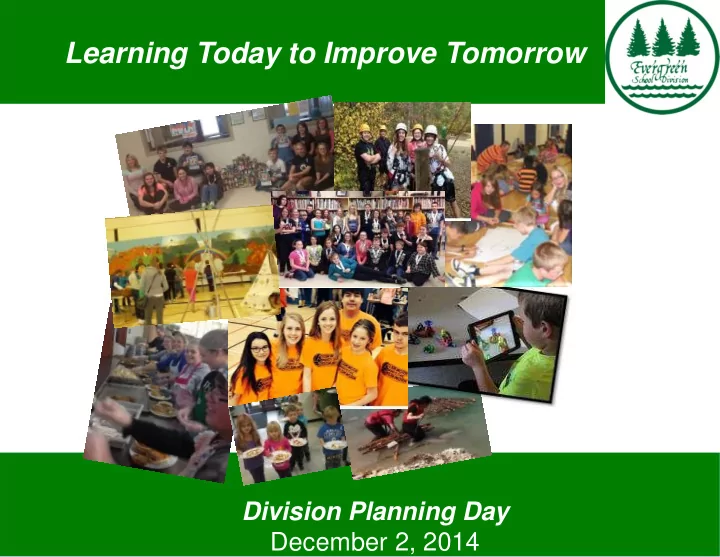
Learning Today to Improve Tomorrow

slide-2
SLIDE 2

Boar Board of d of T Truste ustees es

Ward 1 Ruth Ann Furgala (Chair) Sandra Davies Ward 2 Penny Helgason Gladys Kohler Ward 3 Robert Arnason (Vice Chair) Brent Johnson Dianna Auer Ward 4 Jim Mosher Cheryl Zelenitsky

slide-3
SLIDE 3

Outcomes for the Divisional Planning Day

  • Listen to students, staff, parents and

community members

  • Consider some data, research and

information

  • Engage in reflective conversations on the

purpose, products and processes of education

  • Celebrate our strengths
  • Identify our challenges and strategies to

address those challenges

slide-4
SLIDE 4

Agenda

9:00 am Welcome and Introductions 9:15 am Learning Today to Improve Tomorrow 9:45 am Appreciative Inquiry – School Presentations 10:15 am Refreshment Break 10:30 am Appreciative Inquiry – School Presentations 11:00 am Café Conversations – Round 1 (Colour Groups 1) 11:30 am Group Reports 12:00 pm Lunch (Gallery Walk) 1:00 pm Student Panel – current and former ESD students 2:00 pm Café Conversations – Round 2 (Color Groups 2) 2:15 pm Working Refreshment Break 2:45 pm Group Reports 3:15 pm Reflections 3:30 pm Adjournment

slide-5
SLIDE 5

Introductions – Table Groups

  • Introduce yourself
  • Where are you from? What do you

do? Why are you here?

  • School was best for me when…
slide-6
SLIDE 6
slide-7
SLIDE 7

Evergreen School Division Profile

Our school community is culturally diverse and consists of 1500 students in 8 schools located in four communities (Winnipeg Beach, Gimli, Arborg, and Riverton)

extensive variety of curricular and extra-curricular programs

safe and caring schools

exemplary student services

state of the art information and communication technologies

  • utstanding curriculum and

learning supports

focus on citizenship, learning, well being and sustainability

slide-8
SLIDE 8

Division Information

Total Enrollment (as of Sept. 30, 2014) 1498 Annual Budget (2014-2015) $20,212,099 Division Area (sq. km.) 2,424 Number of Schools 8 Other Facilities Education Support Centre – Gimli TEC Centre – Gimli Bus Garages – Gimli/Arborg Maintenance Facility – Gimli 5 Number of Bus Routes 25 Pupils Transported per day 1036 Distance Driven per day (km) 2518 Trustees 9

Employees Teachers, Principals, Clinicians 121 Educational Assistants 58 Secretaries/Librarians 18 Custodial, Maintenance 26 Bus Drivers, Mechanics 26 Education Support Centre/TEC 14 Total 263

slide-9
SLIDE 9

Programs and Services

  • Junior K, Kindergarten, Early Years,

Middle Years, High School

  • Aboriginal Academic Achievement
  • Apprenticeship
  • Career and Technology Studies
  • Early Literacy Intervention/ Reading

Recovery

  • Student Engagement Grant

Initiatives

  • English as an Additional Language
  • Basic French
  • Band/Choir
  • Arts Programming
  • Guidance and Counselling
  • Student Voice/

Evergreen Student Council

  • Resource Programming
  • Effective Behaviour Supports
  • Curriculum, ICT and Behavior

Consulting Supports

  • Information and Communication

Technologies

  • School Community Liaison
  • Fibre Optic/Broadband Network
  • Speech and Language Pathology
  • Distributed (online) Learning
  • Occupational Therapy/

Physical Therapy

  • Sports Programs/ Clubs
  • Resiliency/Restitution Programming
  • International Students
slide-10
SLIDE 10

Arborg

Arborg Early/Middle School (K-8) 236 Arborg Collegiate (9-12) 117

Gimli

Sigurbjorg Stefansson Early School (K-4) 219

  • Dr. George Johnson Middle School (5-8)

222 Gimli High School (9-12) 306

Riverton

Riverton Collegiate (8-12) 123 Riverton Early/Middle School (K-7) 138

Winnipeg Beach

Winnipeg Beach School (K-7) 137

School Enrollments

As of September 30, 2014

slide-11
SLIDE 11

Enrollment Trends (10 year)

1663 1679 1703 1671 1671 1621 1588 1598 1543 1498 1000 1250 1500 1750 2000

2005-2006 2006-2007 2007-2008 2008-2009 2009-2010 2010-2011 2011-2012 2012-2013 2013-2014 2014-2015

slide-12
SLIDE 12

Vision, Mission, Values, Beliefs “Our Foundations”

The Evergreen Board of Trustees, in consultation with stakeholders, identified and approved new Division Foundations for Evergreen School Division in 2009.

slide-13
SLIDE 13

Vision “Learning Today to Improve Tomorrow” Mission Evergreen School Division will engage students in learning to become contributing citizens of a democratic society. Core Values

  • 1. Students Come First
  • 2. Learning is Our Core Purpose
  • 3. Public Education Serves the Common Good
slide-14
SLIDE 14

What Kind of Citizen?

Personally Responsible Citizen Participatory Citizen Social-Justice Oriented Citizen

Description

  • Acts responsibly in

their community

  • Works and pays taxes
  • Picks up litter, recycles,

and gives blood

  • Helps those in need,

lends a hand during times of crisis

  • Obeys laws
  • Active member of community
  • rganizations
  • Organizes community efforts to

care for those in need, promote economic development, or to clean up environment

  • Knows how government

agencies work

  • Knows strategies for

accomplishing collective tasks

  • Critically assesses social,

political, and economic structures

  • Explores strategies for change

that address root causes of problems

  • Knows about social movements

and how to effect systemic change

  • Seeks out and addresses areas
  • f injustice

Sample Action

  • Contributes food to a

food drive

  • Helps to organize a food drive
  • Explores why people are hungry

and acts to solve root causes Core Assumptions

  • To solve social

problems and improve society, citizens must have good character; they must be honest, responsible, and law- abiding members of the community.

  • To solve social problems and

improve society, citizens must actively participate and take leadership positions within established systems and community structures.

  • To solve social problems and

improve society, citizens must question and change established systems and structures when they reproduce patterns of injustice over time.

slide-15
SLIDE 15

If schools are able to teach young people to have a critical mind and a socially oriented attitude, they will have done all that is necessary. Students will then become equipped with those qualities which are a prerequisite for citizens living in a healthy democratic society.

Albert Einstein

slide-16
SLIDE 16

Sustainable Development and Responsible Citizenship

Human Health and Well-Being Economy Environment

  • Quality
  • f

Life

“Sustainable Development can be defined as development that meets the needs of the present without compromising the ability of future generations to meet their own needs”

World Commission on Environment and Development , 1987

slide-17
SLIDE 17

Student Voice and Engagement

  • Evergreen School Division believes

that student voice should inform decision making

  • Formalized student voice structures
  • Evergreen Student Council
  • EAGLE (Aboriginal)
  • Student Representative on

Evergreen Board

  • Student engagement in division

planning processes

  • Participation in What Did You Do in

School Today? – national research study by CEA, now called Tell Them From Me – surveys annually

  • Participation in Resiliency Initiative -

surveys annually “ESDSC believes in communication, cooperation, and care to facilitate change through student voice.”

slide-18
SLIDE 18

What does the research tell us about Learning and Student Success?

  • Students who can’t read or perform basic numeracy by the end of Grade 3

will struggle in later years of schooling.

  • Quality instruction has the greatest impact on student learning than any other

school factor.

  • Students with low engagement/low academic skills will likely drop out of

school before graduation (trajectory starts at Middle Years).

  • Students who miss credits at Grade 9 will have their chances of competing

high school greatly diminished.

  • a student’s level of intellectual engagement influences her learning and

achievement.

  • Positive relationships (adult and peer) are key factors in student engagement

with school

  • When adults focus on student strengths as opposed to deficits, student
  • utcomes will improve
slide-19
SLIDE 19

Student Engagement

 All Grades 4-12 students participate in annual surveys

Social Intellectual Institutional

Meaningful participation in the life of the school Active participation in the requirements for school success A serious emotional and cognitive investment in learning

slide-20
SLIDE 20

2013-2014 Student “Flow” (Skill vs. Challenge)

Flow

students feel interested and successful

Boredom

students find school work boring or of little relevance

Anxiety

students feel apprehensive

  • r anxious

about learning

Apathy

students feel apathetic towards learning

slide-21
SLIDE 21

1. Teacher are Designers of Learning - Inquiry 2. Make it Mean Something - Relevancy 3. Assessment as Feedback for Learning 4. Build Relationships with and between students 5. Improve Teaching Practices through ongoing professional learning in the company of peers

Principles of Effective Teaching Practices

  • Dr. Sharon Friesen, Galileo Education Network
slide-22
SLIDE 22

Five Core Principles of the Framework for Effective Teaching Practices Current Evergreen School Division Supports/Initiatives

1. Teachers’ design intellectually engaging learning environments.

 Collaborative Time/PLC’s  Inquiry-based /problem-based instruction  Backwards design planning/UDL  Student Engagement/Innovative Project Initiatives

2. Work is personally meaningful to student and deeply connected to world in which they live.

 CTS Programming  Student Engagement Initiatives  Middle Years Career Grants

3. Teachers’ use of assessment is directed towards improving student learning and guiding teaching decisions.

 Assessment Policy - Assessment for, as, of learning  Provincial Report Cards  Portfolios  Student-led Conferences

4. Teachers build strong relationships with and between students.

 Resiliency, Restitution  Evergreen School Division Student Council  Student Voice – School and Division  Student Advisory groups  Peer mediators

5. Teachers are actively engaged in

  • ngoing professional learning.

 Collaborative Time  PLC Grants  Summer Institute  Division sponsored PD – e.g.First Steps, Discovery Education, mRLc  Early Dismissal School PD days  Individual PD funding  Committees

slide-23
SLIDE 23

Youth resiliency can be defined as the capability of children and adolescents to cope successfully in the face of stress-related, at-risk or adversarial situations.

Positive Social Capacity + Excellence in Curriculum and Instruction=

Positive Educational Outcomes

slide-24
SLIDE 24

A Strength-Based Approach

  • Focus on what is strong in youth and not

what is wrong with them

  • Focus on youth as resources and less on

them as absorbing resources

  • Focus on youth as potential – help them

explore their preferences, hopes, and intentions, not what we think they need

  • Focus on what is important and less on

what we think is urgent

slide-25
SLIDE 25

What does our Data tell us?

  • 85% of students graduated from our schools in 2014
  • 77% of Grade 3 students are reading at grade level
  • 81% of Grade 3 students are at grade level in basic numeracy
  • 62% of students are intellectually engaged
  • 55% of students are “in the flow” (high skills and challenge)
  • 24% of students were victims of moderate to severe Bullying
  • 18% of students have moderate to high levels of anxiety
  • 86% of students feel safe in our schools
  • 58% of students have aspirations for pursuing a post-

secondary education (27% plan to pursue a trade or apprenticeship program)

  • 98% of students have a relationship with an adult that

contributes to them feeling heard, understood and respected

slide-26
SLIDE 26

Knowledge and Skills for Success in Today’s Knowledge-Based World

Skills and Attributes for a Knowledge-Based Society

Functional Numeracy and Literacy Critical Thinking and Problem Solving Creativity and Innovation Technological/Digital Literacy Communications and Media Literacy Collaboration and Teamwork Personal Organization Motivation, Self-Regulation and Adaptability Ethics, Civic Responsibility, Cross-Cultural Awareness

slide-27
SLIDE 27
slide-28
SLIDE 28
slide-29
SLIDE 29

2013-2016 Education Plan

PRIORITIES FOCUS AREAS PILLARS OF PRACTICE

Well Being

(Students Come First)

 Resiliency  Diversity  Successful Transitions

Collaboration Personalized Learning Information and Communication Technology Innovation Student/Staff Voice Strength-based Practice Capacity Building Parent and Community Engagement Evidence-based Decisions

Learning

(Learning is Our Core Purpose)

 Literacy  Numeracy  Contemporary Learning Competencies (Creativity, Critical Thinking, Collaboration, Communication)

Sustainability

(Public Education Serves the Common Good)

 Education for Sustainable Development

slide-30
SLIDE 30

Canadian Education Association “From Vision to Action”

slide-31
SLIDE 31

Canadian Education Association “Barriers”

  • The “System” – grades, timetables,

indicators of success

  • Resources – inadequate, effective

distribution

  • Mindsets – fear of failure/change
  • Curriculum – heavy content, relevance
  • Social Challenges – mental health, public

expectations of education, poverty

slide-32
SLIDE 32

What is Deep Learning?

Comprehensive learning that includes a range of skills and attributes related to human flourishing, e.g., creativity, connectedness and collaboration, problem solving, wellness, and the capacity to establish and pursue personal and collective visions.

slide-33
SLIDE 33

Education globally is at a major turning point with digital permeating teaching and learning. We need to to enable students to flourish, and to be prepared for using learning to take action for positive change.

rethink pedagogical approaches and learning goals

New Pedagogies for Deep Learning

slide-34
SLIDE 34

Fullan’s Six C’s

(T (The Deep Learnin ing Goals ls)

slide-35
SLIDE 35

Student as Owner and Driver of Learning; Teacher as Designer and Activator of Learning; and Technology as Accelerator of Learning

The New Pedagogy

slide-36
SLIDE 36

A Flexible Path for Education

slide-37
SLIDE 37

Evergreen Challenges

  • Providing all of our youth with the skills and

competencies to become contributing citizens in today’s knowledge-based and changing world

  • Schools are experiencing declining enrolments: our

ability to maintain our quality programming and local initiatives with declining provincial revenue

  • Increasing demands on public education regarding

student needs

  • Sustainability of our communities – keeping youth in
  • ur communities
slide-38
SLIDE 38

In times of change, learners inherit the Earth, while the learned find themselves beautifully equipped to deal with a world that no longer exists.

Eric Hoffer

slide-39
SLIDE 39

“Children are the living messages we send to a time we will not see”

Neil Postman

How are we preparing them?

slide-40
SLIDE 40

Personal Reflective Question

  • What aspects of the information

presented and the Evergreen Education Plan really caught your attention?

  • What questions does this information

raise for you?

slide-41
SLIDE 41

Café Conversations

slide-42
SLIDE 42

Café Etiquette

  • Focus on what matters
  • Contribute your thinking
  • Speak your mind and heart
  • Listen to understand
  • Link and connect ideas
  • Listen together for insights and deeper questions
  • Note new and interesting ideas to share
  • Enjoy!
slide-43
SLIDE 43

Café Conversation - Round 1 Are We Headed in the Right Direction?

Café Table Tasks

  • Choose one person to facilitate the conversation, one person to record

the conversation and one person to report on the conversation.

  • Facilitator to ensure that everyone has an opportunity to contribute.

Focus Questions: In considering Evergreen’s Education Plan together with the data and research presented as well as what you heard in the school presentations, please answer the following questions. 1. What are the strengths of our current Education Plan? 2. What are schools doing well in preparing our students to become contributing citizens? 3. What are the gaps that you see in the plan or in what our schools are doing to meet our goals?

slide-44
SLIDE 44
slide-45
SLIDE 45
slide-46
SLIDE 46
slide-47
SLIDE 47
slide-48
SLIDE 48
slide-49
SLIDE 49
slide-50
SLIDE 50

Café Conversation - Round 2 How Can We Address the Challenges?

Café Table Tasks:

  • Choose one person to facilitate the conversation, one person to record the

conversation and one person to report on the conversation.

  • Facilitator to ensure that everyone has an opportunity to contribute.

Focus Questions: You have heard the voice of our stakeholders in our group reports this morning regarding our direction as a school division. You also had a chance to hear about some of the initiatives schools are involved with as well as some perspectives of current and former students regarding their experiences.

  • What specific challenges do our schools need to address that will allow us to

achieve our priorities, i.e. student well-being, student learning, sustainability?

  • What specific actions could we take to address the challenges identified?
  • Based on what you heard today, are there issues you would like to raise with

the Board of Trustees to assist them with the division planning that have not been identified in previous questions?

slide-51
SLIDE 51

Thank You!

Please fill out your evaluation form and leave in the box at the registration table