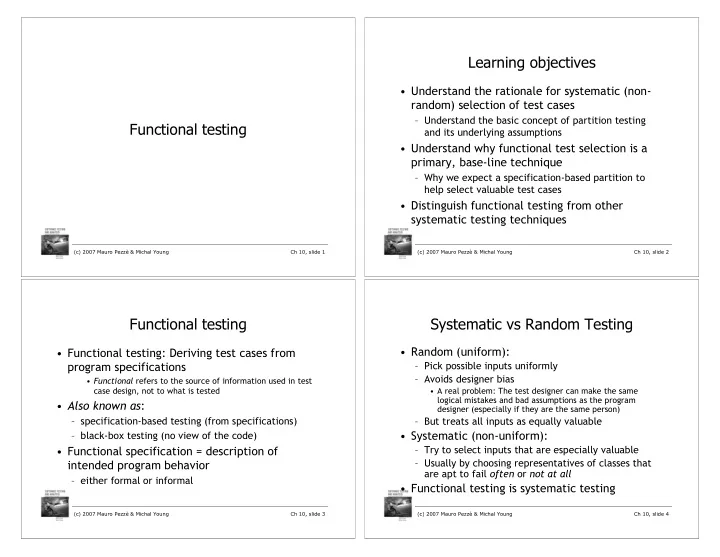

SLIDE 1
(c) 2007 Mauro Pezzè & Michal Young Ch 10, slide 1
Functional testing
(c) 2007 Mauro Pezzè & Michal Young Ch 10, slide 2
Learning objectives
- Understand the rationale for systematic (non-
random) selection of test cases
– Understand the basic concept of partition testing and its underlying assumptions
- Understand why functional test selection is a
primary, base-line technique
– Why we expect a specification-based partition to help select valuable test cases
- Distinguish functional testing from other
systematic testing techniques
(c) 2007 Mauro Pezzè & Michal Young Ch 10, slide 3
Functional testing
- Functional testing: Deriving test cases from
program specifications
- Functional refers to the source of information used in test
case design, not to what is tested
- Also known as:
– specification-based testing (from specifications) – black-box testing (no view of the code)
- Functional specification = description of
intended program behavior
– either formal or informal
(c) 2007 Mauro Pezzè & Michal Young Ch 10, slide 4
Systematic vs Random Testing
- Random (uniform):
– Pick possible inputs uniformly – Avoids designer bias
- A real problem: The test designer can make the same
logical mistakes and bad assumptions as the program designer (especially if they are the same person)
– But treats all inputs as equally valuable
- Systematic (non-uniform):
– Try to select inputs that are especially valuable – Usually by choosing representatives of classes that are apt to fail often or not at all
- Functional testing is systematic testing