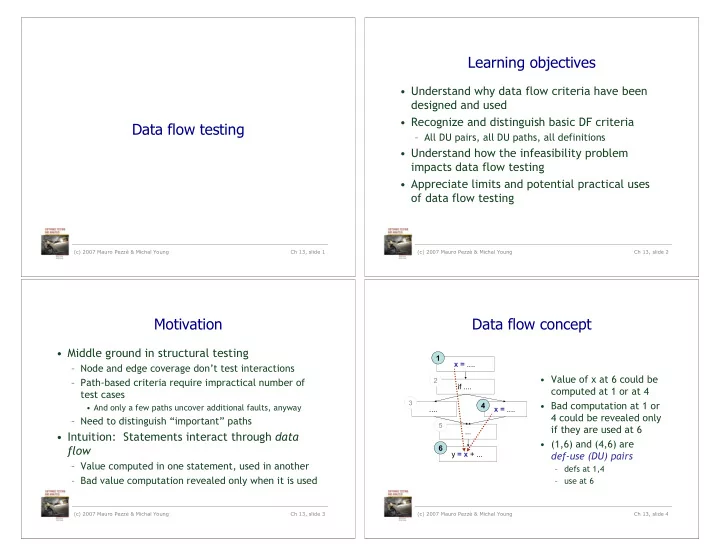
Learning objectives Understand why data flow criteria have been - - PowerPoint PPT Presentation

learning objectives
SMART_READER_LITE
LIVE PREVIEW

Learning objectives Understand why data flow criteria have been - - PowerPoint PPT Presentation

Learning objectives Understand why data flow criteria have been designed and used Recognize and distinguish basic DF criteria Data flow testing All DU pairs, all DU paths, all definitions Understand how the infeasibility


slide-1
SLIDE 1

(c) 2007 Mauro Pezzè & Michal Young Ch 13, slide 1

Data flow testing

(c) 2007 Mauro Pezzè & Michal Young Ch 13, slide 2

Learning objectives

  • Understand why data flow criteria have been

designed and used

  • Recognize and distinguish basic DF criteria

– All DU pairs, all DU paths, all definitions

  • Understand how the infeasibility problem

impacts data flow testing

  • Appreciate limits and potential practical uses
  • f data flow testing

(c) 2007 Mauro Pezzè & Michal Young Ch 13, slide 3

Motivation

  • Middle ground in structural testing

– Node and edge coverage don’t test interactions – Path-based criteria require impractical number of test cases

  • And only a few paths uncover additional faults, anyway

– Need to distinguish “important” paths

  • Intuition: Statements interact through data

flow

– Value computed in one statement, used in another – Bad value computation revealed only when it is used

(c) 2007 Mauro Pezzè & Michal Young Ch 13, slide 4

Data flow concept

x = .... if .... x = .... ... .... y = x + ... 4 1 6

  • Value of x at 6 could be

computed at 1 or at 4

  • Bad computation at 1 or

4 could be revealed only if they are used at 6

  • (1,6) and (4,6) are

def-use (DU) pairs

– defs at 1,4 – use at 6

2 3 5

slide-2
SLIDE 2

(c) 2007 Mauro Pezzè & Michal Young Ch 13, slide 5

Terms

  • DU pair: a pair of definition and use for some

variable, such that at least one DU path exists from the definition to the use

x = ... is a definition of x = ... x ... is a use of x

  • DU path: a definition-clear path on the CFG

starting from a definition to a use of a same variable

– Definition clear: Value is not replaced on path – Note – loops could create infinite DU paths between a def and a use

(c) 2007 Mauro Pezzè & Michal Young Ch 13, slide 6

Definition-clear path

  • 1,2,3,5,6 is a definition-

clear path from 1 to 6

– x is not re-assigned between 1 and 6

  • 1,2,4,5,6 is not a

definition-clear path from 1 to 6

– the value of x is “killed” (reassigned) at node 4

  • (1,6) is a DU pair because

1,2,3,5,6 is a definition- clear path

x = .... if .... x = .... ... .... y = x + ... 4 1 6

2 3 5

(c) 2007 Mauro Pezzè & Michal Young Ch 13, slide 7

Adequacy criteria

  • All DU pairs: Each DU pair is exercised by at

least one test case

  • All DU paths: Each simple (non looping) DU path

is exercised by at least one test case

  • All definitions: For each definition, there is at

least one test case which exercises a DU pair containing it

– (Every computed value is used somewhere)

Corresponding coverage fractions can also be defined

(c) 2007 Mauro Pezzè & Michal Young Ch 13, slide 8

Difficult cases

  • x[i] = ... ; ... ; y = x[j]

– DU pair (only) if i==j

  • p = &x ; ... ; *p = 99 ; ... ; q = x

– *p is an alias of x

  • m.putFoo(...); ... ; y=n.getFoo(...);

– Are m and n the same object? – Do m and n share a “foo” field?

  • Problem of aliases: Which references are

(always or sometimes) the same?

slide-3
SLIDE 3

(c) 2007 Mauro Pezzè & Michal Young Ch 13, slide 9

Data flow coverage with complex structures

  • Arrays and pointers are critical for data flow analysis

– Under-estimation of aliases may fail to include some DU pairs – Over-estimation, on the other hand, may introduce unfeasible test obligations

  • For testing, it may be preferrable to accept under-

estimation of alias set rather than over-estimation or expensive analysis

– Controversial: In other applications (e.g., compilers), a conservative over-estimation of aliases is usually required – Alias analysis may rely on external guidance or other global analysis to calculate good estimates – Undisciplined use of dynamic storage, pointer arithmetic, etc. may make the whole analysis infeasible

(c) 2007 Mauro Pezzè & Michal Young Ch 13, slide 10

Infeasibility

  • Suppose cond has not

changed between 1 and 5

  • Or the conditions could

be different, but the first implies the second

  • Then (3,5) is not a

(feasible) DU pair

  • But it is difficult or

impossible to determine which pairs are infeasible

  • Infeasible test
  • bligations are a problem
  • No test case can cover

them if (cond) x = .... ... .... y = x + ... 3 1

2 4

if (cond) .... 6 5

7

(c) 2007 Mauro Pezzè & Michal Young Ch 13, slide 11

Infeasibility

  • The path-oriented nature of data flow analysis

makes the infeasibility problem especially relevant

– Combinations of elements matter! – Impossible to (infallibly) distinguish feasible from infeasible paths. More paths = more work to check manually.

  • In practice, reasonable coverage is (often, not

always) achievable

– Number of paths is exponential in worst case, but

  • ften linear

– All DU paths is more often impractical

(c) 2007 Mauro Pezzè & Michal Young Ch 13, slide 12

Summary

  • Data flow testing attempts to distinguish

“important” paths: Interactions between statements

  • Intermediate between simple statement and branch

coverage and more expensive path-based structural testing

  • Cover Def-Use (DU) pairs: From computation of

value to its use

  • Intuition: Bad computed value is revealed only when it is

used

  • Levels: All DU pairs, all DU paths, all defs (some use)
  • Limits: Aliases, infeasible paths
  • Worst case is bad (undecidable properties, exponential

blowup of paths), so pragmatic compromises are required