Learning a Segmentation as Classification Classification Model for - - PDF document

learning a
SMART_READER_LITE
LIVE PREVIEW

Learning a Segmentation as Classification Classification Model for - - PDF document

Learning a Segmentation as Classification Classification Model for Segmentation What is a Good Segmentation? Features for Classification Intra-region similarity Elements inside one region are similar: Similar brightness


slide-1
SLIDE 1

1

Learning a Classification Model for Segmentation

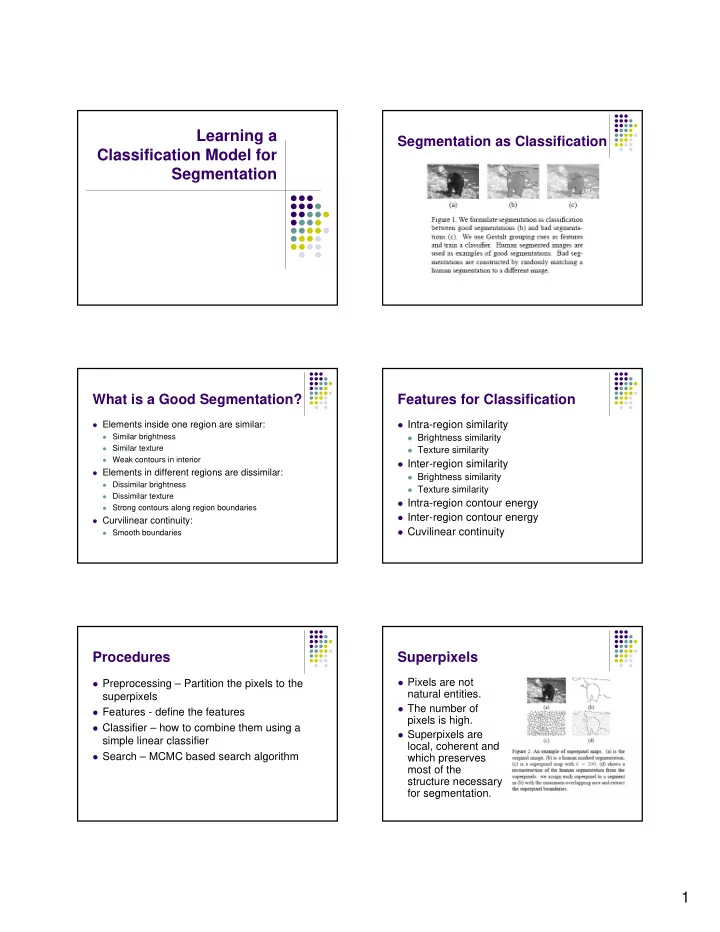
Segmentation as Classification What is a Good Segmentation?

Elements inside one region are similar:

Similar brightness Similar texture Weak contours in interior

Elements in different regions are dissimilar:

Dissimilar brightness Dissimilar texture Strong contours along region boundaries

Curvilinear continuity:

Smooth boundaries

Features for Classification

Intra-region similarity

Brightness similarity Texture similarity

Inter-region similarity

Brightness similarity Texture similarity

Intra-region contour energy Inter-region contour energy Cuvilinear continuity

Procedures

Preprocessing – Partition the pixels to the

superpixels

Features - define the features Classifier – how to combine them using a

simple linear classifier

Search – MCMC based search algorithm

Superpixels

Pixels are not

natural entities.

The number of

pixels is high.

Superpixels are

local, coherent and which preserves most of the structure necessary for segmentation.

slide-2
SLIDE 2

2

Preprocessing: Pixels to Superpixels

Use normalized cut algorithm to make

superpixels.

The criterion for partitioning the graph

minimize the sum of weights of connections

across the groups.

maximize the sum of weights of connections

within the groups.

Texton

The representation of textures using filter responses

is redundant.

Textures with some repeating properties. Clustering the filter responses into a small set of

prototype response vectors (textons) is needed.

The image is convolved with a bank of filters of multiple

  • rientations.

Based on the filter output, the pixels are clustered into a

number of texton channels.

The resulting distribution of textons for each regions makes

histograms.

Texture Similarity

The texture difference of two regions is

measured as the X^2 distance between two histograms.

Texture Similarity

The intra-region similarity

compares the descriptor of a superpixel q to the segment S containing it.

The inter-region similarity

compares the descriptor of a superpixel q on the boundary of S’ to the adjacent segment.

Contour Energy

The oriented energy at angel 0 is defined as

slide-3
SLIDE 3

3

Contour Energy

Intra-region contour energy is the average

  • rientation energy on the superpixel

boundaries on the interior of S.

Inter-region contour energy is the average

  • rientation energy on the boundary of S.

Good Continuation

Curvilinear continuity of S is the

average of tangent changes for all pairs of superpixels on the boundary of S.

Power of the Gestalt Cues Training the classifier Training the classifier

Use a simple logistic regression classifier

The higher the value of G is, the more likely S is a good segment.

Finding good segmentations

It becomes the optimization of f in the space

  • f all segmentations.

The search space is large, so do the random

search.

slide-4
SLIDE 4

4

Search for Good Segmentation

Linear objective function At each step, randomly construct a new

segmentation, based on simulated annealing.

Local search dynamics involves three basic

moves.

Shift Merge Split

Conclusion

It treats the segmentation as the classification

  • f good and bad segmentations.

The Gestalt grouping cues are combined in a

principled way.

A linear classifier and a simple random

search algorithm.

Still difficult optimization problem.