
SLIDE 1
LEARN v ADJUST v IMPROVE
Learning ¡Speed ¡Intelligently ¡
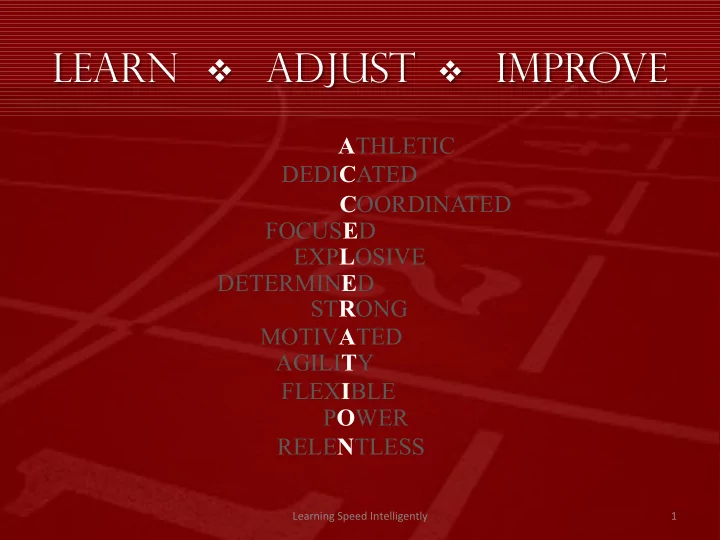
ATHLETIC DEDICATED COORDINATED FOCUSED EXPLOSIVE DETERMINED STRONG MOTIVATED AGILITY FLEXIBLE POWER RELENTLESS
1 ¡
LEARN v ADJUST v IMPROVE A THLETIC DEDI C ATED C OORDINATED FOCUS E D - - PowerPoint PPT Presentation
LEARN v ADJUST v IMPROVE A THLETIC DEDI C ATED C OORDINATED FOCUS E D EXP L OSIVE DETERMIN E D ST R ONG MOTIV A TED AGILI T Y FLEX I BLE P O WER RELE N TLESS Learning Speed Intelligently 1 LEARN v ADJUST v IMPROVE
Learning ¡Speed ¡Intelligently ¡
ATHLETIC DEDICATED COORDINATED FOCUSED EXPLOSIVE DETERMINED STRONG MOTIVATED AGILITY FLEXIBLE POWER RELENTLESS
1 ¡
Learning ¡Speed ¡Intelligently ¡ 2 ¡
Simply put its the Distant traveled in a certain Time in a certain Direction: example: 55mph north (Distant=55mile + Time=hour + Direction=north)
Acceleration is change in VELOCITY. In practical sense Acceleration is change in an Athletes Rate Of Speed (ROS)
Learning ¡Speed ¡Intelligently ¡ 3 ¡
Learning ¡Speed ¡Intelligently ¡ 4 ¡
Learning ¡Speed ¡Intelligently ¡ 5 ¡
Learning ¡Speed ¡Intelligently ¡ 6 ¡
To put you in a position to ACCELERATE efficiently and effectively up the track!
Learning ¡Speed ¡Intelligently ¡ 7 ¡
Learning ¡Speed ¡Intelligently ¡ 8 ¡
Learning ¡Speed ¡Intelligently ¡ 9 ¡
Learning ¡Speed ¡Intelligently ¡ 10 ¡
Learning ¡Speed ¡Intelligently ¡ 11 ¡
Every ¡great ¡Athlete ¡knows ¡exactly ¡where ¡they ¡are ¡in ¡space. ¡ ~Vince Anderson (Coach and Educator)
Learning ¡Speed ¡Intelligently ¡ 12 ¡
The ¡ability ¡to ¡sense ¡the ¡posi?on, ¡loca?on, ¡orienta?on ¡and ¡ movement ¡of ¡the ¡body ¡and ¡its ¡parts
Learning ¡Speed ¡Intelligently ¡ 13 ¡
Learning ¡Speed ¡Intelligently ¡ 14 ¡
Learning ¡Speed ¡Intelligently ¡ 15 ¡
Learning ¡Speed ¡Intelligently ¡ 16 ¡
In ¡the ¡70’s ¡We ¡were ¡taught ¡to ¡keep ¡the ¡ shoulder ¡low. ¡
Learning ¡Speed ¡Intelligently ¡ 17 ¡
Force results from interaction. As it applies to acceleration, its a pushing motion that results from our interaction with the blocks. Its Newton's 3rd Law: For ever action there’s an equal and opposite reaction. This statements means that the size and direction of force applied into the blocks is equal to the size and direction of force that is redirected back into the body. ¡ ¡ ¡ Force ¡always ¡comes ¡in ¡pairs! ¡
Learning ¡Speed ¡Intelligently ¡ 18 ¡
On the subject of magnitude and direction, applied force travels in a straight line. (through the legs, hips and
into dead space)
This ¡teaches ¡us ¡that ¡Force ¡cannot ¡ turn ¡a ¡curve.
Learning ¡Speed ¡Intelligently ¡ 19 ¡
Is characterized by simultaneously extending the ankle, knee and hip joint. The advantage of triple extension is there’s a higher muscle recruitment “Calves, Hamstring, Glute, Lower Back, Quads, Core” All of which are important in the acceleration phase. ¡
Learning ¡Speed ¡Intelligently ¡ 20 ¡
In the acceleration phase the generation of force is the important factor . So muscle recruitment plays a large role. For example the Erector Spinae is capable of rotating the pelvis and can transfer energy through the pelvis, using the pelvis to aid the legs to apply force to the ground. But when the body is hanging forward this weaken the role of the back muscles responsible for keeping the body and spine straight and diminishes the response in efforts to generate force. ¡ ¡
Learning ¡Speed ¡Intelligently ¡ 21 ¡
The athlete who can find him or herself in a favorable position , has strong muscles and good inter-muscular coordination will be able to hold this position longer, therefore prolonging the acceleration phase. ¡ (45 ¡degrees ¡is ¡the ¡ideal ¡angle ¡when ¡accelera:ng ¡but ¡as ¡the ¡athlete ¡becomes ¡
stronger, ¡a ¡more ¡acute ¡angle ¡can ¡be ¡u:lized) ¡
¡ ¡ ¡
22 ¡
“The Start Sets Up The Finish”
Learning ¡Speed ¡Intelligently ¡
23 ¡
1. Measuring ¡the ¡Feet ¡
FB: ¡2 ¡foot ¡lengths ¡from ¡the ¡star?ng ¡line ¡ BB: ¡3 ¡foot ¡lengths ¡from ¡the ¡star?ng ¡line ¡ ¡
2. Mathema9cal ¡formula ¡
TL: ¡Measure ¡Top ¡of ¡Trochanter ¡to ¡the ¡boQom ¡of ¡the ¡heel ¡ FB: ¡ ¡.56 ¡x ¡Trochanter ¡Length ¡ BB: ¡ ¡.42 ¡x ¡Trochanter ¡Length ¡+ ¡FB. ¡ ¡
3. Tradi9onal ¡Ways ¡
The ¡tradi?onal ¡way ¡relies ¡more ¡on ¡body ¡awareness ¡and ¡leg ¡posi?oning. ¡In ¡this ¡method ¡we ¡first ¡ start ¡by ¡puUng ¡the ¡knee ¡of ¡the ¡front ¡leg ¡ ¡to ¡the ¡star?ng ¡line. ¡Then ¡place ¡the ¡front ¡foot ¡pad ¡directly ¡ under ¡the ¡foot ¡for ¡the ¡placement ¡of ¡the ¡front ¡foot ¡pedal. ¡We ¡then ¡measure ¡from ¡the ¡star?ng ¡line ¡ to ¡the ¡front ¡of ¡the ¡pad. ¡From ¡the ¡star?ng ¡line ¡we ¡measure ¡4 ¡inches ¡less ¡then ¡that ¡of ¡the ¡front ¡pad ¡ where ¡we ¡place ¡the ¡knee ¡of ¡the ¡back ¡leg. ¡Then ¡place ¡the ¡foot ¡pad ¡directly ¡under ¡the ¡foot ¡for ¡the ¡ placement ¡of ¡the ¡back ¡foot ¡pedal. ¡ ¡
“No One Size Fit All”
Learning ¡Speed ¡Intelligently ¡
24 ¡
arms ¡ ¡ ¡
track
position
perpendicular with the track
Learning ¡Speed ¡Intelligently ¡
arms ¡ ¡ ¡
position
and Back thigh perpendicular with the track
Learning ¡Speed ¡Intelligently ¡ 25 ¡
Learning ¡Speed ¡Intelligently ¡ 26 ¡
Inherently Stable Position
27 ¡
Pressure Position Power
If ¡posi?oned ¡correctly ¡(in ¡the ¡set ¡posi:on), ¡the ¡shin ¡of ¡the ¡front ¡leg ¡should ¡align ¡with ¡the ¡shoulder. ¡ Executed ¡properly ¡the ¡shoulder ¡should ¡follow ¡that ¡line ¡through ¡the ¡push ¡phase ¡to ¡extension. ¡
Learning ¡Speed ¡Intelligently ¡
28 ¡
The ¡Block ¡exit ¡is ¡the ¡moment ¡the ¡gun ¡goes ¡off ¡and ¡ones ¡neurosenses ¡are ¡s?mulated ¡causing ¡an ¡reac?on ¡
¡ Its ¡a ¡simple ¡way ¡of ¡geUng ¡from ¡what ¡we ¡call ¡the ¡“BoQom ¡to ¡the ¡Top”. ¡The ¡objec?ve ¡is ¡to ¡exit ¡the ¡blocks ¡ with ¡not ¡only ¡power ¡and ¡speed ¡but ¡posture ¡that ¡will ¡allow ¡us ¡the ¡accelerate ¡up ¡the ¡track ¡most ¡efficiently ¡ and ¡effec?vely. ¡ ¡ Side ¡Note: ¡ ¡Foot ¡Pedal ¡-‑ ¡We ¡teach ¡that ¡both ¡feet ¡should ¡be ¡pressed ¡firmly ¡against ¡the ¡blocks. ¡Some ¡ coaches ¡like ¡to ¡teach ¡their ¡athletes ¡to ¡leave ¡space ¡between ¡the ¡heels ¡and ¡the ¡foot ¡pads ¡because ¡they ¡ think ¡that ¡it ¡will ¡help ¡in ¡the ¡force ¡applica?on ¡process. ¡WRONG! ¡ ¡ ¡ ¡ Another ¡way ¡of ¡looking ¡at ¡that ¡process ¡is ¡in ¡the ¡weight ¡room. ¡Imagine ¡doing ¡a ¡clean. ¡You ¡wouldn't ¡have ¡ your ¡female ¡athlete ¡whose ¡about ¡to ¡clean ¡160lbs ¡posi?on ¡her ¡self ¡on ¡her ¡?ppy ¡toes. ¡No!< ¡ ¡because ¡what ¡ sense ¡would ¡that ¡make ¡and ¡why ¡add ¡the ¡extra ¡mo?on. ¡ ¡ ¡ Using ¡the ¡complete ¡foot ¡to ¡apply ¡pressure ¡to ¡the ¡foot ¡pedals ¡creates ¡a ¡greater ¡ra?o ¡of ¡force ¡in ¡the ¡ direc?on ¡of ¡mo?on ¡we ¡intend ¡to ¡go, ¡which ¡in ¡this ¡case ¡would ¡be ¡forward ¡mo?on. ¡ ¡
Learning ¡Speed ¡Intelligently ¡
29 ¡
Low ¡heel ¡recovery ¡is ¡emphasized ¡when ¡the ¡back ¡foot ¡passes ¡the ¡front ¡foot ¡in ¡ac?on. ¡ ¡This ¡is ¡what ¡we ¡ call ¡ankle-‑to-‑ankle. ¡This ¡simply ¡means ¡that ¡when ¡the ¡back ¡foot ¡passes ¡the ¡front ¡it ¡should ¡be ¡ankle ¡to ¡ ankle ¡with ¡the ¡front ¡foot, ¡Causing ¡the ¡heel ¡to ¡keep ¡low ¡to ¡the ¡ground. ¡
Learning ¡Speed ¡Intelligently ¡
This ¡is ¡when ¡the ¡back ¡heel ¡instead ¡of ¡moving ¡forward ¡moves ¡up ¡towards ¡the ¡buQ ¡and ¡further ¡away ¡ from ¡the ¡ground. ¡The ¡further ¡we ¡move ¡our ¡foot ¡from ¡the ¡ground ¡the ¡more ¡we ¡increase ¡the ¡?me ¡to ¡ the ¡point ¡of ¡contact ¡in ¡an ¡event ¡where ¡“Time ¡is ¡Crucial” ¡and ¡“Every ¡Tenth ¡Counts” ¡ ¡ ¡
the ¡front ¡pedal, ¡is ¡dropping ¡that ¡back ¡foot ¡to ¡the ¡ground ¡to ¡fast. ¡When ¡this ¡happens ¡the ¡front ¡leg ¡ isn't ¡allow ¡to ¡go ¡through ¡a ¡func?onal ¡range ¡of ¡mo?on ¡and ¡can ¡cause ¡the ¡Center ¡of ¡Gravity ¡to ¡be ¡to ¡ low ¡and ¡deteriorate ¡the ¡athletes ¡ability ¡to ¡create ¡great ¡forces ¡. ¡Instead ¡an ¡athlete ¡should ¡push ¡ through ¡the ¡pedal ¡for ¡as ¡long ¡as ¡they ¡can. ¡The ¡longer ¡you ¡push ¡the ¡beQer ¡the ¡drive ¡and ¡the ¡more ¡ likely ¡you ¡are ¡to ¡get ¡a ¡great ¡extension ¡and ¡store ¡up ¡energy ¡for ¡a ¡beQer ¡elas?c ¡response. ¡ ¡ It’s ¡a ¡conceptual, ¡intellectual ¡and/or ¡physical ¡deficiency ¡and ¡a ¡very ¡good ¡point ¡to ¡make ¡here ¡in ¡the ¡ use ¡of ¡the ¡Hips. ¡Tony ¡Veney ¡used ¡an ¡interes?ng ¡analogy. ¡He ¡said ¡“we ¡don't ¡drive ¡with ¡our ¡.res, ¡we ¡ drive ¡on ¡them. ¡We ¡drive ¡with ¡the ¡engine”. ¡well ¡what ¡he ¡meant ¡was ¡we ¡don't ¡run ¡with ¡our ¡feet, ¡we ¡ run ¡on ¡them. ¡We ¡run ¡with ¡our ¡hips. ¡Our ¡Hips ¡are ¡the ¡“Engine ¡that ¡turns ¡the ¡Crank ¡ShaK ¡that ¡turns ¡ the ¡Wheels”. ¡ ¡
Learning ¡Speed ¡Intelligently ¡ 30 ¡
development ¡of ¡upper ¡body ¡strength. ¡Arm ¡ac?on ¡can ¡contribute ¡to ¡the ¡force ¡an ¡athlete ¡applies ¡to ¡ the ¡track. ¡Arm ¡movement ¡help ¡stabilizes ¡the ¡body ¡in ¡mo?on, ¡but ¡also ¡takes ¡advantage ¡of ¡the ¡global ¡ workings ¡of ¡the ¡central ¡nervous ¡system. ¡ ¡ ¡ ¡ As ¡you ¡move ¡your ¡arms ¡explosively, ¡the ¡neurological ¡signals ¡sent ¡to ¡the ¡arms ¡also ¡spill-‑over ¡to ¡the ¡
¡ All ¡leg ¡movement ¡happens ¡in ¡an ¡coordinated ¡effort ¡with ¡the ¡arms. ¡Its ¡this ¡coordinated ¡movement ¡ that ¡is ¡the ¡key ¡to ¡efficient ¡sprin?ng ¡and ¡its ¡through ¡range ¡and ¡force ¡that ¡the ¡two ¡coordinate. ¡A ¡ queue ¡to ¡remember ¡is ¡the ¡Arms ¡lead ¡the ¡legs ¡into ¡range ¡of ¡mo?on, ¡force ¡and ¡speed. ¡As ¡well ¡as ¡ contribute ¡to ¡stability ¡and ¡propulsion, ¡Coordina?on ¡between ¡the ¡arms ¡and ¡legs ¡can ¡give ¡a ¡runner ¡a ¡ mechanical ¡advantage ¡over ¡their ¡compe?tors. ¡ ¡
Learning ¡Speed ¡Intelligently ¡ 31 ¡
is ¡ ¡when ¡you’re ¡trying ¡to ¡correct ¡something ¡with ¡the ¡start, ¡be ¡careful ¡trying ¡to ¡correct ¡on ¡top ¡of ¡the ¡
teaches ¡the ¡skill ¡and ¡ac?on ¡of ¡those ¡things ¡we ¡are ¡trying ¡to ¡execute. ¡ ¡Its ¡been ¡determined ¡that ¡it ¡ requires ¡approximately ¡300-‑500 ¡repe??ons ¡to ¡develop ¡a ¡new ¡motor ¡paQern. ¡But ¡where ¡bad ¡or ¡ inadequate ¡habits ¡are ¡already ¡in ¡place, ¡he ¡it ¡requires ¡about ¡3000-‑5000 ¡repe??ons ¡to ¡erase ¡and ¡ correct ¡a ¡bad ¡motor ¡paQern. ¡So ¡we ¡do ¡drill ¡aler ¡drill ¡aler ¡drill ¡aler ¡drill ¡un?l ¡eventually ¡you ¡see ¡the ¡ drill ¡inside ¡the ¡skill. ¡ ¡
instruc?on ¡and ¡correc?on ¡and ¡olen ¡give ¡their ¡athletes ¡instruc?ons ¡that ¡they ¡think ¡are ¡correc?ons. ¡ Instruc?ons ¡are ¡direc?ons ¡or ¡orders ¡given. ¡Correc?on ¡is ¡ac?on ¡or ¡the ¡process ¡of ¡correc?ng ¡
¡
Learning ¡Speed ¡Intelligently ¡ 32 ¡
squeezing ¡against ¡ the ¡foot ¡pads ¡ ¡
blocks ¡ ¡not ¡out ¡ ¡
arms to complete limbs
moving forward advance pass the starting line
Learning ¡Speed ¡Intelligently ¡ 33 ¡
34 ¡
changing ¡and ¡takes ¡place ¡the ¡first ¡0-‑30 ¡meters ¡or ¡about ¡3-‑4 ¡seconds ¡from ¡the ¡start ¡of ¡the ¡sprint. ¡
sprin?ng ¡is ¡an ¡athletes ¡ability ¡to ¡accelerate ¡and ¡generate ¡speed ¡in ¡a ¡short ¡period ¡of ¡?me. ¡
movements, ¡func?onal ¡for ¡sprin?ng. ¡Its ¡important ¡to ¡understand ¡the ¡Sensi?ve ¡Periods ¡of ¡Physical ¡ Development” ¡as ¡it ¡relates ¡to ¡sensi?ve ¡age ¡ranges. ¡Because ¡its ¡during ¡these ¡periods ¡of ¡physical ¡ development ¡that ¡performance ¡capaci?es ¡are ¡largely ¡increased ¡and ¡leads ¡to ¡maximal ¡improvements ¡ during ¡this ¡period. ¡For ¡boys ¡that ¡period ¡is ¡between ¡the ¡ages ¡of ¡12-‑17 ¡and ¡for ¡girls ¡between ¡the ¡ages ¡
¡ Because ¡Movement ¡is ¡a ¡developed ¡and ¡learned ¡behavior ¡its ¡important ¡that ¡we ¡show ¡a ¡sense ¡of ¡ urgency ¡to ¡focus, ¡teach ¡and ¡install ¡the ¡important ¡things ¡ ¡upfront. ¡Our ¡awareness ¡of ¡these ¡periods ¡ will ¡help ¡us ¡see ¡the ¡importance ¡of ¡ ¡early ¡developmental ¡training, ¡so ¡we ¡can ¡beQer ¡guide ¡the ¡ developmental ¡procedures. ¡
Learning ¡Speed ¡Intelligently ¡
35 ¡
¡6 ¡specific ¡ac9vi9es ¡of ¡Accelera9on ¡ ¡ 1. Stride ¡Length ¡= ¡Short ¡to ¡Long: ¡Starts ¡off ¡short ¡and ¡increases ¡un?l ¡maximum ¡velocity ¡is ¡reached ¡(when ¡the ¡stride ¡ length ¡is ¡op?mal) ¡ ¡ 2. Ground ¡Contact ¡Time ¡= ¡Long ¡to ¡Short: ¡Ground ¡Contact ¡Time ¡is ¡the ¡amount ¡of ¡?me ¡each ¡foot ¡spends ¡on ¡the ¡
through ¡force ¡applica?on. ¡ ¡ 3. Shin ¡Angle ¡with ¡ground ¡= ¡Small ¡to ¡Large: ¡The ¡shin ¡angle ¡is ¡going ¡to ¡determine ¡the ¡force ¡applica?on ¡to ¡the ¡ground ¡ and ¡the ¡projec?on ¡angle ¡that ¡the ¡athlete ¡is ¡going ¡to ¡drive ¡out ¡at. ¡The ¡shin ¡angle ¡opens ¡up ¡and ¡increases ¡ throughout ¡accelera?on ¡and ¡into ¡maximum ¡velocity. ¡ ¡ 4. Velocity ¡= ¡Slow ¡to ¡Fast: ¡Velocity ¡is ¡both ¡the ¡speed ¡and ¡direc?on ¡that ¡the ¡body ¡is ¡moving. ¡As ¡the ¡athlete ¡ accelerates, ¡the ¡rate ¡and ¡distance ¡will ¡increase ¡with ¡?me. ¡ ¡ 5. Stride ¡Frequency ¡= ¡Slow ¡to ¡Fast: ¡Like ¡ground ¡contact ¡?me, ¡it ¡starts ¡off ¡slower ¡and ¡increases ¡un?l ¡stride ¡frequency ¡ reaches ¡op?mal ¡level ¡at ¡maximum ¡velocity. ¡ ¡ 6. Heel ¡Recovery ¡= ¡Low ¡to ¡High: ¡Heels ¡should ¡recover ¡quickly, ¡with ¡limited ¡backside ¡mechanics ¡and ¡shouldn’t ¡involve ¡ large ¡amplitudes ¡of ¡mo?on ¡behind ¡the ¡hips. ¡During ¡accelera?on, ¡especially ¡the ¡first ¡6-‑8 ¡steps, ¡you ¡want ¡to ¡ minimize ¡your ¡backside ¡mechanics ¡in ¡a ¡2 ¡stroke ¡mo?on. ¡ ¡
Learning ¡Speed ¡Intelligently ¡
36 ¡
“Putting a brand-new operator at the wheel”
¡ ¡ ¡ ¡Ver?cal ¡Box ¡Jumps ¡ ¡ ¡ ¡Standing ¡Long ¡Jump
Learning ¡Speed ¡Intelligently ¡
37 ¡
¡ ¡ ¡ ¡ ¡ ¡ ¡Wall ¡Sprints ¡ ¡ ¡ ¡ ¡ ¡ ¡Half ¡Starts
Learning ¡Speed ¡Intelligently ¡
38 ¡
¡ ¡ ¡ ¡ ¡ ¡Accelerated ¡Stride ¡Length ¡Drill ¡ ¡ ¡ ¡ ¡ ¡ ¡ ¡ ¡Accelerated ¡Tape ¡Drill
Learning ¡Speed ¡Intelligently ¡
39 ¡
¡ ¡ ¡ ¡ ¡ ¡ ¡ ¡ ¡ ¡Sledded ¡Skater ¡Drill ¡ ¡ ¡ ¡ ¡ ¡ ¡Sledded ¡A-‑B ¡Skips
Learning ¡Speed ¡Intelligently ¡
40 ¡
¡ ¡ ¡ ¡ ¡ ¡ ¡ ¡ ¡ ¡ ¡ ¡ ¡ ¡ ¡ ¡ ¡ ¡ ¡ ¡ ¡ ¡Sled ¡Pulls ¡ ¡ ¡ ¡ ¡ ¡ ¡ ¡ ¡ ¡ ¡ ¡ ¡ ¡ ¡ ¡ ¡ ¡ ¡Up ¡Hills
Learning ¡Speed ¡Intelligently ¡
41 ¡
program ¡the ¡athlete ¡to ¡the ¡extent ¡that ¡they ¡can ¡reproduce ¡the ¡paQern ¡without ¡accessories ¡ ¡
¡
¡
through ¡the ¡accelera?on ¡phase ¡and ¡into ¡the ¡maximum ¡speed ¡phase. ¡ ¡
Learning ¡Speed ¡Intelligently ¡
42 ¡
reach ¡an ¡equilibrium ¡and ¡it ¡is ¡no ¡longer ¡able ¡to ¡accelerate ¡and ¡takes ¡place ¡at ¡about ¡30-‑60 ¡meters ¡ into ¡your ¡race. ¡
¡ For ¡example ¡a ¡sprinter ¡will ¡accelerate ¡rapidly ¡un?l ¡the ¡forces ¡ac?ng ¡against ¡her ¡becomes ¡balanced ¡ and ¡her ¡speed ¡is ¡steady. ¡
¡
pressing ¡and ¡pushing ¡down ¡and ¡back ¡into ¡the ¡track), ¡ ¡but ¡the ¡VERTICAL ¡component ¡is ¡dominant ¡in ¡ maximum ¡velocity ¡(Posture, ¡Leg ¡Recovery, ¡Shin ¡angles, ¡Hip ¡Mobility ¡and ¡Alignment, ¡Ground ¡Strike) ¡
difficulty ¡lies ¡with ¡the ¡conceptual ¡deficiencies. ¡Where ¡ ¡most ¡developmental ¡coaches ¡believe ¡that ¡the ¡ ¡ magic ¡is ¡in ¡the ¡work ¡itself ¡(running). ¡So ¡very ¡liQle ¡?me ¡is ¡spent ¡ ¡actually ¡trying ¡to ¡teach ¡sprin?ng ¡ (mechanics). ¡ ¡
Learning ¡Speed ¡Intelligently ¡
43 ¡
¡5 ¡specific ¡ac9vi9es ¡of ¡maximum ¡Velocity ¡ ¡
impossible ¡to ¡op?mize ¡the ¡other ¡five ¡foci. ¡Conscious ¡competence ¡in ¡this ¡area ¡must ¡quickly ¡give ¡way ¡to ¡unconscious ¡
¡
passive ¡movement ¡and ¡tradi?onally ¡called ¡the ¡"swing ¡phase", ¡the ¡mechanically ¡efficient ¡recovery ¡of ¡the ¡limb ¡sets ¡up ¡ the ¡other ¡phases ¡of ¡the ¡running ¡stride ¡for ¡higher ¡levels ¡of ¡mechanical ¡efficiency. ¡ ¡
the ¡other ¡side ¡of ¡the ¡stride ¡cycle. ¡ ¡
the ¡ground. ¡From ¡the ¡point ¡of ¡view ¡of ¡determining ¡the ¡performance ¡outcome, ¡this ¡is ¡the ¡second ¡most ¡important ¡phase ¡ in ¡the ¡running ¡cycle. ¡ ¡ ¡
path ¡of ¡the ¡center ¡of ¡mass ¡is ¡unalterable ¡un?l ¡the ¡next ¡ground ¡force ¡applica?on. ¡Therefore, ¡geUng ¡the ¡Ground ¡Phase ¡ right ¡is ¡essen?al. ¡ ¡
Learning ¡Speed ¡Intelligently ¡
44 ¡
¡ ¡ ¡ ¡Front ¡side ¡Recovery ¡Drill ¡ ¡ ¡ ¡ ¡ ¡ ¡Fast ¡Leg ¡Drills
Learning ¡Speed ¡Intelligently ¡
45 ¡
¡ ¡ ¡ ¡ ¡ ¡ ¡Max ¡Velocity ¡Drills ¡ ¡ ¡ ¡ ¡ ¡ ¡ ¡ ¡Ultra ¡Speed ¡Tows
Learning ¡Speed ¡Intelligently ¡
46 ¡
¡ ¡ ¡ ¡ ¡ ¡ ¡ ¡ ¡ ¡ ¡ ¡Down ¡Hill ¡Sprints ¡ ¡ ¡ ¡ ¡Straight ¡Leg ¡Bounds
Learning ¡Speed ¡Intelligently ¡
47 ¡
¡ ¡ ¡ ¡ ¡ ¡ ¡Straight ¡Leg ¡Speed ¡Bounds ¡ ¡ ¡ ¡ ¡ ¡ ¡ ¡ ¡ ¡ ¡ ¡ ¡ ¡ ¡ ¡Speed ¡Bounds
Learning ¡Speed ¡Intelligently ¡
48 ¡
¡TRAINING ¡INVENTORY ¡
¡
¡
¡
¡
¡
¡
¡
Learning ¡Speed ¡Intelligently ¡
49 ¡
¡TRAINING ¡CONCEPTS ¡
¡ ¡
¡
¡
¡
¡
¡
¡
Learning ¡Speed ¡Intelligently ¡
50 ¡
¡RACE ¡MODELING ¡(Reac?on, ¡Accelera?on, ¡Transi?on, ¡Max ¡Velocity, ¡Decelera?on) ¡
¡ ¡
¡
¡
¡
¡
¡
¡
Learning ¡Speed ¡Intelligently ¡
51 ¡
¡PERFORMANCE ¡MODELING ¡(Cues, ¡PaQerns, ¡Posi?oning) ¡
¡ ¡
¡
¡ ¡
¡ ¡
Learning ¡Speed ¡Intelligently ¡
52 ¡
¡CONTRAST ¡ ¡TRAINING ¡
¡ ¡
¡
¡
¡
¡
¡
¡
Learning ¡Speed ¡Intelligently ¡
53 ¡
¡INTERMUSCULAR ¡AND ¡INTRA-‑MUSCULAR ¡TRAINING ¡
¡
¡ ¡
Learning ¡Speed ¡Intelligently ¡
54 ¡
ACCELERATION-‑STRIDE ¡LENGTH ¡PATTERNING ¡ ¡(Tape) ¡Direc?ons: ¡Measure ¡Zero ¡(0) ¡from ¡the ¡front ¡
pedal ¡when ¡using ¡blocks. ¡DO ¡NOT ¡measure ¡from ¡start ¡line. ¡
¡
series ¡ ¡0 ¡1 ¡2 ¡3 ¡4 ¡5 ¡6 ¡7 ¡8 ¡9 ¡0 ¡11 ¡12 ¡13 ¡14 ¡15 ¡16 ¡ 2A ¡ ¡2-‑11 ¡ ¡ ¡6-‑3 ¡ ¡ ¡10-‑0 ¡14-‑2 ¡18-‑8 ¡23-‑6 ¡28-‑8 ¡34-‑1 ¡39-‑9 ¡45-‑7 ¡51-‑7 ¡57-‑8 ¡63-‑10 ¡70-‑1 ¡76-‑5 ¡82-‑9 ¡89-‑1 ¡ 2B ¡ ¡3-‑0 ¡3-‑6 ¡10-‑5 ¡14-‑9 ¡19-‑6 ¡24-‑7 ¡30-‑0 ¡35-‑8 ¡41-‑7 ¡47-‑8 ¡53-‑11 ¡60-‑3 ¡66-‑8 ¡73-‑2 ¡79-‑9 ¡86-‑4 ¡92-‑11 ¡ 2C ¡ ¡3-‑1 ¡6-‑8 ¡10-‑8 ¡15-‑1 ¡19-‑11 ¡25-‑1 ¡30-‑7 ¡36-‑4 ¡42-‑4 ¡48-‑6 ¡54-‑10 ¡61-‑3 ¡67-‑9 ¡74-‑4 ¡81-‑10 ¡87-‑8 ¡94-‑4 ¡ 2D ¡ ¡3-‑2 ¡3-‑8 ¡4-‑2 ¡4-‑7 ¡5-‑0 ¡5-‑4 ¡5-‑8 ¡5-‑11 ¡6-‑2 ¡6-‑4 ¡6-‑6 ¡6-‑7 ¡6-‑8 ¡6-‑9 ¡6-‑10 ¡6-‑10 ¡6-‑10 ¡ 2E ¡ ¡3-‑3 ¡3-‑9 ¡4-‑3 ¡4-‑8 ¡5-‑1 ¡5-‑5 ¡5-‑9 ¡6=0 ¡6-‑3 ¡6-‑5 ¡6-‑7 ¡6-‑8 ¡6-‑9 ¡6-‑10 ¡6-‑11 ¡6-‑11 ¡6-‑11 ¡ 2F ¡ ¡3-‑4 ¡3-‑10 ¡4-‑4 ¡4-‑9 ¡5-‑2 ¡5-‑6 ¡5-‑10 ¡6-‑1 ¡6-‑4 ¡6-‑6 ¡6-‑8 ¡6-‑10 ¡6-‑11 ¡7-‑0 ¡7-‑1 ¡7-‑1 ¡7-‑1 ¡
ACCELERATION-‑STRIDE ¡LENGTH ¡PATTERNING ¡ ¡(Wickets) ¡Direc?ons: ¡Place ¡ ¡1st ¡hurdle ¡at ¡start ¡line. ¡
Measure ¡from ¡crossbar ¡to ¡crossbar ¡of ¡every ¡ ¡hurdle ¡
¡
H1 ¡H2 ¡H3 ¡H4 ¡H5 ¡H4 ¡H5 ¡H6 ¡H7 ¡H8 ¡H9 ¡H10 ¡H11 ¡H12 ¡H13 ¡H14 ¡H15 ¡H16 ¡H17 ¡ 2A ¡ ¡1.2 ¡ ¡ ¡1.2 ¡1.3 ¡1.3 ¡1.3 ¡ ¡1.4 ¡1.4 ¡1.4 ¡1.5 ¡1.5 ¡1.5 ¡1.6 ¡1.6 ¡1.6 ¡1.7 ¡1.7 ¡1.7 ¡1.8 ¡ 2B ¡ ¡1.25 ¡ ¡ ¡1.25 ¡1.35 ¡1.35 ¡1.35 ¡ ¡1.45 ¡1.45 ¡1.45 ¡1.55 ¡1.55 ¡1.55 ¡1.65 ¡1.65 ¡1.65 ¡1.75 ¡1.75 ¡1.75 ¡1.8 ¡ 2C ¡ ¡1.3 ¡ ¡ ¡1.3 ¡1.4 ¡1.4 ¡1.4 ¡ ¡1.5 ¡1.5 ¡1.5 ¡1.6 ¡1.6 ¡1.6 ¡1.7 ¡1.7 ¡1.7 ¡1.8 ¡1.8 ¡1.8 ¡1.9 ¡ 2D ¡ ¡1.35 ¡1.35 ¡ ¡1.45 ¡1.45 ¡1.45 ¡1.55 ¡1.55 ¡1.55 ¡1.65 ¡1.65 ¡1.65 ¡1.75 ¡1.75 ¡1.75 ¡1.85 ¡1.85 ¡1.85 ¡1.9 ¡ 2E ¡ ¡1.4 ¡ ¡ ¡1.4 ¡1.5 ¡1.5 ¡1.5 ¡ ¡1.6 ¡1.6 ¡1.6 ¡1.7 ¡1.7 ¡1.7 ¡1.8 ¡1.8 ¡1.8 ¡1.9 ¡1.9 ¡1.9 ¡2.0 ¡ 2F ¡ ¡1.45 ¡ ¡ ¡1.45 ¡1.55 ¡1.55 ¡1.55 ¡ ¡1.65 ¡1.65 ¡1.65 ¡1.75 ¡1.75 ¡1.75 ¡1.85 ¡1.85 ¡1.85 ¡1.95 ¡1.95 ¡1.95 ¡2.0 ¡ ¡
Learning ¡Speed ¡Intelligently ¡
55 ¡
¡Things ¡To ¡Know ¡ ¡
and ¡when ¡you ¡error, ¡its ¡always ¡on ¡the ¡side ¡of ¡simplicity”. ¡ ¡
speed ¡Is ¡the ¡factor ¡that ¡will ¡decisively ¡determine ¡the ¡outcome ¡of ¡a ¡race. ¡Neither ¡it ¡or ¡those ¡things ¡that ¡are ¡part ¡and ¡ parcel ¡of ¡speed ¡can ¡be ¡ignored ¡(Flexibility, ¡Coordina?on, ¡Strength, ¡Power) ¡ ¡
word ¡iden?fica?on, ¡or ¡language ¡comprehension. ¡We ¡break ¡it ¡up ¡into ¡parts ¡(small ¡ac?ons) ¡improving ¡in ¡those ¡areas ¡ before ¡puUng ¡it ¡all ¡back ¡together. ¡PuUng ¡a ¡-‑operator ¡at ¡the ¡wheel. ¡ ¡ So ¡if ¡your ¡athlete ¡has ¡a ¡problem ¡with ¡running, ¡you ¡don’t ¡give ¡them ¡more ¡running ¡to ¡do ¡because ¡that ¡wouldn’t ¡make ¡ sense ¡either. ¡ ¡
beQer ¡the ¡ar?st ¡you ¡become. ¡Read, ¡Ask ¡Ques?on, ¡Experiment. ¡Become ¡ ¡student ¡of ¡the ¡sport ¡learn ¡and ¡understand ¡ what ¡you’re ¡doing ¡and ¡why. ¡Don’t ¡let ¡your ¡athletes ¡talent ¡ ¡become ¡debilitated ¡because ¡of ¡your ¡deficiencies. ¡
Learning ¡Speed ¡Intelligently ¡