SLIDE 1
1
Leadership: The Art of Cultivating a community.
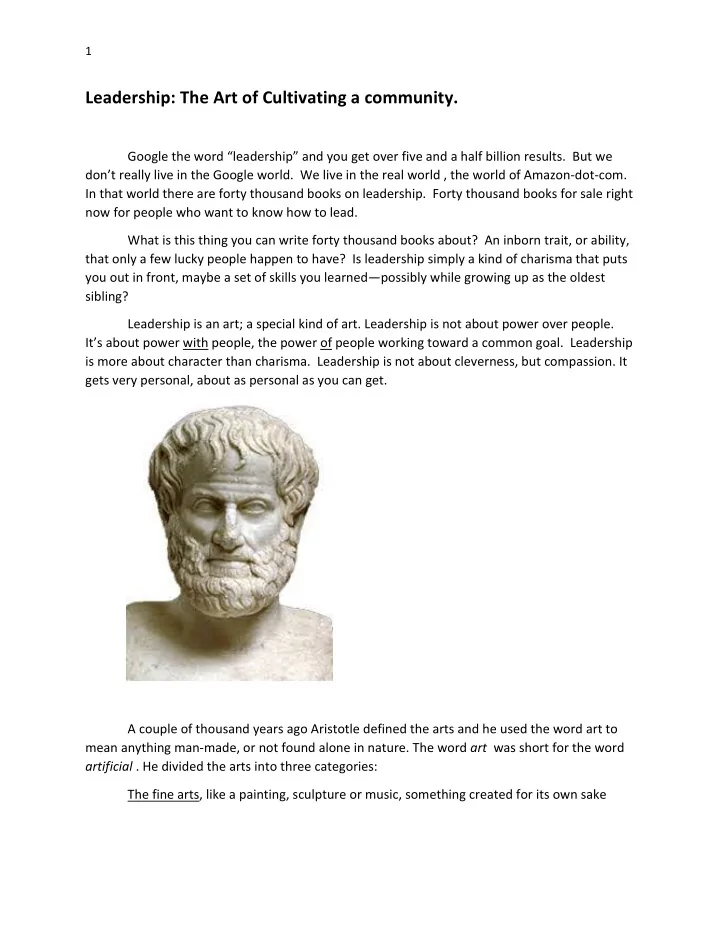
Google the word “leadership” and you get over five and a half billion results. But we don’t really live in the Google world. We live in the real world , the world of Amazon-dot-com. In that world there are forty thousand books on leadership. Forty thousand books for sale right now for people who want to know how to lead. What is this thing you can write forty thousand books about? An inborn trait, or ability, that only a few lucky people happen to have? Is leadership simply a kind of charisma that puts you out in front, maybe a set of skills you learned—possibly while growing up as the oldest sibling? Leadership is an art; a special kind of art. Leadership is not about power over people. It’s about power with people, the power of people working toward a common goal. Leadership is more about character than charisma. Leadership is not about cleverness, but compassion. It gets very personal, about as personal as you can get. A couple of thousand years ago Aristotle defined the arts and he used the word art to mean anything man-made, or not found alone in nature. The word art was short for the word artificial . He divided the arts into three categories: The fine arts, like a painting, sculpture or music, something created for its own sake
SLIDE 2 2
The practical arts, like the art of the woodworker, who may create a practical object, like a chair, or house. He called the third category the cooperative arts, a category into which he put the physician, the teacher and the farmer. He explained that a person can be healthy without ever seeing a doctor, plants can grow in the wild without cultivation, and people can learn by
- themselves. But when the doctor, teacher and farmer cooperate with nature, we clearly have a
healthier, better-educated and better-fed community. That’s what makes leadership a cooperative art. Cooperating with human nature. Fast forward two-thousand-four-hundred years to another leader: Clarence Dellinger. Clarence was born just about a hundred years ago, in 1920. Clarence was a Farmers’ Market leader. When he was sixteen years old, he wrote down ten principles that guided his life in relationships and business, based in honesty, fairness and integrity. Not long after that, in his early twenties, he found himself halfway around the world, in the middle of World War II. Then came the 50’s and Clarence got some land. Clarence was a kind of hippie, even before the word was invented.
SLIDE 3 3
Around 1960, at the age of 40, he began wheeling his old pickup truck into town to sell his excess produce. I doubt that anyone thought of him as a leader at the time—he was just this guy with a vegetable stand. But he was one of the first in the state to be certified as an organic grower. He was
- rganic before it was cool. And he kept showing up with his vegetables, week after week, year
after year, decade after decade. Other farmers followed suit, and a farmers’ market formed around him. This group of farmer-vendors eventually created a bona-fide organization, with bylaws, even Robert’s Rules of Order. Then, in 1994, a non-stock corporation was formed and certified by the state of Virginia. It was a member association, owned, governed and operated by the vendors themselves. Clarence was on the board of directors for the first ten years. By the time Clarence was 90 he was surrounded by some 50 vendors, at a million-dollar
- market. His pickup truck was just as rickety, and he was still using the same set of scales that
he had been using since the early days. A set of scales that he intercepted on their way to the landfill, before they called them landfills.
SLIDE 4 4
The vendors would have potlucks, meetings, sometimes picnics…and Clarence would stand up and start talking about the beginning of it all, and we’d wait for him to finish. He’d go
- n and on, mostly we couldn’t really hear him, but we knew, somehow, he was saying
something that meant a lot to him. Even the new vendors sensed, without knowing exactly why, that he was a valued member of our community. I suspect he was trying to gently show us the way, hoping we would understand, and agree with those ten principles he had worked
- ut. He was still spreading the gospel of honesty, fairness and integrity and it’s too bad we
couldn’t hear him better, and more often. I’d like to hear a conversation between Clarence Dellinger and Aristotle, these two thought leaders separated by two thousand years. They could have met at the farmer’s market, and talked about what’s changed and what hasn’t, they could have chatted about honesty, fairness and integrity. And the price of eggs. And it would have been nice to have Donna Hicks in that conversation. Donna Hicks specializes in Dignity. She teaches at Harvard, and for the past 25 years has traveled the world, the trouble spots that you hear about in the news; introducing, explaining and training people in the concept of dignity, and its role in bringing people together.
SLIDE 5 5
Last year she wrote a book called Leading with Dignity: How to Create a Culture That Brings Out the Best in People. In Donna Hick’s seminars, trainings, speeches…she stresses that real leadership is based
- n honoring dignity, which she defines as every person’s inherent sense of value and self-
worth. Every person is born with, and deserves, to know that they matter. That they have a sense of self-worth that no one can deny. Respect is different, because true respect must be
- earned. Dignity is to be honored simply because you’re dealing with a fellow human. Dignity is
at the heart of how people get along. Violating someone’s sense of self-worth is big trouble. Honoring someone’s dignity is the key to great leadership. Imagine even a lowly pack animal like a donkey. The wisest of the ancients knew that if you could choose between whacking that poor animal with a stick and leading it with a carrot, you would always go with the carrot. Which brings us back to farmers markets. Farmers Markets are where commerce and community become one. That takes some
- rganization, and management, and leading.
Dependence, independence, interdependence There are three developmental stages that can apply to organizations as well as people. In the beginning, as a small child, or for any person’s earliest days in a new job, or for a fledgling
- rganization, you are totally dependent on those around you.
Eventually you absorb enough information and insight to start managing yourself. That’s the independent stage, the stage that writer Steven Covey says rebellious teenagers go
- through. It’s also a stage you can get stuck in, for the rest of your life. Or the rest of the life of
the organization.
This image cannot currently be displayed.
SLIDE 6
6
The third stage, interdependence, brings out the real leader in you. Now you re-learn how to depend on others, not for survival, but for growth and development. For reaching goals that no one person could ever reach alone. For cultivating a strong and healthy community. A true community is diverse. A real community should not sound like a collection of clones chanting in unison, more like a full orchestra, with sections, individuals, counterpoint, syncopation and harmony. To create a real community, you have to cultivate. Nurture. Lead. It’s an art. A cooperative art. Rugged individualists need not apply. Donna Hicks looks at leadership and community through the lens of Dignity. A bit like Aristotle, she breaks it down to three levels. She calls it the Three ‘C’s of Dignity, and she means three connections: to your own dignity, to the dignity of those around you, and to the greater purpose that brings you together. And here’s where it gets personal. When you are truly in touch with your own sense of worth, you’re more open to recognize that of others. When you don’t feel threatened, when your dignity is honored, the way is open to treat others in the same way. And when the whole community, by and large, recognizes the value of a greater project, or idea, or vision, the sum truly does become greater than the parts. Honoring dignity brings out the best in people, and that’s exactly what a leader is supposed to do. The art of persuasion In practice, leaders persuade. Our old friend Aristotle wrote about persuasion. There are 9,000 books on persuasion for sale at Amazon.com. If you change word to ‘selling’, you find 40,000, which comes out to one for every book about leadership. Aristotle’s Rhetoric is one of the earliest books about salesmanship, about persuasion. Here’s his advice, and all you have to do is learn the meaning of three words; Ethos, Pathos and Logos.
SLIDE 7 7
First, and it’s important that it come first, is Ethos, which is all about character, and
- credibility. You have to be trusted, credible. You have to establish some meaningful
- credentials. You have to show that you know what you’re talking about, that you’ve done your
- homework. Don’t try to fake this one…you need to be credible, not just appear credible. One of
the best ways to gain credibility is to be open about what you don’t know. When you can admit the limits of your knowledge (because you’re comfortable with your own sense of worth) you will be more credible, more trustworthy. That’s the starting point. Ethos. Then comes pathos, the motivational part. It’s emotional. You get the listener interested, even excited. You stoke those universal human desires: justice, reputation, liberty. It’s difficult to lead people who just don’t care enough. Pathos prepares the listener for the final step: logos—where logic and reason are your
- tools. If you are first believable, and if your enthusiasm is contagious, the listener is ready for
the logical answer, the nuts and bolts of your proposal. After they know why, they want to know how. Imagine you’re at a board meeting, and you propose to your governing group a certain policy change, maybe it has to do with who is allowed as a vendor, maybe it has to do with changing the fee structure, or vendor location in your market. You don’t want the policy-writers to have any doubt about your credibility. They want, they need to have full confidence that you are a credible source of information. They need to know you’ve done the research. They need to know how important your proposal is, and why it’s important. Finally, they need to know the idea is reasonable and logical. That it has integrity. Ethos, Pathos and Logos. It’s an easy framework to understand, but applying it takes a lot of work. But—it’s worth it. I think Donna Hicks and Aristotle would get along just fine. When you put enough of care and work into an idea or proposal, it’s obvious. You’ve modeled behavior for those board members that you’re hoping to influence, and you’ve suggested through your actions, not your position, that your proposal deserves to be taken seriously. You’ve extended a strong invitation to treat your idea as if it really mattered, to treat you as if you really mattered. Your thorough preparation honors their dignity, and they will return the favor. They may or may not adopt the specific proposal, but everyone’s sense of worth and value will be preserved. In the long run, that’s what carries the day. Anyone can lead We should all think of ourselves as leaders. I was working in a radio station once where I was talking to my manager about my career, and how, so far, I had never really landed what I
SLIDE 8
8
thought were management or leadership positions. I was just one of a handful of announcers at a mid-size NPR station with no specific leadership or management responsibilities. He could have gotten defensive. He could have used a limited budget as an excuse, or explained that the hierarchy couldn’t really be altered, or any number of things. But he answered in a different way. He said just my being there, and being myself, had an influence on the whole operation. He mused about how naïve people can be when it comes to recognizing their impact on the people around them. He thought real leadership had nothing to do with position, and it dawned on me that he was right. He was a servant leader. He honored my dignity. He shared whatever power he was given, and he nudged me towards my potential. That’s the job of a true leader. And for an organization to reach its full potential…what does that take? Strong leadership, often assigned to a governing body, usually a board of directors; a small group of people with a common mission, and official responsibility. Management and leadership are essentially two different things. Management is for things; leadership is for people. Managers drive, leaders navigate. Leaders make decisions for the long-term, managers deal with day-to-day. Managers put out brush fires, leaders prevent them. Leaders get elected to governing boards, managers are hired and supervised by those boards. There is a clear consensus in the business and nonprofit world that boards should not micro-manage, and that managers should not micro-govern. It’s too easy for the roles to get mixed up, for the hierarchy to be vague, maybe even deceptive. There is an accountability rule-of-thumb that helps make these roles and responsibilities clear: you report to and are accountable to whoever chooses you. If you’re elected to the board by the members (in a member association) you’re accountable to those members. That’s who chose you and that’s who you work for. If you’re on what is known as a self-perpetuating board, where directors are chosen by other directors, then it’s the board itself you’re accountable to. There are pros and cons to each of these kinds of governance. Self- perpetuating boards can suffer from a kind of organizational in-breeding, membership-elected boards can suffer from apathetic or poorly informed members. If you’re elected board president by the board, that doesn’t mean you’re in charge of the board…it means the board is in charge of you. They chose you; you serve them. If a board chooses to recognize an executive committee, that committee is accountable to the board.
SLIDE 9 9
Market managers generally report to boards, the group that chooses them. So, market managers get to go to board meetings, where you watch the president of the board, or the chair, lead a meeting. How to lead a meeting You’ve no doubt seen books on “how to lead a meeting”, some with intriguing titles, like: Death by Meeting, and 100 Tricks to Appear Smart in Meetings: How to Get by Without Even Trying, and, of course, everybody’s favorite: Roberts Rules of Order, the book that’s all about parliamentary procedure. There’s a term that will make people cringe. Parliamentary procedure sounds like something that only clever, conniving, devious people would understand. But the principles underlying these rules encourage fair, full, productive discussions of issues, in a way that protects the rights of every single person in the meeting. Meetings, especially contentious
- nes, might be where your ability to honor someone’s dignity is tested.
A good leader will learn how to coax the best ideas out of the introverts as well as the
- extraverts. The keys to productive meetings are a sense of purpose, a focus, and full
participation.
- -The agenda: Everyone should know what the meeting is supposed to accomplish, with an
agenda and supporting materials in plenty of time for thoughtful review before the meeting.
- -Full Participation. A full sharing of ideas, questions and suggestions. No one is to be left out.
- -Focused discussion. No rambling, getting off topic, and losing sight of the goal of the
- discussion. Staying on topic.
SLIDE 10 10
- -A sense of accomplishment. Specific group tasks are completed, or measurable progress has
been made on an issue or idea. Full participation requires some guidance. Those folks who may be on the shy side, or more introverted, are easy to overlook, even though they could well be the most thoughtful in the group. Certain aboriginal tribes in the Northwest solved the problem with what is called a talking stick. About 20 years I was in a class at the Summer Peacebuilding Institute at Eastern Mennonite University. There were about 25 people there, folks from all over the world—the middle east, several African countries, Asia, the Philippines, Europe, and some Americans. We sat in a big circle and had a talking stick…just a stick. The rule was, when you had the stick, you and you alone could speak. Everyone just had to listen. Whoever had the stick could go as long as they wanted. We couldn’t imagine how a rule like that could work. But then we gave it a go, starting each class with an opportunity for each person to bring to the group whatever they wanted, and continuing through a discussion that might last for hours. And not one person ever abused that rule. Not once. When people knew others are listening, when they knew they could not be interrupted, when their sense of dignity was honored, they were always on their best
- behavior. Every single time.
Robert’s Rules of Order offers a similar practice. When a deliberative body, like a board
- f directors, wants to discuss an issue, it’s usually in the form of a proposal. The person
making the proposal speaks first, explaining why they are in favor. Then the chair of the meeting should ask if anyone opposed to the proposal would like to speak. The idea is to alternate, whenever possible, in order to hear as many viewpoints as possible. The idea is to prevent a head-to-head debate between the two most passionate people. So, after anyone has spoken, they must go to the end of the line. Those who have not yet spoken always have priority over those who have. No one gets to dominate, and all ideas are more fully explored. Everyone’s questions, ideas and suggestions matter. And how to keep a discussion focused on the original idea or issue? It’s useful to understand that there are three levels: Principle, Policy and Practice, and everybody should be discussing the same level. At the principle level you find broad concepts, like the golden rule, or the ten commandments, or the mission statement of your organization. Those must be agreed on first. Those are guiding principles which should keep everybody together, no matter how contentious the details. The practice level is about the reality of the situation. Max DePree, one of the great gurus of leadership in the business world, says that the first duty of a leader is to define reality. Reality is about facts, not opinions.
SLIDE 11 11
Policies, generally composed by deliberative assemblies like boards of directors, try to bring practices in line with principles. When discussions bounce around among all three levels, as they often do, nothing really gets done. This is common in political debates. I once produced a television report on the death penalty for Pennsylvania Public TV. The attorney general had just wired up the electric chair, because he believed in the death penalty. The previous attorney general had unhooked it, because he was against the death penalty. The one in favor, to make his point, talked about how, in practice, some little old lady could walk around New York City carrying millions of dollars, safely, because she was working for the Mafia. She was completely safe because everybody in the neighborhood knew who she worked for and knew the harsh penalty of doing her harm. This guy believed in anecdotal evidence. The other took the high road, talking about principles; the ten commandments, the constitutional right to life, liberty, etc. But neither one really talked about policy. A good discussion leader will have some sense of these diversions, and help the group avoid the mistake. The most appropriate policy is rarely the outcome of whoever wins a head to head debate between two people. There are always more than two sides to every issue. The best policies will have considered input from all angles, from all the people concerned. The process will have been inclusive. Easier said than done, but absolutely necessary. The governing group of a farmers’ market, charged with charting a course, strategizing and planning for the long term, navigating towards the highest possible fulfillment of the mission of the organization, should not take this work lightly. Nor try to plow through it too
- quickly. You want to plow deep, and you want to plow in low gear.
That’s why governing groups are called deliberative assemblies. They deliberate, in a deliberate way. The relationship between a board and management is important. There are two ever present dangers, opposite dangers…one of micro-managing and one of micro-governing. A board should not micro-manage, and management should not micro-govern. You don’t want a strong manager and weak board, nor do you want a weak manager and strong board. You want a strong manager and a strong board, each trying to help the other reach their highest potential. Because they have different roles and responsibilities. It should be clear to everyone that every board member has equal rights—each has an equal vote and equal access to information. The officers of the board are responsible and accountable to the entire board, if that’s who voted them into office.
SLIDE 12 12
The board only wields power as a group, following the various guidelines that are in the bylaws, and in governing guidelines that have been official adopted. As individuals, board members have no special power. A board member should not try to throw their weight around. If a board member is lending their expertise or services to management, they should take off their board hat and put on their volunteer hat. When they’re volunteering some service to management, that’s when the person they hired gets to boss them around. Because in that role they are volunteers, not board members. Just as the board officers are accountable to the directors who chose them, board directors are accountable to whoever chose them. The legal framework for all this follows a clear hierarchy. At the top are an
- rganization’s Articles of Incorporation. They are like the U.S. Constitution—spelling out a basic
purpose and governance model. They are supposed to be difficult to change. And the Articles have to conform to state law. Then come an organization’s bylaws, which must conform to the Articles of Incorporation. Bylaws, easier to change than Articles of Incorporation, more specifically spell out purposes, roles, responsibilities and rights. Policies often worked up by committees, and approved by a board, have to conform with the bylaws. At every step of the way, while considering any of these documents, be true to the spirit of the law, not just the letter. Don’t let politics sneak in the side door, no matter how
- tempting. Don’t be above the law like Boss Tweed, one of the sleaziest characters of New York
City politics you could imagine. The Brooklyn Bridge couldn’t be built until his bribes were
- satisfied. His graft and corruption were finally exposed, he was jailed, he escaped, went to
Spain, was recognized and brought back to jail, where he died of pneumonia. Boss Tweed said: “The way to have power is to take it.” He was good at transforming democratically-elected boards into self-perpetuating boards, and he was candid about his methods. He was famous for saying “I don’t care who does the electing, as long as I do the nominating.” He was not following the advice to honor the spirit of the law.
SLIDE 13 13
The governing board, the management team, the vendors…should know who the customer is. Management writer Peter Drucker describes a customer as anyone who can say ‘no’ to you. To a farmers’ market manager, the vendors are as much customers as are the
- shoppers. After all, you can’t have one without the other.
Drucker also says that there are three tasks that every business must undertake: making the present business effective, identifying and realizing its potential, and planning how to change, for a changing future. He reminds us that the time for all that is right now. That the present is when we create the future. He reminds us that people, and their knowledge, are always the deciding factor— everything else is just hardware. And that the hardware, the tools, are available to everybody. Even the knowledge is available to everybody. Those who succeed, according to Drucker, will be those who understand the customer, and who are committed to serving the customer. All the customers. He reminds us that service toward the mission of the organization always comes first. You don’t serve customers to make money, rather you make money so that you can continue to serve your customers, and your mission. The purpose of a leader is to help others reach their fullest potential. Drucker says that effective leaders don’t use the word ”I”, they don’t even think “I”, they always think “we”. What greater goal could you have than nurturing the kind of community that a farmer’s market is? Several years ago, at a Virginia Farmers Market conference, one of the speakers talked about the value of a place where the farmers and the townies could get together. The “been here’s” and the “came here’s”. The reds and the blues. What better place to show the world just how civilized people can be? How everyone’s dignity is honored. Phil Easley phileasley@earthlink.net VAFMA conference, Staunton, VA November 2019