LCCMR ID: 180-G Project Title: Minnesota Zoo Black Bear - - PDF document

lccmr id 180 g
SMART_READER_LITE
LIVE PREVIEW

LCCMR ID: 180-G Project Title: Minnesota Zoo Black Bear - - PDF document

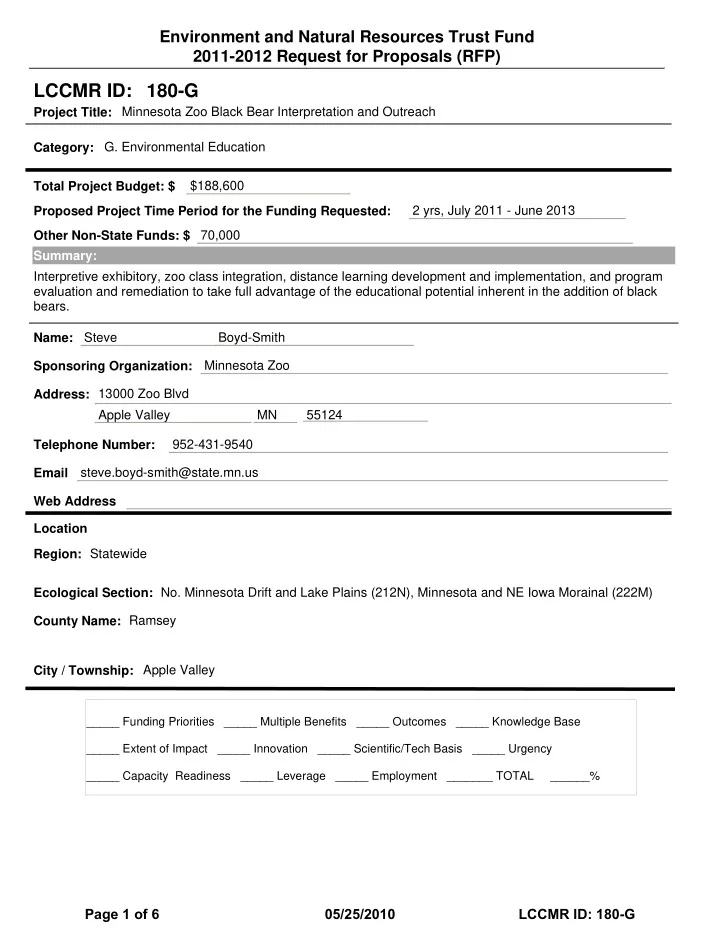
Environment and Natural Resources Trust Fund 2011-2012 Request for Proposals (RFP) LCCMR ID: 180-G Project Title: Minnesota Zoo Black Bear Interpretation and Outreach Category: G. Environmental Education Total Project Budget: $ $188,600


slide-1
SLIDE 1

Environment and Natural Resources Trust Fund 2011-2012 Request for Proposals (RFP)

Minnesota Zoo Black Bear Interpretation and Outreach $188,600 2 yrs, July 2011 - June 2013 70,000 Steve Boyd-Smith Minnesota Zoo 13000 Zoo Blvd Apple Valley MN 55124 952-431-9540 steve.boyd-smith@state.mn.us Ramsey Apple Valley Interpretive exhibitory, zoo class integration, distance learning development and implementation, and program evaluation and remediation to take full advantage of the educational potential inherent in the addition of black bears. Project Title: Total Project Budget: $ Proposed Project Time Period for the Funding Requested: Other Non-State Funds: $ Name: Sponsoring Organization: Address: Telephone Number: Email Web Address County Name: City / Township: Region: Summary: Statewide Location Ecological Section: No. Minnesota Drift and Lake Plains (212N), Minnesota and NE Iowa Morainal (222M)

_____ Funding Priorities _____ Multiple Benefits _____ Outcomes _____ Knowledge Base _____ Extent of Impact _____ Innovation _____ Scientific/Tech Basis _____ Urgency _____ Capacity Readiness _____ Leverage _____ Employment _______ TOTAL ______%

Category:

  • G. Environmental Education

LCCMR ID: 180-G

Page 1 of 6 05/25/2010 LCCMR ID: 180-G

slide-2
SLIDE 2

2011-2012 MAIN PROPOSAL

PROJECT TITLE: Minnesota Zoo Black Bear Interpretation and Outreach

  • I. PROJECT STATEMENT

In 2007, the Minnesota Zoo opened a renovated Minnesota Trail to great acclaim, bringing guests close to iconic Minnesota animals with one big exception: the black bear. Now that the Zoo has successfully raised private dollars, we will build a black bear exhibit (opening summer, 2012) to continue our success in arousing excitement, increasing understanding, and burnishing pride in Minnesota’s natural heritage. Funds raised to date support the design and building of the exhibit, including landscaping, security, animal holding, and structures. It includes only minimal funds for on-site interpretation and no money to build classes into our new distance learning program or to integrate bears into our existing education programs and classes – all of which will increase understanding and appreciation of this commonly misunderstood species. To help provide direct experiences with animals to more than 1.3 million annual visitors and foster natural science learning in K-12 schools across the state, the Zoo seeks $188,600 from the ENRTF for creative solutions to the delivery of informal environmental education. Through creative exhibitry, onsite programs and classes, and distance learning opportunities available throughout the state, the Zoo seeks to:

  • Excite visitors about Minnesota’s natural heritage by giving guests up-close views of black bears.
  • Connect people to the animals and natural habitats of Minnesota with engaging exhibitry that builds
  • n the excitement of the bears.
  • Use black bears as the climax of the Minnesota Trail experience, highlighting the importance of

place and animals to Minnesota’s history and identity.

  • Highlight DNR research on bears and its uses for management of the population, medical research,

and transfer of knowledge to parts of the world where native species of bears are less well known.

  • Encourage audiences to better understand current relationships between bears and people, building
  • ff the DNR’s popular “Living With Bears” curriculum and the Zoo’s proven “Perspectives” exhibits.
  • Incite a desire in students, program participants, and Zoo visitors to get outside, enjoy, and care for

the state’s wild animals and wild places.

  • II. DESCRIPTION OF PROJECT ACTIVITIES

Activity 1: On-Site Interpretation of Black Bears Budget: $ 99,200 The Project Manager will convene a team, including experts from the DNR and Zoo staff, to refine the messages of the bear exhibit within the successful framework of the Minnesota Trail. This will lead to the selection of a specialized exhibit design-build firm to deliver a creative combination of proven exhibit means, including sculpture, photography, media, and touchable objects. Outcome Completion Date

  • 1. Definition of refined messages and RFP for design-build

8/31/2011

  • 2. Completed and approved design documents

11/31/2011

  • 3. Public opening of new black bear exhibit

6/1/2012

  • 4. Any adjustments indicated in the evaluation (Activity 5)

2/1/2013 Activity 2: Distance Learning Programs Budget: $ 52,500 Building on the Zoo’s new distance learning program, the Zoo will work directly with teachers and the DNR to develop, evaluate, and launch interactive videoconference programs focusing on black bears and Minnesota ecology. Program will be adapted to grades 3-5, 6-8, and 9-12. All program content and material will be aligned to the Minnesota K-12 Academic Standards for Science.

Page 2 of 6 05/25/2010 LCCMR ID: 180-G

slide-3
SLIDE 3

Outcome Completion Date

  • 1. Raise awareness of the upcoming program and recruit teachers.

11/1/2011

  • 2. Work with teachers and the DNR to develop the K-12 curriculum

2/1/2012

  • 3. Acquire any necessary hardware and run a limited (free) pilot

6/1/2012

  • 4. Full-scale launch (beginning Fall, 2012), aiming for 40 classes in first year

5/30/2013 Activity 3: Integration of black bears into existing school and family programs Budget: $ 15,100 The Zoo offers successful onsite classes and programs for K-12 students and families: school programs serve 100,000 students/year; public programs for children from preschoolers to teens, scouts, and families educate 10,000+ each year. Minnesota and mammal focused programs (about 1/3rd Outcome the total) will be revised—new curriculum, materials, and supplies—to integrate black bear biology and ecology. Completion Date

  • 1. Development of classes and camps (beginning September, 2011)

5/1/2012 Activity 4: Field Research through DNR partnership Budget: $ 6,800 Long-running field research and black bear tracking in northern Minnesota offers the opportunity to place a GPS collar on a selected (wide-ranging) bear and follow its hourly movements throughout a year. This data will appear digitally in the exhibit and will be built into the programs of Activities 2 and 3. In subsequent years visitors will follow the bear’s recorded movements from the lifetime of the collar. Outcome Completion Date

  • 1. Collar the selected bear (in hibernation)

3/31/2012

  • 2. Develop and implement the digital habitat map in the exhibit and programs

6/1/2012 Activity 5: Evaluation Budget: $ 15,000 Using professional evaluators, the exhibit and all formal educational programs will be evaluated for effectiveness at the end of Year 1. Any indicated changes will be made in Year 2 (see Activity 1). Outcome Completion Date

  • 1. Exhibit pre-testing

9/1/2011

  • 2. Program evaluation (pilot phase)

7/1/2012

  • 3. Exhibit post-testing

7/1/2012

  • III. PROJECT STRATEGY
  • A. Project Team/Partners

The Minnesota Zoo is continuing its Minnesota Trail partnership with the Minnesota DNR. Team leads: Minnesota Zoo: Steve Boyd-Smith, Interpretive Projects Lead (Project Manager); Carol Strecker, School and Teacher Programs Supervisor (both paid in part through the requested funds and in part as in-kind). DNR: Dr. David Garshelis, Bear Project Leader; Jan Welsh, Project Wild coordinator (both as in-kind).

  • B. Timeline Requirements

Everything builds to the opening of the exhibit in June, 2012. Year 2 is focused more completely on the launch and continual improvement of the ongoing programs.

  • C. Long-Term Strategy and Future Funding Needs

The exhibit is intended to live on as a permanent part of the Minnesota Zoo, though the interpretive portion will likely need to be updated in total in 10 – 12 years. Likewise, distance learning and on-site camps and classes will continue and grow into the foreseeable future. The Zoo will provide ongoing

  • peration of the exhibit and programs beyond the costs requested.

Page 3 of 6 05/25/2010 LCCMR ID: 180-G

slide-4
SLIDE 4

BUDGET ITEM (See list of Eligible & Non-Eligible Costs, p. 13) Personnel: Interpretive Planner/Project Manager: .25 FTE, year 1 School and Teacher Programs Supervisor: .10 FTE, year 1 Interpretive Naturalist 1/Curriculum Writer: .75 FTE, year 1 Contracts: Interpretive Exhibit Design/Build firm. Includes interpretive exhibit design; fabrication and installation of graphics, casework, sculptures, media. (See below for other funds) Evaluation, strategy development, tools, professional interceptors, and reporting Distance learning set development: providing a set for the live on-screen instructor to stand for presentations, out of the way of regular zoo visitors but with good access to bear visuals Teacher Stipends : Advise program content development, assist with development and review of pre/post classroom materials, review and evaluate program educational effectiveness, quality, and student

  • engagement. 6 teachers (2 grades 3-5, 2 grades 6-8, 2 grades 9-12) x 3 days

@ $200/day Equipment/Tools/Supplies: Permanently-mounted all-weather cameras providing live video of exhibit bears for distance learning programs Program and training materials ($500), supplies ($100), props ($1000), and acquisition/production of B-roll video footage ($2000) for student programs and teacher training.

Satellite Radio Collar (to DNR)

Travel: Team travel between Zoo, Grand Rapids DNR office, and research site Additional Budget Items: TOTAL ENVIRONMENT & NATURAL RESOURCES TRUST FUND $ REQUEST SOURCE OF FUNDS AMOUNT Status Other Non-State $ Being Applied to Project During Project Period: The Zoo has received private funding that will set the foundation for this project by building the black bear exhibit (landscaping, security fencing, holding, structures), including $70,000 for interpretive exhibit design/build 1,500,000 $ Pledged Other State $ Being Applied to Project During Project Period:

  • $

In-kind Services During Project Period: Interpretive Planner/Project Manager salary and benefits: .25 FTE, year 1; .1 25,200 $ School and Teacher Programs Supervisor: .15 FTE, year 1; .1 year 2 14,000 $ Interpretive Naturalist 1/Curriculum Writer: .25 FTE, years 1-2 27,000 $ DNR staff time 5,000 $ Promotion of exhibit, classes, camps, and distance learning 12,000 $ Interpretive Exhibit changes: the Zoo will pay for any changes indicated through the evaluation, estimated here at a maximum of 5% of total cost 7,500 $ Distance Learning classes offered for free in year 2 (qty 10) 2,000 $ Remaining $ from Current ENRTF Appropriation (if applicable):

  • $

Funding History: Legacy Amendment Arts and Cultural Heritage Fund, FY2010 for Black Bear exhibit research and overall planning 111,375 $ Legacy Amendment Arts and Cultural Heritage Fund, FY2011 for development and piloting of initial distance learning program 111,375 $ 4,500 $ 2,500 $ n/a 80,000 $

2011-2012 Detailed Project Budget

  • IV. TOTAL TRUST FUND REQUEST BUDGET: 2 years

AMOUNT 7,000 $ 40,000 $ 18,000 $ 4,000 $ 8,000 $

  • V. OTHER FUNDS

188,600 $ 6,000 $ 15,000 $ 3,600 $

Page 4 of 6 05/25/2010 LCCMR ID: 180-G
slide-5
SLIDE 5

Bald Eagle bird viewing deck Cave Cave bear tracks on existing trail

holding area

pool cave

gate

Lodge

Lynx Puma Wolverine

viewing area

Black Bear Exhibit Minnesota Trail:

viewing area

viewing area

bear sclupture

Minnesota Trail: Existing

Page 5 of 6 05/25/2010 LCCMR ID: 180-G

slide-6
SLIDE 6

Project Manager Qualifications and Organization Description

ORGANIZATIONAL INFORMATION The Minnesota Zoo is the state’s largest environmental learning center, with 1.3 million annual visitors through our gates and others participating through innovative outreach programs. On-site, the Northern Trail and the Tropics Trail bring our guests up close with amazing animals from around the world. The award-winning renovation of the Minnesota Trail reminds visitors that we have amazing animals in Minnesota, including our iconic bald eagle, gray wolf, beaver, and walleye. The immediacy of the encounter with these animals creates a sense of wonder and care that sets a foundation for a desire to

  • learn. The exhibit also gives guests tools to help them watch for signs in nature and encourages them to

go outside and explore. Between Zoomobile and field trips from throughout the state, the Zoo’s education programs currently reach all 87 counties over a 3-5 year period. Temporary funding secured for FY2011 will build the foundations of a distance learning program using videoconferencing technology to increase that reach to an even wider range of Minnesota students and teachers: delivering approximately 200 programs in FY2012 and expanding at 10-15% annually until maximum sustainability is reached. Mission and Goals The mission of the Minnesota Zoo is to connect people, animals, and the natural world. The Zoo is dedicated to inspiring guests to act on behalf of wildlife and wild lands, most immediately here in

  • Minnesota. The goal is to change the way people think about their relationships to the natural world

through positive, personal interactions. The Zoo’s Master Plan clearly sets our objective to become one of the world’s great zoos. With this goal as our guide the Zoo works to:

  • increase environmental literacy statewide,
  • strengthen animal conservation efforts, and
  • create a major tourist destination and cultural icon for Minnesota.

PROJECT MANAGER QUALIFICATIONS Steve Boyd-Smith has been leading message development and content delivery for museums and zoos nationally for 20 years. He has been with the Zoo for nearly 5 years, leading content development and managing contracts for projects including the renovation of the Minnesota Trail, the award-winning “Russia’s Grizzly Coast,” and this summer’s upcoming “Faces of the African Forest.” With black bears, Steve will coordinate the capable team that will further develop the content and deliver it through exhibit, web, classes, camps, and videoconferencing.

Page 6 of 6 05/25/2010 LCCMR ID: 180-G