SLIDE 1 Environment and Natural Resources Trust Fund 2010 Request for Proposals (RFP)
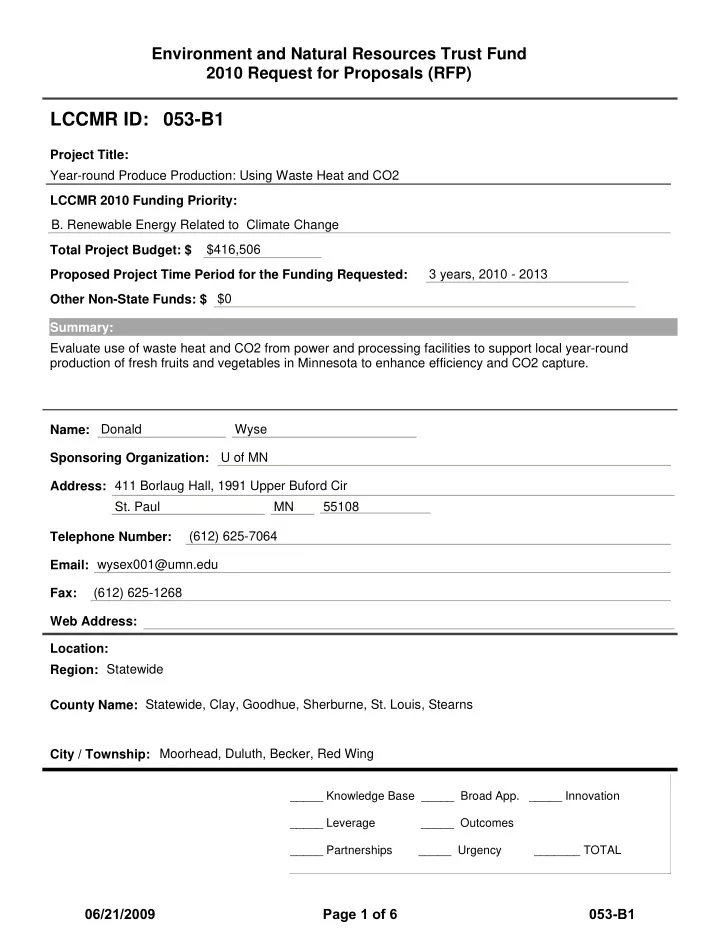
Year-round Produce Production: Using Waste Heat and CO2 $416,506 3 years, 2010 - 2013 $0 Donald Wyse U of MN 411 Borlaug Hall, 1991 Upper Buford Cir
MN 55108 (612) 625-7064 (612) 625-1268 wysex001@umn.edu Statewide, Clay, Goodhue, Sherburne, St. Louis, Stearns Moorhead, Duluth, Becker, Red Wing Evaluate use of waste heat and CO2 from power and processing facilities to support local year-round production of fresh fruits and vegetables in Minnesota to enhance efficiency and CO2 capture. Project Title: Total Project Budget: $ Proposed Project Time Period for the Funding Requested: Other Non-State Funds: $ Name: Sponsoring Organization: Address: Telephone Number: Email: Fax: Web Address: County Name: City / Township: Region: Summary: Statewide
LCCMR ID: 053-B1
LCCMR 2010 Funding Priority:
- B. Renewable Energy Related to Climate Change
Location:
_____ Knowledge Base _____ Broad App. _____ Innovation _____ Leverage _____ Outcomes _____ Partnerships _____ Urgency _______ TOTAL
06/21/2009 Page 1 of 6 053-B1
SLIDE 2 MAIN PROPOSAL
PROJECT TITLE: Year-round Produce Production: Using Waste Heat and CO
2
- I. PROJECT STATEMENT - This project which falls under 2010 LCCMR Funding Priority G will
explore how best to transform Minnesota’s existing waste heat by-products and CO2 – from power plants and processing facilities – into a high value energy resource for local year-round production of fresh fruits and vegetables and a corresponding reduction in the carbon foot print
- f energy production in the state.
This project will examine opportunities to link local waste energy utilization with local food production by: 1) Identifying waste heat sources and CO2 from Minnesota power and processing plants and assessing ways to most effectively deliver it to greenhouses that would support year round production of fresh fruit and vegetables; 2) determining and optimizing the energy needs – both heat, light and CO2 – for greenhouse fruit and vegetable production in Minnesota; and 3) assessing the market potential for year round local fresh fruit and vegetable products in Minnesota. This work will capture information needed to develop a template that – cooperating with American Crystal Sugar (ACS) as a test bed – will combine more efficient energy utilization and CO2 sequestration with increased local food production to deliver new economic opportunities to Minnesota communities and consumers.
- II. DESCRIPTION OF PROJECT RESULTS
Result 1: Identify and assess waste heat and CO2 sources from power and processing plants and ways to deliver heat and CO2
- 1. Compile inventory of major waste heat and CO
to support year round production of fresh fruits and vegetables in Minnesota - Budget: $135,364
2
- 2. Assess and characterize waste heat from a sugar processing plant
sources statewide in Minnesota
- 3. Assess greenhouse energy needs for year round fruit & vegetable production
- 4. Assess waste heat recovery system options and designs
Deliverable Completion Date
- 1. Identify power and processing plants with potential waste heat and CO2
October 2011 available to support year-round fruit and vegetable production
- 2. Intensive survey of waste heat sources from an (ACS) plant located in
Moorhead, MN October 2012
- 3. Estimate fuel costs to produce different fruits and vegetables in different
greenhouse systems December 2012
- 4. Assess alternatives to transfer available waste heat and CO2
December 2012 to meet greenhouse energy needs Result 2: Determine energy and CO2
- 1. Identify energy and lighting benchmarks for greenhouse production of fruits and
vegetables in Minnesota requirements for greenhouse local fruit and vegetable production in Minnesota - Budget: $139,530
- 2. Determine quantities of CO2, light, and heat greenhouse fruits and vegetables need
from an alternative energy source to achieve maximum yield
06/21/2009 Page 2 of 6 053-B1
SLIDE 3 Deliverable Completion Date
- 1. Response of 5 vegetable species to temperature, light and CO2 to
determine energy and CO2 February 2012
enrichment needs for a greenhouse production
facility adjacent to the ACS facility in Moorhead, MN
- 2. Modeling of yield and profitability profiles for greenhouse production
facility supported by waste heat February 2013
- 3. Photosynthesis response curves to light intensity, temperature and
carbon dioxide will be developed February 2013 Result 3: Assess market potential for year round local fresh fruit and vegetable production in Minnesota - Budget: $141,612
- 1. Consumer survey of greenhouse fruit and vegetable preferences
- 2. Experimental auction to determine price points of selected greenhouse crops
Deliverable Completion Date
- 1. Identify consumer attitudes and preferences for specific fruits and
vegetables including importance of point of production, quality and labeling December 2012
- 2. Determine consumer price points for locally produced greenhouse crops
December 2012
- III. PROJECT STRATEGY
- A. Project Team/Partners
- John Erwin, Professor, Greenhouse Crop and Floriculture Physiology and Extension,
UMN Department of Horticultural Science – Role – responsible for Result 2 deliverables
- Kevin Janni Professor and Extension Engineer, Bioproducts and Biosystems
Engineering, UMN – Role – Lead efforts on waste heat assessment work for Result 1
- Linda Kingery, Executive Director, UM Northwest Regional Sustainable Development
Partnerships – Role - connect with business groups (e.g., ACS) and engage local foods advocates in developing and using market research data to help replicate this model
- Tom Kuehn Professor, Mechanical Engineering, UMN – Role – lead assessment and
thermodynamic analysis of waste heat recovery system options
- Lissa Pawlisch Clean Energy Resource Teams Coordinator, UM Regional Sustainable
Development Partnerships – Role - Inventory waste heat source facilities and identify locations with potential to support year-round greenhouse fruit and vegetable production.
- Don Wyse, Professor, Department of Agronomy and Plant Genetics, UMN – Role –
Overall project lead and coordinator
- Chengyan Yue Assistant Professor, Department of Horticultural Science and Applied
Economics, Bachman Endowed Chair of Horticultural Marketing, UMN – Role - responsible for consumer survey and auction design and results (Result 3 deliverables)
- American Crystal Sugar – Role – partner in determining waste heat energy availability at
ACS Moorhead, MN facility and developing feasibility of use/market acceptance studies
- B. Timeline Requirements - Project timeline requirements are based on the expected amount
- f time needed to complete each specified result as effectively and efficiently as possible. It
is expected that this project will be completed by June 2013.
- C. Long-Term Strategy – This proposal should be seen as series of key steps in assessing
the potential for use of waste heat and CO2 in year-round local fruit and vegetable production in Minnesota. If sufficient potential is identified with this work, it is expected that future investments would be required in infrastructure and business development.
06/21/2009 Page 3 of 6 053-B1
SLIDE 4 C:\Documents and Settings\dgriffit\My Documents\ML2010\RFP\2010 Proposals - JUNE FINALS\053-B1 - Wyse Donald 0409-2-192 - Budget
BUDGET ITEM (See list of Eligible & Non-Eligible Costs, p. 13) Personnel:
3 Undergraduate Students; 1200 hrs; $10/hr; $12,000 salary; x 3 years = $108,000 1 Research Fellow; 50% time; $24,000 salary; $7,752 fringe [32.3%]; x 3 years = $95,256 3 Graduate Student; 25% time; $10,155 salary; $7,295 fringe; x 3 years = $157,050
Contracts: Equipment/Tools/Supplies:
Waste heat source assessment supplies $5,000 Greenhouse and growth chamber rental and lab supplies $18,000 Market research analysis, services and supplies $20,000
Acquisition (Fee Title or Permanent Easements): Travel:
In-state travel; 8,000 mi/year; $0.55/mi; x 3 years
Additional Budget Items: TOTAL PROJECT BUDGET REQUEST TO LCCMR SOURCE OF FUNDS AMOUNT Status Other Non-State $ Being Applied to Project During Project Period:
N/A
Other State $ Being Applied to Project During Project Period:
N/A
In-kind Services During Project Period:
5,057 $ Donald Wyse, 1% effort, $4,057 [Salary and fringe @32.3%] x 3 years
Remaining $ from Current Trust Fund Appropriation (if applicable): N/A Funding History:
None
AMOUNT
360,306 $ 416,506 $ 43,000 $ N/A 13,200 $ N/A N/A
Project Budget
INSTRUCTIONS AND TEMPLATE (1 PAGE LIMIT) (1-page limit, single-sided, 11 pt. font minimum. Retain bold text and delete all instructions typed in italics. Add or delete rows as necessary. If a category is not applicable you may write “N/A” , leave it blank, or delete the row.)
- IV. TOTAL PROJECT REQUEST BUDGET ([Insert # of years for project] years)
Attach budget, in MS-EXCEL format, to your “2010 LCCMR Proposal Submit Form”.
06/21/2009 Page 4 of 6 053-B1
SLIDE 5
Moorhead Duluth Becker Red Wing
06/21/2009 Page 5 of 6 053-B1
SLIDE 6
BIOGRAPHICAL SKETCH DONALD L. WYSE Department of Agronomy and Plant Genetics University of Minnesota, St. Paul, MN 55108 Phone: 612-625-7064, E-mail: wysex001@umn.edu EDUCATIONAL HISTORY The Ohio State University, 1970, B.S., Agronomy Michigan State University, 1972, M.S., Crop Science (Weed Science) Michigan State University, 1974, Ph.D., Crop Science (Weed Science) PROFESSIONAL POSITIONS Founding Director, Minnesota Institute for Sustainable Agriculture, Univ. of Minnesota, 1992-2000 Co-director, Center for Integrated Natural Resources and Agricultural Management, 1995-present Professor, Dept. of Agronomy and Plant Genetics, University of Minnesota, 1986-present Associate Professor, Dept. of Agronomy/Plant Genetics, University of Minnesota, 1980-1986 Assistant Professor, Dept. of Agronomy and Plant Genetics, University of Minnesota, 1974-1980 PROFESSIONAL ORGANIZATIONS AND HONOR SOCIETIES North Central Weed Science Society Weed Science Society of America Sigma XI Plant Physiology HONORS AND AWARDS Co-author of the Outstanding Paper published in Weed Science, 1987 Weed Science Society of America Outstanding Young Weed Scientist, 1987 Outstanding Teacher Award in the College of Agriculture, 1988 Weed Science Society of America Outstanding Teacher Award, 1991 Outstanding Faculty Performance Northrup King Award, 1991 CIBA-GEIGY Award for Outstanding Achievement in Agriculture, 1991 TEACHING EXPERIENCE My responsibilities include teaching and supervising graduate student research in weed science and cropping systems. AGRO 4503 (3 credits), Biology, Ecology and Management of Invasive Plants RESEARCH AND MANAGEMENT EXPERIENCE Donald Wyse is a Professor in the Department of Agronomy and Plant Genetics at the University of Minnesota, St. Paul, where he teaches and conducts research in weed management, cropping system development, and plant breeding and selection. His research concentrates on biological weed management, development of multifunctional agricultural systems, perennial crop breeding, and legume and grass seed production systems. He has focused his research efforts on the development of perennial cropping systems, cover crop systems, biomass prairie polycultures, and has studied their impact on soil and water quality. He has lead several multi-disciplinary research teams composed of university faculty and scientists from both state and federal agencies. He has experience in managing large multi year grants. Dr. Wyse was the founding Director of the Minnesota Institute for Sustainable Agriculture and currently serves as Co-director of the Center for Integrated Natural Resources and Agricultural Management at the University of Minnesota. Recent activities of the Center have led to the development of the Mississippi River—Green Land, Blue Water Initiative that includes universities, state and federal agencies, and NGO’s that have organized to deal with the landscape issues that impact water quality in the Mississippi River and Great Lakes Basin. He was one of the founding organizers of the Midwest Cover Crops Council and is an active member of the Executive Committee. 06/21/2009 Page 6 of 6 053-B1