LCCMR ID: 049-B1 Project Title: An Analysis of Biofuel Alternatives - - PDF document

lccmr id 049 b1
SMART_READER_LITE
LIVE PREVIEW

LCCMR ID: 049-B1 Project Title: An Analysis of Biofuel Alternatives - - PDF document

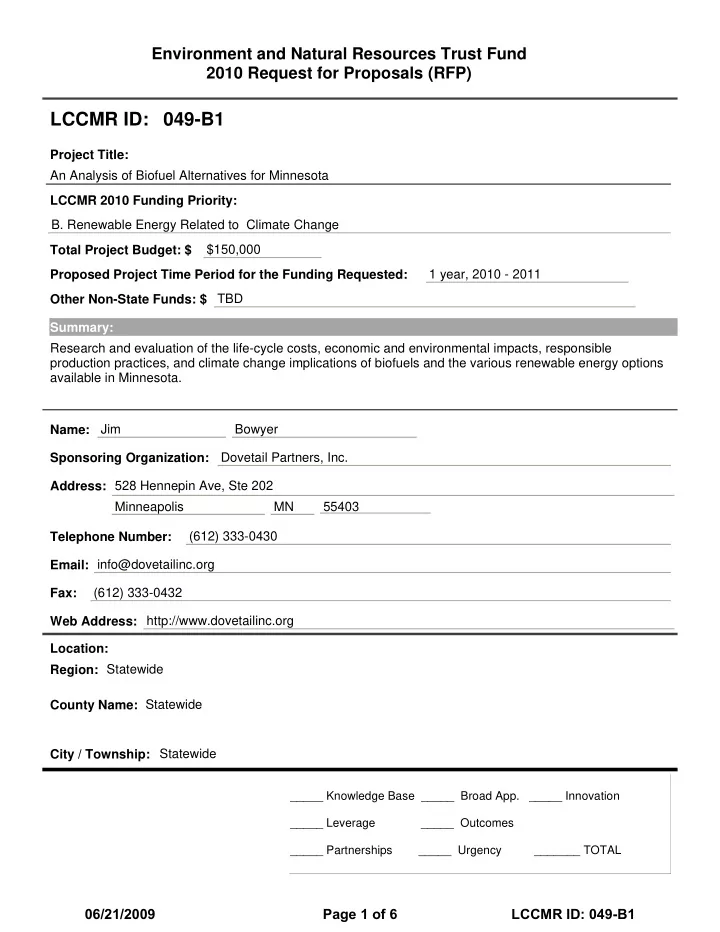
Environment and Natural Resources Trust Fund 2010 Request for Proposals (RFP) LCCMR ID: 049-B1 Project Title: An Analysis of Biofuel Alternatives for Minnesota LCCMR 2010 Funding Priority: B. Renewable Energy Related to Climate Change Total


slide-1
SLIDE 1

Environment and Natural Resources Trust Fund 2010 Request for Proposals (RFP)

An Analysis of Biofuel Alternatives for Minnesota $150,000 1 year, 2010 - 2011 TBD Jim Bowyer Dovetail Partners, Inc. 528 Hennepin Ave, Ste 202 Minneapolis MN 55403 (612) 333-0430 (612) 333-0432 info@dovetailinc.org http://www.dovetailinc.org Statewide Statewide Research and evaluation of the life-cycle costs, economic and environmental impacts, responsible production practices, and climate change implications of biofuels and the various renewable energy options available in Minnesota. Project Title: Total Project Budget: $ Proposed Project Time Period for the Funding Requested: Other Non-State Funds: $ Name: Sponsoring Organization: Address: Telephone Number: Email: Fax: Web Address: County Name: City / Township: Region: Summary: Statewide

LCCMR ID: 049-B1

LCCMR 2010 Funding Priority:

  • B. Renewable Energy Related to Climate Change

Location:

_____ Knowledge Base _____ Broad App. _____ Innovation _____ Leverage _____ Outcomes _____ Partnerships _____ Urgency _______ TOTAL

06/21/2009 Page 1 of 6 LCCMR ID: 049-B1

slide-2
SLIDE 2

MAIN PROPOSAL

PROJECT TITLE:

An Analysis of Biofuel Alternatives for Minnesota

  • I. PROJECT STATEMENT

There is growing global and regional interest in renewable energy and biofuels that provide benefits related to climate change, reduced environmental impacts, and improved economic

  • pportunities. As renewable energy options are being developed it is important to review the

alternatives in a thoughtful and holistic manner that will allow for consideration and comparison of the available approaches. A useful strategy for completing the review of alternative biofuels and renewable energy options is to use a life-cycle style evaluation that considers impacts from harvest through all stages of production and distribution. This project will utilize existing data and generate new data related to the life cycle costs and impacts of renewable energy options in Minnesota. Particular attention will be paid to alternative biofuel options and the environmental and economic trade-offs. Factors to be considered in the analysis will include effects on the economy, climate change and greenhouse gas considerations, water quality and quantity impacts, carbon sequestration comparisons, biodiversity concerns and energy transportation, delivery and utilization. Alternative production methods, best management practices, and sustainable yield rates will be included in the analysis. By using a life-cycle approach the project offers the opportunity to compare and contrast many different alternatives in a consistent and replicable manner. The alternatives to be evaluated include:

  • bioenergy and biomass alternatives from agricultural and forest-based resources;
  • solar and wind energy production methods;
  • geothermal energy systems for both small and large scale applications; and
  • nuclear, trash incinerators, hydropower, and other energy alternatives.

To maximize the benefits of the life-cycle approach, the project will aim to include comparisons of the greenhouse gas emissions, carbon sequestration, water quality and quantity, biodiversity, embodied energy, transportation networks and economic considerations of a full range of renewable energy options. The project will provide a comparative “matrix” to aid in explaining the life-cycle impacts of each alternative and the associated trade-offs.

  • II. DESCRIPTION OF PROJECT RESULTS

Result 1: Evaluation of Current Status Budget: $25,000 This activity will include a complete review of existing and recently proposed research and evaluations related to alternative energy and biofuels production in Minnesota. Relevant data and research from other regions, including international research, will be included to the extent it has relevancy and can inform decision making in Minnesota. Deliverable Completion Date

  • 1. Literature Review

Dec 2010

  • 2. Report summarizing findings

Dec 2010 Result 2: Synthesis of Opportunities Matrix Budget: $ 75,000 This activity will synthesize the renewable energy and biofuel opportunities in Minnesota and provide a matrix for comparing alternatives, including life-cycle costs and related impacts. The 06/21/2009 Page 2 of 6 LCCMR ID: 049-B1

slide-3
SLIDE 3

matrix will provide comparative factors for each alternative to allow for efficient evaluation and decision-making. Deliverable Completion Date

  • 3. Updated report of findings

March 2011

  • 4. Alternative Energy and Biofuels Matrix

March 2011 Result 3: Development of Recommendations Budget: $ 50,000 The final activity for the project will be to develop concise recommendations for next steps and any strategic activities, research, or other actions that may be needed to secure opportunities for alternative energy and biofuels developments in Minnesota. These recommendations will be developed in consultation with project partners and other stakeholders. Deliverable Completion Date

  • 5. Final report

July 2011

  • III. PROJECT STRATEGY
  • A. Project Team/Partners

.

The lead investigator for the project is Dr. Jim Bowyer. The lead investigator will have responsibility for the project deliverables and coordinating partnerships and engagement with project stakeholders, including the LCCMR staff and members.

  • Dr. Jim Bowyer is professor emeritus, University of Minnesota Department of Bioproducts and

Biosystems Engineering. He is an Elected Fellow of the International Academy of Wood Science; President of Bowyer and Associates, Inc. – a wood science and bioenergy consulting firm; Member

  • f the Governance Board and Chairman of the Scientific Advisory Board of the Temperate Forest

Foundation (Portland, Oregon); and a Member of the Blandin Foundation Vital Forests/Vital Communities Board of Advisors. Bowyer has served as President of the Forest Products Society (1993-94) and of the Society of Wood Science and Technology (1987-88), Vice President of the Consortium for Research on Renewable Industrial Materials (1992-2003), and Chairman of the Tropical Forest Foundation (2002-2008). He was Head of the University of Minnesota's Department of Wood & Paper Science from 1984 to 1994, and Founder and Director of the Forest Products Management Development Institute at the University of Minnesota (an organization dedicated to education and development of industry professionals) from 1994-2003. He served as Project Leader of the Minnesota Agricultural Experiment Station project “Environmental Life Cycle Assessment of Bio-based Materials and Products” from 1988 to 2003 and he also led a research team focused on global raw materials consumption and supply trends for more than 30 years. Dr. Bowyer earned a BS degree in forest management from Oklahoma State University (1964), a MS in forest products from Michigan State University (1966), and a PhD in wood science in technology from the University of Minnesota (1973).

  • B. Timeline Requirements

The project is anticipated to take one year to complete the necessary steps. There are no unique timeline requirements associated with the project.

  • C. Long-Term Strategy

This project is not a component of a larger project; however, the results of this project may identify gaps, needs or barriers to the further development of alternative fuels and their use in Minnesota. The results of this project may be used to inform other current and future efforts related to renewable energy use and development in the state. 06/21/2009 Page 3 of 6 LCCMR ID: 049-B1

slide-4
SLIDE 4

C:\Documents and Settings\dgriffit\My Documents\ML2010\RFP\2010 Proposals - JUNE FINALS\049-B1 - Bowyer Jim 0409-2-174 - Budget

BUDGET ITEM AMOUNT % FTE Personnel: % Project Manager and Lead Investigator $80,000 50% Contracts: Additional Investigators $60,000 Project Supplies, Travel $10,000 Equipment/Tools: Acquisition (Including Easements): Restoration: Other: TOTAL PROJECT BUDGET REQUEST TO LCCMR $150,000 SOURCE OF FUNDS AMOUNT Status Remaining $ From Previous Trust Fund Appropriation (if applicable): How much Trust Fund money remains not spent

  • r legally obligated from any previous Trust Fund

appropriation for any directly related project of the proposing project, project manager, or project organization? Specify the appropriation. $- Unspent

  • r Not

Legally Obligated Other Non-State $ Being Leveraged During Project Period: What additional non-state cash $ will be spent on the project $- Secured

  • r
  • V. OTHER FUNDS

Project Budget Project Title: An Analysis of Biofuel Alternatives for Minnesota

  • IV. TOTAL PROJECT REQUEST BUDGET

INSTRUCTIONS AND TEMPLATE (1 PAGE LIMIT)

06/21/2009 Page 4 of 6 LCCMR ID: 049-B1

slide-5
SLIDE 5

Organizational Description: Dovetail Partners is a nonprofit (501c3) organization that provides authoritative information about the impacts and trade-offs of environmental decisions, including consumption choices, land use, and policy alternatives. Dovetail Partners is a highly skilled team that excels at solving complex business problems and helping responsible firms to become successful. We also help regions define programs that increase the job creation and the job quality of resource-based industries. Additional information is available at the Dovetail website: http://www.dovetailinc.org

Resumé JAMES L. BOWYER Education B.S. Forest Management, Oklahoma State University, 1964 M.S. Forest Products, Michigan State University, 1966 Ph.D. Wood Science and Technology, University of Minnesota, 1973 Experience 2007-Present President, Bowyer and Associates, Inc., a wood science and bioenergy consulting firm. 2005-Present Director, Responsible Materials Program, Dovetail Partners, Inc., a nonprofit organization that collaborates to develop unique concepts, systems, programs, and models to foster sustainable forestry and catalyze responsible trade and consumption. 2003-2006 Professor (Part time), Department of Wood and Paper Science, University of Minnesota and Forestry/Wood Products Consultant. 1994 - 2003 Director, Forest Products Management Development Institute, Department of Wood and Paper Science, University of Minnesota. 1984-1994 Professor and Head, Department of Forest Products, University of Minnesota. 1973-1984: Assistant, Associate, and Full Professor, Department of Forest Products, University of Minnesota. 1970-1973: Instructor, Department of Forest Products, University of Minnesota. 1966:

  • Economist. Forestry Sciences Laboratory, U.S. Forest Service, Princeton, West Virginia.

1964-1966: Teaching Assistant in the Department of Forest Products, Michigan State University. Taught wood anatomy laboratory. 1960-1964: (Summers). Forestry Aid. U.S. Forest Service. Worked two summers in Black Hills National Forest, Sundance, Wyoming (TSI, inventory, fire fighting), and in Arapaho National Forest, Kremmling, Colorado (Timber sales, campground maintenance, primitive area patrol and management).

06/21/2009 Page 5 of 6 LCCMR ID: 049-B1

slide-6
SLIDE 6

06/21/2009 Page 6 of 6 LCCMR ID: 049-B1