SLIDE 1
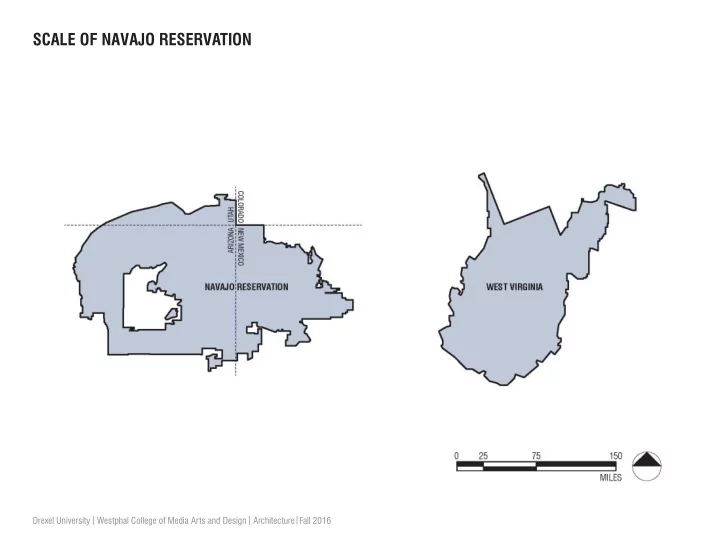
SCALE OF NAVAJO RESERVATION Drexel University Westphal College of - - PowerPoint PPT Presentation
SCALE OF NAVAJO RESERVATION Drexel University Westphal College of Media Arts and Design Architecture Fall 2016 TRANSFER OF AMERICAN INDIAN LAND Drexel University Westphal College of Media Arts and Design Architecture Fall 2016 THE
SLIDE 2
SLIDE 3
Drexel University Westphal College of Media Arts and Design Architecture Fall 2016
THE NAVAJO CODE TALKERS
Beginning in the late 1800s Indian children were forbidden to speak their own languages and were punished in church and government boarding schools if they did so. Until 1924 many American Indians weren’t even considered citizens of the United States (Schupman). Despite this history many Navajo Indian men and woman honorably defended their homeland and the United States when it was threatened during World War II. Ironically, their language would take a critical role as a weapon during this war. Instead of be- ing forbidden to speak, as they previously were, the Navajo were encouraged to develop secret battle communications based on their language. The soldiers, known as Code Talk- ers, became one of the biggest assets to the United States during the war. More than 400 Navajos were recruited as Code Talkers. It wasn’t until 1968 that these veterans were recognized for their service. Up until that time the operation was still considered classified. Their involvement during the war demonstrated the importance of their native language and their dedication to their land and people. These veter- ans deserve to be recognized and their legacy and language should be preserved and passed on to future generations.
“Language is central to cultural identity. It is the code containing the subtleties and secrets
- f cultural life. In many ways, language
determines thought.”
— W. Richard West, Jr., Southern Cheyenne and member
- f the Cheyenne and Arapaho Tribes of Oklahoma; Found-
ing Director, National Museum of the American Indian
SLIDE 4
Drexel University Westphal College of Media Arts and Design Architecture Fall 2016
PROGRAM
In 2011 the National Navajo Code Talkers Museum and Veterans Center, which is currently located in Tuba City, had a Nationwide competition for a Museum and Veterans’ Center to be located on Navajo Code Talker land a few miles east of Window Rock, Arizona. The mission for the museum and veterans center is as follows: “Preserve and pass on the legacy and language of the Na- vajo Code Talkers while educating the public and providing a place of refuge, renewal and healing for all veterans, military personnel, and their families” (National Navajo Code Talkers Museum and Veteran Center Report). This thesis will seek to uphold this mission through the
- proposal. It will seek to celebrate the history of the WWII
Navajo Code Talkers as well as the history of Navajo tra- ditions and culture and site history. It will not only seek to preserve a memory but also support these veterans and the entire community.
Components
- A. Museum
Oral History Archives Exhibits Collections Language Preservation Education Programs Research and Technology Commerce Administration - Back of House - Mechanical Restrooms
- B. Veterans Center
Meeting Facilities Social Room Honor Hall Spiritual/Cultural Celebration Center Administration - Back of House - Mechanical Restrooms
- C. Clinic
Health and Wellness Long-Term Care Complex Support Services Business Support Administration - Back of House - Mechanical Restrooms
- D. Constructed Landscape
Memorial Garden Long Walk Honor Trail
Program Goals
- 1. Tell the Story
- 2. Honor All Veterans
- 3. Educate about Culture and Language
- 4. Support the Community
- 5. Sensitivity to Site
SLIDE 5
Drexel University Westphal College of Media Arts and Design Architecture Fall 2016
Dine Bitah “Among the People” Scenic Road
SLIDE 6