LBNE L ong B aseline N eutrino E xperiment Sam Zeller LANL NDM09, - - PowerPoint PPT Presentation

lbne
SMART_READER_LITE
LIVE PREVIEW

LBNE L ong B aseline N eutrino E xperiment Sam Zeller LANL NDM09, - - PowerPoint PPT Presentation

LBNE L ong B aseline N eutrino E xperiment Sam Zeller LANL NDM09, Madison September 4, 2009 looking beyond T2K and NOvA efforts to expand U.S.-based program to longer baselines (~1000 km) proposal to send intense beam of s


slide-1
SLIDE 1

Sam Zeller, NDM09, 09/04/09

1

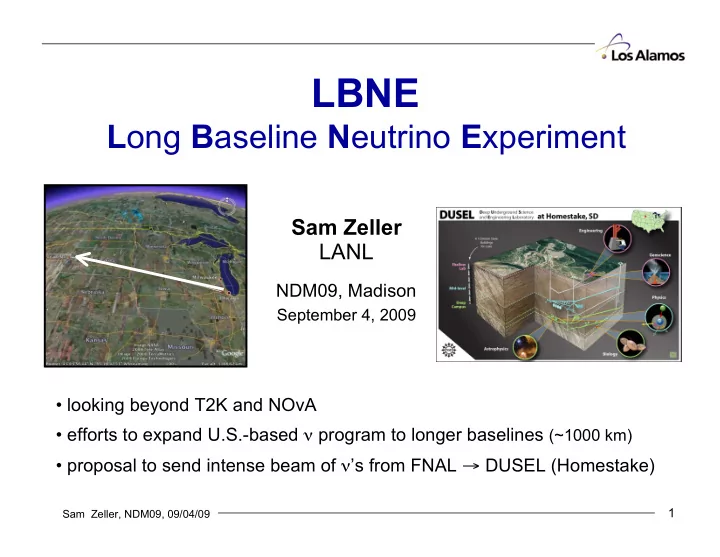
LBNE

Long Baseline Neutrino Experiment

Sam Zeller LANL

NDM09, Madison

September 4, 2009

  • looking beyond T2K and NOvA
  • efforts to expand U.S.-based ν program to longer baselines (~1000 km)
  • proposal to send intense beam of ν’s from FNAL → DUSEL (Homestake)
slide-2
SLIDE 2

Sam Zeller, NDM09, 09/04/09

2

What We Know

  • have known that ν’s oscillate and have mass for >10 years
  • have made great progress

slide-3
SLIDE 3

Sam Zeller, NDM09, 09/04/09

3

What We Know

  • have known that ν’s oscillate and have mass for >10 years
  • have made great progress

solar ν + KAMLAND sin22θ12 = 0.87 ± 0.03 Δm2

21 = (7.6 ± 0.2) x10-5 eV2

slide-4
SLIDE 4

Sam Zeller, NDM09, 09/04/09

4

What We Know

  • have known that ν’s oscillate and have mass for >10 years
  • have made great progress

sin22θ23> 0.92 Δm2

32 = (2.43 ± 0.13) x10-3 eV2

atmospheric ν & long baseline νµ disappearance solar ν + KAMLAND sin22θ12 = 0.87 ± 0.03 Δm2

21 = (7.6 ± 0.2) x10-5 eV2

slide-5
SLIDE 5

Sam Zeller, NDM09, 09/04/09

5

What We Know

  • have known that ν’s oscillate and have mass for >10 years
  • have made great progress

sin22θ23> 0.92 Δm2

32 = (2.43 ± 0.13) x10-3 eV2

atmospheric ν & long baseline νµ disappearance solar ν + KAMLAND sin22θ12 = 0.87 ± 0.03 Δm2

21 = (7.6 ± 0.2) x10-5 eV2

reactor sin22θ13 < 0.19 (90% CL)

slide-6
SLIDE 6

Sam Zeller, NDM09, 09/04/09

6

What We Know

  • have known that ν’s oscillate and have mass for >10 years
  • have made great progress

sin22θ23> 0.92 Δm2

32 = (2.43 ± 0.13) x10-3 eV2

atmospheric ν & long baseline νµ disappearance solar ν + KAMLAND sin22θ12 = 0.87 ± 0.03 Δm2

21 = (7.6 ± 0.2) x10-5 eV2

reactor sin22θ13 < 0.19 (90% CL) δCP = ?? long baseline νe appearance

slide-7
SLIDE 7

Sam Zeller, NDM09, 09/04/09

7

What We Know

  • have known that ν’s oscillate and have mass for >10 years
  • have made great progress

atmospheric ν & long baseline νµ disappearance solar ν + KAMLAND reactor long baseline νe appearance

  • three remaining parameters: - θ13
  • ν mass hierarchy
  • CP violating phase, δCP
slide-8
SLIDE 8

Sam Zeller, NDM09, 09/04/09

8

Phase I

T2K (295 km, 2.50 OA) NOvA (810 km, 0.90 OA)

  • reactor experiments

( νe disappearance) (R. McKeown’s talk)

  • long baseline accelerator-based ν experiments

(νe appearance) (J. Paley’s talk)

Daya Bay Double CHOOZ

(B. Viren’s talk) (M. Worcester’s talk)

will probe sin22θ13 ~ 0.01

at least a factor of 10

  • ver present CHOOZ limit!
slide-9
SLIDE 9

Sam Zeller, NDM09, 09/04/09

9

Phase II

  • give more precise information on θ13
  • determine ν mass hierarchy
  • explore CP violation!

already starting to think about this now & how phase II experiments might tackle

  • an extensive and even more ambitious program is

required to study ν oscillations beyond present program

  • if θ13 is large enough, hope to expand this program …
slide-10
SLIDE 10

Sam Zeller, NDM09, 09/04/09

10

How?

  • study of νµ → νe and νµ → νe oscillations over

even longer baselines (sub-dominant is preferred channel)

  • allows meas of θ13

and δCP

  • can also determine

ν mass hierarchy from matter effects

slide-11
SLIDE 11

Sam Zeller, NDM09, 09/04/09

11

In Practise, This is Complex

(S. Parke)

total P(νµ → νe) in matter

  • sin22θ13 = 0.04
  • L = 1200 km
  • rich structure depending on

the ν mass hierarchy and δCP

  • requires information from both

1st & 2nd oscillation maxima to resolve these ambiguities (spectral information and ν ) P(νµ → νe)

slide-12
SLIDE 12

Sam Zeller, NDM09, 09/04/09

12

Why Longer Baselines?

  • with increasing L:
  • 1st and 2nd oscillation maxima at higher energy

(more favorable region, larger stats, away from larger nuclear effects)

  • larger matter effects

(increasing the potential for the determination of ν mass hierarchy

P(νµ → νe)

slide-13
SLIDE 13

Sam Zeller, NDM09, 09/04/09

13

Phase II Experiments

T2KK

(295 km, 1050 km)

LBNE

(1300 km)

(1) longer baselines (~1000 km) (2) have access to both 1st & 2nd osc max (to remove degeneracies)

θ13 mass hierarchy CP violation

→ significant reach beyond present generation of LBL ν exps

2 MW proton beam (Project-X upgrade) (1300 km)

  • NBB
  • study 1st and 2nd osc max separately
  • 2 detectors at 2 different OA locations

(2.50 OA @ 295 km, 10 OA @ 1050 km)

  • WBB
  • study both 1st and 2nd osc with

single detector at a fixed baseline

slide-14
SLIDE 14

Sam Zeller, NDM09, 09/04/09

14

Phase II Experiments

T2KK

(295 km, 1050 km)

LBNE

(1300 km)

(1) longer baselines (~1000 km) (2) have access to both 1st & 2nd osc max (to remove degeneracies) → significant reach beyond present generation of LBL ν exps

2 MW proton beam (Project-X upgrade) (1300 km)

will focus on U.S.-based program (LBNE) in this talk

  • NBB
  • study 1st and 2nd osc max separately
  • 2 detectors at 2 different OA locations

(2.50 OA @ 295 km, 10 OA @ 1050 km)

  • WBB
  • study both 1st and 2nd osc with

single detector at a fixed baseline

slide-15
SLIDE 15

Sam Zeller, NDM09, 09/04/09

15

LBNE

1300 km

  • idea is to send intense

ν, ν beams from Fermilab

  • long baseline (1300 km)
  • very massive detectors

(100’s kton) in a deep underground laboratory

  • water Cerenkov
  • liquid Argon TPC

new beam → long baseline → large detectors → big project → potential big payoff ! 1300 km

Homestake mine in Lead, SD FNAL

slide-16
SLIDE 16

Sam Zeller, NDM09, 09/04/09

16

LBNE Science

  • there is a lot you can do with super-sensitive large detectors

under thousands of feet of rock!

slide-17
SLIDE 17

Sam Zeller, NDM09, 09/04/09

17

LBNE Science

  • θ13
  • ν mass hierarchy
  • CP phase δ

(M. Dierckxsens, 2008) assuming 300 kton H2O, 120 GeV ν + ν

mass hierarchy

θ13

CP violation

significant reach in physics sensitivity beyond the present generation of LB ν oscillation experiments

slide-18
SLIDE 18

Sam Zeller, NDM09, 09/04/09

18

LBNE Science

  • can establish finite θ13 at 3σ

if sin22θ13 > 0.005 (all δCP)

  • measure mass hierarchy

and δCP if sin22θ13 > 0.01

  • θ13
  • ν mass hierarchy
  • CP phase δ

(M. Dierckxsens, 2008)

~

assuming 300 kton H2O, 120 GeV ν + ν

mass hierarchy

θ13

CP violation

slide-19
SLIDE 19

Sam Zeller, NDM09, 09/04/09

19

LBNE Science

1300 km

(E. Kearns)

  • current limit τ1/2 > 8.2 x 1033 yrs (Super-K I+II)
  • H2O C most sensitive to this decay mode
  • with a large detector can push limits to 1035 yr

v

  • θ13
  • ν mass hierarchy
  • CP phase δ
  • proton decay
slide-20
SLIDE 20

Sam Zeller, NDM09, 09/04/09

20

LBNE Science

1300 km

(E. Kearns)

  • K+ is below C threshold
  • here, lAr does better

v

  • θ13
  • ν mass hierarchy
  • CP phase δ
  • proton decay
slide-21
SLIDE 21

Sam Zeller, NDM09, 09/04/09

21

LBNE Science

1300 km highly complementary

  • H2O: νe
  • lAr: νe (enhanced by osc)
  • θ13
  • ν mass hierarchy
  • CP phase δ
  • proton decay
  • supernova ν’s
slide-22
SLIDE 22

Sam Zeller, NDM09, 09/04/09

22

LBNE Science

1300 km

  • θ13
  • ν mass hierarchy
  • CP phase δ
  • proton decay
  • supernova ν’s
  • solar ν detection

(pp flux)

slide-23
SLIDE 23

Sam Zeller, NDM09, 09/04/09

23

LBNE Science

1300 km

  • θ13
  • ν mass hierarchy
  • CP phase δ
  • proton decay
  • supernova ν’s
  • solar ν detection

(pp flux) physics potential

  • f a very large

underground detector is extremely rich!

  • need large detector for LBL osc physics
  • if at same time, also in low background

environment, then these additional physics capabilities come “for free”

slide-24
SLIDE 24

Sam Zeller, NDM09, 09/04/09

24

  • both NSF and DOE sponsoring our efforts

Launched with P5

slide-25
SLIDE 25

Sam Zeller, NDM09, 09/04/09

25

Big Project Requires Coordination

formal science collab has been formed (self-organized) DOE project

  • ffices

have been established

  • versee effort

for DUSEL design & construction within NSF MREFC

working together

slide-26
SLIDE 26

Sam Zeller, NDM09, 09/04/09

26

LBNE Collaboration (Aug 2009)

Argonne National Laboratory

  • M. Goodman, M. Sanchez, M. Wetstein

Brookhaven National Laboratory

  • M. Bishai, R. Brown, H. Chen, G. de Geronimo, M. Diwan,
  • R. Hackenberg, R. Hahn, S. Hans, D. Jaffe, S. Junnarkar,
  • S. Kettell, F. Lanni, D. Makowiecki, B. Marciano, W. Morse,
  • Z. Parsa, C. Pearson, V. Radeka, S. Rescia, J. Sondericker,
  • J. Stewart, C. Thorn, B. Viren, M. Yeh, B. Yu

Boston University

  • E. Hazen, E. Kearns, J. Raaf, J. Stone

University of California, Davis

  • J. Felde, R. Svoboda, M. Tripathi

University of California, Irvine

  • B. Kropp, M. Smy, H. Sobel

University of California, Los Angeles

  • K. Arisaka, D. Cline, Y. Meng, F. Sergiampietri, H. Wang

Caltech

  • R. McKeown

University of Catania and INFN, Catania

  • V. Bellini, R. Potenza

University of Chicago

  • E. Blucher, M. Dierckxsens

Colorado State University

  • B. Berger, N. Buchanan, W. Toki, R. Wilson

Columbia University

  • L. Camilleri, C. Chi, C. Mariani, M. Shaevitz,
  • W. Sippach, W. Willis

Drexel University

  • C. Lane, J. Maricic

Duke University

  • J. Fowler, K. Scholberg, C. Walter

Fermilab

  • D. Allspach, B. Baller, S. Childress, P. Hurh,
  • J. Hylen, G. Koizumi, T. Lackowski, C. Laughton,
  • P. Lucas, B. Lundberg, P. Mantsch, J. Morfin,
  • V. Papadimitriou, R. Plunkett, S. Pordes,
  • G. Rameika, B. Rebel, K. Riesselmann, R. Schmitt,
  • D. Schmitz, P. Shanahan, R. Zwaska

Indiana University

  • C. Bower, W. Fox, M. Messier, J. Musser, J. Urheim

Kansas State University

  • T. Bolton, G. Horton-Smith

Lawerence Berkeley Laboratory

  • B. Fujikawa, R. Kadel

Lawrence Livermore National Laboratory

  • A. Bernstein, R. Bionta, S. Dazeley, S. Oeudraogo

Los Alamos National Laboratory

  • G. Garvey, T. Haines, W. Louis, C. Mauger, G. Mills,
  • Z. Pavlovic, R. Van de Water, H. White, G. Zeller

Louisiana State University

  • T. Kutter, W. Metcalf, J. Nowak

University of Maryland

  • E. Blaufuss, G. Sullivan

Michigan State University

  • E. Arrieta-Diaz, C. Bromberg, D. Edmunds,
  • J. Houston, B. Page

University of Minnesota

  • M. Marshak, W. Miller

University of Minnesota, Duluth

  • R. Gran, A. Habig

MIT

  • W. Barletta, J. Conrad, P. Fisher

University of Pennsylvania

  • J. Klein, K. Lande, M. Newcomer,
  • R. Van Berg

Rensselaer Polytechnic Institute

  • D. Kaminski, J. Napolitano, S. Salon,
  • P. Stoler

Princeton University

  • K. McDonald, Q. He

South Carolina University

  • S. Mishra, R. Petti, C. Rosenfeld

Institute for Physics & Mathematics

  • f the Universe, U. Tokyo
  • M. Vagins

Tufts University

  • H. Gallagher, T. Kafka,
  • T. Mann, J. Schneps

University of Wisconsin, Madison

  • B. Balantekin, F. Feyzi, L. Gladstone,
  • K. Heeger, A. Karle, R. Maruyama,
  • P. Sandstrom, C. Wendt

Yale University

  • B. Fleming, M. Soderberg

currently ~150 people from 33 institutions
slide-27
SLIDE 27

Sam Zeller, NDM09, 09/04/09

27

LBNE Collaboration Meetings

collab meeting @ UC Davis, Feb 2009

  • BNL
  • Oct. 15, 2008
  • UC, Davis
  • Feb. 26-28, 2009
  • Fermilab

July 15-17, 2009

  • + one coming up

in October (will mention more details later)

+ many more!

slide-28
SLIDE 28

Sam Zeller, NDM09, 09/04/09

28

DUSEL (Sanford Lab/Homestake)

part of NSF’s major research equipment and facility construction effort (MREFCE) preferred location for the LBNE far detector ….

slide-29
SLIDE 29

Sam Zeller, NDM09, 09/04/09

29

Where is Homestake?

  • mine is situated

in middle of Black Hills in western SD

  • facility is an old gold mine
  • extracted over

42 million ounces

  • f gold (6 semi trucks)
  • ver the course
  • f 126 years
  • 27 miles north
  • f Mt. Rushmore
  • 40 miles from

Rapid City

(population ~ 3,000) (population ~ 8,600) (population ~ 1,300) (population ~ 6,500)

Homestake mine

slide-30
SLIDE 30

Sam Zeller, NDM09, 09/04/09

30

Attributes of Homestake

  • state now owns free and clear

(long term access)

  • concentrated, focused facility for underground science

(without disruption from mining - no competing uses for its infrastructure)

  • access to unusual depths for deep science

(up to 8000 ft)

  • large excavations which can hold a variety of exp’l programs

(with the ability to expand in capacity and depth)

  • low radioactivity rock

(important for dark matter, 0νββ, solar ν experiments, etc.)

particularly attractive place to do science

slide-31
SLIDE 31

Sam Zeller, NDM09, 09/04/09

31

Not Just Physics

multi-disciplinary laboratory

  • mass hierarchy
  • CP violation
  • solar ν’s
  • supernova ν’s
  • proton decay
  • 0νββ
  • dark matter
  • biology
  • geology
  • engineering
  • education & outreach
  • C. Anderson (Black Hills State U.)

sampling “interesting” fungus at 2000 L

  • G. Rastogi et al, “Isolation and Characterization of

Cellulose Degrading Bacteria from Deep Subsurface of the Homestake Gold Mine”,

  • J. Ind. MicroBiol. Biotech, 36, 585 (2009)

(http://www-nsd.lbl.gov/homestake/)

physics

slide-32
SLIDE 32

Sam Zeller, NDM09, 09/04/09

32

Major Milestones

Barrick donates mine to state of SD (April 2006)

  • 2002 process for underground lab starts
  • 2003 Homestake mine closed & sealed
  • 2007 NSF selects Homestake!
  • 2007 Sanford Lab startup
  • $50M (SD) + $70M (T. Denny Sanford)
  • re-entry begins (rehab of shafts & hoists)
  • dewatering & site preparation
  • enables early start for science
  • 2010 DUSEL PDR submission
  • 2011 NSB review
  • 2013 earliest construction start, if approved
  • T. Denny Sanford

cuts ribbon (June 2006)

slide-33
SLIDE 33

Sam Zeller, NDM09, 09/04/09

33

Aerial View

property donation includes:

  • 186 acres

at the surface

  • >20 existing buildings
  • 800 acres of

underground workings

  • 370 miles of shafts

and tunnels at 60 levels

~1km

all has been deeded to the state and is owned by SD

slide-34
SLIDE 34

Sam Zeller, NDM09, 09/04/09

34

Three Major Campuses

(DUSEL CDR, January 2007, www-nsd.lbl.gov/homestake)

  • series of campuses; multiple levels
slide-35
SLIDE 35

Sam Zeller, NDM09, 09/04/09

35

Three Major Campuses

(DUSEL CDR, January 2007, www-nsd.lbl.gov/homestake) drive-in site

  • series of campuses; multiple levels
slide-36
SLIDE 36

Sam Zeller, NDM09, 09/04/09

36 (DUSEL CDR, January 2007, www-nsd.lbl.gov/homestake)

Three Major Campuses

LBNE

  • series of campuses; multiple levels
slide-37
SLIDE 37

Sam Zeller, NDM09, 09/04/09

37

Three Major Campuses

(DUSEL CDR, January 2007, www-nsd.lbl.gov/homestake)

  • series of campuses; multiple levels
slide-38
SLIDE 38

Sam Zeller, NDM09, 09/04/09

38

DeWatering

4550L submersible pumps in action

  • T. Denny Sanford & Gov. Mike Rounds
  • 4850 L reached (May 13, 2009)
  • 600M gallons H2O pumped from mine
  • had not been accessed

since the mine was sealed shut in 2003

  • currently at 4,992 level

(http://www.sanfordlab.org)

  • mine was slowly filling with water until

last year when SDSTA began pumping out

  • pumping out at rate of 1500 gallons/min
slide-39
SLIDE 39

Sam Zeller, NDM09, 09/04/09

39

DeWatering

4550L submersible pumps in action

  • will have to remove

4M ton water to get from 4850 to 7400 L

  • should reach 7400 L

sometime in 2011

  • mine was slowly filling with water until

last year when SDSTA began pumping out

  • pumping out at rate of 1500 gallons/min
slide-40
SLIDE 40

Sam Zeller, NDM09, 09/04/09

40

LBNE Depth Requirements

  • A. Bernstein et al., arXiv:0907.4183 [hep-ex]
  • none of the physics signatures

requires a depth greater than 4850 ft (4290 mwe)

CR rates for 50m height/diameter detector

  • 4850 ft depth is sufficient to carry out an excellent physics program &

takes best advantage of infrastructure & rock conditions at Homestake

  • variety of ν physics possible

in a single detector drives the requirement to larger depths

  • want to reduce CR & CR spallation products
slide-41
SLIDE 41

Sam Zeller, NDM09, 09/04/09

41

Proposed 4850 L Campus

ν’s

(conceptual layout) Ray Davis cavern

slide-42
SLIDE 42

Sam Zeller, NDM09, 09/04/09

42

Legacy of Science at Homestake

Ray Davis solar ν experiment under construction at Homestake in 1965 (100,000 gallons cleaning fluid)

  • Davis cavern is now dry
  • SDSTA to host “early physics”:
  • LUX (dark matter)
  • Majorana demonstrator (0νββ)

(R. Johnson’s talk on Monday)

Davis cavern: ~9m W x 8m H x 15m L

slide-43
SLIDE 43

Sam Zeller, NDM09, 09/04/09

43

ν’s

large cavities (H2O C)

53m span x 54m height

v

Proposed 4850 L Campus

slide-44
SLIDE 44

Sam Zeller, NDM09, 09/04/09

44

ν’s

lab modules (lAr)

20m x 20m x (50,75,100m)

Proposed 4850 L Campus

slide-45
SLIDE 45

Sam Zeller, NDM09, 09/04/09

45

LBNE Ingredients

0.8 GeV 2.7 GeV

design a WBB to cover 1st and 2nd oscillation maxima

(to provide sufficient event rates ideally ~100’s νe events/yr)

  • so can measure θ13, mass hierarchy, δCP
  • long baseline and small νµ → νe probability, requires:

(1) intense beam (2) massive far detectors

slide-46
SLIDE 46

Sam Zeller, NDM09, 09/04/09

46

New Beam at FNAL

  • beam WG lead by FNAL (V. Papadimitrio)
  • makes use of existing infrastructure at FNAL with upgrades
slide-47
SLIDE 47

Sam Zeller, NDM09, 09/04/09

47

Neutrino Beam

  • conceptual starting

point is NuMI (considerable experience)

  • on-axis: best broad-beam coverage
  • still working on optimizing; preliminary cost estimates this fall
  • design goal:
  • enhance low energy (2nd osc max)
  • reduce high energy tails (NC bkgs)
  • NuMI decay pipe: 750m long

x 2m diameter

  • LBNE decay pipe: 250m long

x 4m diameter preliminary design

slide-48
SLIDE 48

Sam Zeller, NDM09, 09/04/09

48

New Beam to Homestake

use the same extraction from the MI as the existing NuMI beam

slide-49
SLIDE 49

Sam Zeller, NDM09, 09/04/09

49

New Beam to Homestake

2 5 m d e c a y near detector hall

(~120 m underground, ~700 m from target)

slide-50
SLIDE 50

Sam Zeller, NDM09, 09/04/09

50

New Beam to Homestake

2 5 m d e c a y near detector hall

(~120 m underground, ~700 m from target) downward angle 5.80 to Homestake

slide-51
SLIDE 51

Sam Zeller, NDM09, 09/04/09

51

Near Detector

  • near detector WG lead by LANL (C. Mauger)
  • flux of neutrinos

at near detector (91% νµ, 8% νµ, 1% νe)

<Eν> = 2.3 GeV

  • main goals are to measure:
  • intrinsic νe contamination in beam
  • νµ NC π0 and NC γ
  • un-oscillated νµ spectrum

(complicated by nuclear effects, transition region)

  • both ν and ν
  • same nuclear target as far detector
  • dedicated flux measurements
  • putting together strawman design
  • developing for both H2O C and lAr

v

slide-52
SLIDE 52

Sam Zeller, NDM09, 09/04/09

52

Far Detector(s)

  • 2 options under consideration for far detectors at DUSEL:
  • must have a life cycle of ~10 years; both are complementary
  • if affordable, combination of both detectors would be very powerful
  • either one is an enormous detector …

(~20-60 kton) (~100-300 kton)

Water Cerenkov

imaging detector

Liquid Argon TPC

very fine-grained tracking detector

slide-53
SLIDE 53

Sam Zeller, NDM09, 09/04/09

53

300kT H2O Cerenkov 50kT liquid argon

  • assuming preliminary

WBB design for LBNE (based on NuMI focusing system)

  • 120 GeV
  • 5% bkg uncertainty
  • ν + ν
  • with lAr, seems can do

same amount of physics with ~1/6 the detector (M. Dierckxsens, 2008) CP

Size?

(driven by the physics)

slide-54
SLIDE 54

Sam Zeller, NDM09, 09/04/09

54

Pros and Cons

Water Cerenkov

  • known technology

(could be built with little R&D)

  • 2-3x Super-K
  • lower efficiency, higher bkgs
  • excavate large caverns,

PMT procurement issues Liquid Argon

  • not proven at the required size

(requires substantial R&D)

  • 100x scale
  • higher efficiency, lower bkgs

(due to excellent e− vs. π0 (γ) separation)

  • technical risks, safety issues,

unknown cost

extensive experience in construction & operation

(well known technology perfected over last 3 decades)

high granularity of detector means high ε for important physics goals

slide-55
SLIDE 55

Sam Zeller, NDM09, 09/04/09

55

Water Cerenkov WG Leaders

  • J. Stewart (BNL)
  • water containment: F. Feyzi (PSL, UW)
  • water system: R. Bionta (LBNL), H. Sobel (UCI)
  • PMT characterization: J. Klein (UPenn)
  • electronics: E. Kearns (BU), R. Van de Berg (UPenn)
  • simulations: C. Walter (Duke)
  • regular meetings
  • S4 proposal recently funded
slide-56
SLIDE 56

Sam Zeller, NDM09, 09/04/09

56

Far Detector: Water Cerenkov

  • Super-K
  • 50 kton total mass
  • 11k 20” PMTs
  • 40% coverage
  • 39m diameter x 42m height
  • LBNE (subject to change)
  • 3 x 100 kton FV modules
  • 60k 10-12” PMTs (per 100 kton)
  • 25% coverage
  • 50m diameter x 50m height

2-3 x Super-K

~ twice as deep

compare to largest operating water C with a completely man-made detector volume

v

slide-57
SLIDE 57

Sam Zeller, NDM09, 09/04/09

57

Large Cavity Design

  • excavation could start as early as 2013
  • ~6 yrs to complete 1st module (8 yrs for all 3)
  • R. Kadel (LBL)
  • cylindrical cavern
  • 1 module = 100 kton

(3x100 kton = 300 kton)

slide-58
SLIDE 58

Sam Zeller, NDM09, 09/04/09

58

Liquid Argon WG Leaders

  • B. Baller (FNAL)
  • physics reach (simulations): B. Fleming (Yale)
  • cavern: C. Laughton (FNAL)
  • cryostat, purification: J. Urheim (IU)
  • TPC/HV, photon detectors: H. Wang (UCLA), B. Yu (BNL)
  • electronics: C. Thorne (BNL), R. C. Bromberg (MSU)
  • installation, commissioning, operation: B. Miller (Minn)
  • life safety, ES&H: R. Poling (Minn)
  • regular meetings
slide-59
SLIDE 59

Sam Zeller, NDM09, 09/04/09

59

Phased Program for lAr

small test stands at FNAL, Yale

  • 0.01 ton
slide-60
SLIDE 60

Sam Zeller, NDM09, 09/04/09

60

Phased Program for lAr

ArgoNeuT

May 2009: 1st ν events seen in lAr TPC in the U.S.

  • 0.3 ton total, 50 cm drift
  • 500 channels
  • funded by NSF/DOE
  • NuMI beam
  • largest lAr TPC currently
  • perating in the U.S.
  • goals: gain experience in
  • perating underground &

develop simulation tools

slide-61
SLIDE 61

Sam Zeller, NDM09, 09/04/09

61

Phased Program for lAr

(B. Fleming)

MicroBooNE

  • 170 ton total, 2.5 m drift distance
  • 10,000 channels
  • received stage 1 approval from FNAL

in design phase now (DOE CD process)

  • BNB beam + off-axis ν’s from NuMI
  • next step in pushing the technology;

R&D towards full-scale DUSEL detector

slide-62
SLIDE 62

Sam Zeller, NDM09, 09/04/09

62

Phased Program for lAr

demonstration of the technology is a crucial step on the way to large underground LAr detectors

(want to approach in a staged way)

5-20 kT

slide-63
SLIDE 63

Sam Zeller, NDM09, 09/04/09

63

Far Detector: Liquid Argon

  • several design options; lots of people actively looking into this

(subject to change)

  • 1st step in

terms of physics for LBNE is 20 kton (17kton FV)

internally supported vessel

slide-64
SLIDE 64

Sam Zeller, NDM09, 09/04/09

64

DUSEL Lab Modules

  • lAr can fit nicely into one of planned modules

(20m wide x 20m high with vaulted ceiling) 4850 L campus

(LANDD design,

  • D. Cline et al.,

astro-ph/0604548

ν’s

slide-65
SLIDE 65

Sam Zeller, NDM09, 09/04/09

65

Timeline for LBNE Project

  • currently starting the design process for the project

(includes works on the ν beamline, near detector, far detectors)

  • CD-0 (hopefully) later this year
  • CD-1 baseline design (2010-2012)
  • we’re getting going
  • funding is starting to come in for this initial design work
  • good time to get involved!
slide-66
SLIDE 66

Sam Zeller, NDM09, 09/04/09

66

Find Out More

  • major workshop on DUSEL science

(Oct 1-3 in Lead, SD)

  • scientists interested in proposing underground experiments
  • LBNE collaboration meeting

(Oct 4-6 in Lead, SD)

  • those interested in

long baseline ν physics

  • will include tour of the mine
  • encourage you to attend!

(challenging problems need to work out,

lively group of very smart people) http://www.sanfordlab.org

slide-67
SLIDE 67

Sam Zeller, NDM09, 09/04/09

67

Conclusions

  • since the discovery of neutrino oscillations, our understanding
  • f ν masses & mixing has improved dramatically
  • in the near future, hope to have indications of non-zero θ13

sin22θ13 > 0.01 (Double CHOOZ, Daya Bay, T2K, NOvA)

  • next big goals: ν mass hierarchy, CP
  • longer baselines & massive detectors
  • LBNE in U.S., T2KK in Japan
  • very challenging projects to build,

but have the potential for big pay-off (+ proton decay, solar & SN ν’s, surprises?)

  • committed group of scientists working to design & build LBNE
  • have started thinking about next steps … come join us!