
SLIDE 1
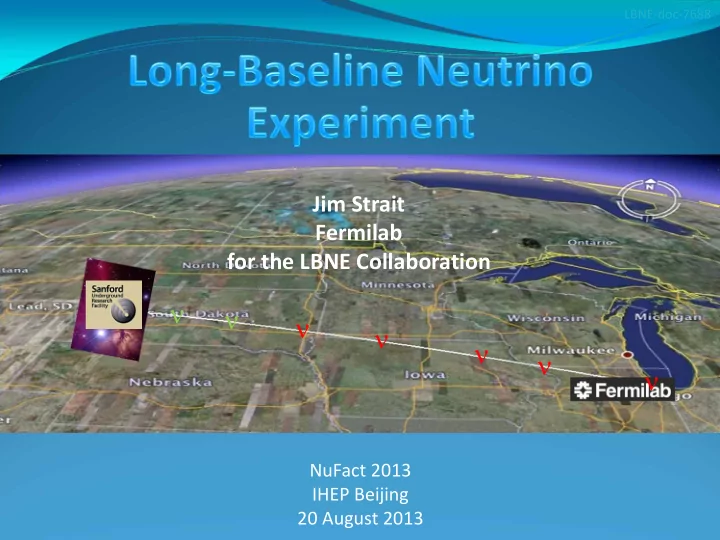
NuFact 2013 IHEP Beijing 20 August 2013
Jim Strait Fermilab for the LBNE Collaboration
LBNE‐doc‐7688
NuFact 2013 IHEP Beijing 20 August 2013 Overview - - PowerPoint PPT Presentation
LBNE doc 7688 Jim Strait Fermilab for the LBNE Collaboration NuFact 2013 IHEP Beijing 20 August 2013 Overview Scientific Motivation LBNE Collaboration LBNE Science LBNE Design Status
NuFact 2013 IHEP Beijing 20 August 2013
LBNE‐doc‐7688
2 J.Strait NuFact 2013
Precision measurements of known
fundamental mixing parameters
New physics ‐> non‐standard interactions,
sterile neutrinos… (with beam + atmospheric sources)
Precision neutrino interactions studies (near detector)
Baryon‐Number Violation Astrophysics: Supernova burst flux
3 J.Strait NuFact 2013
Further details: “Science Opportunities w/ LBNE,” arXiv:1307.7335.
4 J.Strait NuFact 2013
Deadwood, SD 25‐28 May 2010
372 members, 61 institutions, 5 countries (April 2013) Applications from 16 institutions and >50 members (and
Co‐spokespersons Milind Diwan (BNL), Bob Wilson (CSU)
Alabama Argonne Boston Brookhaven Cambridge Catania Columbia Chicago Colorado Colorado State Columbia Dakota State Davis Drexel Duke Duluth Fermilab Hawaii Indian Group Indiana Iowa State Irvine Kansas State Kavli/IPMU‐Tokyo Lawrence Berkeley NL Livermore NL London UCL Los Alamos NL Louisiana State Maryland Michigan State Minnesota MIT NGA New Mexico Northwestern Notre Dame Oxford Pennsylvania Pittsburgh Princeton Rensselaer Rochester Sanford Lab Sheffield SLAC South Carolina South Dakota South Dakota State SDSMT Southern Methodist Sussex Syracuse Tennessee Texas, Arllington Texas, Austin Tufts UCLA Virginia Tech Washington William and Mary Wisconsin Yale
Fermilab, March 2013
5 J.Strait NuFact 2013
Detailed calculation with horn based realistic beam optimization at each baseline and assumption of liquid argon TPC of 35 kt. Assume 120 GeV protons at 700kW. Mass Hierarchy
The LBNE design with a 1300 km, 120 GeV proton beam, on‐axis LArTPC
far detector is economical for a comprehensive oscillation program
Any other choice will necessitate larger detector or higher beam intensity Full scientific paper in preparation.
CP Violation
6
w/o osc: 20,000 w/ osc: 7,000 w/o osc: 6,700 w/ osc: 2,200
Appearance Disappearance
750evts (330 IH) 180 evts (272 IH)
e
J.Strait NuFact 2013
7
750 evts 180 evts 272 evts 330 evts
Difference due to mass ordering
34 kt fid.
Normal Inverted
J.Strait NuFact 2013
True Normal Hierarchy not known 8
Bands: 1 variations of 13, 23, m31
2 (Fogli et al. arXiv:1205.5254v3)
NOA 700 kW x (3 yr + 3 yr ) (3.8 x10²¹pot)
pot) (7.8x10 yr 5 kW x 750 T2K
21
LBNE10 (80 GeV*) 700 kW x (5 yr + 5 yr ) *Improved over CDR 2012 120 GeV MI proton beam
Significance for ≠0,
J.Strait NuFact 2013
LBNE10 does much better than full program for existing experiments
9
With 80 GeV MI protons source
Bands: Beam design range
Long‐range program in tandem with near detector neutrino
interactions and non‐accelerator physics
J.Strait NuFact 2013
10
Bands: Range of CP (best‐worst case)
NF‐IDS entry has assumptions about conversion from muon rate to POT and beam power
J.Strait NuFact 2013
Exposure (MW kt yrs) CP (ₒ)
11
LBNE MH Sensitivity
(H. Gallagher + A. Blake*)
J.Strait NuFact 2013
HyperK and LBNE have comparable sensitivity to the MH with
atmospheric neutrinos!
LBNE’s higher resolution of event energy and direction makes up for
smaller mass.
11
LBNE MH Sensitivity
(H. Gallagher + A. Blake*)
J.Strait NuFact 2013
HyperK MH Sensitivity
(C. Walter*) *ISOUPs, May 2013 4000 kt‐yrs 275 kt‐yrs
12 J.Strait NuFact 2013
Preliminary: work in progress
Duan smeared w/ SNOwGLoBES response, fit to pinched thermal spectrum
ph/0208035, w/ collective oscillations (NH & IH)
Measuring SN e temperature vs. time
LAr TPC high efficiency for kaon modes Especially interesting if SUSY
discovered at LHC
13 J.Strait NuFact 2013
LBNE
Adapted from a plot by E. Kearns
Neutrino beam at Fermilab for 700 kW operation,
Highly‐capable near neutrino detector on the Fermilab
34 kt fiducial mass LAr far detector at
14 J.Strait NuFact 2013
15 J.Strait NuFact 2013
16 J.Strait NuFact 2013
17 J.Strait NuFact 2013
18
18 J.Strait NuFact 2013
19 J.Strait NuFact 2013
Space for several 200 kt modules
20 J.Strait NuFact 2013
21
22 J.Strait NuFact 2013
Last year US funding agency (DOE) asked us to stage LBNE construction
and gave us a budget of $867M for the first phase
They also encouraged us to develop new partnerships to maximize the
scope of the first stage.
We chose to proceed with emphasis on the most important aspects of
the experiment: 1300 km baseline and the full capability beam
With just the DOE budget, the far detector would be 10 kt LAr TPC at the
surface.
An external review panel recommended this phase 1 configuration. DOE approved “CD‐1” in December 2012 for this phase‐1 scope. Our plan continues to be to build the full scope originally planned, and
are working with domestic and international partners to make the first phase as close as possible to the original goal.
http://lbne2‐docdb.fnal.gov/cgi‐bin/RetrieveFile?docid=6681;filename=LBNE%20CD‐1%20appr.pdf
23
We have launched geotechnical investigation of the LBNE detector
site at the 4850 level, which is on critical path.
24
25 J.Strait NuFact 2013
26 J.Strait NuFact 2013
J.Strait NuFact 2013 27
J.Strait NuFact 2013 28
Rapid progress in neutrino oscillation physics, with significant European involvement, has established a strong scientific case for a long‐baseline neutrino programme exploring CP violation and the mass hierarchy in the neutrino sector. CERN should develop a neutrino programme to pave the way for a substantial European role in future long‐baseline experiments. Europe should explore the possibility of major participation in leading long‐baseline neutrino projects in the US and Japan.
Brussels on 30 May 2013.
platform from which European groups can participate in long‐baseline
29 J.Strait NuFact 2013
30
Need longer baseline and very large instrumented targets for a
comprehensive program
Proton decay (Grand Unified Theories) Supernova burst neutrinos from intra‐galactic distances
It will be a major US HEP facility for the 2020’s With a budget of $867M we are proceeding with the most
important aspects in the first phase and actively working with partners to expand the scope
J.Strait NuFact 2013 31
32 J.Strait NuFact 2013
Mary Bishai
Optimum is achieved when the asymmetry due to the matter effect is larger than the largest CP effect, but does not saturate the total asymmetry. At the first maximum at the optimum baseline there is no degeneracy.
CP asymmetry in vacuum Matter effect
33 Assumes known (Normal) Mass Hierarchy
Bands: 1 variations of 13, 23, m31
2
(Fogli et al. arXiv:1205.5254v3)
NOA 700 kW x (3 yr + 3 yr ) (3.8 x10²¹pot)
T2K 750 kW x 5 yr (7.8x10²¹pot)
LBNE10 (80 GeV*) 700 kW x (5 yr + 5 yr )
*Improved over CDR 2012 120 GeV MI proton beam
Significance for ≠0
J.Strait NuFact 2013 True Normal Hierarchy not known
34 J.Strait NuFact 2013
Current reactor error Final reactor error expectation
CD‐0 (“Mission Need”) approves the need for the
project.
CD‐1 (“Alternative Selection and Cost Range”) approves
CD‐2 (“Performance Baseline”) approves the precise
technical design, cost and schedule.
CD‐3A (“Approve Long‐Lead Item Procurements”)
approves early start of selected parts of the project.
CD‐3 (“Start of Construction”) approves the start of
construction.
CD‐4 (“Project Completion”) approves transition to
Jan 2010 Dec 2012
(for phase 1)
Early 2017 Early 2016 Late 2017 2023
35 J.Strait NuFact 2013
12
Affected
J.Strait NuFact 2013 36
37 J.Strait NuFact 2013
38 J.Strait NuFact 2013
J.Strait NuFact 2013 39
Costs for the options have been developed