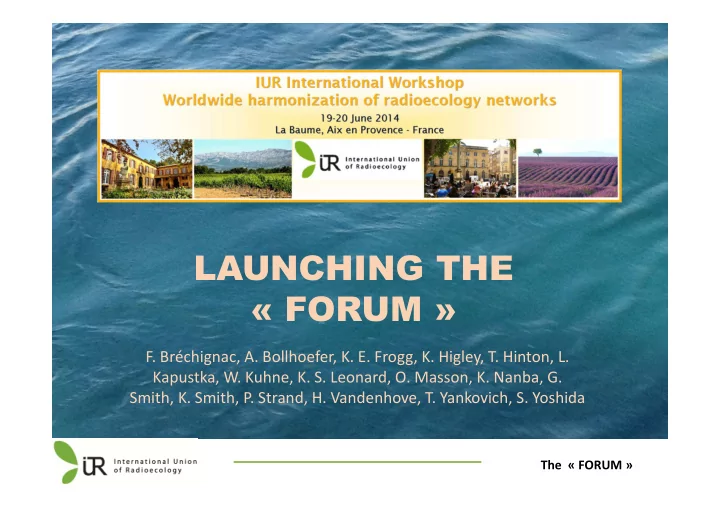
LAUNCHING THE FORUM F. Brchignac, A. Bollhoefer, K. E. Frogg, K. - - PowerPoint PPT Presentation

launching the forum
SMART_READER_LITE
LIVE PREVIEW

LAUNCHING THE FORUM F. Brchignac, A. Bollhoefer, K. E. Frogg, K. - - PowerPoint PPT Presentation

LAUNCHING THE FORUM F. Brchignac, A. Bollhoefer, K. E. Frogg, K. Higley, T. Hinton, L. Kapustka, W. Kuhne, K. S. Leonard, O. Masson, K. Nanba, G. Smith, K. Smith, P. Strand, H. Vandenhove, T. Yankovich, S. Yoshida The FORUM ASIAN


slide-1
SLIDE 1

LAUNCHING THE « FORUM »

  • F. Bréchignac, A. Bollhoefer, K. E. Frogg, K. Higley, T. Hinton, L.

Kapustka, W. Kuhne, K. S. Leonard, O. Masson, K. Nanba, G. Smith, K. Smith, P. Strand, H. Vandenhove, T. Yankovich, S. Yoshida

The « FORUM »

slide-2
SLIDE 2

ASIAN Task Group

slide-3
SLIDE 3

IUR STRATEGY OF NETWORKING initiated 10 years ago…

  • Worldwide international research network in Radioecology launched in

2003 based on 2 TG work

  • “Protection of the environment“ & “Radioecology and non-radioactive contaminants“
  • Identification of research teams, facilities, priorities in research
  • Same basis used later for the construction of STAR (European Network
  • f Excellence in Radioecology, EURATOM)
  • Federating around IUR neighbour international scientific associations/

networks … largely developed now, to be continued…

  • Fostering the creation of an International Observatory in charge of

centralised data registry to support environmental radiological assessment … still to be done …

  • Fostering international harmonisation of Radioecology networks

… the issue tackled here …

The « FORUM »

slide-4
SLIDE 4

WHY A NEED FOR HARMONISATION?

  • A large variety of networks currently active
  • dealing with radioecology (exclusively or partly)
  • dealing with environmental radioactivity (exclusively or partly)
  • dealing with environmental issues of relevance (including non-radioactive)
  • governmental – non-governmental
  • international – regional – national
  • global – topical (problem-oriented)
  • IUR : > 36 years old, large international membership now spread within 68

countries…

  • … has identified the need to achieve a Worldwide effort of networking …

in order to promote and maintain a harmonized and coordinated development process for Radioecology

The « FORUM »

slide-5
SLIDE 5

IUR initiative to hold a workshop on worldwide harmonisation of radioecology

  • Held on 19-20 June 2014 in La Baume, Aix en Provence, France
  • 15 global/regional/topical networks and international organisations

participating

  • Sharing views on activities and priorities for R&D and expertise
  • Aim to construct a collective view and an operational approach to

harmonization of Radioecology

The « FORUM »

slide-6
SLIDE 6

WORKSHOP OBJECTIVES

  • Share across all networks on-going activities of relevance, perspectives

and orientations, priorities for research and expertise

  • Initiate the development of an international framework instrument for

worldwide harmonization of networks in radioecology, and for efficient global coordination

  • Initial ideas:
  • optimize selection of priority research, avoid duplications
  • optimize exploitation of existing infrastructures and resources
  • support harmonized and coherent regulatory developments
  • help the development of well informed, balanced, and adapted consensus …

… whilst meeting the specificities of problem-oriented or regional objectives

The « FORUM »

slide-7
SLIDE 7

FOUNDING NETWORKS REPRESENTED

Regional networks:

SPERA South Pacific Environmental Radioactivity Association COMET Coordination and implementation of a paneuropean instrument for radioecology (EC) ALLIANCE European Radioecology Alliance NCoRE US National Center for Radioecology Fukushima Univ. IER + international collaboration Asian Network Japan, Korea, and neighbour countries Arctic Council Arctic countries and regions STAR European network of excellence in radioecology (EC)

The « FORUM »

slide-8
SLIDE 8

FOUNDING NETWORKS REPRESENTED

Networks led by international organizations :

UNSCEAR United Nations Scientific Committee on the Effects of Atomic Radiation IUR International Union of Radioecology ICRP International Commission on Radiological Protection IAEA International Atomic Energy Agency SETAC Society for Environmental Toxicity And Chemistry OSPAR Oslo-Paris Convention for the protection of the marine environment of the North-East Atlantic

Problem-oriented Networks :

BIOPROTA International collaboration on biosphere research for radioactive waste disposal Ring of Five Low-level atmospheric contamination watch and surveillance

The « FORUM »

slide-9
SLIDE 9

THE NETWORKS’ LEADERS ATTENDING

The « FORUM »

  • K. Nanba - K. E. Frogg - A. Bollhoefer - T. Yankovich - S. Yoshida - K. Smith - G. Smith - L. Kapustka
  • W. Kuhne - P

. Strand - O. Masson- K. Higley - K. Leonard - H. Vandenhove - F.Brechignac - T. Hinton

slide-10
SLIDE 10

WORKSHOP PROGRAM OVERVIEW

  • Presentation of the 15 networks activities

Goals and objectives, organization (countries represented, legal status, executive

  • peration…), on-going R&D activities of relevance, perspectives and orientations

for the future

  • Presentation of their on-going efforts of prioritization in research and

expertise

  • General discussion on global harmonization and competence sharing

Constructing global priorities for worldwide research and expertise in Radiecology, application of resources to develop a framework instrument for efficient global coordination of research and expertise, and for a worldwide harmonization of networks (roles and functions, processes to achieve roles, identification of functional links and interfaces,…)

  • Conclusions and drafting communication at ICRER

The « FORUM »

slide-11
SLIDE 11

WORKSHOP DISCUSSION

The « FORUM »

slide-12
SLIDE 12

COLLECTIVE DECISION TO LAUNCH THE « FORUM »

Discussion outcomes:

  • Roles and functions of various networks within radioecology R&D

Explain how the whole integrated system works (is organized)

Explain focus for R&D (improve reliability and confidence in risk assessments, eliminate unnecessary pessimism/over-cautious assumptions, support optimization of managing risk)

  • Interface with international regulatory bodies, with operators needs,

with stakeholders and society

The « FORUM »

slide-13
SLIDE 13

Synergy of science and expertise in radioecology

The « FORUM »

Brazil Norway France Sweden Australia Safety standards Regulations Expert Reports Global, International National R&D priorities EC Directives Scientific data, knowledge Japan … Risk principles Scientific paradigms FORUM (IUR) UNSCEAR ICRP IAEA

Environ. Environ.

Man Man

Environ.

SCIENCE

Environ.

REGULATION UNEP SETAC ICRU WHO NEA

ARPANSA NRPA ASN

Environ.

Man Man

Harmonization Priorities synthesis Global integration

Asian TG/IER IUR TGs SPERA ALLIANCE OSPAR BIOPROTA NCoRE South American CIS IAEA/Modaria WG Ring of 5 … … Arctic Council Broad Regional Topical/small regional

Canada USA Stakeholders Society

slide-14
SLIDE 14

COLLECTIVE DECISION TO LAUNCH THE « FORUM »

Discussion outcomes:

  • Need to develop strategies to reach consensus on assessment and

communication of risk

  • Need to achieve a holistic view, system understanding

Integration of ecological transfers, effects, dosimetry, ecology, risk… Cross-cutting issues (climate change, concomitant impact from other toxicants,…)

The « FORUM »

slide-15
SLIDE 15

COLLECTIVE DECISION TO LAUNCH THE « FORUM »

Discussion outcomes:

  • Need to work out better justification of the value of radioecology R&D

to decision makers (demonstrating the value)

Key accomplishments, key projects Success stories

  • Need to improve communication (demonstrating the value)

Across radioecology networks and other networks Towards decision makers, regulators Link R&D to reducing risk and costs associated to risk

The « FORUM »

slide-16
SLIDE 16

COLLECTIVE DECISION TO LAUNCH THE « FORUM »

The « FORUM »

Consensus agreement on the role of IUR to operate the FORUM FORUM assigned overall objectives:

  • Global integration and construction of consensus
  • Communication
  • Maintenance of expertise
slide-17
SLIDE 17

IUR TO OPERATE THE « FORUM »

The « FORUM »

What is next ?

  • Enlarge the FORUM network partners (NEA, UNEP, UNSCEAR, CERAD,

CIS countries, South America, Africa…)

  • Develop a framework instrument for efficient worldwide harmonization
  • f networks

Roles and functions, processes to achieve roles, identification of functional links and interfaces,…)

  • Establish a working plan for the next years
  • Hold a second international workshop in 2015 to achieve the above
slide-18
SLIDE 18

The « FORUM »

Warm thanks to the 15 networks involved in founding the FORUM All further new partners of the FORUM much welcome (please, contact IUR) Good luck to the FORUM in strengthening radioecology