Latin and Greek Elements in English Lesson 12: Specialization and - - PowerPoint PPT Presentation

latin and greek elements in english
SMART_READER_LITE
LIVE PREVIEW

Latin and Greek Elements in English Lesson 12: Specialization and - - PowerPoint PPT Presentation

Latin and Greek Elements in English Lesson 12: Specialization and Generalization part of our continuing study of semantic change SPECIALIZATION : the process by which the meaning of a word moves from a more general to a more specific


slide-1
SLIDE 1

Latin and Greek Elements in English

Lesson 12: Specialization and Generalization

  • part of our continuing study of semantic change
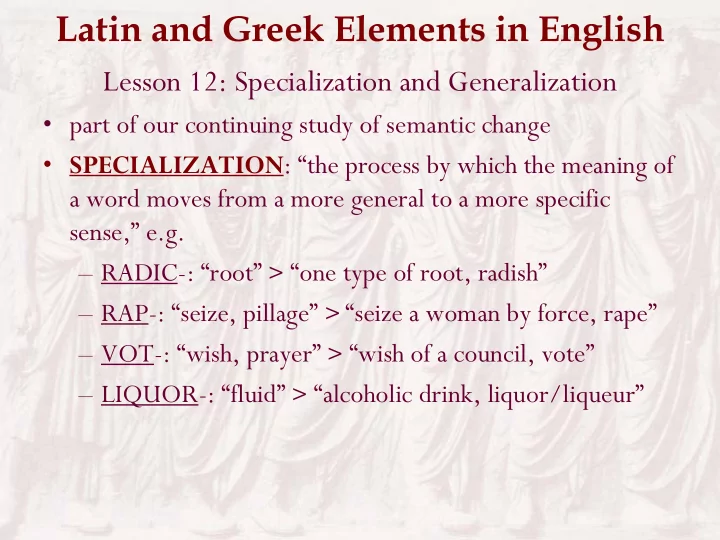
  • SPECIALIZATION: “the process by which the meaning of

a word moves from a more general to a more specific sense,” e.g. – RADIC-: “root” > “one type of root, radish” – RAP-: “seize, pillage” > “seize a woman by force, rape” – VOT-: “wish, prayer” > “wish of a council, vote” – LIQUOR-: “fluid” > “alcoholic drink, liquor/liqueur”

slide-2
SLIDE 2

Latin and Greek Elements in English

Lesson 12: Specialization and Generalization

  • GENERALIZATION: “the process by which the meaning
  • f a word moves from a more specific to a more general

sense,” e.g. – TREMENDUS: “dreadful, to be trembled at” > “awesome, huge, amazing, very good, tremendous” – COMOEDIA: “party-song, ribald verse” > “humorous drama, anything funny or comical” – TRIUMPHUS: “Roman parade in honor of a victorious general” > “military conquest, any sort of triumph”

slide-3
SLIDE 3

Latin and Greek Elements in English

Lesson 12: Specialization and Generalization

  • specialization is much more common than generalization
  • the reason for this is that English tends to use general Latin-

based terms to cover specific things for which there is no existing word – cf. the generalizations cited above were already generalized in antiquity

  • in general, language tends to move toward more specific

terminology as new things come into being and new words are needed for those new things

slide-4
SLIDE 4

Latin and Greek Elements in English

Lesson 13: Functional Change

  • FUNCTIONAL CHANGE: “the process by which a word

takes on a new usage as a different part of speech, without a change in form or the addition of a suffix”

  • vs. participles: verbs > adjectives, with the addition of a suffix

– e.g. what’s in (or out): preposition > adjective – to out someone: preposition > verb – pros and cons: (Latin) prefix/preposition > noun – to while away the time: conjunction > verb – to firm up: adjective > verb – to black out: adjective > verb

slide-5
SLIDE 5

Latin and Greek Elements in English

Lesson 13: Functional Change

  • nouns functioning as adjectives

– flower pot – noun suffix – elevator repairman – disk drive – party animal – n.b. the second/last noun is the essential thing

  • this is a very common feature of Germanic languages:

– e.g. National Laboratory Zero Power Plutonium Reactor Criticality Facility

slide-6
SLIDE 6

Latin and Greek Elements in English

Lesson 13: Functional Change

  • noun functioning as verbs

– a very common feature of English

  • because we have very few verb-forming suffixes, either from

Latin or our Germanic mother tongue

  • thus, put a noun into the verb slot of a sentence and it’s a

verb!

– e.g., to film a movie – to telephone your friend – to bag your homework – to finger a criminal

slide-7
SLIDE 7

Latin and Greek Elements in English

Lesson 13: Functional Change

  • noun functioning as verbs

– to troop around – to panhandle – to skirt an issue – to cap the enrollment in a class

slide-8
SLIDE 8

Latin and Greek Elements in English

Lesson 13: Functional Change

  • verbs functioning as noun

– to have a go at something – to make a run for the border – to have a look-see

  • not nearly as common a type of functional change in English

as the other types – because many words enter English as nouns – thus, there’s less pressure to create nouns – and with many noun-forming suffixes, it isn’t necessary to create nouns from verbs through functional change