Latin and Greek Elements in English Lessons 10-21: How Words Change - - PowerPoint PPT Presentation

latin and greek elements in english
SMART_READER_LITE
LIVE PREVIEW

Latin and Greek Elements in English Lessons 10-21: How Words Change - - PowerPoint PPT Presentation

Latin and Greek Elements in English Lessons 10-21: How Words Change with this lesson, we begin an overview of how words change form, function and meaning Lesson 10: how letters inside words change to facilitate pronunciation, e.g.

slide-1
SLIDE 1

Latin and Greek Elements in English

Lessons 10-21: How Words Change

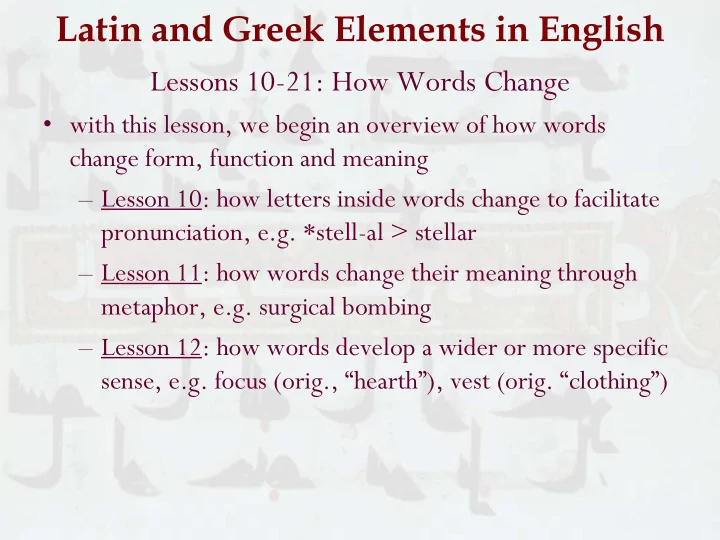
  • with this lesson, we begin an overview of how words

change form, function and meaning – Lesson 10: how letters inside words change to facilitate pronunciation, e.g. *stell-al > stellar – Lesson 11: how words change their meaning through metaphor, e.g. surgical bombing – Lesson 12: how words develop a wider or more specific sense, e.g. focus (orig., “hearth”), vest (orig. “clothing”)

slide-2
SLIDE 2

Latin and Greek Elements in English

Lessons 10-21: How Words Change

  • with this lesson, we begin an overview of how words

change form, function and meaning – Lesson 13: how words change their function (part of speech), e.g. to impact – Lesson 14: how words take on a more negative or positive connotation, e.g sensual – Lesson 15: how words move between concrete and abstract senses, e.g. inheritance

slide-3
SLIDE 3

Latin and Greek Elements in English

Lessons 10-21: How Words Change

  • with this lesson, we begin an overview of how words

change form, function and meaning – Lesson 16: how words can lose force through overuse and exaggeration, e.g.

  • unique: one of a kind > distinctive
  • thus, “more unique”?

– Lesson 17: how words evolve to meet and match a changing world, e.g. humor – Lesson 18: how words are intentionally misused to manipulate people’s feelings, e.g. casualty

slide-4
SLIDE 4

Latin and Greek Elements in English

Lessons 10-21: How Words Change

  • with this lesson, we begin an overview of how words

change form, function and meaning – Lesson 19: how the misunderstanding of verbal elements can change words, e.g. laxadaisical – Lessons 20 and 21: how words are intentionally “clipped” down and/or blended, e.g. psych exam

slide-5
SLIDE 5

Latin and Greek Elements in English

Lesson 10: Changes in Sound

  • DISSIMILATION: “the process by which two similar or

identical sounds diverge or become unlike, usually in order to facilitate pronunciation,” e.g. meridiem (< *medi-diem) – the most common form of dissimilation occurs with l/r, e.g. -ar vs. -al suffixes

  • familiar < famili-al, cf. general
  • lunar < lun-al, cf. renal

– also, -iety < *-iity

  • piety, society, anxiety, notoriety, sobriety, propriety, variety,

satiety

slide-6
SLIDE 6

Latin and Greek Elements in English

Lesson 10: Changes in Sound

  • the Latin -t(um) suffix also produces sound changes

– -t(um) = the Latin past participle

  • PARTICIPLE: “an adjective formed from a verb, in English

usually by adding -ing (present) or -ed (past) to a verb base,” e.g. preserving, preserved

  • n.b. Latin -t(um) is cognate with English -ed

– -t(um) accounts for the frequency of two forms of a base

  • e.g. TEN-/TENT- (present/past); REG-/RECT-
slide-7
SLIDE 7

Latin and Greek Elements in English

Lesson 10: Changes in Sound

  • but often with the addition of the -t(um) suffix there is a

change of sound to assist in pronunciation – LOQU- > LOCUT- (loss of w-sound next to t) – TANG- > TACT- (loss of n, g > c [unvoiced]) – also, SCRIPT- (< SCRIB-), FRACT- (< FRANG-)

slide-8
SLIDE 8

Latin and Greek Elements in English

Lesson 10: Changes in Sound

  • -t(um) sometimes changes to -s(um)

– if base ends D (Dt):

  • SED- > SESS- (sit), CID- > CIS- (cut)

– if base ends T (Tt):

  • PAT(I)- > PASS- (suffer), POT- > POSS- (be able)

– if base ends -RR (RRt):

  • CURR- > CURS- (run)
  • I tell you this to help you memorize the various forms of

bases, but if it doesn’t help, don’t worry about it!

slide-9
SLIDE 9

Latin and Greek Elements in English

Lesson 11: Semantic Change

  • SEMANTIC CHANGE: “the modification of meaning in a

word” – sema (Greek): “significance, meaning”

  • basic process: similitude > metaphor > new meaning

– see Ayers, p.76 – e.g. carrothead, egghead, meathead

  • METAPHOR: “an implied comparison between two

things,” e.g. “All the world’s a stage …” – the arm of a chair, the butt of a rifle, a ship plowing through waves, head over heels

slide-10
SLIDE 10

Latin and Greek Elements in English

Lesson 11: Semantic Change

  • metaphor runs our lives, e.g. your business career:

– at first, you go with the flow – you gear up – but then you have a cow – you push the envelope – you go into a feeding frenzy – you reach for the stars – to be the top dog – to be the big cheese

slide-11
SLIDE 11

Latin and Greek Elements in English

Lesson 11: Semantic Change

  • metaphor runs our lives, e.g. your business career:

– to eat the whole enchilida – but then you come unglued – you push the panic button – you go into a nose dive – then you go on a bender – so you have to go on the wagon – you have to dry out – and then you go back to the drawing board

slide-12
SLIDE 12

Latin and Greek Elements in English

Lesson 11: Semantic Change

  • there are also many “dead” metaphors in modern English

– i.e. metaphors for which the thing being referenced no longer exists

  • though once these expressions had vivid currency

– e.g. inoculate: “to insert the bud (“eye”) of one plant into another” – delirium: “to be out of one’s furrow,” cf. off your rocker – limelight: “a spotlight produced by incandescent lime”

slide-13
SLIDE 13

Latin and Greek Elements in English

Lesson 11: Semantic Change

  • R.W. Emerson, Essays: Second Series, “The Poet”:

For though the origin of most of our words is forgotten, each word was at first a stroke of genius, and obtained currency because for the moment it symbolized the world to the first speaker and to the

  • hearer. The etymologist finds the deadest word to have been once a

brilliant picture. Language is fossil poetry. As the limestone of the continent consists of infinite masses of the shells of animalcules, so language is made up of images or tropes, which now, in their secondary use, have long ceased to remind us of their origin.

slide-14
SLIDE 14

Latin and Greek Elements in English

Lesson 11: Semantic Change

  • but this “fossil poetry” is often the very source of difficulty

in deducing the figurative meaning of a word from its literal components – it’s necessary to understand the “images and tropes” that gave rise to the word originally in order to determine the way in which a word is used today

slide-15
SLIDE 15

Latin and Greek Elements in English

Lesson 11: Semantic Change

  • in this class, that means knowing ancient Latin metaphors

which come from those spheres of life which were more important in their world – principally, military and agricultural contexts – but also law, medicine, engineering, religion and trade

  • we’ll spend a whole class period before the midterm

looking at both the concept of metaphor itself and the dominant metaphors that entered English through Latin derivatives

slide-16
SLIDE 16

Latin and Greek Elements in English

Lesson 11: Semantic Change GO TO EXERCISE IV (Lesson 10), p. 75 GO TO EXERCISE IV (Lesson 11), p. 82