Latin and Greek Elements in English Lessons 1 and 2: Overview of - - PowerPoint PPT Presentation

latin and greek elements in english
SMART_READER_LITE
LIVE PREVIEW

Latin and Greek Elements in English Lessons 1 and 2: Overview of - - PowerPoint PPT Presentation

Latin and Greek Elements in English Lessons 1 and 2: Overview of Greek Civilization Prehistory Indo-European Invasions earliest known inhabitants are the mysterious Pelasgians some ancient Greek words/names may be Pelasgian in


slide-1
SLIDE 1

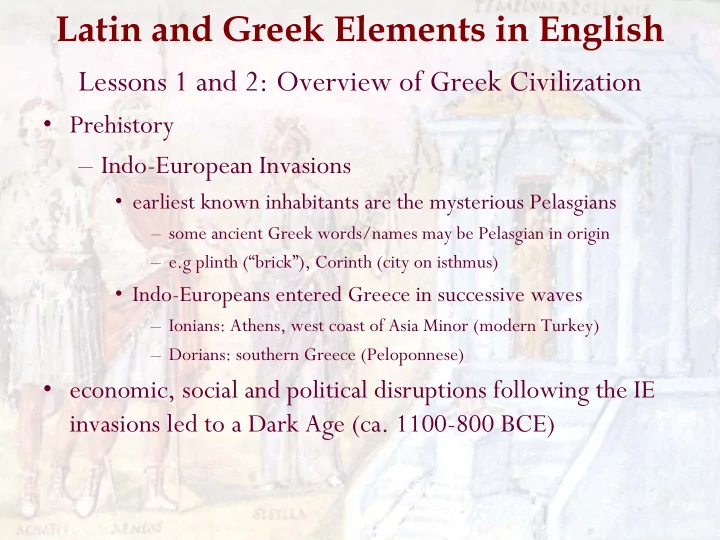
Latin and Greek Elements in English

Lessons 1 and 2: Overview of Greek Civilization

  • Prehistory

– Indo-European Invasions

  • earliest known inhabitants are the mysterious Pelasgians

– some ancient Greek words/names may be Pelasgian in origin – e.g plinth (“brick”), Corinth (city on isthmus)

  • Indo-Europeans entered Greece in successive waves

– Ionians: Athens, west coast of Asia Minor (modern Turkey) – Dorians: southern Greece (Peloponnese)

  • economic, social and political disruptions following the IE

invasions led to a Dark Age (ca. 1100-800 BCE)

slide-2
SLIDE 2

Latin and Greek Elements in English

slide-3
SLIDE 3

Latin and Greek Elements in English

Lessons 1 and 2: Overview of Greek Civilization

  • many Greek myths have their dramatic setting during the

age of the Indo-European invasions and the Dark Age

  • Trojan War cycle (ca. 1185 BCE)

– The Iliad: the story of the sack of Troy by the Greeks

  • Achilles [Achilles’ heel]: invulnerable except for his heel
  • Cassandra: the prophetess whose predictions of doom are

ignored

– The Odyssey: Odysseus (Ulysses) wanders around the Mediterranean Sea for ten years before returning home

  • while his son and wife wait patiently at home
  • one of his few loyal supporters is Mentor, his son’s tutor
slide-4
SLIDE 4

Latin and Greek Elements in English

Lessons 1 and 2: Overview of Greek Civilization

  • Greek religion

– Olympian gods

  • Zeus: the aegis is his protective shield
  • Apollo: hymns to Apollo are called paeans

– also, older demon-gods

  • giants called Titans, e.g. Atlas who holds up the sky
  • blood-demons, e.g. Nemesis, the goddess of retribution
slide-5
SLIDE 5

Latin and Greek Elements in English

Lessons 1 and 2: Overview of Greek Civilization

  • many myths based on local legends, e.g.

– Athens: Theseus and the labyrinth

  • Theseus kills Procrustes who makes his guests “fit” his bed

(Procrustean)

  • Theseus marries an Amazon queen

– Asia Minor (modern Turkey)

  • Tantalus punished in Hades (tantalize)
  • Narcissus fascinated with his own reflection (narcissism)
  • Venus loves Adonis but he dies

– Thessaly (northern Greece)

  • Ceyx and his wife Alcyone become sea-birds (halcyon)
slide-6
SLIDE 6

Latin and Greek Elements in English

Lessons 1 and 2: Overview of Greek Civilization

  • Greek history begins in earnest after the Dark Age (1100-

800 BCE)

  • ca. 800-700 BCE: the Homeric Age

– also, the time of the re-emergence of writing and the earliest use of the Greek alphabet

  • 700-500 BCE: the rise of the Greek polis (“city-state”)

– e.g. Athens, Thebes, Corinth – Sparta in the area of Laconia: laconic

  • Spartan message intercepted after a naval disaster: “Ships lost.

Commander dead. Men starving. Please advise.”

slide-7
SLIDE 7

Latin and Greek Elements in English

Lessons 1 and 2: Overview of Greek Civilization

  • 700-500 BCE: also known as the Age of Tyrants

– at some point, most city-states are ruled by a single powerful man who seizes control through military action – in some cases, these “tyrants” are law-givers

  • so this is also called the Age of Law-givers
  • writing led to the codification of nomoi (“customs,” later “law”)
  • Athens had two important early law-givers:

– Draco (ca. 620 BCE): very severe laws (Draconian) – Solon (ca 580 BCE): much fairer laws (solon)

slide-8
SLIDE 8

Latin and Greek Elements in English

Lessons 1 and 2: Overview of Greek Civilization

  • 700-500 BCE: also known as the Age of Colonization

– Greeks send out colonies all around the Mediterrean Sea

  • had an excellent merchant marine

– from Sicily to the coastal regions of the Black Sea

  • also, Asia Minor: e.g. Soli (SE Asia Minor) where sub-standard

Greek was spoken (solecism)

  • and also southern Italy (“Magna Graecia”): e.g., Sybaris well-

known for a decadent lifestyle (sybarite)

slide-9
SLIDE 9

Latin and Greek Elements in English

Lessons 1 and 2: Overview of Greek Civilization

  • The Classical Age (500-400 BCE)

– Athens assumes political and cultural prominence

  • begins with the establishment of democracy (510-500 BCE)
  • including ostracism

– The Persian Wars: 490/481-79 BCE

  • rise of independence, wealth and prestige for the Greeks
  • also fostered growth in the arts: tragedy, painting, sculpture
slide-10
SLIDE 10

Latin and Greek Elements in English

Lessons 1 and 2: Overview of Greek Civilization

  • The Classical Age (500-400 BCE)
  • also, the growth of philosophy

– at first imported from Asia Minor via sophists

  • some of these sophists challenge traditional morality

(sophistry)

– Socrates and Plato attempt to respond to this challenge

  • Plato founds a philosophical school called the Academy
  • the Classical Age ends with the Peloponnesian War (431-

404 BCE): Sparta vs. Athens – essentially a civil war in which Sparta defeats Athens

slide-11
SLIDE 11

Latin and Greek Elements in English

Lessons 1 and 2: Overview of Greek Civilization

  • Post-Classical Greece (404-323 BCE)

– in the fourth century, the Greeks lapsed back into civil war: Sparta vs. Thebes vs. Athens – this allows the Macedonians in the north to build up their empire

  • Philip II defeated the combined Greek forces at the Battle of

Chaeronea (338 BCE)

  • he was hated by the southern Greeks, especially the famous

Athenian orator Demosthenes (philippic)

  • but he was assassinated shortly thereafter (336 BCE)
slide-12
SLIDE 12

Latin and Greek Elements in English

Lessons 1 and 2: Overview of Greek Civilization

  • Alexander the Great (356-323 BCE)

– 336 BCE: Alexander (Philip’s son) inherited the burgeoning Macedonian empire – 333 BCE: Alexander launched an attack on the vast Persian Empire to the east of Greece

  • he swept in only a few years across Asia Minor, the eastern

seaboard of the Mediterranean Sea and Egypt

  • then he took Persia and western India, only to die of disease in

Babylon (323 BCE)

  • his adventures left behind many stories (the Gordian knot)
slide-13
SLIDE 13

Latin and Greek Elements in English

Lessons 1 and 2: Overview of Greek Civilization

  • Hellenistic Greece (after 323 BCE)

– Alexander’s generals carved up his domain – but they turned out to be petty tyrants compared to him

  • e.g. Pyrrhus who was the first Greek general to fight the

Romans in Italy (Pyrrhic victory)

  • Damocles in Sicily (the sword of Damocles)

– though richer than ever before, the Greeks were shaken to the core by their successes which exposed them to the world at large and many new religions and ways of life

slide-14
SLIDE 14

Latin and Greek Elements in English

Lessons 1 and 2: Overview of Greek Civilization

  • Later Greek Philosophy: the new way of life demanded new

ways to thinking – Stoicism: withdrawal from emotional attachment and devotion to duty and public service (stoic) – Epicureanism: withdrawal from all forms of strife and pain and devotion to pleasure (epicure/epicurean) – Cynicism: rejection of all material rewards and the world at large (cynic)

slide-15
SLIDE 15

Latin and Greek Elements in English

Lessons 1 and 2: Overview of Greek Civilization

  • starting around 200 BCE, the Romans conquered the

Greeks and the rest of the eastern Mediterranean basin

  • ultimately, Roman and Greek culture merged to create

Greco-Roman culture – and this culture was then passed on to us across the Middle Ages – which explains why there are so many aspects of Greek culture to be found in Roman art, drama, literature — and especially words!

slide-16
SLIDE 16

Latin and Greek Elements in English

Lessons 1 and 2: Overview of Greek Civilization PLEASE GO TO AYERS, PAGE 161