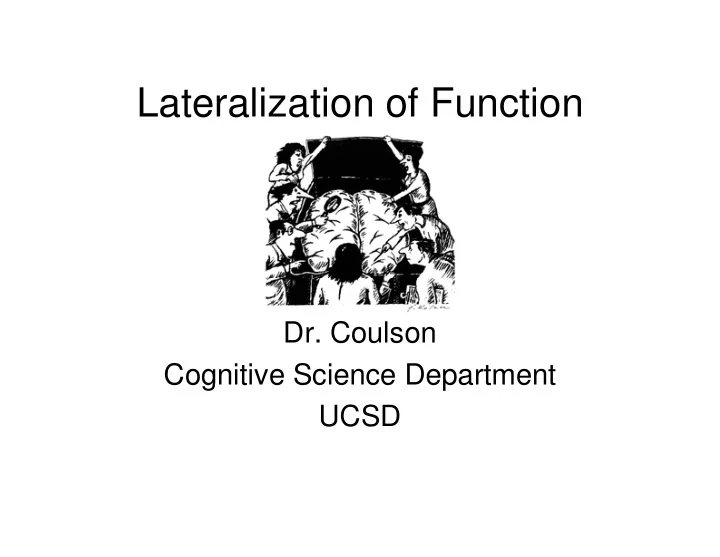
Lateralization of Function Dr. Coulson Cognitive Science Department - - PowerPoint PPT Presentation

lateralization of function
SMART_READER_LITE
LIVE PREVIEW

Lateralization of Function Dr. Coulson Cognitive Science Department - - PowerPoint PPT Presentation

Lateralization of Function Dr. Coulson Cognitive Science Department UCSD Human Brain An extension of the spinal cord Cerebral Hemispheres Corpus Callosum Cartoon View of Brain Cerebral Lobes Neurons Brain composed of neurons


slide-1
SLIDE 1

Lateralization of Function

  • Dr. Coulson

Cognitive Science Department UCSD

slide-2
SLIDE 2

Human Brain

  • An extension of the spinal cord
slide-3
SLIDE 3

Cerebral Hemispheres

slide-4
SLIDE 4

Corpus Callosum

slide-5
SLIDE 5

Cartoon View of Brain

slide-6
SLIDE 6

Cerebral Lobes

slide-7
SLIDE 7

Neurons

  • Brain composed of

neurons

– 100 billion

  • Neurons both send and

receive signals to other receive signals to other cells in form of pulses

  • Important parts

– Cell body – Axon – Synapse

slide-8
SLIDE 8

Connectivity

  • Each neuron

connected to 10,000

  • ther neurons
  • Point of contact is the
  • Point of contact is the

synapse

  • Computing power of

brain comes from connections

slide-9
SLIDE 9

Cortex

  • Two millimeters thick and has area of 1.5

square meters

slide-10
SLIDE 10

Cartoon View: Frontal Lobe

  • In front of central

sulcus

  • Decisions, judgments,

emotions emotions

slide-11
SLIDE 11

Cartoon View: Parietal Lobe

  • Behind central sulcus
  • Perception of stimuli

related to touch, pressure, pressure, temperature, pain

slide-12
SLIDE 12

Cartoon View: Temporal Lobe

  • Below lateral fissure
  • Perception,

recognition, auditory processing processing

slide-13
SLIDE 13

Cartoon View: Occipital Lobe

  • Located at back of

brain, behind the parietal lobe and temporal lobe

  • Vision
slide-14
SLIDE 14

Lateralization of Function

  • One side of the brain is

more crucial for a given function and/or more efficient at the underlying computational tasks

  • Typically a matter of
  • Typically a matter of

degree

– Strongly vs. Weakly Lateralized

  • Motor control a good

example of a lateralized function

slide-15
SLIDE 15

Sensorimotor Cortex

slide-16
SLIDE 16
slide-17
SLIDE 17

Motor Control

slide-18
SLIDE 18

What about language?

  • Language is a paradigmatic example of a

lateralized cognitive phenomenon

slide-19
SLIDE 19

Wada Test

slide-20
SLIDE 20

Lateralization of Function

  • Most evidence of

lateralized brain function comes from

  • bserving how brain

damage affects behavior on various sorts of cognitive tasks

slide-21
SLIDE 21

Paul Broca

  • 19th century French neurologist
  • Star patient: Leborgne
  • Understood most of what was said to him
  • Able to eat, drink (move mouth and tongue)
  • Only utterance was “tan”
slide-22
SLIDE 22

Broca’s Discovery

  • Leborgne’s brain had damage

to the lower rear portion of frontal lobe, lower front portion

  • f parietal lobe, and upper part
  • f the temporal lobe
  • Broca deemed frontal lobe

damage most important damage most important

  • Aphasia – partial or total loss
  • f ability to articulate ideas due

to brain damage

  • Broca’s Area – lower rear

portion of frontal lobe, adjacent to motor cortex

– Inferior frontal gyrus – Brodmann’s Areas 44/45

slide-23
SLIDE 23

Brodmann’s Areas

  • Korbinian Brodmann examined brain cells with various

stains designed to detect chemical differences between areas

  • Brain areas defined by cytoarchitectonic characteristics

known as Brodmann’s Areas

– 52 areas in the human brain (though some subdivided into a, b, – 52 areas in the human brain (though some subdivided into a, b, etc)

slide-24
SLIDE 24

Broca’s Aphasia

  • M.E. Cinderella...poor...um 'dopted her...scrubbed floor, um, tidy...poor,

um...'dopted...Si-sisters and mother...ball. Ball, prince um, shoe...

  • Examiner Keep going.
  • M.E. Scrubbed and uh washed and un...tidy, uh, sisters and mother, prince,

no, prince, yes. Cinderella hooked prince. (Laughs.) Um, um, shoes, um, twelve o'clock ball, finished.

  • Examiner So what happened in the end?
  • Examiner So what happened in the end?
  • M.E. Married.
  • Examiner How does he find her?
  • M.E. Um, Prince, um, happen to, um...Prince, and Cinderalla meet, um met

um met.

  • Examiner What happened at the ball? They didn't get married at the ball.
  • M.E. No, um, no...I don't know. Shoe, um found shoe...
slide-25
SLIDE 25

Wernicke’s Aphasia

  • 1871 Karl Wernicke

reported a different sort of language disorder

  • Symptoms

– Talk fluently, excessively – Use made up words – Don’t understand, in spite of intact hearing

slide-26
SLIDE 26

Wernicke’s Area

slide-27
SLIDE 27

Wernicke’s Area

slide-28
SLIDE 28

Wernicke’s Aphasic

  • C.B. Uh, well this is the ... the /dodu/ of this. This and this and this

and this. These things going in there like that. This is /sen/ things

  • here. This one here, these two things here. And the other one here,

back in this one, this one /gesh/ look at this one.

  • Examiner: Yeah, what's happening there?
  • C.B. I can't tell you what that is, but I know what it is, but I don't

know where it is. But I don't know what's under. I know it's you know where it is. But I don't know what's under. I know it's you couldn't say it's ... I couldn't say what it is. I couldn't say what that is. This shu-- that should be right in here. That's very bad in there. Anyway, this one here, and that, and that's it. This is the getting in here and that's the getting around here, and that, and that's it. This is getting in here and that's the getting around here, this one and

  • ne with this one. And this one, and that's it, isn't it? I don't know

what else you'd want.

  • Describing a picture of a child taking a cookie
slide-29
SLIDE 29

Pop Quiz

slide-30
SLIDE 30

Pop Quiz

slide-31
SLIDE 31

Sex Differences

  • Women more vulnerable

to aphasia after damage to frontal lobe

  • Men more vulnerable to

aphasia after damage to aphasia after damage to parietal and temporal lobe areas

  • Similar sex differences in

apraxia, impairment in voluntary motions

slide-32
SLIDE 32

Wernicke-Geschwind Model

  • Broca’s Area stores

motor representation of speech

  • Wernicke’s Area stores

auditory representation of auditory representation of speech sounds

  • Connected by fiber tract

known as arcuate fasiculus

  • Considered an
  • versimplified model
slide-33
SLIDE 33

Wernicke-Geschwind Model: Repeating a Spoken Word

slide-34
SLIDE 34

Reading a Written Word

slide-35
SLIDE 35

Concepts Motor word Comprehension Auditory word Comprehension Association Cortex Ventral prefrontal cortex X Arcuate Posterior Temporal Cortex

Broca’s Aphasia

Comprehension Comprehension Speech motor output Auditory input

X

Arcuate Fasciculus

psychology.rutgers.edu/~rypma/

slide-36
SLIDE 36

Concepts Motor word Comprehension Auditory word Comprehension Association Cortex Ventral prefrontal cortex

X

Arcuate Posterior Temporal Cortex

Wernicke’s Aphasia

Comprehension Comprehension Speech motor output Auditory input

X

Arcuate Fasciculus

psychology.rutgers.edu/~rypma/

slide-37
SLIDE 37

Concepts Motor word Comprehension Auditory word Comprehension Association Cortex Ventral prefrontal cortex

X

Arcuate Posterior Temporal Cortex

Conduction Aphasia

Comprehension Comprehension Speech motor output Auditory input

X

Arcuate Fasciculus

psychology.rutgers.edu/~rypma/

slide-38
SLIDE 38

Reprise

  • Wada Test
  • Broca’s Aphasia
  • Wernicke’s Aphasia
  • Conduction Aphasia
  • But remember, these models are

cartoons…