SLIDE 1
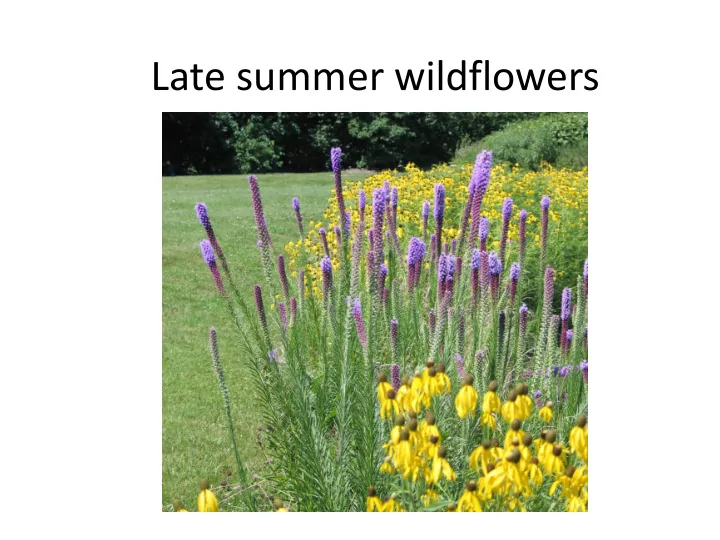
Late summer wildflowers
SLIDE 2
Fall-Winter
SLIDE 3
Wildflowers, grasses, tiny lawn!
SLIDE 4
Naturalized area
SLIDE 5
DEEP natural border (the way borders are supposed to be!)
SLIDE 6
Hudson River Valley has some of the most beautiful natural places
SLIDE 7
Flowers in my butterfly-bee-bird garden, first year
SLIDE 8
SLIDE 9 Some reasons to plant native gardens
- 1. Maintenance – save time and $$$
- 2. Conserve water
- 3. Prevent water and air pollution
- 4. Control pests without chemicals
- 5. Save pollinators from pesticides
- 6. Save water animals from pesticides and fertilizers.
- 7. Reduce noise pollution
- 8. Attract wildlife and give it food, shelter, nesting
habitat
- 9. Reduce habitat loss
- 10. Refuel your innate connection with Nature
- 11. Other?
SLIDE 10
Monarch on Milkweed (Asclepias), where it lays its eggs
SLIDE 11
Swallowtail butterfly (mature)
SLIDE 12
Native tree - Sassafras leaves (mittens)
SLIDE 13
Spicebush drupes
SLIDE 14
Spicebush flowers
SLIDE 15
Spicebush
(Lindera benzoin)
SLIDE 16
Spicebush (mature)
SLIDE 17
Swallowtail butterfly larvae (feeds only on Spicebush and Sassafras)
SLIDE 18
A standoff: who’s scaring whom?
SLIDE 19
‘Wild’life that can live in the garden
SLIDE 20 Some excellent native plants
- (SHRUBS)
- Spicebush
- Clethra alnifolia
- Solidago (goldenrod)
- Asclepias (for monarchs)
- Joe Pye Weed
- Aralia spinosa (attracts bluebirds)
- Winterberry
- Late bottlebrush buckeye
- Oakleaf hydrangea
- (continued)
SLIDE 21 Some excellent native plants (cont.)
- (TREES)
- Prunus Serotina (native black cherry)
- Sweetbay magnolia
- Green hawthorn
- Amelanchier
- White fringetree
- Franklinia
- Smoketree
- OAKS!
- (VINES) Lonicera, Campsis radicans (hummingbirds)
SLIDE 22
(Native) Oakleaf hydrangea – species form
SLIDE 23
Muhly grass
SLIDE 24
Equisetum ‘living wall’
SLIDE 25
Bottlebrush buckeye flowers
SLIDE 26
Native: Cercis canadensis (redbud)
SLIDE 27 Landscape Principles
- 1. Right plant, right place
- 2. Intentional, unified; not piecemeal. Some repetition
- f plants
- 3. Variety of shape, sizes, textures, leaf and flower
colors
- 4. Massing
- 5. Layering
- 6. 4-season interest: blooms, bark, berries,
architecture
- 7. Sequential interest/color. Something standing out
at any particular time.
SLIDE 28
“Natural,” but sedums aren’t native
SLIDE 29
NAG at National Arboretum
SLIDE 30
NAG: Non-natives looking native
SLIDE 31
NAG: layering and massing
SLIDE 32
NAG: mid-summer
Aster, Joe Pye weed, Sedum, River birch
SLIDE 33
NAG: Limestone fountain on uncrowded hillside, early spring
SLIDE 34
NAG: Massing made simple
SLIDE 35
NAG: Molinaria, Liriope, Hypericum calycinum (St.
John’s Wort), Russian sage, Astilbe, Pennisetum (Oriental fountain grass)
SLIDE 36
NAG: bordered walkway, late summer: Artemisia ‘Silver Mound,’ Hibiscus moscheutos, Yucca pendula, upright Calamagrostis and larger Miscanthus grasses
SLIDE 37
NAG: blurred edges, backlighting, Liatris, various grasses, & juniper
SLIDE 38 Favorite perennials of the New American Garden
- Aralia racemosa
- Coreopsis verticillata
- Joe Pye Weed
- Hibiscus moscheutos
- Liatris
- Lythrum (not invasive here)
- Black-eyed Susan
- Yucca filimentosa
- Deschampsia (tufted hair grass)
- Panicum and Miscanthus grasses
- Amelanchier (large shrub or small tree)
- Hypericum calycinum
SLIDE 39 Favorite Perennials of the New American Garden (continued)
- Artemisia ‘Silver Mound’
- Aster x frikartii
- Astilbe taquetii
- Caryopteris x clandonensis
- Daylily ‘Stella d’Oro’
- Hosta
- Hypericum (St. John’s Wort – several sizes)
- Ligularia
- Lambs ears
SLIDE 40
Containers can have impact
SLIDE 41
A deck corner has its own ‘wildness’ with containers & hummer feeder (unseen)
SLIDE 42
Exquisite annual hydrangea
SLIDE 43
A simple patio made colorful with just a few annuals in containers
SLIDE 44
Old front stoop gets a facelift
SLIDE 45 Maple shaped leaves and nodding orange,
- ld-fashioned flowers: a prairie look?
SLIDE 46 A few additional favorites of mine
- Nandina domestica species form
- Mahonia bealii
- Perennial plumbago
- Perennial begonia
- TREES (not exhaustive) Franklinia, Hawthorne
‘Winter King,’ River Birch, Sweetbay magnolia
- Hakone grass
- ‘Nellie Stevens’ holly
SLIDE 47
Achillea (looks native to me!)
SLIDE 48
Fall Japanese Maple colors
(not native but can’t live without them)
SLIDE 49
Begonia grandis, Hakone grass, Japanese painted fern in SHADE
SLIDE 50
Begonia grandis / liriope vignette
SLIDE 51
Perennial plumbago – fabulous groundcover w/red fall color too
SLIDE 52
Peonies
(not native, but can’t live without them!)
SLIDE 53
Lily-of-the-valley
The heavenly fragrance goes with me to the bridge table
SLIDE 54
Oh--and the lilacs go to the table with me, too
SLIDE 55 CRAPEMYRTLE ‘Chickasaw’
- nly grows to 1-3 feet high!
SLIDE 56
“Natural” or “native”
SLIDE 57
Wildflowers – prairie effect
SLIDE 58
More natural walkway Front of house!
SLIDE 59
Natural woodland floor – but designed
SLIDE 60
If they spread into the lawn area their orderly garden would look even more natural
SLIDE 61
BE CREATIVE! Boulder art
SLIDE 62 My dream: wildlife and whimsy in the same garden.
Put YOUR wild ideas in YOUR garden
SLIDE 63 National Wildlife Foundation’s “Certified Wildlife Habitat” Garden
- Contains:
- - sustainable habitat
- - water source(s)
- - nesting boxes
- - FOOD of various kinds, for various creatures
- - cover for wildlife to escape view
- - places to raise young
- - sustainable, natural planting & maintenancepractices