Last Time Both BFS and DFS are 2 ways to find all the connected - - PowerPoint PPT Presentation

last time
SMART_READER_LITE
LIVE PREVIEW

Last Time Both BFS and DFS are 2 ways to find all the connected - - PowerPoint PPT Presentation

1 Last Time Both BFS and DFS are 2 ways to find all the connected components in a graph. It doesn t matter what node we start at when we look for a connected component. The trees constructed will generally look different based on the


slide-1
SLIDE 1

Last Time

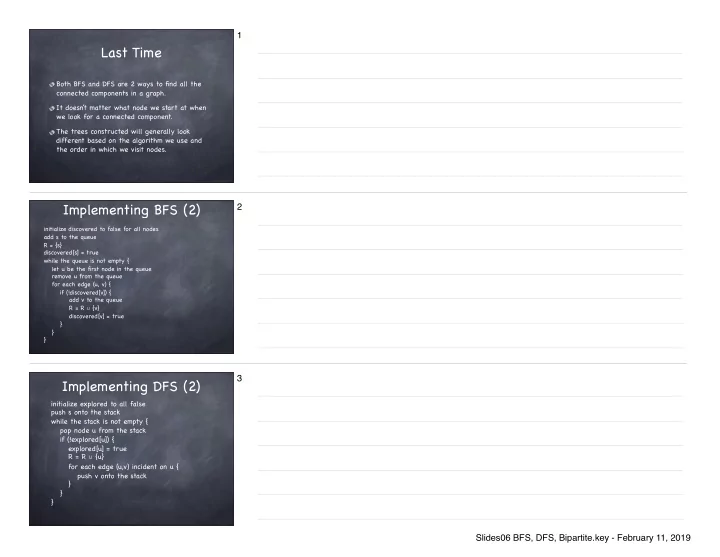
Both BFS and DFS are 2 ways to find all the connected components in a graph. It doesn’ t matter what node we start at when we look for a connected component. The trees constructed will generally look different based on the algorithm we use and the order in which we visit nodes.

1

Implementing BFS (2)

initialize discovered to false for all nodes add s to the queue R = {s} discovered[s] = true while the queue is not empty { let u be the first node in the queue remove u from the queue for each edge (u, v) { if (!discovered[v]) { add v to the queue R = R ∪ {v} discovered[v] = true } } }

2

Implementing DFS (2)

initialize explored to all false push s onto the stack while the stack is not empty { pop node u from the stack if (!explored[u]) { explored[u] = true R = R ∪ {u} for each edge (u,v) incident on u { push v onto the stack } } }

3 Slides06 BFS, DFS, Bipartite.key - February 11, 2019

slide-2
SLIDE 2

Representing Graphs: Adjacency Matrix

1 3 5 4 2

Adjacency matrix. n-by-n matrix with Auv = 1 if (u, v) is an edge. Two representations of each edge. How much memory? How long does it take to find out if a specific edge exists? How long does it take to find all edges incident on a node?

1 2 3 4 5 1 0 1 0 1 1 2 1 0 1 1 3 0 1 0 0 1 4 1 1 0 0 0 5 1 0 1 0 0

4

Representing Graphs: Adjacency List

Adjacency list. Node indexed array of lists. Two representations of each edge. How much memory? How long to find a specific edge? How long to find all edges incident on a node?

1 3 5 4 2

1 2 3 4 5 2 4 5 1 3 4 2 5 1 2 1 3

5

Implementing BFS (2)

initialize discovered to false for all nodes add s to the queue R = {s} discovered[s] = true while the queue is not empty { let n be the first node in the queue remove n from the queue while there are more nodes in n’ s adjacency list { let n2 be the next node in n’ s adjacency list if (!discovered[n2]) { add n2 to the queue R = R ∪ {n2} discovered[n2] = true } } }

6 Slides06 BFS, DFS, Bipartite.key - February 11, 2019

slide-3
SLIDE 3

Runtime Analysis

initialize discovered to all false add s to the queue R = {s} discovered[s] = true while the queue is not empty { let n be the first node in the queue remove n from the queue while there are more nodes in n’ s adjacency list { let n2 be the next node in n’ s adjacency list if (!discovered[n2]) { add n2 to the queue R = R ∪ {n2} discovered[n2] = true } } }

7

Implementing DFS (2)

initialize explored to all false push s onto the stack while the stack is not empty { pop node u from the stack if (!explored[u]) { explored[u] = true R = R ∪ {u} for each edge (u,v) incident on u { push v onto the stack } } }

8

Runtime Analysis

initialize explored to all false push s onto the stack while the stack is not empty { pop node u from the stack if (!explored[u]) { explored[u] = true R = R ∪ {u} for each edge (u,v) incident on u { push v onto the stack } } }

9 Slides06 BFS, DFS, Bipartite.key - February 11, 2019

slide-4
SLIDE 4

Summary

Adjacency lists generally use less memory and are faster than adjacency matrices BFS and DFS differ only in the order in which nodes are visited and have cost O(m+n)

10

Party Problem

You want to throw a party at which there are no pairs of guests that do not get along. You want to invite as many guests as possible. How would you solve this?

11

The party problem

Represent each guest as a node Draw an edge between guests who do not get along Find the largest set of nodes where there is no edge between any pair of nodes in the set

Alice Greta Freida Eunice Dorothy Cheryl Brenda

12 Slides06 BFS, DFS, Bipartite.key - February 11, 2019

slide-5
SLIDE 5

Bipartite Graphs

A bipartite graph is an undirected graph G = (V, E) in which the nodes can be colored red or blue such that every edge has one red and one blue end.

is a bipartite graph is NOT a bipartite graph

13

A bipartite solution

Alice Greta Freida Eunice Dorothy Cheryl Brenda

14

A bipartite solution

Alice Greta Freida Eunice Dorothy Cheryl Brenda

15 Slides06 BFS, DFS, Bipartite.key - February 11, 2019

slide-6
SLIDE 6

A bipartite solution

Alice Greta Freida Eunice Dorothy Cheryl Brenda

16

A bipartite solution

Alice Greta Freida Eunice Dorothy Cheryl Brenda

17

A bipartite solution

Alice Greta Freida Eunice Dorothy Cheryl Brenda

18 Slides06 BFS, DFS, Bipartite.key - February 11, 2019

slide-7
SLIDE 7

A bipartite solution

Alice Greta Freida Eunice Dorothy Cheryl Brenda

19

A bipartite solution

Alice Greta Freida Eunice Dorothy Cheryl Brenda

20

A bipartite solution

Alice Greta Freida Eunice Dorothy Cheryl Brenda

Who should you invite?

21 Slides06 BFS, DFS, Bipartite.key - February 11, 2019

slide-8
SLIDE 8

Layer 1 Layer 2 Layer 3 Layer 4 Layer 0

BFS and Bipartite Graphs

  • Lemma. Let G be a connected graph, and let L0, …, Lk be the

layers produced by BFS starting at node s. Exactly one of the following holds. (i) No edge of G joins two nodes of the same layer, and G is bipartite. (ii) An edge of G joins two nodes of the same layer, and G contains an odd-length cycle (and hence is not bipartite).

Alice Greta Freida Eunice Dorothy Cheryl Brenda

22

BFS and Bipartite Graphs

Layer 1 Layer 2 Layer 3 Layer 4 Layer 0

  • Lemma. Let G be a connected graph, and let L0, …, Lk be the

layers produced by BFS starting at node s. Exactly one of the following holds. (i) No edge of G joins two nodes of the same layer, and G is bipartite. (ii) An edge of G joins two nodes of the same layer, and G contains an odd-length cycle (and hence is not bipartite).

Alice Greta Freida Eunice Dorothy Cheryl Brenda

23 Slides06 BFS, DFS, Bipartite.key - February 11, 2019