Laser Bathymetry Preliminary results 18 September 2013 Laser - - PowerPoint PPT Presentation

laser bathymetry
SMART_READER_LITE
LIVE PREVIEW

Laser Bathymetry Preliminary results 18 September 2013 Laser - - PowerPoint PPT Presentation

Contents Project description Goals Current status Laser Bathymetry Preliminary results 18 September 2013 Laser Bathymetry 2 Project description Project description Laserbathymetry is in use in hydrography Principle of


slide-1
SLIDE 1

1 Laser Bathymetry

18 September 2013

2

Contents

  • Project description
  • Goals
  • Current status
  • Preliminary results

Laser Bathymetry

Project description

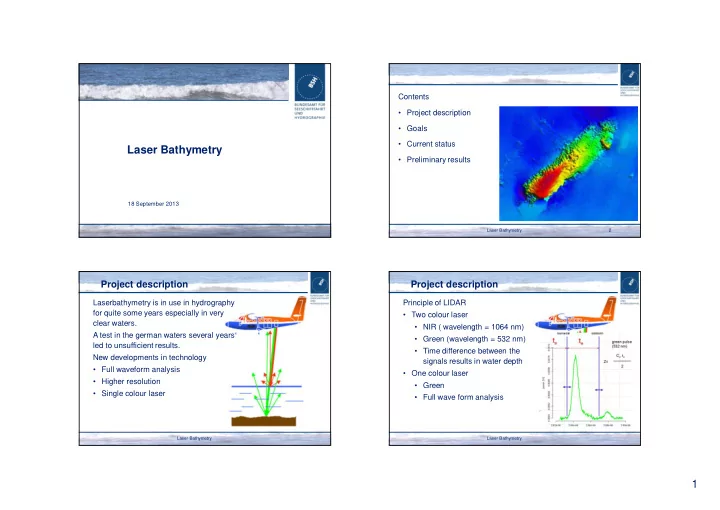
Laserbathymetry is in use in hydrography for quite some years especially in very clear waters. A test in the german waters several years led to unsufficient results. New developments in technology

  • Full waveform analysis
  • Higher resolution
  • Single colour laser

Laser Bathymetry

Project description

Principle of LIDAR

  • Two colour laser
  • NIR ( wavelength = 1064 nm)
  • Green (wavelength = 532 nm)
  • Time difference between the

signals results in water depth

  • One colour laser
  • Green
  • Full wave form analysis

Laser Bathymetry

slide-2
SLIDE 2

2

Project description

  • Duration from 2012 to 2014;
  • Contracted partner is the

Leibnitz University in Hannover (IPI);

  • 3 independend flights

(November 2012, September 2013, Spring 2014)

  • Comparison with regular

surveys;

  • Associated partners support

with their know-how;

  • One test area;
  • Different operating heights.

Laser Bathymetry

Project description

Technical aspects:

  • Large footprints due to beam

divergence, ½ water depth

  • High resolution versus high

penetration of water column i.e. 138 kHz – 4 kHz

Laser Bathymetry

Project goals

The main goals are (1)

  • To derive clear and detailed figures of the quality depending
  • n a.o.:
  • visibility
  • topography
  • sea floor conditions
  • time of year
  • weather conditions
  • influence of operating altitude

Laser Bathymetry

Project goals

The main goals are (2)

  • To what extend objects can be detected
  • What are the maximum and minimum depth
  • Whether a coastline can be derived
  • To do a market survey
  • How expensive is such a survey

Finally, to identify the areas in which that technology can be used economically, especially in cooperation with other agencies.

Laser Bathymetry

slide-3
SLIDE 3

3

Current status

Laser Bathymetry Trends in der Seevermessung

Projekt Laserbathymetrie

Test Site:

  • 345 m²
  • 4 overlapping areas
  • Different directions
  • Wrecks and obstructions
  • Waterdepth 0 to 20 m
  • Land area included
  • Rough topography
  • Boulders
  • different sea floor

characteristics

  • Measured Secchi-depth

Trends in der Seevermessung

Von der TKS zur GDI

Das Ergebnis ist ein Modell; es beschreibt den Meeresboden und die Wattflächen gut trotz Vertikallotungen; Standardprodukt für die Geodateninfrastruktur (GDI): Gittermodell 50m Raster umfasst jeweils die aktuellsten Vermessungen des BSH.

Laser Bathymetry

Current status

Systems used A test site has been decided on. A first flight took place in November 2012, where the system Riegl VQ-820G was used. Flight altitudes:

  • Flights in 300, 400, 500, 600 and 700 meters
  • Some limitations due to laser class

The next flight is scheduled for this month with AHAB Chiroptera and Hawk Eye II. One more flight is planned for spring 2014.

Laser Bathymetry

slide-4
SLIDE 4

4

Trends in der Seevermessung

Preliminary results

LIDAR Depth information

Laser Bathymetry Trends in der Seevermessung

Preliminary results

DTM Difference between LIDAR and regular survey

Laser Bathymetry

Preliminary results

DTM Difference between LIDAR and regular survey

depth area Std.Dev [m] mean [m] min [m] max [m] % within limits of Order 1 % within limits of Order 2 0-1 0,37 0,20

  • 0,80

4,30 88,71 96,96 1-2 0,33

  • 0,03
  • 1,20

3,75 88,71 99,00 2-3 0,27

  • 0,12
  • 1,72

1,35 90,56 99,27 3-4 0,25

  • 0,15
  • 1,47

4,64 93,48 99,56 4-5 0,24

  • 0,26
  • 1,28

4,49 88,85 99,69 5-6 0,27

  • 0,30
  • 1,48

4,91 87,21 99,53 6-7 0,31

  • 0,29
  • 1,31

4,70 88,25 99,04 7-20 0,49

  • 0,40
  • 2,93

2,43 84,27 95,51 mean 0,32

  • 0,17
  • 1,52

3,82 89,90 99,17

Laser Bathymetry

Preliminary results

Density of depth information Wrecks and obstructions?

depth area depth points Std.Dev Mean Min Max 0-1 7.213.589 10,28 17,15 1 200 1-2 5.072.351 9,89 11,57 1 158 2-3 4.657.428 10,02 12,28 1 147 3-4 5.390.654 11,04 11,70 1 207 4-5 5.477.469 3,32 3,56 1 40 5-6 2.492.328 1,05 1,57 1 16 6-7 284.523 0,32 1,08 1 7 7-20 71.898 0,16 1,02 1 4 Mean: 3.832.530 5,76 7,49 1,00 97,38

Laser Bathymetry

slide-5
SLIDE 5

5

Trends in der Seevermessung

Preliminary results

Density per m²

Laser Bathymetry

Preliminary results

The current findings are premature and can only give some hints.

  • Secchi depths 5-6 meters. A good resolution has been obtained

down to this depth (5 points/m²).

  • Costs: depending on shape and size of the area, flight altitude and

availability, in our case: roughly 300 to 350 €/km².

  • It seems to be very difficult to detect objects on the sea floor.
  • Anyway, for the investigated Western Baltic laser bathymetry can
  • nly be a supplement to the ship based hydrographic surveys in

very shallow areas, where vessel operations are especially difficult.

Laser Bathymetry

Laser Bathymetry

The Commission is invited to

  • take note of the report;

Laser Bathymetry