LARGE DISPLACEMENT ANALYSIS OF SHAPE MEMORY ALLOY FIBER REINFORCED - - PDF document

large displacement analysis of shape memory alloy fiber
SMART_READER_LITE
LIVE PREVIEW

LARGE DISPLACEMENT ANALYSIS OF SHAPE MEMORY ALLOY FIBER REINFORCED - - PDF document

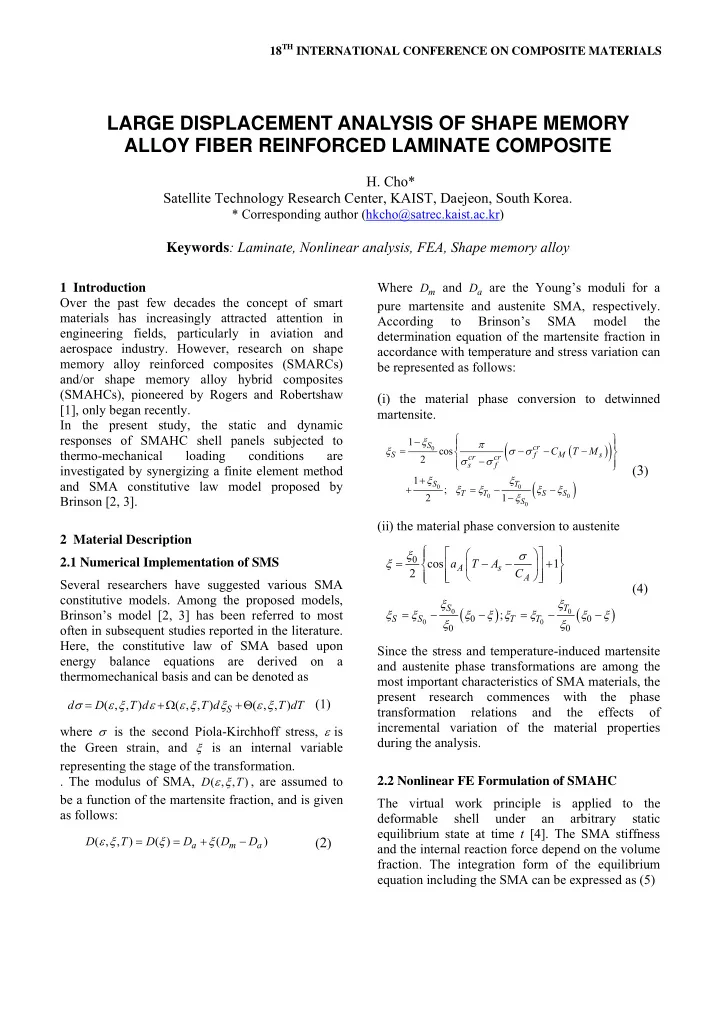
18 TH INTERNATIONAL CONFERENCE ON COMPOSITE MATERIALS LARGE DISPLACEMENT ANALYSIS OF SHAPE MEMORY ALLOY FIBER REINFORCED LAMINATE COMPOSITE H. Cho* Satellite Technology Research Center, KAIST, Daejeon, South Korea. * Corresponding author


slide-1
SLIDE 1

18TH INTERNATIONAL CONFERENCE ON COMPOSITE MATERIALS

1 Introduction Over the past few decades the concept of smart materials has increasingly attracted attention in engineering fields, particularly in aviation and aerospace industry. However, research on shape memory alloy reinforced composites (SMARCs) and/or shape memory alloy hybrid composites (SMAHCs), pioneered by Rogers and Robertshaw [1], only began recently. In the present study, the static and dynamic responses of SMAHC shell panels subjected to thermo-mechanical loading conditions are investigated by synergizing a finite element method and SMA constitutive law model proposed by Brinson [2, 3]. 2 Material Description 2.1 Numerical Implementation of SMS Several researchers have suggested various SMA constitutive models. Among the proposed models, Brinson’s model [2, 3] has been referred to most

  • ften in subsequent studies reported in the literature.

Here, the constitutive law of SMA based upon energy balance equations are derived on a thermomechanical basis and can be denoted as (1) where  is the second Piola-Kirchhoff stress,  is the Green strain, and  is an internal variable representing the stage of the transformation. . The modulus of SMA,

( , , ) D T  

, are assumed to be a function of the martensite fraction, and is given as follows:

( , , ) ( ) ( )

a m a

D T D D D D        

(2) Where

m

D and

a

D are the Young’s moduli for a

pure martensite and austenite SMA, respectively. According to Brinson’s SMA model the determination equation of the martensite fraction in accordance with temperature and stress variation can be represented as follows:

(i) the material phase conversion to detwinned

martensite.

 

 

 

1 cos 2 1 ; 2 1

S cr S f M s cr cr s f S T T T S S S

C T M                                    

(3) (ii) the material phase conversion to austenite

cos 1 2

A s A

a T A C                               

   

;

S T S S T T

                 

(4) Since the stress and temperature-induced martensite and austenite phase transformations are among the most important characteristics of SMA materials, the present research commences with the phase transformation relations and the effects

  • f

incremental variation of the material properties during the analysis. 2.2 Nonlinear FE Formulation of SMAHC The virtual work principle is applied to the deformable shell under an arbitrary static equilibrium state at time t [4]. The SMA stiffness and the internal reaction force depend on the volume

  • fraction. The integration form of the equilibrium

equation including the SMA can be expressed as (5)

LARGE DISPLACEMENT ANALYSIS OF SHAPE MEMORY ALLOY FIBER REINFORCED LAMINATE COMPOSITE

  • H. Cho*

Satellite Technology Research Center, KAIST, Daejeon, South Korea.

* Corresponding author (hkcho@satrec.kaist.ac.kr)

Keywords: Laminate, Nonlinear analysis, FEA, Shape memory alloy

( , , ) ( , , ) ( , , )

S

d D T d T d T dT            

slide-2
SLIDE 2

t ijrs rs ij ij ij V V ijrs ij rs ij rs V t t t t th ij rs ij V V t sma t ij ij ij V V

C e e dV S dV H C f f e e dV S e dV R e dV e dV S e dV           



      

      

(5) 3 Example Problem of SMAHC Subjected to Structural and Thermal Loading The suggested description can be verified through an example problem. The dimensions of the analyzed plate are 240mm by 160mm rectangular laminate, whereas the thickness is 2mm, including the top SMA/epoxy layer. Clamped boundary conditions are applied to the left edge of the plate.

  • Fig. 1 illustrates the configuration of a modeled

element consisting of five layers. The orientation angle of the SMA wires within the SMA/epoxy layers maintains zero degrees, measured in a counter-clock wire direction from the positive x-axis. The relative volume fraction of the SMA wires within the top layer of the plate is 0.2. All SMA wire properties and graphite/epoxy composite are summarized and presented in Tables 1 and 2. Table 1. Material properties of Gr/E. The purpose of this analysis is to quantifiably verify the effects of SMA wires embedded in a laminated composite on the responses of static and dynamic behaviors upon thermomechanical loadings. For this, two different layups are compared, a pure Gr/E layup and a hybrid SMA/E and Gr/E layup. In reality, the material properties of the graphite/epoxy vary according to temperature change; however, in the present analysis, it is assumed that the material properties of the graphite/epoxy ply are constant regardless of any increase or decrease of temperature. Table 2. Material properties of the SMA Fig.1. Geometry configuration of the SMAHC plate. Note that this is not for SMAs. Consequently, the code can more clearly represent the effects of SMA reinforced lamina with respect to a general composite. A total of four cases were analyzed and the results compared: case I: [0/0/0/0/0]Gr/E, [(SMA/epoxy)/0/0/0/0]hybrid; case II: [30/-30/30/- Properties Graphite Epoxy (Gr/E) E11 138 GPa E22 = E33 8.28 GPa υ12 = υ13 0.33 υ23 0.37 G12 = G13 6.9 GPa G23 3.6GPa ρ 1600 kg/m3

1

0.18e-6/℃

2

 =

3

27.0e-6/℃ Properties Value Coefficients of constitutive equation

a

D =67.0GPa

m

D =26.3Gpa  =0.55MPa

Density

 =6448.1kg/m3

Recovery strain limit

L

 =0.067

Four phase transformation temperature

f

M =9.0℃

s

M =18.4℃

s

A =34.5℃

f

A =49.0℃

Transition stiffness (stress/temperature)

M

C =8.0MPa/℃

A

C =13.8MPa/℃

Critical transformation stress

cr s

 =100MPa

cr f

 =170MPa

Thermal expansion

A

 =11e-6/℃

M

 =6.6e-6/℃

slide-3
SLIDE 3

3 PAPER TITLE

30/30]Gr/E, [(SMA/epoxy)/-30/30/-30/30]hybrid; case III: [45/-45/45/-45/45]Gr/E, [(SMA/epoxy)/-45/45/- 45/45]hybrid; case IV: [90/0/90/0/90]Gr/E, [(SMA/epoxy)/0/90/0/90]hybrid. 4 Results For all analyzed SMAHC shell panels, SMA wires are embedded along the x-direction and remain

unchanged and the volume fraction of SMA wire is about 20% with respect to its matrix.

The results were obtained at three temperature levels, i.e., 5 , 25 , and 50 . These temperatures were ℃ ℃ ℃ selected for their importance to phase transformation. For the four analysis cases, nonlinear static solutions

  • f the vertical deflection at the center of the loading

edge are plotted in Figs. 2. From the deflection results it can be seen that the temperature, as well as the ply stacking angle, has a strong influence on the relative deflection of the cantilever plate. Fig.2. SMAHC deflection at the end of cantilever. For the cantilever plate, the fundamental natural frequency

  • f

the [(SMA/epoxy)/-45/ 45/- 45/45]hybrid lay-up is minimal, as seen in Table 3. This corresponds with the maximum displacement in

  • Fig. 2. In general, as the stiffness of a structure is

increased, the natural frequency increases but the deflection conversely decreases. The nonlinearity is found in all cases and the phenomena are more apparent with the [(SMA/epoxy)/-45/45/-45/45] hybrid lay-up. For this reason, the author used nonlinear formulations. It should be noted that SMA behaviors strongly depend

  • n

the material nonlinearity and phase transformations. When the SMA ply has a temperature above

s

A , martensite

starts to transform into austenite, and at temperature

  • f

f

A

  • r above, the whole sample becomes
  • austenite. This accounts for the SMA constitutive

model used and can be observed in the following figures. Table 3. Displacements and natural frequencies for both Gr/E and SMAHC

Test types Gr/E SMA HC ANSYS Present Present Case I Linear (mm) 37.6 37.6 65.0 Nonlinear (mm) 36.4 36.5 58.8 Frequency(Hz) 52.2 86.0 230.6 52.2 86.4 231.7 39.4 63.2 167.2 Case II Linear (mm) 78.4 78.5 134.3 Nonlinear (mm) 61.0 61.2 93.9 Frequency (Hz) 36.6 119.8 223.3 36.8 120.3 225.2 27.9 93.6 167.0 Case III Linear (mm) 163.7 163.7 288.8 Nonlinear (mm) 103.1 103.1 139.4 Frequency (Hz) 25.7 122.8 156.6 25.7 123.0 157.3 19.3 97.5 116.0 Case IV Linear (mm) 146.1 146.2 160.9 Nonlinear (mm) 106.2 106.1 114.1 Frequency (Hz) 26.4 69.4 164.1 26.4 69.8 165.5 25.1 54.1 157.5

5 Conclusion The present research has introduced a procedure for modeling a shape memory alloy hybrid composite subjected to thermomechanical environments. Based

  • n a nonlinear iterative FEA formulation, a three-

dimensional shell element for a SMAHC was

  • developed. The present extension to a three-

dimensional shell SMAHC-FE procedure overcomes limitations of other shape memory alloy-reinforced composite plate models, thereby extending the method’s applicability. The analysis of a SMA reinforced hybrid composite is extremely difficult due to the inconsistent thermal response of individual materials and building up effective material properties. The developed nonlinear static, free vibration procedure and finite element simulation code were verified through comparison with the results of FEA commercial code and experimental data. Through several more analyses

slide-4
SLIDE 4

cases

  • f

a clamped cantilever plate, thermomechanical behaviors of SMAHC were well represented, and the response gap between a SMA embedded composite and a composite without SMA was distinct. Also, the suggested static and dynamic SMAHC- FEA procedure is characterized by a dramatically enhanced ability to accommodate variable SMA constitutive, isotropic or orthotropic materials, and thermo-elastic models without being restricted to certain geometries, and most importantly, by its capacity to deal with any nonlinearity whether due to large deformations or to SMA material functions. Precise analysis of the hybrid-material’s behavior has been accomplished by consecutively updating material parameters at every iteration step. . References

[1] C. Roger, H. Robertshaw “Development of a novel smart material”. ASME Winter Annual Meeting, Chicago, IL, 1988. [2] L. Brinson, R. Lammering “Finite element analysis

  • f the behavior of shape memory alloys and their

applications”. International Journal of Solids and Structures, Vol. 30, pp. 3261-3280, 1993. [3] L. Brinson “One-dimensional constitutive behavior

  • f

shape memory alloys: thermomechanical derivation with non-constant material functions and redefined martensite internal variable”. Journal of Intelligent Material Systems and Structures, Vol. 4,

  • pp. 3261-3280, 1993.

[4] K. Bathe “Finite element procedures in engineering analysis”. 1st edition, Prentice-Hall, 1982.