Language Understanding Systems IBM Watson Can we create a computer - - PDF document

language understanding systems
SMART_READER_LITE
LIVE PREVIEW

Language Understanding Systems IBM Watson Can we create a computer - - PDF document

3/21/17 Language Understanding Systems IBM Watson Can we create a computer system to compete against the best humans at a task thought to require high levels of intelligence? NELL Never-Ending Language Learning System Tom Mitchell, CMU


slide-1
SLIDE 1

3/21/17 1

Language Understanding Systems

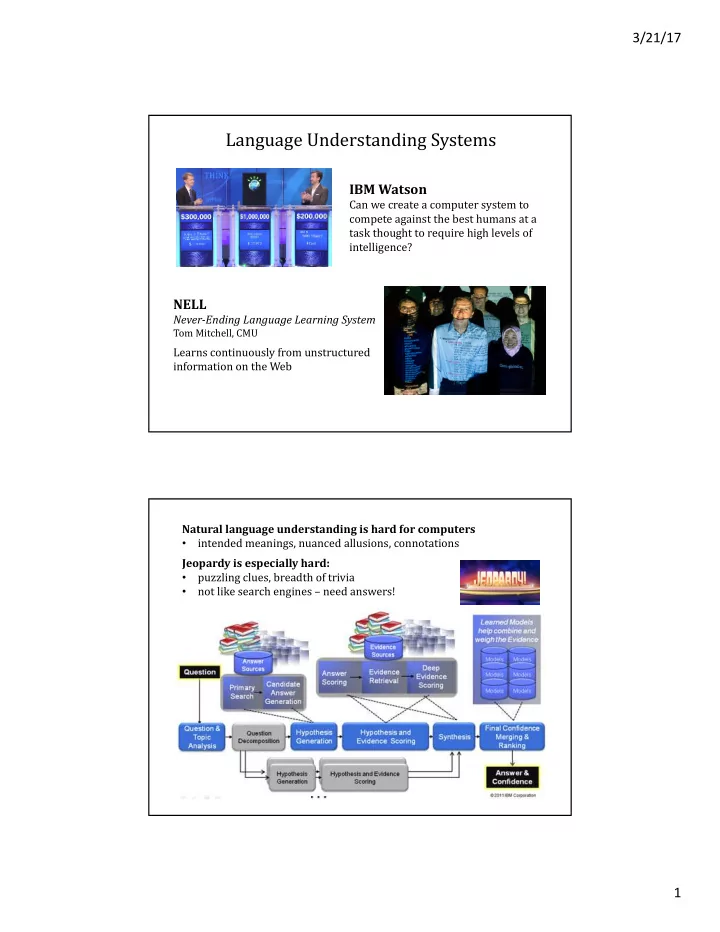
IBM Watson

Can we create a computer system to compete against the best humans at a task thought to require high levels of intelligence?

NELL

Never-Ending Language Learning System

Tom Mitchell, CMU

Learns continuously from unstructured information on the Web Natural language understanding is hard for computers

  • intended meanings, nuanced allusions, connotations

Jeopardy is especially hard:

  • puzzling clues, breadth of trivia
  • not like search engines – need answers!
slide-2
SLIDE 2

3/21/17 2

Made possible by advances in computer speed, memory

  • Early implementation ran on a single processor, took 2 hours to answer

a single question

  • Now scaled up to over 2,500 computer cores, IBM servers, reduced the

time to about 3 seconds

DeepQA Architecture

Massive parallelism:

  • considers many interpretations/hypotheses simultaneously

Many experts:

  • facilitate integration, application, contextual evaluation of wide range loosely

coupled probabilistic question and content “experts” Pervasive confidence estimation:

  • no one component commits an answer, all produce features and associated

confidences, scoring different question and content interpretations

Confidence Profile from Many Factors

slide-3
SLIDE 3

3/21/17 3

The Outtakes...

Category: “Letters” Clue: “In the late 40s a mother wrote to this artist that his picture Number Nine looked like her son’s finger painting” Correct answer: “Jackson Pollock” Watson’s answer: “Rembrandt” Reason: Watson failed to recognize that “late 40s” referred to the 1940s Category: “U.S. City” Clue: “Its largest airport is named for a World War II hero, its second largest for a World War II battle” Correct answer: “Chicago” Watson’s answer: “Toronto” Reasons: (1) by studying previous competitions, Watson “learned” to pay less attention to the category part of the rule (2) Watson knew that a Toronto team is in the U.S. baseball league, and one of Toronto’s airports is named for a WWI hero

Question: Can we create a computer system to compete against the best humans at a task thought to require high levels of intelligence?

But ...

  • IBM has not created a machine that thinks like us
  • Watson’s success does not bring us closer to understanding human

intelligence

  • Watson’s occasional blunders should remind everyone that this

problem is still not solved Some of Watson’s legacy:

  • great piece of engineering
  • remarkable performance (not thought possible at outset)
  • re-ignited public interest in Artificial Intelligence
  • new technology with broad applications
slide-4
SLIDE 4

3/21/17 4

NELL: Never-Ending Language Learner

“We will never truly understand machine or human learning until we can build computer programs that, like people,

  • learn many different types of knowledge or functions,
  • from years of diverse, mostly self-supervised experience,
  • in a staged curricular fashion, where previously learned knowledge enables

learning further types of knowledge,

  • where self-reflection and the ability to formulate new representations and

new learning tasks enable the learner to avoid stagnation and performance plateaus.” Mitchell et al., AAAI, 2015 Natural language understanding requires a belief system

  • I understand, and already knew that
  • I understand, and didn’t know, but accept it
  • I understand, and disagree because ... “

Inputs:

  • initial ontology with hundreds of categories and relations to “read about”
  • n the web
  • categories, e.g. person, sportsTeam, fruit, emotion
  • relations, e.g.

playsOnTeam(athlete,sportsTeam) playsInstrument(musician,instrument)

  • 10-15 examples of each category and relation
  • the web (~ 500 million webpages + access to search engines)

The task:

  • run continuously, forever
  • each day:

1) extract new instances of categories and relations (noun phrases) 2) learn to read (perform step (1)) better than yesterday

NELL: Never-Ending Language Learner

slide-5
SLIDE 5

3/21/17 5

http://rtw.ml.cmu.edu/rtw

Learn which noun phrases are cities:

Paris Pittsburgh Seattle Montpelier mayor of <arg> live in <arg> San Francisco Berlin denial <arg> is home of traits such as <arg> anxiety selfishness London

Early Work – Simple “Bootstrap” Learning

Too unconstrained! Learn based on multiple cues simultaneously, e.g.:

(1) distribution of text contexts (appear in phrases with the same words) (2) same features of character string (e.g. capitalized, ends with “... burgh”) (known)

slide-6
SLIDE 6

3/21/17 6

NELL is simultaneously trying to learn: (1) which noun phrases refer to which categories (2) which noun phrases participate in which relations NELL knows: (1) constraints between categories e.g. athletes must be people, sports cannot be people (2) constraints on categories for relations e.g. playsSport(athlete,sport)

athlete(NP) à person(NP) athlete(NP) à NOT sport(NP) sport(NP) à NOT athlete(NP)

Coupling of Categories & Relations

Read web pages to find new candidate beliefs (classify instances of categories and relations) Use expanded knowledge base to “re-train” classifiers Further learning by NELL: (1) new constraints between relations:

if (athlete X plays for team Z) and (team Z plays sport Y) then (athlete X plays sport Y)

(2) new relations:

<musical instrument> master <musician> <mammals> eat <plant>

(3) new subcategories, e.g. pets, predators (subcategories of animal)

slide-7
SLIDE 7

3/21/17 7

Learns new relations from frequent co-occurrences of instances of two categories ... ... but humans have veto power!