10 10-26 26-16 16 1
& Land Tenure Presented by: Lin Fehlmann Retired BLM Water - - PowerPoint PPT Presentation
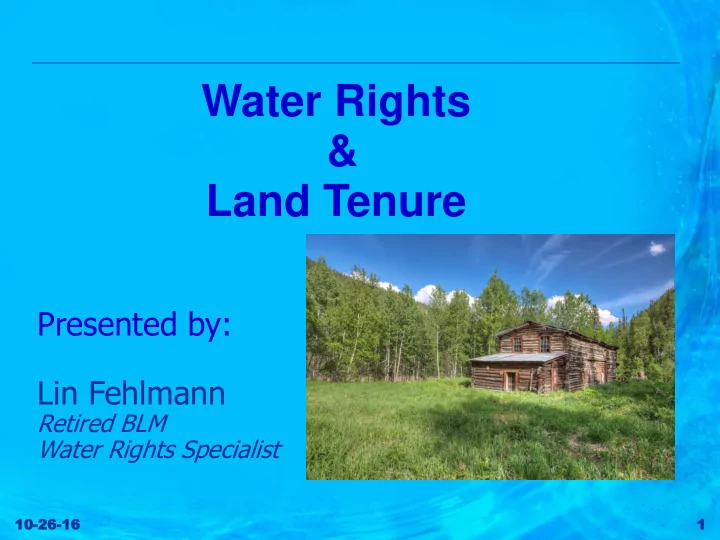
Water Rights & Land Tenure Presented by: Lin Fehlmann Retired BLM Water Rights Specialist 10 10-26 26-16 16 1 Objective Identify the steps and processes used to address water right issues in proposed land tenure actions. Land
Objective
Identify the steps and processes used to address water right issues in proposed land tenure actions.
Land Tenure Examples:
- Land exchange
- Acquisition
- Disposal
- Purchase or donation
- Conservation easement
10 10-26 26-16 16 2
Right to Use Water – Basics
- Real property right => “usufructuary” right
- Water is an interest in land (see Federal Land Transaction
Facilitation Act, FLTFA)
- Can be disposed of or acquired
- Considered when determining value
10 10-26 26-16 16 3
Right to Use Water in Alaska
- Managed by :
- Department of Natural Resources
(DNR)
- State regulations for Change of
Ownership of water rights:
- Alaska Statutes – Chapter
46.15 Water Use Act
- Alaska Administrative Code –
Title 11, Chapter 93 – Water Management
10 10-26 26-16 16 4
When & Where to Begin
Start EARLY!!
10 10-26 26-16 16 5
Resolving issues TAKES TIME! Identifying water rights is
ESSENTIAL!!
10 10-26 26-16 16 6
Water Rights considerations:
– In general, appurtenant to land – Adds value – Document even if source has no water right – Negotiate & Cost-share with proponent / seller / donor – Know management’s position
Assign person familiar with:
− Water rights − Alaska water law
When & Where to Begin (continued)
Water Rights – Proposal Process
Address Water Rights during the entire process: Initial Proposal Evaluating the Proposal The Closing Process
10 10-26 26-16 16 7
Feasibility Phase
1. Identify State Water Rights 2. Identify Reserved Water Rights 3. Gather Ownership & Encumbrances Info
Analysis Phase
4. Field Verification: Is the Water “Wet”? 5. Consult with Appraiser
10 10-26 26-16 16 8
Initial Proposal Phases & Steps
Obtain legal descriptions Identify sources and uses
- Contact the proponent
- Check aerial photos & topographic maps
- Check agency files
10 10-26 26-16 16 9
Initial Feasibility Phase
- 1. Identify Water Rights
- 1. Identify Water Rights (continued)
ID water sources with water rights by using:
- Previous deeds
- Preliminary Title Report
- List from proponent/seller/donor
- List of associated water rights from DNR
Website for water rights & TWUAs:
http://dnr.alaska.gov/mlw/mapguide/wr_intro.cfm
Well Log Tracking System (WELTS):
https://dnr.alaska.gov/welts/#show-welts-intro-template
Local DNR offices (call or visit)
10 10-26 26-16 16 10 10
Initial Feasibility Phase
Obtain copies of all water rights & verify
information
10 10-26 26-16 16 11 11
The true measure of a water right is based on information from the
- riginal
documents!
Initial Feasibility Phase
- 1. Identify Water Rights (continued)
- Identify partial
assignment/acquisition
10 10-26 26-16 16 12 12
- Identify any associated
infrastructures
Initial Feasibility Phase
- 1. Identify Water Rights (continued)
- For wells, obtain completion reports & logs
- Consult with appraiser
- Work with involved federal agencies
10 10-26 26-16 16 13 13
Initial Feasibility Phase
- 1. Identify Water Rights (continued)
- 2. ID Reserved Water Rights
10 10-26 26-16 16 14 14
BLM
- Wild and Scenic Rivers
Wilderness Act National Monuments 1897 Organic Act
Initial Feasibility Phase
USFS FWS
National Wildlife Refuges
NPS
- National Parks/Preserves
- National Monuments
- Wild & Scenic Rivers
- ANILCA: Grants authorization to acquire land
- May transfer between federal agencies
- Cannot transfer to non-federal owners
- No longer in effect if land transferred to private
- wners – Advise DNR of change
10 10-26 26-16 16 15 15
Initial Feasibility Phase
- 2. ID Reserved Water Rights (continued)
- 3. ID Ownership/Encumbrances
- Is water right in name of
proponent/seller/donor?
- What do deed records &
preliminary title report show?
- Any land use restrictions?
NOTE: See current BLM right-of-way (ROW) regulations regarding land disposal & ROWs.
10 10-26 26-16 16 16 16
Initial Feasibility Phase
- 3. ID Ownership/Encumbrances (continued)
- Land located in:
– Critical Ground Water Area? – Critical Water Management Area?
- Proponent has water rights on leased land?
- Water Power Withdrawals?
- Reservations or outstanding rights?
10 10-26 26-16 16 17 17
Initial Feasibility Phase
- Current Use
Follow State Law Address Agency needs Include Water Sources to be filed on Identify inaccurate legal descriptions Identify systems that need repairs
10 10-26 26-16 16 18 18
Initial Analysis Phase
- 4. Verify: Is the Water “Wet”?
- On-the-ground inspection
Evaluate authorized Place of Use vs on-site conditions Is water amount sufficient to supply irrigated acreage? Has there been recent use? Are metering devices and fish screens installed? Amount of water sufficient for interpretation of acquired historical sites?
- Well tested and examined?
- Well access port functional?
- Well delivery system operable?
- Ground water quality sufficient for new uses?
10 10-26 26-16 16 19 19
Initial Analysis Phase
- 4. Verify: Is the Water “Wet”? (continued)
FIELD CHECK PRIOR TO CLOSING
10 10-26 26-16 16 20 20
ALL water rights issues must be RESOLVED BEFORE the closing!! The proponent/seller/donor has
little incentive to work with Agency
- n water rights issues after the fact!
Provide information summary to appraiser Initial Analysis Phase
- 5. Consult with Appraisal Staff
Evaluating the Proposal
Address water rights in all steps
–Feasibility Analysis (include valuation consultation) –Agreement to Initiate –Notice of Exchange Proposal –Environmental Documentation –Decision –Notice of Decision
10 10-26 26-16 16 21 21
Evaluating the Proposal (continued)
Consider Potential Desired Beneficial Uses
–Maintain riparian/wetland values –Use existing right or transfer to instream uses –Use entire or portion of acquired right(s) –Quantify amount of water needed for new uses
Address management costs &responsibilities UP FRONT!
10 10-26 26-16 16 22 22
Closing
- List all water rights to be conveyed in deeds
List all elements of the water rights Mention all infrastructures associated with the water rights (e.g., metering devices)
- Include general clause
to acquire all water rights to cover any omissions
- Provide documentation
to all parties
10 10-26 26-16 16 23 23
At or Before Closing
Closing (continued)
- Complete DNR “Ownership Transfer” form for:
Surface and ground water rights Temporary Water Use Authorizations (TWUA) Existing (vested) rights
- No change of ownership fees in AK
10 10-26 26-16 16 24 24
Closing At or Before Closing
- Record deed with appropriate recording district
Keep a copy of deed for water rights file Submit recorded deed and forms to DNR via registered mail
- Lands Staff: Update exchange file
- Water Staff: Create files
- Add to & update databases and maps
- File any needed new applications, changes, etc.
10 10-26 26-16 16 25 25
After Closing
Closing (continued)
Post Acquisition Responsibilities
- Manage => Ensure it will not be lost
- Remember =>
– Apply the water as specified in the water right – Maintain all facilities in operable condition – Be vigilant in reviewing notices
10 10-26 26-16 16 26 26
Use it
- r
Lose it
Conservation Easements & Water Rights
- What is a Conservation easement?
– Restrict use of land for specific purpose(s) – Economic Importance – Tool to protect natural resources
- Water Rights on Conservation Lands
– Identify all water sources and rights – Identify water rights needed for conservation purpose(s) – Ensure water remains with the land – What happens if water provisions not enforced?
10 10-26 26-16 16 27 27
10 10-26 26-16 16 28 28
No Assumptions! Do your Homework!
Questions?
10 10-26 26-16 16 29 29