Lancaster County Transportation Strategy Jeff McKerrow, PE, PTOE - - PowerPoint PPT Presentation

lancaster county transportation strategy
SMART_READER_LITE
LIVE PREVIEW

Lancaster County Transportation Strategy Jeff McKerrow, PE, PTOE - - PowerPoint PPT Presentation

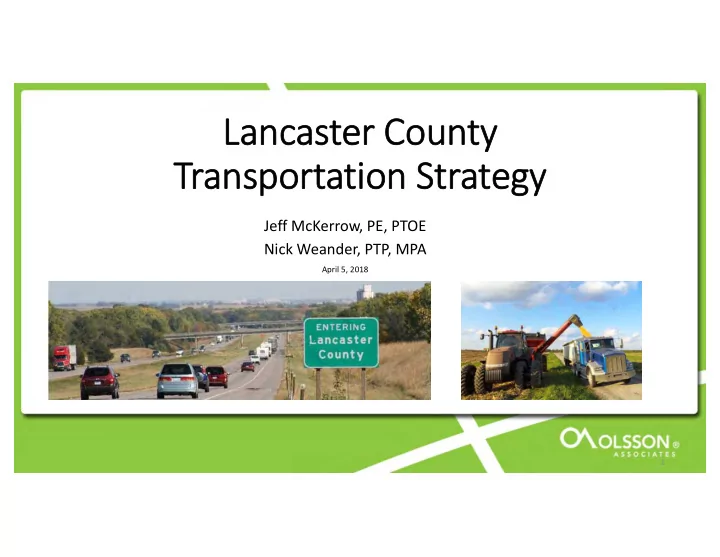
Lancaster County Transportation Strategy Jeff McKerrow, PE, PTOE Nick Weander, PTP, MPA April 5, 2018 1 Agenda Team Introductions Study Goals Community Profile Existing Conditions Preservation and Optimization Baseline

slide-1
SLIDE 1

Lancaster County Transportation Strategy

Jeff McKerrow, PE, PTOE Nick Weander, PTP, MPA

April 5, 2018 1

slide-2
SLIDE 2

Agenda

  • Team Introductions
  • Study Goals
  • Community Profile
  • Existing Conditions
  • Preservation and Optimization Baseline Report
  • Existing practices
  • Design Standards
  • Previous Studies
  • Requirements for new development
  • Budget/Revenue structure
  • Discussion of Peer Counties
  • Next Steps

2

slide-3
SLIDE 3

Study Goals

  • Summarize Existing Conditions
  • Discuss County Future Goals/Objectives
  • Identify Best Management Practices for:
  • Preservation
  • Optimization
  • Growth

3

slide-4
SLIDE 4

Purpose of Study

  • Roadmap for how transportation infrastructure will

develop in Lancaster County

  • Assist Lancaster County with best management strategies
  • Why is it important?
  • Informs decisions about where to direct limited resources
  • Furthers county goals and objectives
  • Provides access to future economic activity
  • Addresses immediate needs for infrastructure, with transparency
  • Increases coordination of agencies for maximum use of funding

4

slide-5
SLIDE 5

Setting the Stage – Lancaster County

Where Are We? Where do we want to be?

  • 2040 LRTP, 2016 Update:
  • Vision
  • Goals, Objectives, Performance Measures
  • Lancaster County staff – Key Stakeholder
  • Sets high‐level goals
  • Next Step 

5

slide-6
SLIDE 6

Lancaster County – Vision

  • Specific goals for Lancaster County?

OR

  • Should we use goals from the LRTP?

6

Regional LRTP Goals

1. Maintenance 2. Mobility and System Reliability 3. Livability and Travel Choice 4. Safety and Security 5. Economic Vitality 6. Environmental Sustainability 7. Funding and Cost Effectiveness

slide-7
SLIDE 7

Lancaster County – Example Goals

Regional Goals

1. Maintenance 2. Mobility and System Reliability 3. Livability and Travel Choice 4. Safety and Security 5. Economic Vitality 6. Environmental Sustainability 7. Funding and Cost Effectiveness

  • 1. Maintenance Goal: Well‐maintained

roads, bridges, and County infrastructure.

  • Objectives:
  • Maintain roads, bridges and County infrastructure to

a state of good repair to maximize the value of Lancaster Co transportation assets.

  • Performance Measures:
  • Percent of roads rehabilitated
  • Bridge sufficiency ratings

What Should County Target Be?

  • Rehab X percent of roads each year
  • Maintain at least X percent of bridges with a sufficiency rating above 80
  • Increase the percent of bridges with a sufficiency rating above 50 to 100 percent

What Should County Target Be?

  • Rehab X percent of roads each year
  • Maintain at least X percent of bridges with a sufficiency rating above 80
  • Increase the percent of bridges with a sufficiency rating above 50 to 100 percent

7

slide-8
SLIDE 8

Lancaster County – Goals

Regional Goals

1. Maintenance 2. Mobility and System Reliability 3. Livability and Travel Choice 4. Safety and Security 5. Economic Vitality 6. Environmental Sustainability 7. Funding and Cost Effectiveness

  • 2. Mobility and System Reliability

Goal: An efficient, reliable, and well‐ connected transportation system for moving people and freight.

  • Objectives:
  • Optimize the reliability of the transportation

network

  • Focus on Farm‐to‐Market Reliability?
  • Performance Measures:
  • Congested roadways

What Should County Target Be?

  • Provide reliable access for key Farm‐to‐Market routes.

What Should County Target Be?

  • Provide reliable access for key Farm‐to‐Market routes.

8

slide-9
SLIDE 9

Lancaster County – Goals

Regional Goals

1. Maintenance 2. Mobility and System Reliability 3. Livability and Travel Choice 4. Safety and Security 5. Economic Vitality 6. Environmental Sustainability 7. Funding and Cost Effectiveness

  • 3. Livability and Travel Choice Goal: A

multimodal system that provides travel

  • ptions to support livable

communities.

  • Objectives:
  • Provide paved shoulders on paved roadways
  • Performance Measures:
  • Percent of paved roads with paved shoulders

What Should County Target Be?

  • Coordinate land use and transportation decisions
  • Implement facility recommendations in regional transportation plans, supporting

multimodal connections, as appropriate What Should County Target Be?

  • Coordinate land use and transportation decisions
  • Implement facility recommendations in regional transportation plans, supporting

multimodal connections, as appropriate

9

slide-10
SLIDE 10

Lancaster County – Goals

Regional Goals

1. Maintenance 2. Mobility and System Reliability 3. Livability and Travel Choice 4. Safety and Security 5. Economic Vitality 6. Environmental Sustainability 7. Funding and Cost Effectiveness

  • 5. Economic Vitality Goal: A transportation system

that support economic vitality for residents and businesses.

  • Objectives:
  • Improve transportation network for flow of commerce and

residents in the County. (Farm to Market routes)

  • Improve economic competitiveness of the county by enhancing the

transportation system

  • Performance Measures:
  • Percentage of federally classified roads that are rated good or

better.

  • Annual freight tonnage movement

What Should County Target Be?

  • Percentage of federally classified roads rated good or better.
  • Establish and prioritize Farm‐to‐Market routes

What Should County Target Be?

  • Percentage of federally classified roads rated good or better.
  • Establish and prioritize Farm‐to‐Market routes

10

slide-11
SLIDE 11

Lancaster County – Goals

Regional Goals

1. Maintenance 2. Mobility and System Reliability 3. Livability and Travel Choice 4. Safety and Security 5. Economic Vitality 6. Environmental Sustainability 7. Funding and Cost Effectiveness

  • 6. Environmental Sustainability Goal: A

transportation system that enhances the natural, cultural, and built environment.

  • Objectives:
  • Maintain compliance with air quality standards (burn permits)
  • Reduce fossil fuel consumption by providing access to

alternative modes and fuels

  • Avoid, minimize, and mitigate environmental impacts of

transportation projects, to the extent reasonably possible

  • Performance Measures:
  • Number of minimal impact projects completed

What Should County Target Be?

  • Vehicle miles of travel (VMT) per capita
  • Number of alternative fuel vehicles in fleet
  • Number of minimal impact projects completed

What Should County Target Be?

  • Vehicle miles of travel (VMT) per capita
  • Number of alternative fuel vehicles in fleet
  • Number of minimal impact projects completed

11

slide-12
SLIDE 12

Lancaster County – Goals

Regional Goals

1. Maintenance 2. Mobility and System Reliability 3. Livability and Travel Choice 4. Safety and Security 5. Economic Vitality 6. Environmental Sustainability 7. Funding and Cost Effectiveness

  • 7. Funding and Cost Effectiveness Goal:

Collaboration in funding transportation projects that maximize funding.

  • Objectives:
  • Make the best use of public resources
  • Decrease the gap between gaps and needs
  • Performance Measures:
  • Annual transportation funding
  • Number of projects

What Should County Target Be?

  • Consider implementing other funding mechanisms
  • Communication programs to the community for the need for increased funds

What Should County Target Be?

  • Consider implementing other funding mechanisms
  • Communication programs to the community for the need for increased funds

12

slide-13
SLIDE 13

Lancaster County – Goals

Maintenance Goal: Well‐maintained roads, bridges, and County infrastructure

  • Objectives:
  • Maintain roads, bridges and County infrastructure to a state of good repair to

maximize the value of Lancaster Co transportation assets.

  • Performance Measures:
  • Percent of roads rehabilitated
  • Bridge sufficiency ratings

What Should County Target Be?

  • Rehab X percent of roads each year
  • Maintain at least X percent of bridges with a sufficiency rating above 80
  • Increase the percent of bridges with a sufficiency rating above 50 to 100

percent What Should County Target Be?

  • Rehab X percent of roads each year
  • Maintain at least X percent of bridges with a sufficiency rating above 80
  • Increase the percent of bridges with a sufficiency rating above 50 to 100

percent

13

Sample Graphic of Dashboard Results

slide-14
SLIDE 14

Lancaster County ‐ Today

14

slide-15
SLIDE 15

Lancaster County 2010 2011 2012 2013 2014 2015 2016 Avg. Annual Growth Rate

Population 286,195 289,945 293,606 297,489 302,097 305,705 309,607 Change ‐ 1.31% 1.26% 1.32% 1.55% 1.19% 1.29% 1.32%

Annual Change in Population Since 2010

167,972 192,884 213,641 250,291 285,407 326,864 368,844 412,679 150,000 200,000 250,000 300,000 350,000 400,000 450,000 1970 1980 1990 2000 2010 2020 2030 2040

Population Year

Census Population Projected Population

Lancaster County Population

Community Profile – Lancaster County

Source: https://lincoln.ne.gov/city/plan/reports/cpanrev/benchrpt/bench17.pdf 15

slide-16
SLIDE 16

Community Profile – Lancaster County

Source: https://lincoln.ne.gov/city/plan/reports/cpanrev/benchrpt/bench17.pdf Population Trends Municipality Historical Change

2000 2010 2016 Percent Change Lincoln 225,581 258,379 273,018 17% Bennet 570 719 889 36% Davey 153 154 143 7% Denton 189 190 229 17% Firth 564 590 467 21% Hallam 276 213 246 12% Hickman 1,084 1,657 1,891 43% Malcolm 413 382 408 1% Panama 253 256 262 3% Raymond 186 167 123 51% Roca 220 220 195 13% Sprague 146 142 131 11% Waverly 2,448 3,277 3,686 34% Total Population 232,083 266,346 281,688 18%

16 Ratio of City to County Population

‐ 50,000 100,000 150,000 200,000 250,000 300,000 350,000 2010 2011 2012 2013 2014 2015 2016 Population ‐ Lincoln Population ‐ Small Towns & Unincorporated Areas

slide-17
SLIDE 17

Total Employment Change Average Annual Change 1993 ‐ 2000 2000 ‐ 2010 2010 ‐ 2015 1993 ‐ 2015 1993 ‐ 2000 2000 ‐ 2010 2010 ‐ 2015 1993 ‐ 2015 Lancaster County 20.88% 4.40% 8.67% 37.14% 2.75% 0.43% 1.68% 1.45% Nebraska State 8.53% 1.31% 6.94% 14.55% 1.18% 0.13% 1.35% 0.62% U.S, (000’s) 18.89% 3.01% 9.13% 25.85% 2.50% 0.30% 1.76% 1.05%

Growth in Employment from 1993‐2015 Source: https://lincoln.ne.gov/city/plan/reports/cpanrev/benchrpt/bench17.pdf

Top 10 Industries in Lancaster, County (Employees)

Employment

17

7883 7901 9365 11481 11869 13115 13826 16484 17254 22301 5000 10000 15000 20000 25000 Transportation and Warehousing Construction Professional, Scientific, and Technical Services Accommodation and Food Services Finance and Insurance Manufacturing Public Administration Retail Trade Educational Services Health Care and Social Assistance

slide-18
SLIDE 18

Travel Flow

  • 44,000 travel to Lancaster County

to work

  • 22,000 leave Lancaster County to

work

  • 120,000 live and work in

Lancaster Co (84%)

18

slide-19
SLIDE 19

Lancaster County Road and Bridges ‐ Today

19

slide-20
SLIDE 20

2016

http://www.lincoln.ne.gov/city/plan/reports/complan/2025/fu_tran1.pdf 2040 LRTP

Existing Functional Classification

CHANGES IN LAST DECADE:

  • Urban Area Boundary expanded
  • Little impact to rural areas with

change of classification

  • All roadways above rural minor

collector ‐ eligible for federal‐aid

  • Designated federal‐aid bridges

eligible for federal funding

20

slide-21
SLIDE 21

National Highway System

21

slide-22
SLIDE 22

System Jurisdictions

22

slide-23
SLIDE 23

Unpaved County Roads with 300

  • r More ADT

23

slide-24
SLIDE 24

County Dirt Roads

24

slide-25
SLIDE 25

REC Roads

25

slide-26
SLIDE 26

Lancaster System Summary

26

slide-27
SLIDE 27

Average Daily Traffic

27

Source: Lancaster County, 2017

slide-28
SLIDE 28

Traffic Growth Impact from Lincoln

28

slide-29
SLIDE 29

Pavement – Lancaster County

  • 250 Miles – Mainline Road
  • 30.79 miles eligible for SRR funding
  • 36 miles within subdivisions
  • Current Needs (2017 assessment)
  • 79 mile requiring overlay with a rating <80 @ $360k/mile
  • 21 miles of 79 mi. with a rating <50
  • Current Traffic over 400 trips/day ‐ threshold for requiring paving
  • 6 miles@ $530k/mile

29

slide-30
SLIDE 30

Lancaster County Bridges ‐ Today

30

slide-31
SLIDE 31

Definitions

31

Bridge Sufficiency Rating: An overall rating of a bridge’s fitness for the duty it performs. Scale of 1‐100, where below 50 is eligible for replacement Scour: Erosion of soil surrounding a bridge foundation, caused by fast moving water. Structurally deficient : If deck, superstructure, substructure or culvert is rated in “poor” condition. Or if load carrying capacity is significantly below current design standards; or if a waterway frequently overtops the bridge during floods.

slide-32
SLIDE 32

Definitions

32

Functionally Obsolete : Bridge that is no longer by design functionally adequate for its task. I.e., not enough traffic lanes or not enough clearance for oversized vehicles. Not related to its structural nature. Fracture Critical Bridges: Lacking structural capacity or redundancy to prevent failure in event one structural element fails. Posted Bridges: Bridges that, due to their condition or design, do not have the structural capacity to safely carry the state legal loads. Culvert: Become ‘bridges’ after spanning 20 feet

slide-33
SLIDE 33

Bridges ‐ Today

  • County maintains 184 bridges
  • Bi‐annual inspections
  • Or if rehab or replacement
  • Sufficiency Rating (0‐100)
  • Between 50‐80 = eligible for rehab
  • < 50 = eligible for replacement
  • Avg Rating = 75.2

33

slide-34
SLIDE 34

Bridges ‐ Today

34

27 5 24 15 15 9

Structurally Deficient Functionally Obsolete Scour Critical Fracture Critical Posted bridges Currently Closed

Lancaster County Maintains 184 Bridges

slide-35
SLIDE 35

Bridges ‐ Today

  • Structurally Deficient – 27
  • Scour Critical – 24
  • Currently Closed ‐ 9

35

slide-36
SLIDE 36

27 Structurally Deficient Bridges

Structurally deficient : If deck, superstructure, substructure or culvert is rated in “poor” condition. Or if load carrying capacity is significantly below current design standards; or if a waterway frequently overtops the bridge during floods.

36

slide-37
SLIDE 37

24 Scour Critical Bridges

Scour: Erosion of soil surrounding a bridge foundation, caused by fast moving water. Scour Critical: When scour causes bridge foundations to become unstable Susceptible: Bridge is of type that historically causes problems and leads to scour

37

slide-38
SLIDE 38

15 Fracture Critical Bridges

38

Fracture Critical Bridges: Lacking structural capacity or redundancy to prevent failure in event one structural element fails.

slide-39
SLIDE 39

5 Functionally Obsolete Bridges

39

Functionally Obsolete : Bridge that is no longer by design functionally adequate for its task. I.e., not enough traffic lanes

  • r not enough clearance for oversized
  • vehicles. Not related to its structural

nature.

slide-40
SLIDE 40

15 Posted Bridges

40

Posted Bridges: Bridges that, due to their condition or design, do not have the structural capacity to safely carry the state legal loads.

slide-41
SLIDE 41

9 Closed Bridges Today

41

Permanent (extreme low‐volume): 3 Temporary: 6

slide-42
SLIDE 42

Lancaster County Culverts

42

  • 83 Combination Structures
  • Culvert / Pipe / Bridge combinations
  • Substandard Design
  • Approx. 6,900 pipes
  • Includes driveways
  • Approx. 1,000 box culverts
slide-43
SLIDE 43

Existing Practices and Guidelines

  • 300 trips per day = 100’ ROW
  • 66’ Historic Section‐Line ROW
  • 50’ from center on current platting
  • 400 trips per day = pavement
  • Dependent on Funding
  • Residential subdivisions:
  • With lot sizes of < 3 acres, must have community water/sewer
  • Lot sizes of 1 acre or less, roads must be paved

43

slide-44
SLIDE 44

Adopted Design Standards/Guidelines

  • 2040 Regional Transportation Plan
  • Interlocal Agreement County/City – Rural to Urban Transition

Street (RUTS)

  • ROW and construction standards within 3‐mile zoning jurisdiction of

the City

  • County Zoning Regulations
  • https://lincoln.ne.gov/city/plan/dev/zoning/stratreg/cozon.htm
  • Chapter 2.20 Rural Public and Intermediate BTA (Build

Through Acreage) Public Street Design Standards ‐ City of Lincoln Design Standards

  • http://lincoln.ne.gov/city/attorn/designs/ds220.pdf
  • http://www.lincoln.ne.gov/city/plan/reports/acre/2627.pdf
  • http://www.lincoln.ne.gov/city/plan/reports/acre/build.pdf

44

slide-45
SLIDE 45
  • Nebraska Board of Public Roads Classifications &

Standards (NBCS)

  • Minimum Design Standards for Rural Roads
  • American Association of State Highway and

Transportation Officials (AASHTO)

  • A Policy on Geometric Design of Highways and Streets
  • Access Management Policy, City of Lincoln, 2012
  • http://lincoln.ne.gov/city/pworks/docs/pdf/access‐mgmt.pdf
  • Rural‐type cross‐sections and a parallel ditch, a drainage

culvert shall be installed under the driveway approach.

Adopted Design Standards/Guidelines

45

slide-46
SLIDE 46

Previous Reports

  • 2017 Annexation Study
  • https://lincoln.ne.gov/city/plan/long/AnnexStudy/Study.pdf
  • 2040 Long Range Transportation Plan, 2016 Update
  • 2018 Lincoln Transportation Strategy Report
  • County Construction Report, Monthly/Annual
  • Traffic Model 2040 Data by TAZ
  • Rural Cost of Services Study – Lincoln/Lancaster County, 2003
  • http://www.lincoln.ne.gov/city/plan/reports/acre/cost.pdf
  • Complete Streets Gap Analysis and Prioritization Strategy, 2015
  • http://lincoln.ne.gov/city/plan/reports/GapAnalysis.pdf
  • SE NE Regional ITS Architecture, 2005
  • http://local.iteris.com/senearch/deliver/Executive%20Summary%203‐17‐05.pdf

46

slide-47
SLIDE 47

One‐ and Six‐Year Plans

  • Unique annual mandatory reporting to NDOT
  • Promotes orderly development of an integrated system of public

roads

  • Electronic filing
  • Separate Financial Sheet submitted. Must be fiscally constrained.
  • The NE Board of Public Roads Classifications and Standards
  • versees annual construction and planning.
  • Identifies projects to be accomplished over next one and six

years.

  • Includes maps of projects
  • Public hearing must be held, prior to governing body adopting

the plan.

47

slide-48
SLIDE 48

Evolution of a typical road project

  • Survey: 1 – 3 months
  • Design: 2 – 12 months depending on complexity
  • Permit: 6 – 12 months
  • ROW Acquisition (if needed): 2 – 4 months
  • Utility Relocation (if needed): 1 – 3 months
  • Construction: 3 – 24 months

Total 12 – 58 months

48

slide-49
SLIDE 49

Existing Plans

  • Bennet 2026 Comprehensive Plan, 2006‐2026
  • Denton Comprehensive Plan, 1977
  • Firth Comprehensive Plan, 1969
  • Hallam 2035 Comprehensive Plan
  • Hickman Comprehensive Plan, 2007‐2030
  • Malcolm Comprehensive Plan, 2007
  • Panama Comprehensive Plan, 2013
  • Raymond Comprehensive Plan, 2000
  • Roca Comprehensive Plan, 1976
  • Sprague‐Martell Comprehensive Plan, 1976
  • Waverly Comprehensive Plan, 2013‐2033

http://www.lincoln.ne.gov/city/plan/reports/index.htm Towns & Village Plans

49

slide-50
SLIDE 50

Rural Road Project Identified Needs

50

Source: LPLAN 2040, 2016

slide-51
SLIDE 51

Rural Road Identified Projects

51

Source: LPLAN 2040, 2016 Source: LPLAN 2040, 2016

slide-52
SLIDE 52

Budget/Revenue Structure

Expenditures Expenditures Budget FY15‐16 FY16‐17 FY17‐18 General Fund 4,023,757 $ 3,795,626 $ 4,166,669 $ Bridge/Road Fund 8,107,359 $ 9,224,301 $ 5,936,983 $ Highway Fund 11,368,159 $ 13,302,754 $ 14,093,804 $ Total 23,499,275 $ 26,322,681 $ 24,197,456 $

$0 $5,000,000 $10,000,000 $15,000,000 $20,000,000 $25,000,000 $30,000,000 General Fund Bridge/Road Fund Highway Fund Total

Lancaster County Budget

FY15‐16 FY16‐17 FY17‐18

52

FEMA provided $4M for reimbursement due to floods

slide-53
SLIDE 53

Budget/Expenditure

Expenditures Expenditures Budget FY15‐16 FY16‐17 FY17‐18 General Fund 4,023,757 $ 3,795,626 $ 4,166,669 $ Bridge/Road Fund 8,107,359 $ 9,224,301 $ 5,936,983 $ Highway Fund 11,368,159 $ 13,302,754 $ 14,093,804 $ Total 23,499,275 $ 26,322,681 $ 24,197,456 $

53

slide-54
SLIDE 54

Research of Best Practices

  • Best Practices to Enhance the Transportation‐Land Use Connection in the

Rural United States, NCHRP Report 582.

  • http://onlinepubs.trb.org/onlinepubs/nchrp/nchrp_rpt_582.pdf
  • Moving Toward Performance‐Based Transportation Planning in Rural and

Small Metropolitan Regions, NADO Research Foundation.

  • http://ruraltransportation.org/wp‐

content/uploads/2015/02/MovingTowardPerformance_NADORF.pdf

  • Domestic Scan Pilot Program Best Practices in Transportation Asset

Management, NCHRP 20‐68

  • http://onlinepubs.trb.org/onlinepubs/trbnet/acl/ncrhp2068_domestic_scan_tam_fin

al_report.pdf

  • Best Practice in Performance Measurement for Highway Maintenance and

Preservation, NCHRP Project 20‐68A, Scan 10‐03

  • http://onlinepubs.trb.org/onlinepubs/nchrp/docs/nchrp20‐68a_10‐03.pdf

54

slide-55
SLIDE 55

Discussion of Peer Counties

  • Goal of Peer Review
  • Determine what other

areas are using to manage system preservation,

  • ptimization, and

growth

  • Similar size

communities w/ similar development & travel patterns

  • Up to 12 Counties
  • Local Preferences

55

‐ We need to give them suggestions.

Nearby Municipality Population Median HH Income Poverty Rate Employment Rate Bachelors Degree or Higher Sarpy County, NE Omaha, NE 172,460 $72,269 6.20% 70.10% 38.40% Douglas County, KS Lawrence, KS 116,352 $52,698 19.20% 65.40% 49.70% Story County, IA Ames, IA 94,834 $51,201 22.30% 63.90% 50.30% Riley County, KS Manhattan, KS 75,026 $46,609 21.70% 55.80% 46.00% Boone County, MO Columbia, MO 172,773 $50,813 19.30% 64.90% 46.80% Hamilton County, IN Carmel, IN 303,042 $87,782 5.10% 70.10% 56.30% Winnebago County, IL Rockford, IL 288,896 $49,468 15.50% 58.00% 22.40%

Average

174,769 58,691 15.61% 64.03% 44.27% Lancaster County, NE Lincoln, NE 301,707 $53,730 14.30% 68.60% 37.30%

slide-56
SLIDE 56

Schedule ‐ Lancaster County Infrastructure Task Force Executive Committee

  • April 5, 2018: 2‐3:30 pm ‐ Kick‐Off Meeting
  • May 3, 2018: 2‐3:30 pm ‐ Meeting 2 ‐ Waverly Engineering Shop, tour to follow.
  • Best Management Practice Recommendation
  • June 12, 2018: 2‐3:30 pm ‐ Meeting 3 – Norris Public Schools, tour to follow.
  • Budget Analysis
  • Intro to Funding Options
  • July 12, 2018: 2‐3:30 pm ‐ Wrap‐Up Meeting – Denton Community Center, tour to follow.
  • Wrap‐up

56

slide-57
SLIDE 57

Next Steps

  • Consensus on Goals
  • Existing Infrastructure Assessment Report
  • Roadway and Bridge Conditions
  • Maintenance Needs
  • Peer County Review

57

slide-58
SLIDE 58

Discussion/Questions Thank you!!

58

Jeff McKerrow, PE, PTOE Nick Weander, PTP, MPA