S.R. Moss Cigar Co./Lancaster Press Building N. Prince Street, - - PowerPoint PPT Presentation

s r moss cigar co lancaster press building
SMART_READER_LITE
LIVE PREVIEW

S.R. Moss Cigar Co./Lancaster Press Building N. Prince Street, - - PowerPoint PPT Presentation

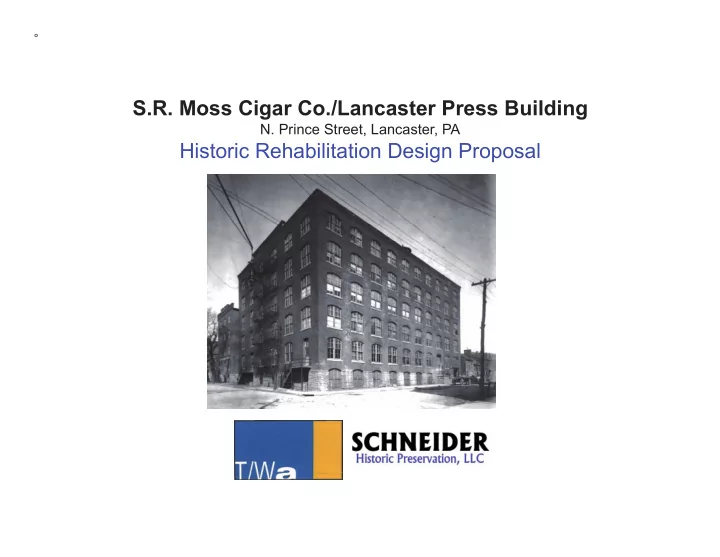
S.R. Moss Cigar Co./Lancaster Press Building N. Prince Street, Lancaster, PA Historic Rehabilitation Design Proposal Introduction to the Project: The Resource Built in 1907 for the S.R Moss Cigar Company to replace earlier building


slide-1
SLIDE 1

S.R. Moss Cigar Co./Lancaster Press Building

  • N. Prince Street, Lancaster, PA

Historic Rehabilitation Design Proposal

slide-2
SLIDE 2

Introduction to the Project: The Resource

  • Built in 1907 for the S.R Moss Cigar

Company to replace earlier building destroyed by fire

  • contributing resource to both the North

Prince Street Historic District (1989) and the Lancaster City Historic District (2001)

  • Vacant since 1992, rehabilitation has

proven to be challenging due to its size, the density of surrounding development, and the restricted availability of parking within the immediate area

  • It remains as one of the few major

tobacco-related landmarks in the city that have not been rehabilitated since the late 1980s, when local preservation efforts teamed with the city's business leadership to target their redevelopment

slide-3
SLIDE 3

Introduction to the Project: The Resource

slide-4
SLIDE 4

Introduction to the Project: The Resource

slide-5
SLIDE 5

Introduction to the Project: The Resource

slide-6
SLIDE 6

Introduction to the Project: The Resource

slide-7
SLIDE 7

Introduction to the Project: The Project

  • Will convert the building into

residential apartments with some retail/restaurant space at the lower floor

  • Will be rehabilitated in accordance

with the Secretary of the Interior’s Standards

  • Historic exterior and interior

features will typically be retained and repaired as needed

slide-8
SLIDE 8

Introduction to the Project: The Project

South Elevation

slide-9
SLIDE 9

Introduction to the Project: The Project

West Elevation

slide-10
SLIDE 10

Introduction to the Project: The Project

East Elevation

slide-11
SLIDE 11

Introduction to the Project: The Project

North Elevation

slide-12
SLIDE 12

Introduction to the Project: The Project

Main Floor Level

slide-13
SLIDE 13

Introduction to the Project: The Project

Typical Upper Floor Plan

slide-14
SLIDE 14

Introduction to the Project: Issues to Discuss

  • 1. Demolition of the noncontributing office addition
  • 2. The appropriateness of the elevated pedestrian connector
  • 3. The location and design of the elevated pedestrian connector
  • 4. Windows
  • 5. Fire Escape
  • 6. Exterior Stair
  • 7. Design of the main entrance
  • 8. Demolition associated with the city’s parking garage project
slide-15
SLIDE 15
  • 1. Demolition of the Office Addition
  • Built in 1956 to house the offices of Lancaster Press
  • Listed as a noncontributing resource in the Lancaster City Historic

District (outside the period of significance of 1760 to 1950)

  • Noncontributing to N. Prince Street H.D. (1881-1938)
slide-16
SLIDE 16
  • 1. Demolition of the Office Addition
  • Post-War Modern style office building does not relate architecturally to

the tobacco warehouse district to the west, nor the primarily residential character of the buildings to the east

slide-17
SLIDE 17
  • 1. Demolition of the Office Addition

C ¡ B ¡ A ¡

  • Necessary to make possible the rehabilitation of the historically significant

and highly visible Moss/Lancaster Presser Building

  • No other place available for vehicle circulation necessary for the rehab.
  • A) Alley too narrow – B) Loading area too tight – C) No major street access
slide-18
SLIDE 18
  • 1. Demolition of the Office Addition
  • A) Alley too narrow
slide-19
SLIDE 19
  • 1. Demolition of the Office Addition
  • B) Loading area too tight
slide-20
SLIDE 20
  • 1. Demolition of the Office Addition
  • C) No major street access
slide-21
SLIDE 21
  • 2. The Connector

Overhead connectors are common to Lancaster’s historic industrial resources, particularly its tobacco related buildings

  • Secure, covered access from the parking garage is essential to the

success of the rehabilitation of the Moss/Lancaster Press Building

  • The design of the connector, at least as it spans N. Market Street, will

reflect the traditional design of typical historic connectors

slide-22
SLIDE 22
  • 2. The Connector

Overhead connectors are common to Lancaster’s historic industrial resources, particularly its tobacco related buildings

slide-23
SLIDE 23
  • 2. The Connector

Including tobacco warehouses …

slide-24
SLIDE 24
  • 2. The Connector

… and spanning major streets

slide-25
SLIDE 25
  • 2. The Connector

… and even the S.R. Moss Cigar Factory and Warehouse that preceded the present building

slide-26
SLIDE 26
  • 2. The Connector
  • The connector will be visible only from a very narrow view angle

down N. Market Street (a narrow alley)

slide-27
SLIDE 27
  • 2. The Connector
  • The design of the connector, at least as it spans N. Market Street,

will reflect the traditional design of typical historic connectors

slide-28
SLIDE 28
  • 3. 408 N. Market Street
  • Built circa 1880 as a rental property
  • 1st known tenant was Joseph Dellet’s Lancaster Steam Cigar Box Factory
  • Later became Charles Ursprung’s horse collar factory
  • Contributing resource to City of Lancaster Historic District
  • Not included in the N. Prince Street H.D.
slide-29
SLIDE 29
  • 3. 408 N. Market Street
  • The building has been altered
  • The original proposal was to demolish the building in order to

accommodate the connector and additional parking

  • Locating the connector north to the alley is not preferred because it

requires additional structure to span the driveway

  • There are also issues with where the connector can tie into the parking

garage

slide-30
SLIDE 30
  • 3. 408 N. Market Street
  • A The ramp will result in the loss of minimal historic fabric and is

reversible

  • B The upper left window will be removed but a reveal will be retained in

the brick infill

  • C The modern entrance stop will be removed to allow the entrance to be

lowered to a new floor level at grade A ¡ B ¡ C ¡

slide-31
SLIDE 31
  • 3. 408 N. Market Street
  • The building is only visible

along N, Market Street – essentially an alley

  • It can barely be seen from

Lemon Street

slide-32
SLIDE 32
  • 3. 408 N. Market Street
slide-33
SLIDE 33
  • 4. Windows

The majority of the windows are in deteriorated condition and/or are missing partial or complete sash. Operability, energy efficiency and maintenance are an issue for this largely residential project. The proposed work would be to salvage enough historic windows to complete the basement and first floor levels and then install new replacement windows to match at the upper floors. Due to the height of the building, the visual character of the windows should not be altered.

slide-34
SLIDE 34
  • 4. Windows
slide-35
SLIDE 35
  • 4. Windows
slide-36
SLIDE 36
  • 5. Fire Escape

The fire escape is a character-defining feature and will be retained. The proposed work would convert the fire escape landings into balconies. Privacy and life safety considerations require that the flights of stairs be

  • removed. The owners would like to remove the complete stair system. The

diagonal outer stringer and possibly the outer railing could be retained (with the treads and inner stringer removed) to visually express the stair if absolutely necessary.

slide-37
SLIDE 37
  • 6. Secondary Stair

The stair is a character-defining feature and will be retained. The preferred option for life safety and security considerations would be to retain the landing but to remove the staircase. Alternately, we could retain the stair and block it with a simple rail.

slide-38
SLIDE 38
  • 7. Design of Main Entrance

Historically, this opening accessed an interior loading dock.

slide-39
SLIDE 39
  • 8. Demolition Associated with the Parking Garage

The parking garage is a separate project being undertaken by the City of

  • Lancaster. Our project will

lease space in the garage and will be physically attached to it by the

  • crossover. The garage

requires access to North Queen Street and that will require the removal of a building.

slide-40
SLIDE 40
  • 8. Demolition Associated with the Parking Garage

The building in question is a former industrial building that was later converted into apartments. While it is a contributing resource to the City of Lancaster historic district, it is otherwise inconsistent with the residential scale of the neighborhood and without its removal, development of the garage would not be feasible. The garage is necessary to accommodate redevelopment on the adjacent blocks that will result in the rehabilitation of the Moss/Lancaster Press Building and hopefully others.

slide-41
SLIDE 41
  • 8. Demolition Associated with the Parking Garage
slide-42
SLIDE 42

Summary

  • The S.R. Moss Cigar Company/

Lancaster Press Building is one of the most significant and prominent

  • f Lancaster’s important collection
  • f historic tobacco-related

resources

  • It is also one of the last of such

resources to be rehabilitated

  • Vacant since 1992, rehabilitation

has proven to be challenging due to its size, the density of surrounding development, and the restricted availability of parking within the immediate area.

slide-43
SLIDE 43

Summary

  • The project is seeking to rehabilitate the building for a compatible use
  • Some modifications are needed to accommodate rehabilitation, but will

adversely impact the building’s historic fabric or features

  • Adverse impacts have been limited to secondary adjacent buildings and

have been designed to minimize their overall impact on the surrounding historic district

slide-44
SLIDE 44