
SLIDE 1
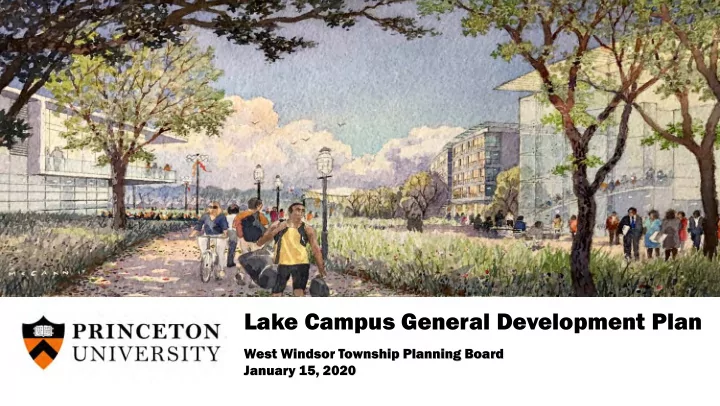
Lake Campus General Development Plan Plan
West Windsor Township Planning Board January 15, 2020
Lake Campus General Development Plan Plan West Windsor Township - - PowerPoint PPT Presentation
Lake Campus General Development Plan Plan West Windsor Township Planning Board January 15, 2020 The Lake Campus General Development Plan (GDP) This is not a site plan application. This is a GDP application. Complies with current
West Windsor Township Planning Board January 15, 2020
The Lake Campus General Development Plan (“GDP”)
2
Process and Timeline: Lake Campus Development
January 2018 Campus Planning Update at Planning Board 2026 Campus Plan Framework Presentation at Planning Board Lake Campus Vision Presentation at Planning Board GDP Presentation at Planning Board Submit 1st Site Plan Application June 2017 January 2019 January 2020 Anticipated Fall 2020
3
4
GDP Ordinance Requirements Section 200-115 Contents of General Development Plan requires that a general development plan application include the following:
to be included in the planned development
including facilities for pedestrian access, within the planned development and any improvement to the existing transportation system outside the planned development.
any other land area to be set aside for conservations and recreational purposes.
water lines and drainage facilities necessitated by the physical characteristics of the site.
managing stormwater on the site. F. An environmental inventory including a general description of the vegetation, soils, topography, geology, surface hydrology, climate and cultural resources of the site.
5
GDP Ordinance Requirements
facilities which may include, but not be limited to, educational and cultural facilities and historic sites.
which any housing obligation assigned to the municipality pursuant to P.L. 1985, c. 222 (N.J.S.A. 52:27D-301 et seq.) will be fulfilled by the development. I. A local service plan indicating those public services which the applicant proposes to provide and which may include, but not be limited to, water, sewer, cable and solid waste disposal. J. A fiscal report describing the anticipated demand on municipal services to be generated by the planned development and any other financial impacts to be faced by the Township or school district as a result of the completion of the planned development.
is contemplated over a period of years. L. A municipal development agreement which shall mean a written agreement between a municipality and a developer relating to the planned development.
Agenda 1. History and Vision 2. What this University Investment Means for West Windsor 3. The Lake Campus Plan 4. Specific Approvals Requested 5. Compliance with the E District Standards 6. Plan Elements Circulation, Traffic and Parking Existing Princeton University Parking Strategies Fiscal Impact Open Space and Community Facilities Environmental Inventory Utilities Stormwater Management
6
7
1922: The University acquired 216 acres of land between Washington Road and Alexander Road. 1945: The University acquired a third farm. 1948: The University acquired a fourth farm. 1980: E Education District zoning adopted by the Township
8
History of the Lake Campus
Shared Goals for the Lake Campus (As identified at January 10, 2018 and January 2, 2019 meeting with West Windsor Planning Board)
University and West Windsor Township can take pride in
Township and Princeton University
through the Lake Campus for both the campus community and the community at large
transportation: walking, biking, mass transit
recreation and reflection
9
10
Development of the Lake Campus will:
Community Benefits
11
A Vibrant Campus: Active Throughout the Day
12
13
A Vibrant Campus with an Array of Uses
common areas engaging students, faculty, staff and researchers
activity at the heart of the plan
to the Yard
amenities
in both indoor and outdoor facilities
students
education and research
the innovation cluster
researchers, and industry partners
9 2 1 4 4 4 6 7 3 7 1 5 5 5 5 5 7 6 8 8
14
14
15
16
17
2026 Campus Plan: Initial framework plan for Lake Campus as presented to the West Windsor Township Planning Board in January 2018 18
19
20 20
General Land Use Plan
21
Example of Near-Term Potential Development Plan Design
22
Example of Mid-Term Potential Development Plan Design
23 23
Future Development
Future Development = 47.93 acres
24
25
Approvals Requested: Land Use Plan
and/or Graduate Student Housing;
nonresidential uses, consisting of:
and Research facilities;
facilities; and,
26 26
Millstone By-pass + Lake Campus Connector
NJDOT grade-separated interchange
grade-separated interchange
Near-Term– Years 0-10:
student housing
Administrative, Collaboration and Research facilities
Campus recreation
Utility facilities
and amenities
27
GDP Approval would permit Flexible Development and Timing Schedule
Mid-Term– Years 11-20:
student housing
Administrative, Collaboration and Research facilities
Campus recreation
and amenities
28
29
The proposed GDP complies with all of the use and bulk standards of a Planned Educational Development in the E District, with the one exception of a height variance for varsity baseball and softball playing field lighting.
The Lake Campus GDP complies with:
E District Compliance
30
Variance Requested: Height of Athletic Field Lights Proposed Height 100 feet Permitted Height 70 feet Closest residence (owned by Princeton University) is 1,485 feet
31
Variance for Height of Athletic Field Lights
32
Variance for Height of Athletic Field Lights
33
Variance for Height of Athletic Field Lights
34
Variance for Height of Athletic Field Lights
The L Lake C Campus w will : ll :
trails ls a and w walk alkways/bikeways t to destinat ations i in West W Windsor
and b beyon
traffic n nee eeds t through c circulation t to an and t through t the e site
and e encourage a a range o
mod
beyon
single le o
ancy v vehicle les
35
Circulation Plan
36
Circulation and Traffic: Pedestrians and Bicyclists
Connecting trails and walkways to destinations in West Windsor Washington Road Allée D&R Canal State Park Woodland Trails Community Connections
37
38
Circulation and Traffic: Roadway Sections
Mid-Term
Princeton
Near-Term (projected for 2022-25)
projects in the Near-Term Phase
Circulation and Traffic: Summary of Traffic Impact Study (“TIS”)
39
Section 200-28 Supplementary parking and loading space requirements
(3) Educational facilities parking modifications. (a) Where a building is for an educational institution which prohibits the
areas in another Township, such students need not be included in the calculation of automobile parking requirements. (b) Institutional parking spaces of educational institutions that are provided for normal daytime activity for other purposes shall be considered to be available for such public uses as are normally conducted in the evening or on weekends in places of public assembly of such institutions.
Parking Calculations for Educational Institutions
40
41
Parking Calculations for Educational Institutions
Buildings Size Number of Units or Employee Density (Note 1) Employees Parking Ratio (Note 2) Spaces per Parking Required per §200-27 (Spaces) Ordinance Reduction Use by PU Students (Note 3) Shared Parking Reductions per §200-28.D(3) Weekdays 9 am to 4 pm (Note 5) Weekday Night Times (Note 6) Weekday (Friday) Evenings 6 to 9 pm (Note 7) Saturday Day Time Use (Note 7) Percent Presence Spaces Needed Percent Presence Spaces Needed Percent Presence Spaces Needed Percent Presence Spaces Needed Student Housing Apartments 1-bdrm 181 units 1.8 space/unit 326
277 100% 326 80% 261 60% 195 2-bdrm 127 units 2.0 space/unit 254
216 100% 254 80% 203 60% 152 3-bdrm 79 units 2.1 space/unit 166
141 100% 166 80% 133 60% 100 Townhouses 3-bdrm 37 units 2.4 space/unit 89
75 100% 89 80% 71 60% 53 4-bdrm 76 units 2.4 space/unit 182
155 100% 182 80% 146 60% 109 Education/Admin/Collaboration/Research Education/Admin offices (GSF) 140,000 225 SF/empl 622 0.8 space/empl 498
498 0% 5% 25 5% 25 Educ/Collabor/Research offices (GSF) 430,000 325 SF/empl 1323 0.8 space/empl 1058
1058 5% 53 15% 159 15% 159 Convening Space (seats) 425
space/seat 106 40% 100% 64 0% 50% 32 50% 32 Campus Retail Service Amenities (GSF) 30,000 375 SF/empl 80 0.8 space/empl 64
64 10% 6 100% 64 100% 64 Athletics Athletics Services + Racquet Center Squash (Indoor) seats 550
space/seat 138 15% 50% 58 0% 60% 70 60% 70 Tennis (Indoor) seats 500
space/seat 125 15% 0% 0% 60% 64 60% 64 Varsity Tennis (exterior) seats 500
space/seat 125 15% 0% 0% 60% 64 60% 64 Varsity Softball seats 500
space/seat 125 15% 0% 0% 60% 64 60% 64 Varsity Baseball seats 450
space/seat 113 15% 50% 48 0% 60% 57 60% 57 Ice Hockey Rink seats 2500
space/seat 625 5% 0% 0% 60% 356 60% 356 Athletics Employees 50 0.8 space/empl 40
40 0% 50% 20 50% 20 TOTAL 4,034 2,695 1,077 1,789 1,585 Notes:
that on average 60% of the total seating capacity for the athletic venues could be occupied at the same time on a Friday evening or Saturday mid-day. This could be the ice hockey rink plus the varsity soft ball seats occupied at 100% or a combination of the smaller venues at 100%
42 42
Millstone By-pass + Lake Campus Connector
NJDOT grade-separated interchange
grade-separated interchange
Circulation and Traffic: Transit and TDM Strategies
Incorporating a range of travel modes beyond single occupancy vehicles
43
walk or bike to work
passes and connections to nearby mass transit options
Lake Campus
commuters
have cars
Staff and Graduate Students
demand/supply
44
Circulation and Traffic:
Existing University Parking Strategies
45
for the Lake Campus, due to their educational nature, would be expected to be tax exempt.
build-out (20-year GDP).
commercially zoned areas in West Windsor as businesses opt to locate near the talent pool generated by the University.
46
Fiscal Impact
47
The Lake Campus will include:
48 48
Open Space Plan
Shared Open Spaces
49 49
50
51
52
Existing Conditions Plan
53
Example of Mid-Term Potential Development Plan Design + Environmentally Constrained Areas
54
55
Near-Term Potential Utilities
56
Mid-Term Potential Utilities
57
Development of the Lake Campus will be designed to mitigate runoff and flooding issues through both campus- and project-scale strategies
Stormwater Management
Campus-scale Strategies Project-scale Strategies
58
Bioswales Green Infrastructure Corridors Surface Retention (Wet Meadow) Rain Gardens + Bioretention Permeable Pavers + Porous Asphalt Under-Field Storage, Subsurface Infiltration and Green Roofs
59
Near-term Stormwater Plan
60
Mid-term Stormwater Plan
61
Process and Timeline: Lake Campus Development
January 2018 Campus Planning Update at Planning Board 2026 Campus Plan Framework Presentation at Planning Board Lake Campus Vision Presentation at Planning Board GDP Presentation at Planning Board Submit 1st Site Plan Application June 2017 January 2019 January 2020 Anticipated Fall 2020
62
Summary
63