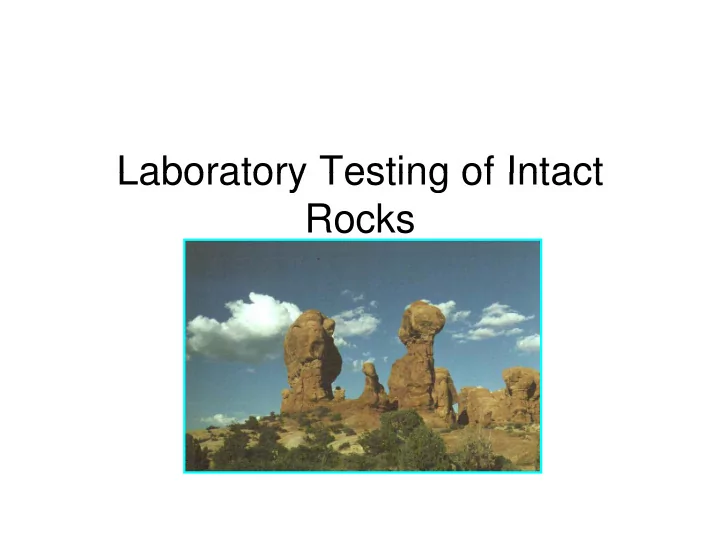
SLIDE 1
Laboratory Testing of Intact Laboratory Testing of Intact Rocks
SLIDE 2
Wh T t R k? Why Test Rock?
SLIDE 3 Objectives: Lab Testing of R k Rock
- Recognize why and when to test intact rock
- Locate & review standard lab testing
procedures for indexing parameters of strength, stiffness, and durability.
- Select representative specimens for testing
p p g
- Recognize importance of QA/QC for
mitigating common errors during lab testing mitigating common errors during lab testing
SLIDE 4 Laboratory Testing of Rocks Laboratory Testing of Rocks
- Index testing of intact rock materials for
identification & classification.
- Strength and stiffness characteristics
g
- Degradation potential; Durability
- Used in assessing the overall Rock
- Used in assessing the overall Rock
Mass P f C t ti kfill t
- Purposes of Construction: rockfill, cuts,
slopes, foundations, tunnels
SLIDE 5
Rock Core Specimens p
FIG.8-0
SLIDE 6 Index Testing of Intact Rocks Index Testing of Intact Rocks
- Unit weight, γR = Weight/Volume
γR
- Ultrasonics Velocities
- Strength
- Strength
– Point Load Index Swiss Hammer (Schmidt Hammer) – Swiss Hammer (Schmidt Hammer) – Uniaxial Compressive Strength
SLIDE 7 Ultrasonics Testing
- Determine compression (P-wave) and
shear (S wave) velocities of rock core shear (S-wave) velocities of rock core
- Nondestructive measurements
- Fast and inexpensive
- Evaluation of small-strain elastic
stiffness (strains < 10-6 mm/mm)
- May be used to evaluate anisotropy
May be used to evaluate anisotropy
FIG.8-7
SLIDE 8
Lab Ultrasonics Testing of Rocks Rocks
Vp Vs Vs
FIG.8-7
SLIDE 9
Uniaxial Compression Test
GCTS Device ARA Setup at Tyndall AFB, Florida p y Page 8-4
SLIDE 10
Uniaxial Compression Test p
Fig.8-2
SLIDE 11 Uniaxial Compressive St th Strength
- Standard index property (qu = σu = σc)
A l t t i t d il
- Analogous tests in concrete and soil
(unconfined compression test).
- ASTM 4543 procuredures.
- Planar ends on NQ size core (d = 47.6
( mm)
2 < H/d < 2 5 Length to width ratio: 2 < H/d < 2.5
- Axial loading of cylindrical core specimen
- σu = Max. Force/(πd2/4)
Page 8-4
SLIDE 12
Swiss Hammer (Schmidt Hammer)
SLIDE 13 Point Load Index
- Quick evaluation for uniaxial strength
(field or lab setup) (field or lab setup)
- ASTM D 5731 procedures
- Little sample preparation (cores,
pieces)
- Measure force (P) to crunch intact rock
specimen
- Point Load Index: Is = P/de
2 where de
= equivalent core diameter equivalent core diameter
Fig.8-1
SLIDE 14
Point Load Index
GCTS Device Roctest Equipment Fig.8-1
SLIDE 15
SLIDE 16
Triaxial Compression (ASTM D 2664) D 2664)
Computerized Compression Frame Rock Triaxial Cell Computerized Compression Frame Rock Triaxial Cell
SLIDE 17 Deformation Parameters of Intact R k Rocks
Elastic Modulus from Uniaxial and/or Triaxial Compression
SLIDE 18 Tensile Strength (T0) of Rocks Tensile Strength (T0) of Rocks
- Direct tensile strength (ASTM D 2936) is
diffi lt b f d ff t difficult because of end effects.
- Generally replaced by indirect (Brazilian)
split-tension test (ASTM D 3967).
- Length-to-diameter ratios: 2 < H/d < 2.5
g
- Diametrical compression of rock core
specimens across specimens across
SLIDE 19 Brazilian Split-Tension Test on Rock Rock
SLIDE 20 Direct Shear Shear Testing of Rock Specimens Specimens
(ASTM D 5607) 5607)
SLIDE 21
Direct Shear Testing of Rock Specimens Specimens
(ASTM D 5607)
Roctest Equipment, Montreal q p
SLIDE 22 Durability of Rock Materials Durability of Rock Materials
- Longevity of the materials for use in
t ti (fill b kfill kfill) construction (fill, backfill, rockfill)
- Will the rock deterioriate when exposed
to the elements, time, freeze-thaw, wet- dry cycles, temperatures, chemicals.
- Tests used to accelerate exposure (slake
durability, LA abrasion, freeze-thaw). y, , )
Section 8.2.2.
SLIDE 23 Slake Durability Test of Rocks Slake Durability Test of Rocks
- Evaluate shales and weak rocks that may
degrade in service environment degrade in service environment.
- Rock fragments of known weight placed
in rotating drum apparatus (ASTM D in rotating drum apparatus (ASTM D 4644).
- Materials are circulated through wet & dry
cycles.
- Reweigh rock fragments to determine the
Slake Durability Index (SDI).
SLIDE 24 Slake Durability Test
SLIDE 25 Common Sense Lab Testing f R k
- f Rocks
- Clear identification
- f samples &
- Photo documentation
- f test specimens
specimens
- Avoid moisture loss
- f test specimens
- Careful alignment of
axes for measurement
damage to samples by dial gages, load cells, and
during specimen l ti displacement transducers S t i selection
i d ki
- Save remnant pieces
- f rock after testing.
in good working
Table 8-2
SLIDE 26 Objectives: Lab Testing of R k Rock
- Recognize why and when to test intact rock
- Locate & review standard lab testing
procedures for indexing parameters of strength, stiffness, and durability.
- Select representative specimens for testing
p p g
- Recognize importance of QA/QC for
mitigating common errors during lab testing mitigating common errors during lab testing