Labeling of Cellular Products with Unique Product and Patient - - PowerPoint PPT Presentation

labeling of cellular products with unique product and
SMART_READER_LITE
LIVE PREVIEW

Labeling of Cellular Products with Unique Product and Patient - - PowerPoint PPT Presentation

Labeling of Cellular Products with Unique Product and Patient Identifiers When Products Are Intended for Further Manufacture by a Contract Organization or Study Sponsor Stakeholder Associations: AABB American Association Tissue Banks American


slide-1
SLIDE 1

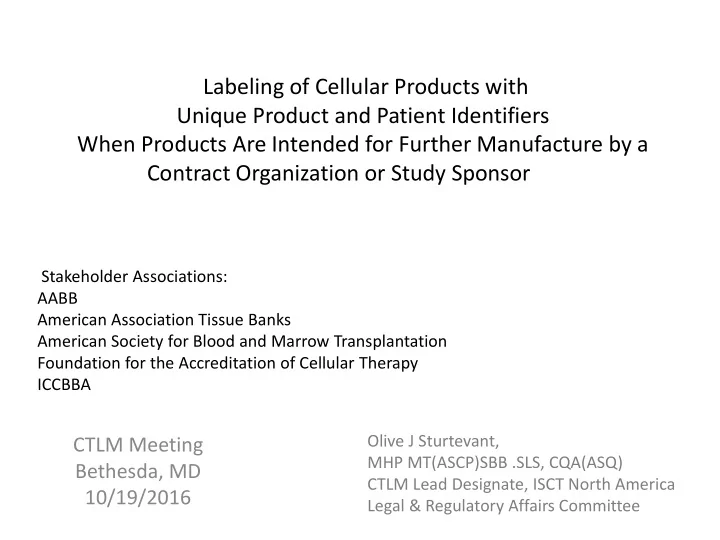
Labeling of Cellular Products with Unique Product and Patient Identifiers When Products Are Intended for Further Manufacture by a Contract Organization or Study Sponsor

CTLM Meeting Bethesda, MD 10/19/2016

Stakeholder Associations: AABB American Association Tissue Banks American Society for Blood and Marrow Transplantation Foundation for the Accreditation of Cellular Therapy ICCBBA Olive J Sturtevant, MHP MT(ASCP)SBB .SLS, CQA(ASQ) CTLM Lead Designate, ISCT North America Legal & Regulatory Affairs Committee

slide-2
SLIDE 2

Agenda

  • Why cellular products should not be treated as

routine “Off the Shelf” drugs

  • Current Labeling Practice for Cellular Products

amongst accredited laboratories (AABB, FACT, CAP)

  • Labeling workarounds developed for “off-site”

manufacturing of novel cellular products

  • Examples of near misses
  • Request from clinical sites, accrediting agencies, and

ICCBBA

slide-3
SLIDE 3

Sources of Cellular Products

  • Patient-specific

– Autologous donors – HLA-matched allogeneic donors (related or unrelated)

  • Not patient-specific

– Partially HLA-matched but not an actual “directed” collection, could be considered “Off the Shelf”

  • Product identity testing

– No real time serological or antigen testing to confirm identity of product to a specific patient – Serologic HLA testing / matching done weeks prior to collection

  • Reliance on labeling and identifiers to confirm identity

– Matching based on donor / patient identifiers linked to HLA testing results

slide-4
SLIDE 4

Bar-coding of Cellular Products and Patient Information for Documentation and Confirmation

Patient Identifier: Infusing institution’s medical record number and patient name bar-coded

  • nto the Cell Infusion Record

Product Identifiers: All products have: Unique ISBT compliant product Identifiers , Bar-coding of Product Type and modifiers Bar-coding of Expiration and ABO/Rh

  • Unique Product number

– W1221 16 123123 – Traceability from donor to patient and back in eMR

  • Standard Product Codes

– S28474BO – Standard product types in eMR for data gathering,

  • utcomes
  • Bar-coding for easy scanning into eMR
slide-5
SLIDE 5

An Example where Sponsor and CMO will accept PHI Institutional Labels with PHI can be applies, but PHI is not bar-coded

Leukapheresis Collection Final Label at Receipt for Infusion

Use of Institutional label applied at collection PHI (protected health information) NCT Product

slide-6
SLIDE 6

Various Labeling Formats and Practices for “Off-Site” / Commercially Prepared Cellular Products

  • Label format varies with each company

– Private manufacturers are not accredited and are not required to followed standard cellular product labeling standards such as ISBT-128 – Autologous and directed HLA-matched cellular products are being labeled as drug products BUT should be handled as autologous and directed blood products following ISBT-128 format

  • Many sponsors refuse to use patient identifiers making it impossible

to use without relabeling of product at infusion

– Unable to scan product into eMR for positive patient identification – Those manufacturing under IND often use study numbers that are not a unique number nor can the be found in the patient’s eMR

  • Products often need to be deidentified when shipped out and

reidentified / labeled when received back

– Increased risk of error in properly linking the product to the intended patient

Not Test for Biohazard Caution New Drug – Limited by Federal Law For Investigational Use Only Autologous Tumor NCT Product Patient ID: xx-0000 Product # 1234567 Vol 1.2 mL Vial 1 Date Manufactured 7/1/16 Sterile Store in Vapor LN2 phase

slide-7
SLIDE 7

The Re-Labeling Cycle

Patient Screened Enrolled Collection Shipped to CMO Product Manufactured Returned to clinical site Patient treated / Product stored Product infused

Collection through Infusion

De identified Re identified

Manufactured: Disney Land 23 Cinderella Road, Happy Ville, FL

slide-8
SLIDE 8

Some Products Require Final Packaging and Relabeling

Figure 18: Secondary Label Figure 19: Primary Labels (x3)

NCT Product or Placebo MFG 12/31/12 Lot: A123123 ID: xx-0000C000B000

NCT Product or Placebo MFG 12/31/12 Lot: A123123 ID: xx-0000C000B000 Address: Sig: Exp date: 12/31/16

NCT Product or Placebo MFG 12/31/12 Lot: A123123 ID: xx-0000C000B000 NCT Product or Placebo MFG 12/31/12 Lot: A123123 ID: xx- 0000C000B000

slide-9
SLIDE 9

Requirements for Infusion / Use

  • Accreditation standards & clinical team require:

– patient’s name and – two unique identifiers also found in medical record

  • To enhance patient safety, the move is to scan

the following into the patients e-Medical Record along with the patient identifiers listed above:

– Product unique identifier / lot – Product code and attributes – Unique aliquot, if applicable – Expiration date and time

slide-10
SLIDE 10

Use of Patient Identifiers, HIPAA and Rationale Companies Use to avoid Using PHI

  • “Not allowed to have access to PHI, under HIPAA”

– Especially if product is under an IND

  • Legal Statutes

– Privacy Rule is to ensure that individuals’ health information is properly protected while allowing the flow

  • f health information needed to provide and promote high

quality health care and to protect the public's health and well being. – Authorization of PHI access can be disclosed in consent – Language can be added to sponsor / CMO agreements & contracts for use of PHI – PHI can be used by third parties for research products if approved by IRB

slide-11
SLIDE 11

Example 1 – Near Miss

  • Autologous MNC products from two patients on same trial

from same institution are collected and de-identified post collection

  • The following information represented the unique identifiers used

(Pt initials – study #-enrollment # and DOB) – Product #1 MS – 16034-01 5/1/56 – Product #2 MS – 16034-02 12/15/55

  • CAR-T Products returned

– MS – 16034-01 12/15/55 – MS – 16034-02 5/1/56

  • Reliant on labeling and identifiers to confirm identity
  • No real time serological or antigen testing to confirm

identity

  • Products could not be used. Error reported to sponsor.
slide-12
SLIDE 12

Example 2

  • Require Sponsor & CMO to label products with:

– Patient’s name – Medical Record Number – DOB

  • Without notification changed their policy and sent

a product without identifiers

  • Urgent situation created of not being able to use

the product as delivered

  • Finally CMO was able to provide documentation

linking the product lot number back to the patient and unique identifiers

slide-13
SLIDE 13

Marriage of both USAN / NDC and ISBT128

slide-14
SLIDE 14

Desired Outcome

  • f This Meeting
  • To inform the agency about patient safety risks that is a current and growing concern

amongst healthcare providers with advent of manufacturing by industry / commercial CMOs.

– Unique and traceable product and patient identifiers are not being used.

  • To recommend that we work towards using common healthcare standards (AABB,

FACT, ISBT 128) regardless of the point of manufacturing for tracking and labeling of cellular product.

– The use of common standards set forth by accreditation agencies will improve safety, standardize practice and reduce risk of product/patient misidentification.

  • To develop working subgroups (the Agency, industry commercial CMO partners,

software partners, and accrediting agencies) to educate why moving to common ISBT-128 labeling practices is a win for everyone.

– Will benefit those developing electronic medical records and cellular manufacturing systems. – Will ultimately provide safer products by ensuring the right product gets to the correct patient.

slide-15
SLIDE 15

References

  • AABB Standards for Cellular Therapy Services, 7th

edition

  • FACT-JACIE International Standards for

Hematopoietic Cellular Therapy, 6th edition

  • FACT - STANDARDS FOR IMMUNE EFFECTOR CELL
  • ADMINISTRATION, 1st edition - Draft
  • ICCBBA – ISBT 128 Cellular Therapy Standard

Labeling formats and nomenclature