LA-UR-11-06021 Approved for public release; distribution is - - PowerPoint PPT Presentation

la ur 11 06021
SMART_READER_LITE
LIVE PREVIEW

LA-UR-11-06021 Approved for public release; distribution is - - PowerPoint PPT Presentation

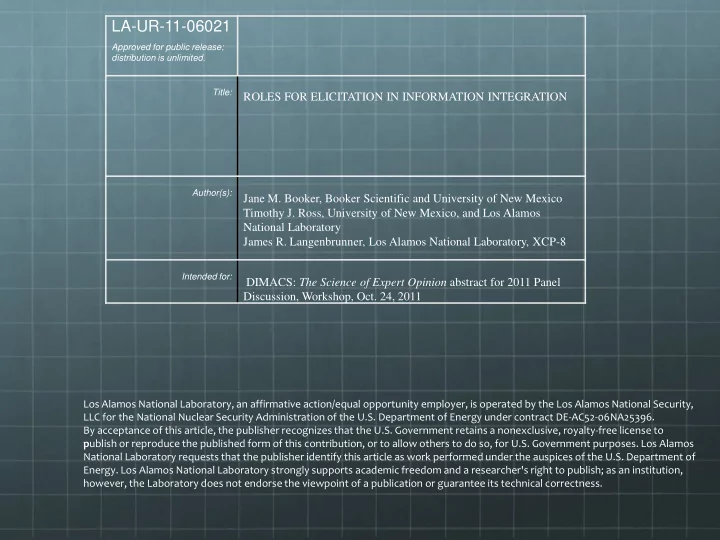
LA-UR-11-06021 Approved for public release; distribution is unlimited. Title: ROLES FOR ELICITATION IN INFORMATION INTEGRATION Author(s): Jane M. Booker, Booker Scientific and University of New Mexico Timothy J. Ross, University of New


slide-1
SLIDE 1

LA-UR-11-06021

Approved for public release; distribution is unlimited. Title:

ROLES FOR ELICITATION IN INFORMATION INTEGRATION

Author(s):

Jane M. Booker, Booker Scientific and University of New Mexico Timothy J. Ross, University of New Mexico, and Los Alamos National Laboratory James R. Langenbrunner, Los Alamos National Laboratory, XCP-8

Intended for:

DIMACS: The Science of Expert Opinion abstract for 2011 Panel Discussion, Workshop, Oct. 24, 2011

Los Alamos National Laboratory, an affirmative action/equal opportunity employer, is operated by the Los Alamos National Security, LLC for the National Nuclear Security Administration of the U.S. Department of Energy under contract DE-AC52-06NA25396. By acceptance of this article, the publisher recognizes that the U.S. Government retains a nonexclusive, royalty-free license to publish or reproduce the published form of this contribution, or to allow others to do so, for U.S. Government purposes. Los Alamos National Laboratory requests that the publisher identify this article as work performed under the auspices of the U.S. Department of

  • Energy. Los Alamos National Laboratory strongly supports academic freedom and a researcher's right to publish; as an institution,

however, the Laboratory does not endorse the viewpoint of a publication or guarantee its technical correctness.

slide-2
SLIDE 2

Roles of Elicitation in Information Integration

Jane M. Booker (retired!) Timothy J. Ross University of New Mexico James R. Langenbrunner (physicist) Los Alamos National Laboratory

LA-UR-11-06021, Oct. 19, 2011

slide-3
SLIDE 3

Abstract: Twenty years ago, Meyer and Booker published their practical guide on formal elicitation of expert knowledge. Their expert-

  • riented, bias minimization approach established the important linkage

between elicitation and the subsequent analysis of the expert’s knowledge in physical science and engineering applications. The NRC’s reactor safety study (NUREG 1150) and Los Alamos’ reliability of nuclear weapons program were the first to utilize their methods. From those, they formalized the use of expertise to formulate the structure of complex problems — the second role for elicitation of expert

  • knowledge. By 1999, the first Information Integration methodology,

PREDICT, was developed. Elicited knowledge became a primary source

  • f information along with data and models, and experts’ predictions

were validated. In today’s Information Integration, experts provide multi-faceted products, including experts taking on the role of hunter and gatherer of data, information and knowledge to be integrated in a waste nothing philosophy, and they play a prominent role in providing “glue” for the integration. LA-UR-11-04498

LA-UR-11-06021, Oct. 19, 2011

slide-4
SLIDE 4

Disclaimer

Los Alamos National Laboratory strongly supports academic freedom and a researcher’s right to publish; as an institution, however, the Laboratory does not endorse the viewpoint of a publication or guarantee its technical correctness.

LA-UR-11-06021, Oct. 19, 2011

slide-5
SLIDE 5

1991 & 2001 Formal Elicitation

Mary A. Meyer (anthropologist) and Jane M. Booker (meteorologist & statistician)

Eliciting and Analyzing Expert Judgment: A Practical Guide

Linking elicitation methods with analysis—two sides of the same coin. Bias minimization, expert-oriented elicitation methods.

NOT talking about these methods per se—you can still buy the book.

LA-UR-11-06021, Oct. 19, 2011

slide-6
SLIDE 6

Some Definitions

Expert Judgment —aka—Expert Knowledge is more than “the man on the street” opinion. It reflects the current state of what is known (or unknown) according to the Experts in a field. Experts—those recognized by their peers as knowledgeable; having expertise from experience. Bias minimization—Bias is anything that alters or changes the expert’s fundamental knowledge. Often bias occurs between what the expert knows or understands and what the expert verbalizes. Sometimes biases distorts basic knowledge, memories (experiences), problem solving abilities, decision making and thinking.

LA-UR-11-06021, Oct. 19, 2011

slide-7
SLIDE 7

More Definitions

Expert-oriented elicitation methods—Permit subject matter experts to determine definitions, question phrasing and response modes, aggregation methods uncertainty types, analysis methods, etc. —all consistent with the “Community of Practice” —Reliance upon detailed elicitation methods to capture the experts’ cognitive and problem solving processes. What you will hear from me today. Analysis—what can be done with elicited knowledge? Some of my experience in answering that question follows

First a Little History/Background

LA-UR-11-06021, Oct. 19, 2011

slide-8
SLIDE 8

Applications of Elicited Expert Knowledge

NUREG 1150—Nuclear Regulatory Commission’s nuclear reactor probabilistic risk assessment. Los Alamos weapons in conjunction with GM/Delphi Systems—PREDICT reliability methodology in the absence

  • f testing.

Turbine jet engine performance in aerospace companies— high cycle fatigue studies. Articles “Model choice considerations and information Integration using Analytical Hierarchy Process”, “Inference Uncertainty Quantification Instead of Full-Scale Testing”

LA-UR-11-06021, Oct. 19, 2011

slide-9
SLIDE 9

First Role for Formally Elicited Knowledge

Elicited Expert Estimates as a Place Holder for Test Data Energy

?? ??

  • Expt. 1

2.9 2.8

  • Expt. 2

3.0 3.2

LA-UR-11-06021, Oct. 19, 2011

slide-10
SLIDE 10

Second Role for Formally Elicited Knowledge

Expert Provides Structure for complex or challenging physics processes problem

Initial conditions f3 f2 c2 p2 p1 c1 f1 Energy Output

{

LA-UR-11-06021, Oct. 19, 2011

slide-11
SLIDE 11

Third Role for Formally Elicited Knowledge

Expert Knowledge is an information source to be combined with other sources Test Data Expert estimates & predictions

First Information Integration PREDICT Performance & Reliability Evaluation

with Diverse Information Combination & Tracking

E± ∆Ε

Uncertainties are fuzzy & probabilistic

LA-UR-11-06021, Oct. 19, 2011

slide-12
SLIDE 12

My perspective on expert elicitation:

what is the expert thinking (and hence) doing when they are doing it?

And why does this matter to you?

LA-UR-11-06021, Oct. 19, 2011

slide-13
SLIDE 13

What is the expert doing?

LA-UR-11-06021, Oct. 19, 2011

slide-14
SLIDE 14

What is the Expert Doing?

Code to Experiment Evaluation

Space of Experimental Input Parameters

LA-UR-11-06021, Oct. 19, 2011

Looking at the Experiment as a Modeler

slide-15
SLIDE 15

Space of Simulation Output Parameters

What is the Expert Doing?

Code to Experiment Evaluation

LA-UR-11-06021, Oct. 19, 2011

Looking at the Models as an experimentalist

slide-16
SLIDE 16

Each of these has its strengths and weaknesses. Can hope to build on both.

Reality Experiment Small Statistical Inference Code Output

What is the Expert Doing?

Evaluating Reason to Integrate

LA-UR-11-06021, Oct. 19, 2011

slide-17
SLIDE 17

“Hunter & Gatherer” Expert:

Available Data, Information & Knowledge

Test Theory Simulation History

Our 4-Box Approach to Information Integration

Waste Nothing

LA-UR-11-06021, Oct. 19, 2011

slide-18
SLIDE 18

What is the Hunter &Gatherer Expert Doing?

Test Theory Simulation History

Determines what’s inside these boxes . . .

LA-UR-11-06021, Oct. 19, 2011

slide-19
SLIDE 19

Understanding Inferences Expert:

Test Theory Simulation History

Inferences occur between boxes.

Inferences have Uncertainty!

validation

Inferences are present in just about everything we do.

LA-UR-11-06021, Oct. 19, 2011

slide-20
SLIDE 20

Understanding Inferences Expert:

Test Theory Simulation History

Inferences occur within boxes.

Inferences have Uncertainty!

proxy statistical proxy proxy prediction statistical prediction prediction

Inferences are present in just about everything we do.

LA-UR-11-06021, Oct. 19, 2011

slide-21
SLIDE 21

Test Theory Simulation History

Estimating weights from pairwise comparisons.

Saaty’s AHP!

validation

Estimating Weights Expert for Information Integration

How to integrate the information between boxes?

LA-UR-11-06021, Oct. 19, 2011

slide-22
SLIDE 22

Test Theory Simulation History

Estimating inferences and their uncertainties.

Inference Estimation

validation

Information Integration

How to integrate the information between boxes?

proxy statistical proxy proxy prediction statistical prediction prediction

LA-UR-11-06021, Oct. 19, 2011

slide-23
SLIDE 23

LA-UR-11-06021, Oct. 19, 2011 NIA/SACD Distinguished Lecture Series

We have developed and successfully applied a set of formal techniques to mathematically combine all sources of data/information/knowledge into an

  • verarching process for assessment & prediction.

Goal: Combine everything we know (information integration) along with how well we know it (uncertainty assessment).

Example 1: Inference Uncertainty Quantification Instead of Full-scale Testing

Quantification of uncertainty arising from inference has an important role to play in lieu of full-scale testing. System-level uncertainties may not be

  • bservable by observing separate effects tests. Little attention has been

paid to this inference uncertainty, which is prevalent in numerous scientific applications. An example of information integration illustrates the beginning of the research effort into understanding and utilizing uncertainty from inference.

slide-24
SLIDE 24

LA-UR-11-06021, Oct. 19, 2011

Example 2: Validation Inference—

How many ways are there for this?

Increasing Information Content Used to Draw Conclusion

Variances Mapping Calc to Obs Regression

  • f Calc on

Obs Dn metric

The work for Variance Comparison, and Mapping is in our paper, as are the details of estimating the validation inferences and their uncertainties from the 4-boxes. Comparison of 5 validation methods:

4-Box integration

slide-25
SLIDE 25

Summary of Roles for Experts in Information Integration

  • Elicited Expert Estimates as a Place Holder for Test Data
  • Expert Provides Structure for Complex or Challenging Physics

Processes

  • Expert Knowledge as an Information Source to be Combined

with Other Sources

  • Code to Experiment Evaluation by Experts
  • Evaluating Reason to Integrate Experts
  • Hunter & Gatherer of Data, Information and Knowledge Expert
  • Expert as an Estimator of Weights for Information Integration
  • Understanding Inferences and Inference Uncertainties Expert
  • Experts Providing the Big Picture for Quality Processing

LA-UR-11-06021, Oct. 19, 2011

slide-26
SLIDE 26

Big Picture:

A Larger Integration Process beyond the 4 boxes

LANL

LA-UR-11-06021, Oct. 19, 2011

slide-27
SLIDE 27

Examples of Common Cognitive Biases

Anchoring: Experts (in their thinking and responses) cannot move from their preconceptions. The inability to adequately update in light of new information. Inconsistency: Confusion, such as from differing assumptions or definitions or high uncertainty, can lead to inconsistencies in thinking / responses. Memory problems fatigue and lack of knowledge also contribute. Underestimation of Uncertainty: Humans often think we know more than we really do. Classic (and deadly) example is the “unsinkable” Titanic. Availability: Depending upon personal experience, experts cannot accurately account for rare events. Someone recently in a car accident will overestimate the likelihood of another and someone never in one will underestimate it.

LA-UR-11-06021, Oct. 19, 2011

slide-28
SLIDE 28

LA-UR-11-06021, Oct. 19, 2011

Group Think: Group social pressure to slant responses or silently acquiesce to what experts believe will be acceptable to the group. Classic (and deadly) example is the Bay of Pigs Misinterpretation: Inadequate translation of knowledge into

  • response. Example, analyst changes expert’s “likelihood”

response to a probability. Wishful Thinking: Experts' hopes or wishes about how they think things should be influence their responses. Not necessarily restricted to positive outcomes, but for outcomes according to expert’s wishes (to be right). Impression Management: Responding according to politically correct or current managerial interpretations.

Examples of Motivational Biases

slide-29
SLIDE 29

Formal Elicitation of Expert Knowledge

Uses expert-oriented elicitation methods from research and implementation in many applications. Draws from cognitive psychology, decision analysis, uncertainty quantification, statistics, sociology, risk analysis, cultural anthropology, and knowledge acquisition. Minimizes common biases arising from human cognition and behavior. Adds rigor, defensibility, and increased ability to update the knowledge (i.e., traceability).

LA-UR-11-06021, Oct. 19, 2011

A formal elicitation is designed like an experimental physicist plans and implements the experiment—controlling the environment and determining the initial conditions.