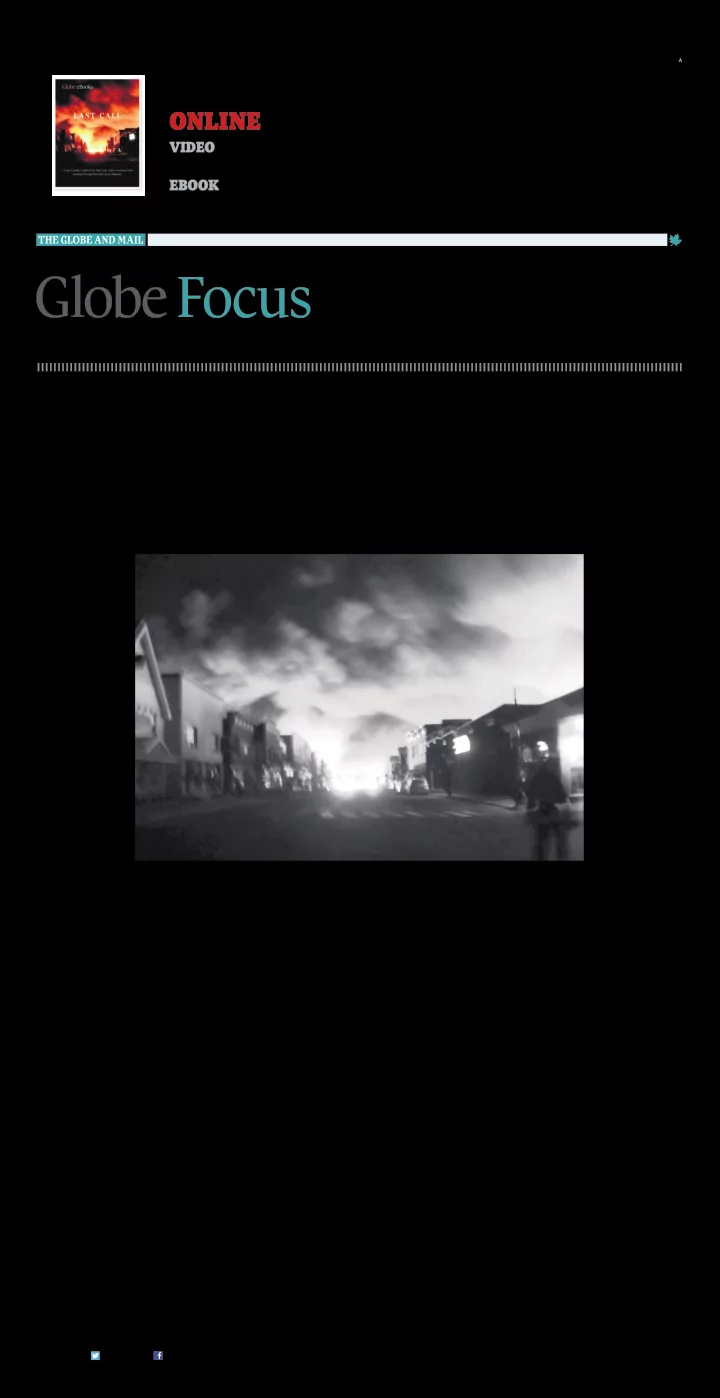
SLIDE 5 Estel Blanchet lost her mother Natacha Gaudreau: ‘She had confidence in me.”
F6
A
THE GLOBE AND MAIL
- SATURDAY, NOVEMBER 30, 2013
THE GLOBE AND MAIL
- SATURDAY, NOVEMBER 30, 2013
A
F7
him to join. The party must have taken off because at 1 a.m. they were still there.” Éric Pépin was one of Mathieu’s neighbours on Sevigny Street, an upscale sector of Lac-Mégantic. The three also spent the evening with another friend, David Lacroix-Beaudoin, who was visit- ing his hometown and had packed his suitcases before head- ing to the bar. He was flying the next morning back to Switzer- land, where he had moved three years earlier. “I was told the four guys took up station at the bar and people kept coming to see them over the evening,” Alexia said. The bar’s last call was 3 a.m., and Mathieu and friends would often go to a restaurant at 4 a.m. for poutine and snacks. Around 11:30 p.m., Sylvain Brier was returning from a party with his wife and passed the train on the outskirts of Nantes. It was on
- fire. “We drove into a big cloud,”
he said. “I thought it was fog, but it was black and smelled like fire mixed with oil – like an engine that had burned out. I was going to call 911, but as soon as we got
- ut of the cloud I saw the fire-
men.” He watched as a half dozen fire- fighters moved around the lead
- engine. In the half-hour since Mr.
Harding, the engineer, had left the scene, engine oil had spilled and the locomotive had caught
- fire. In his rearview mirror, Syl-
vain could see dark smoke so thick that headlights couldn’t penetrate it. After 2 a.m., Alexia woke up to find the light pulsing blue at the top-left corner of the smart- phone she shared with her hus-
- band. The digits on the alarm
clock beside her bed were also
- flashing. She was confused. The
wind outside wasn’t strong; a power failure seemed unlikely. She looked at the first text mes- sage, addressed to Mathieu: “Are you OK?”
................................................................
The art teacher René Simard
Over two decades as an art teach- er at Lac-Mégantic’s Polyvalente Montignac, René Simard saw thousands of students come and
- go. He continued to see many of
them daily as successful adults. A native of the province’s north, René was inching towards
- retirement. Soft-spoken and dap-
per, he stood out in rural Quebec, wearing polished brown leather wingtips and furnishing his home with cream leather ches-
- terfields. He planned to spend
the evening of July 5 at the Musi- Café, but first he went to a cinq-à- sept, where he was joined by a friend, Melissa Roy. Melissa, 29, and her partner Emmanuel Tossel were due to celebrate their fourth anniversary two weeks later. The pair had been planning to start a family, but in December of last year Melissa miscarried. The loss weighed heavily on the couple; months later the baby’s room was still stocked with a bottle and rocking horse. The two worked in the industri- al park on the edge of town – Melissa at the door factory, Emmanuel at the particleboard
- plant. On that Friday, Emmanuel
drew the late shift at work, leav- ing Melissa to go out with René. “I just bought a new Mini Coo- per and Melissa wanted to see my
- car. She was really pretty,” René
joked, “so I told her to come. When we arrived at the Musi- Café we found parking right in front and I told her that she was my little cheeky blond girl – we had fun laughing about that.” Many of René’s friends were at the Musi-Café that evening to celebrate Stéphane Bolduc’s
- birthday. Most belonged to the
Boat Crew, a group of boat own- ers who travelled on Mégantic Lake as a flotilla. “The crew was divided in two because we had to celebrate Sté- phane’s birthday on Friday and Nathalie Lafrance’s on Saturday,” René said. “Our group was a bit
- smaller. While 20 people showed
up that evening, the attendance could have been twice that much.” By 8 p.m., most of the group had arrived and perused the eclectic menu, the majority
- rdering the Mexican-style pani-
- no. Soon Karine Champagne was
pleading with the musicians to go easy on her boyfriend. While the two agreed not to ply Sté- phane with drinks, René and an-
- ther man “decided that we were
going to make him start taking shots even before dinner, just to tease a little,” René said. “We also wanted to mess with Karine a bit.” He didn’t know what shoot- ers to order, deferring to the wait- ress who had been his student a few years earlier. “There was a nice ambience that evening, it was really mag- ical,” he said. “Everyone knew each other, exchanging kisses and taps on the back. It was a well-lubricated evening, a party night.” René also knew Mathieu Pelle- tier, a colleague from school, and had taught two of Mathieu’s drinking buddies. At midnight, a number of Sté- phane’s guests began leaving; they planned to meet early the next morning and take 10 boats
- ut on the lake. Frédéric Fortin, a
Lac-Mégantic native who had moved to Montreal to work for an engineering firm, was in town to attend the party for Stéphane, a childhood friend. He and René “were smoking together all night,” Frédéric said. “But I had the cigarettes. Each time I went
- ut I would offer him a cigarette.”
He eventually gave René his pack and stayed in the bar. As people left, René decided to go
- utside and smoke, but he was
constantly interrupted by old friends, colleagues and students wanting to talk. “Jean-Pierre Roy was sitting there,” René said. “My daughter used to date one of his sons, so he looked at me with a big smile, shook my hand.” Jean- Pierre was on a first date and had just ordered a final round of beer. “The whole way out of the bar took a long time,” René said. He passed Geneviève Breton, an aspiring singer who had appeared on Star-Académie, a popular Quebec copy of American Idol; studying in Sherbrooke, Geneviève was visiting her home- town and was at the bar ordering a bottle of water for a late walk. René stepped out into the warm night to find a small crowd of smokers on the terrace. Frédéric spotted his friend outside and joined him – he didn’t know why, he just went. A moment later, both he and René felt something. “Under my feet I could feel vibrations like an earthquake, and then the train came very fast,” René said. “I said to myself, ‘Christ! He’s crazy. He’s
- ut of his mind. He’s coming way
too fast.’”
................................................................
The Lafontaines Josée and Christian
Josée Lafontaine was angry. Earlier in the day, her brothers Pascal, Christian and Gaétan Lafontaine were called to nearby Lac-Drolet, along with her part-
- ner. The four principals of Lafon-
taine Excavation had to supervise some emergency repairs – and would miss most of her 40th birthday party at her home. It went ahead anyway, but as the sun was setting at 9 p.m., a squa- dron of mosquitoes dive-bombed her party guests, forcing them
- inside. She surveyed what was
left of an evening that had gone wrong. “I really didn’t have my heart in celebrating, I don’t know why,” Josée said. “When I went outside to the party, people saw that I wasn’t doing well. My head and heart just didn’t feel right.” When Christian and his broth- ers finally arrived, less than a dozen people remained. They heard that guests had departed and met up at the Musi-Café. “People left because the ambience wasn’t good,” Christian said. By midnight, nearly everyone had gone. Christian, 45, went to the bar with his wife, Melanie Gerard, and his brother Pascal’s wife, Karine. They could hear the music from outside. They met up with Julie Heon and Marie-Noëlle Faucher, a secretary at the com- pany, and later with his brother Gaétan and his wife, Joanie Tur-
- mel. On Sunday, Gaétan planned
to run a Tough Mudder race – a nearly 20-kilometre test studded with serious obstacles. Inside the Musi-Café, Christian, a businessman, was constantly
- networking. One of the people he
spoke to first was Stéphane Bol- duc’s girlfriend, Karine Cham- pagne. “We spoke for 15 minutes and we were really happy to see each
- ther,” he said. “It was the love-
liest discussion I’d ever had with
- her. I told her that I loved her
and admired how she raised her
- children. Our last moment was
smiles and laughter. We were real friends.” By 1 a.m., Christian and his wife were getting ready to settle up and leave. They were standing at the end of the bar, far from the front exit. Several kilometres to the north, Josée was preparing for bed. She had picked up the bottles of wine and beer that littered her back- yard and living room, and was going to put a bad day behind her. “I was lying in bed with my lov- er talking and he said, ‘Stop. Lis- ten to that train going by. It doesn’t sound like it normally does,’” she recalled. “I live near the tracks. It sounded like a whooshing sound instead of the typical slow chugging sound we’re used to. There was no whis- tling either, which the train nor- mally does at level crossings. We were stumped and then we turned off the lights.”
................................................................
‘I started crying like a child’
It happened at 1:14 a.m., and Christian Lafontaine didn’t un- derstand. “There was a first vibration,” he said, “and I looked at my wife and asked, ‘Did you feel that? It felt like an earthquake?’ She had. By the time she answered, we were shaken a second time, it took maybe five seconds. It was much more violent the second time.” He glanced over at his brother Gaétan, whose wife had gone to the bathroom. Gaétan’s eyes dart- ed toward the back of the bar. He was going to get her. “He would have never left without her. If he had left, he would have gone nuts,” Christian said. Christian told his own wife it was time to get out. They started
- walking. Marie-Noëlle was stand-
ing alone near the bar’s front
- door. “She looked at my wife
with terror on her face, she just couldn’t comprehend what was happening,” Christian said. “The two of them were best friends. Melanie told her, ‘We don’t know what is going on, but we’re get- ting out.’ That’s when the power failed.” The entire bar went pitch black, then turned orange – “brighter than the middle of the day, a blinding, lively orange,” Christian
- said. The tall buildings around
the Musi-Café were reflecting the light through the big windows that lined the front of the bar. The lead wagons of the train had blown past the level cross-
- ing. The five locomotives at the
front navigated a sharp bend behind the bar – despite going 10 times the speed limit, they stayed
- n the tracks. Following the last
locomotive, an empty buffer car flew off. One oil wagon after an-
pushed the pileup three storeys high, the twisted wreck of steel carrying more than seven million litres of oil. Inside the bar, some-
Only 15 seconds had gone by since the first rumblings. “I was just afraid I’d get sepa- rated from my wife in a panic,” Christian said. “She just wanted to hide, everyone wanted to hide.” There was no screaming, but with the orange light coming through the windows, many peo- ple mistakenly thought the area in front of the bar was danger-
- us. Christian’s wife wanted to
move to the back and take cover, but he pulled her out the front door. “That was the last time I saw any of them,” he said of other
- patrons. Had he waited 15 more
seconds, he would have died. Outside, Christian saw his car parked across the road, and a wave of fire as wide as the street coming toward them. “Asphalt doesn’t burn, buildings do,” he
- said. “When I saw the fire coming
down the street I knew it was oil. I just started running, racing south.” Yvon Ricard saw chaos, the train flying past the terrace and
- exploding. “A big mushroom
cloud went up – I couldn’t be- lieve it,” the musician said. Stunned, he stood with his mouth open, trying to make sense of things. Soon, the heat of burning oil jolted him to action and, along with four other peo- ple, he took off. “We were running around houses and through backyards,” Yvon said. “We demolished a
- fence. We eventually got to the
- lake. We stopped running when
we couldn’t feel the heat on our backs.” Turning, he saw a scene
- f devastation. “The entire town
was on fire to my right. It was hallucinating; wires were falling, transformers were exploding.” Running around the back of the train, as unexploded rail cars were slowly pulled by gravity towards the inferno, Yvon went searching for his family. He found them standing on the porch out- side his in-laws’ home. His wife’s gaze was fixed on the flames downtown, her hands pulling at her hair as she screamed in hor- ror. “She knew that it hit the Musi- Café, she was certain we were
- dead. When she saw me, she
jumped into my arms,” Yvon
- said. His musical partner’s wife
was also standing on the porch, preparing her teenagers to evac-
- uate. She waited all night for
news about her husband, Guy
- Bolduc. Dawn arrived – no news
came. René Simard was disoriented as he began running from the Musi- Café. He stumbled on the steps and fell. Frédéric Fortin turned back and picked up his friend, pulling him onto the town’s main
- street. “The heat, the smell, the
noise was so loud, like a tearing sound,” René said, describing the rolling-pin-like motion of the burning oil as it flowed down the
- street. “It was like big waves com-
ing to get you. They rolled, the sound beating. Then, explosions everywhere.” As René sprinted towards his new Mini Cooper, the car explod-
- ed. He had parked on the south
side of the bar, away from the rail
- line. At that point, he knew his
friends inside were dead. With Frédéric, he ran away from the fire and didn’t stop until he reached a bridge spanning the Chaudière River several blocks to the south. Standing under a mas- sive lighted cross erected on a hill
- verlooking Lac-Mégantic, the art
teacher watched as his adopted town burned. Luc and Julie had jumped over the side of the terrace and run toward the lake. Luc ducked be- tween two tall brick buildings and dashed through a narrow passageway between houses. By the time he got down to Mégan- tic Lake, the long park along the water was already burning. Oil had started spilling into the plac- id water. He looked back down an alley to see four blocks of downtown burning. He and Julie were separated. She ran north towards her home, crossing land that moments later would be on fire. Luc headed south towards the Chaudière. Standing near the Eau-Berge Hotel, he called his mother and left a message on her answering machine: “When you turn on the TV tomorrow morning you’ll see that downtown Mégantic is burn-
- ing. I’m safe, I’m alive.”
Inside the Eau-Berge, engineer Thomas Harding was awakened by the explosions. He pulled on his clothes and bolted for the
- door. A waitress, standing on the
terrace as consecutive blasts shook the hotel, saw Mr. Har- ding’s first reaction as he spotted the wagons: His eyes widened and colour drained from his face. He headed towards the flames, helping first responders pull wag-
- ns from the fire before they
could rupture. As they ran away from the Musi-Café, Christian Lafontaine’s wife fought his grip – she wanted to go back and get her purse from the car. “Forget the money,” he yelled. Behind them, fuel tanks began exploding as build- ings crackled in heat growing more intense by the moment. His wife, Melanie, stopped to remove her high heels. Christian caught a breath and saw the flames, several storeys high, rap- idly approaching. He tugged her arm again and she ran barefoot. The two reached the south end
- f town without a singed hair.
They were ready to cross the bridge, fearing downtown would turn to ash. “We saved ourselves and the wave of flames washed over the Musi-Café,” he said. “Some tried to leave from the front and couldn’t, others tried to exit by the back and that was a sea of flames.” The Quebec coroner’s office told the families of victims that moments after the initial exodus, the rapidly expanding fire began to consume all the oxygen in the
- bar. The doors and windows soon
- imploded. Anyone left inside was
asphyxiated. Gaétan’s body was found near his wife Joanie at the back of the
- bar. “They were together, they
found each other,” Christian said. “That makes me feel better.” Moments before the train derailed, Yannick Gagné’s preg- nant wife arrived home. Lisandra Arencibia went to the couch and soon fell asleep. “I started closing the windows,” Yannick said. “While I was look- ing towards downtown the ground shook, the electricity cut
- ut and a fireball turned the sky
- range. I thought a meteor had
hit.” He dashed outside to see what was going on. Other people were running. They said wagons were exploding and everyone should leave town. The proud owner of the Musi- Café felt a double pull of respon- sibility, personal and profession-
- al. He told his wife and kids they
had to go. He took out his phone to call the restaurant, but it was already ringing. “One of my employees was call- ing,” he said. “She was screaming, telling me that she was running away, that everything was on fire, it was chaos, the restaurant was gone, everything was gone, and people were still inside. I told her to calm down, that I’d go see. “I got into the car and turned towards the Musi-Café. I saw the wagons blocking the road. I couldn’t pass. There was a wall of fire hundreds of feet high. My kids were screaming and crying. I turned the car around. Then I started crying like a child.”
Epilogue
Thomas Harding Following the derailment, Mr. Harding was interviewed by the Quebec provin- cial police. He has stayed out of the public eye and is on medical leave from the MM&A as it struggles through creditor protection. He has not been charged with any crime.
..............................................................................................
Luc Dion and Julie Heon Five months after the disaster, the couple is still dating. Luc has returned to teaching French at the local high school; Julie runs a daycare.
..............................................................................................
Karine Blanchette Karine still lives in the Lac- Mégantic area and continues to audition for act- ing parts.
..............................................................................................
Estel Blanchet The morning after the derailment, Estel took to social media looking for her moth- er, Natachat Gaudreau. Estel’s brother, Édouard, provided police with the DNA sample that identi- fied his mother. He now lives in Sherbrooke with his father; Estel has moved to St-George-de- Beauce to start college.
..............................................................................................
Yvon Ricard Yvon headlined a benefit concert in Montreal on Aug. 13. Despite returning to playing music, he still sees images of the Musi-Café when he closes his eyes. Dozens of Quebec’s most famous musicians attended Guy Bolduc’s funeral.
..............................................................................................
Mathieu Pelletier The bodies of Mathieu Pelle- tier, Éric Pépin, Maxime Dubois and David Lacroix-Beaudoin were identified near the stools where they sat most of the evening. Maxime’s daughter Anais was born on July 10, four days after the train derailed.
..............................................................................................
René Simard Shaken by the loss of so many friends, René has not returned to teaching. His friend Melissa Roy died at the Musi-Café.
..............................................................................................
Christian Lafontaine Three members of the Lafontaine family perished in the fire. Gaétan Lafontaine’s portrait now hangs at the headquar- ters of the family construction company, along with photos of his wife Joanie Turmel, Karine Lafontaine and secretary Marie-Noëlle Faucher.
..............................................................................................
YannickGagné After the loss of his bar, Yannick launched the Musi-Café d’été, a popular six-week series of musical acts under a tent that gave the grieving community a place to meet. Despite struggling with insurers, he plans to rebuild – bigger.
..............................................................................................
With reports from Megan Dolski and Kim Mackrael
GLOBE FOCUS
- Yannick Gagné owned the Musi-Café. He plans to rebuild the bar.
For musician Yvan Ricard, playing in Lac-Mégantic was like coming home. Sketches drawn by survivors of the interior of the Musi-Café at the moment of the crash, showing where people were sitting. From left, drawings by Heather Gordon, René Simard and Josée Lafontaine.
Product: Standard PubDate: 11-30-2013 Zone: Atl Edition: 1 Page: F6 ( Focus_1093508) User: cci Time: 11-29-2013 12:10 Colour: C M Y K