SLIDE 1
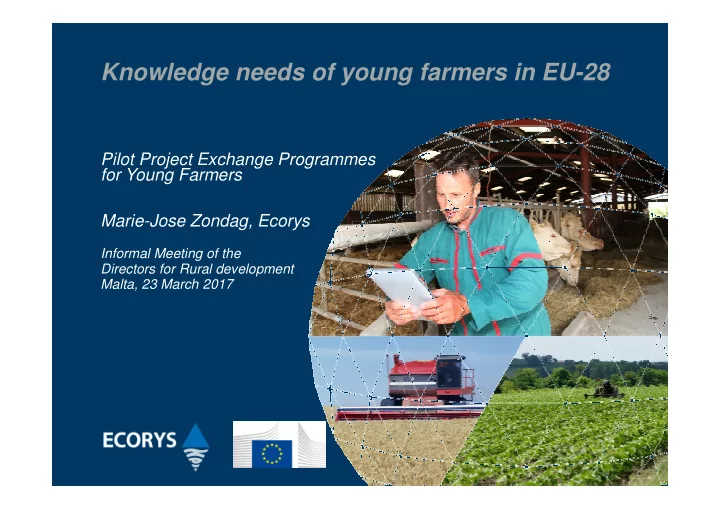
Knowledge needs of young farmers in EU-28
Pilot Project Exchange Programmes for Young Farmers Marie-Jose Zondag, Ecorys
Informal Meeting of the Informal Meeting of the Directors for Rural development Malta, 23 March 2017
SLIDE 2
- The pilot project
- The needs of young farmers
- Conclusions
Contents
SLIDE 3 The Pilot Project
Objectives: 1. Assessment of specific needs of young farmers across the EU 2. Overview existing exchange schemes for young farmers 3. Identify effective and efficient results of exchange schemes 4. Recommendations on the design, implementation and delivery of exchange programmes and schemes Approach: Approach:
- Literature review on needs of young farmers
- Interviewed variety of stakeholders
- Interviewed 2 205 young farmers, around 75 per country
- Focus group per Member State
- Interviewed 22 exchange schemes (manager, host, participant)
- Check by representative of focus group
- Disseminated at final conference of 15-16 October 2015 in Brussels
SLIDE 4 Why focus on young farmers
- Young farmers can contribute the most to fostering innovation and
resource-efficiency (Dellapasqua, 2010)
- Overview of CAP reform 2014-2020: 14% of EU farmers are younger than
40 years of age (European Commission, 2013)
- Farmers face a lot of challenges: High investments in the start-up phase,
- Farmers face a lot of challenges: High investments in the start-up phase,
difficulties in accessing finance and small turnover in the first years, prolonged generation renewal and diminished access to land can reduce the interest of young farmers in entering into te sector
- Training should be fine-tuned to the (knowledge) needs of young farmers:
Appropriate technical and economic training
SLIDE 5
Needs of young farmers in EU-28
EU-28
SLIDE 6
% young farmers having difficulty to obtain land
SLIDE 7
Knowledge needs of interviewed young farmers
Management skills Financial skills Skills related to applying for subsidies/ grants/ credit Develop a farm strategy Obtain specific technological knowledge necessary for the farm
0% 10% 20% 30% 40% 50% 60% 70%
Foreign languages Skills related to the improvement of animal welfare Marketing skills Resource and nature/ environment management Networking skills/ ability to create partnership Communication skills New MS EU15 All countries EU-28
SLIDE 8
% young farmers who like to develop…
entrepreneurial skills technological & managerial skills
SLIDE 9
% young farmers who obtain knowledge through…
e-learning, social media, e-discussions searching on internet
SLIDE 10
Information sources for young farmers
EU-28
SLIDE 11
% young farmers obtaining knowledge from…
Other farmers Farmer associations
SLIDE 12
% young farmers using exchange schemes to obtain knowledge
SLIDE 13 Hindrances for obtaining information
Lack of time
EU-28
SLIDE 14 Awareness and participation in exchange scheme
% young farmers who actually participated in exchange scheme % young farmers who think positive
SLIDE 15
Most important hindrances for joining an exchange scheme
Lack of money No replacement on my farm Lack of time
0% 10% 20% 30% 40% 50% 60% 70% 80%
Lack of knowledge Language barrier
New MS EU15 All countries EU-28
SLIDE 16 Conclusions on needs of young farmers
- Knowledge needs are influenced by the available knowledge
infrastructure and education system in a country
- Knowledge needs are highest in new Member States
- The needs are highest in more intensive, specialised
agricultural sectors and in less favourable areas
- Higher educated young farmers have more interest in acquiring
- Higher educated young farmers have more interest in acquiring
knowledge and participating in exchange scheme
- Legal status of the young farmer influences his knowledge
needs and availability for exchange
- Land availability is the biggest need of young farmers, followed
by access to credits, subsidies and qualified labour
SLIDE 17 Conclusions on needs of young farmers
Information sources of young farmers
- Internet, field days or excursions, fairs and individual advice are
the most popular knowledge sources
- Internet discussions, online-training, e-learning and social media
less important
- Other farmers and farmers associations are the most
important sources where the knowledge infrastructure is less
Identified needs for exchange schemes
- Awareness of knowledge needs is limited
- There is a positive attitude & high intention to join
- Participation is however low (9-23%)
- Lack of time, replacement and costs are
main hindrances
SLIDE 18 Recommendations for young farmers
- Improve communication and publicity to make young farmers aware of
exchange schemes
- Prepare a transparent and complete overview of available schemes
- Allow further study on the effects and impact of exchange schemes
- Optimize the allocation of RDP funds to allow use of Erasmus for
- Optimize the allocation of RDP funds to allow use of Erasmus for
Young Entrepreneurs and other exchange schemes
- Facilitate the start-up of exchange schemes
- Take away legal barriers on visa, work permits for trainees etc
- Offer a farm replacement service to improve participation rates
SLIDE 19 Recommendations for exchange schemes
- Study young farmers’ changing needs continuously and be
flexible in your offer
- Improve health, liability insurances for hosts, participants
- Offer language courses to improve participation rates
- Allow easy replacements in case of mismatches between host
and participant and participant
- Keep administrative burden low through combinations of internet
and face-to-face selection steps
- Expectation management is important key to satisfied hosts and
participants!
- Organise your alumni and cherish their energy and experience
for future recruitment and management.
SLIDE 20
Thank you!
Website with reports: http://ec.europa.eu/agriculture/external- studies/index_en.htm DG AGRI
More information
DG AGRI agri-evaluation@ec.europa.eu Project manager from Ecorys Marie-Jose Zondag Marie-Jose.Zondag@ecorys.com +31 10 453 88 00