KINGS CHAMBERS LEGAL THOUGHT LEADERS DEBRIEF: A Kings Chambers - - PDF document

kings chambers legal thought leaders
SMART_READER_LITE
LIVE PREVIEW

KINGS CHAMBERS LEGAL THOUGHT LEADERS DEBRIEF: A Kings Chambers - - PDF document

KINGS CHAMBERS LEGAL THOUGHT LEADERS DEBRIEF: A Kings Chambers Podcast Factsheet EPISODE 12 Conversation with Gerard McDermott QC Nigel Poole QC in conversation with Gerard McDermott QC: the Role of the Barrister. Gerard is was called to


slide-1
SLIDE 1

KINGS CHAMBERS LEGAL THOUGHT LEADERS

DEBRIEF: A Kings Chambers Podcast Factsheet

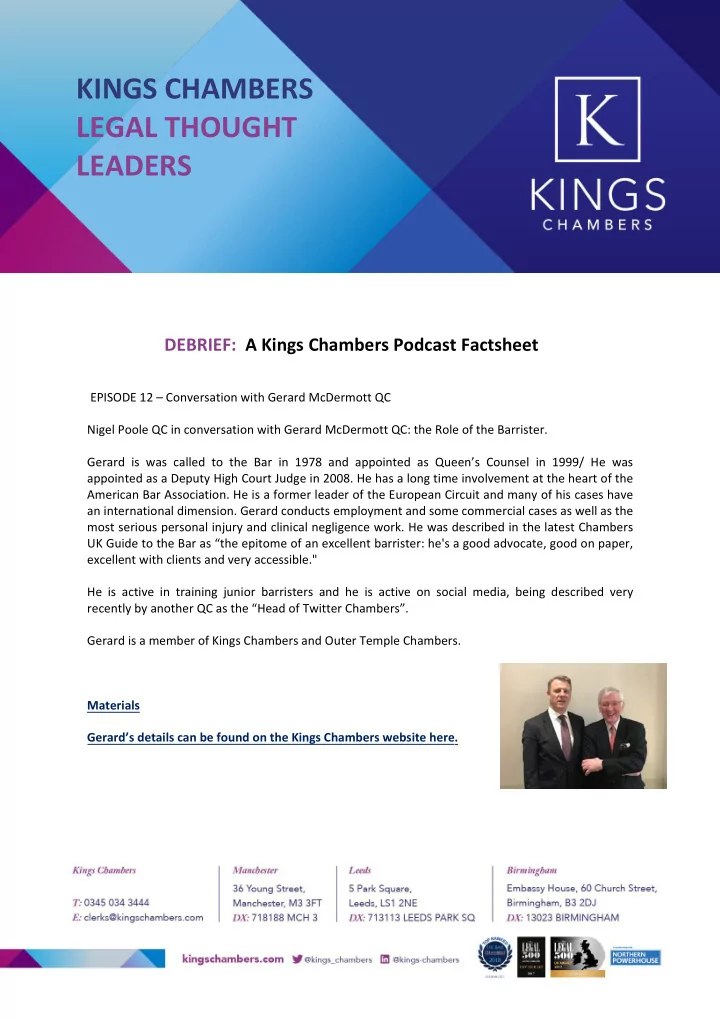
EPISODE 12 – Conversation with Gerard McDermott QC Nigel Poole QC in conversation with Gerard McDermott QC: the Role of the Barrister. Gerard is was called to the Bar in 1978 and appointed as Queen’s Counsel in 1999/ He was appointed as a Deputy High Court Judge in 2008. He has a long time involvement at the heart of the American Bar Association. He is a former leader of the European Circuit and many of his cases have an international dimension. Gerard conducts employment and some commercial cases as well as the most serious personal injury and clinical negligence work. He was described in the latest Chambers UK Guide to the Bar as “the epitome of an excellent barrister: he's a good advocate, good on paper, excellent with clients and very accessible." He is active in training junior barristers and he is active on social media, being described very recently by another QC as the “Head of Twitter Chambers”. Gerard is a member of Kings Chambers and Outer Temple Chambers. Materials Gerard’s details can be found on the Kings Chambers website here.

slide-2
SLIDE 2

Speaker Profiles

Nigel Poole QC Nigel is ranked as a leading QC by Chambers UK and the Legal

  • 500. He is Head of Kings Chambers and sits as a Deputy High

Court Judge and a chair of the Bar Tribunal and Adjudication

  • Service. He has appeared in the Supreme Court and Court of
  • Appeal. He has given many lectures and seminars around the

country on subjects including human rights, loss of earning capacity and proving reduction in life expectancy. To access further information about the Debrief Podcast, the speakers or Kings Chambers please visit: https://www.kingschambers.com

Some Books on Advocacy The Art of the Advocate Richard du Cann Advocacy Plus – Nigel Pascoe QC The Devil’s Advocate – Iain Morley QC And on life at the Bar Learning the Law – Glanville Williams The Secret Barrister – Stories of the Law and How it is Broken In Your Defence – Sarah Langford Rumpole – The First Omnibus – John Mortimer Gerard has prepared a presentation on trial preparation – available here.

Gerard McDermott QC Nigel is ranked as a leading QC by Chambers UK and the Legal

  • 500. He is Head of Kings Chambers and sits as a Deputy High

Court Judge and a chair of the Bar Tribunal and Adjudication

  • Service. He has appeared in the Supreme Court and Court of
  • Appeal. He has given many lectures and seminars around the

country on subjects including human rights, loss of earning capacity and proving reduction in life expectancy.

slide-3
SLIDE 3

Ge Gerar ard McDerm rmot

  • tt Q

QC

slide-4
SLIDE 4
  • The end of the process of litigation
  • Not that many cases go to trial
  • The Vanishing Trial – how many are there ?
  • Collectively much to learn
  • And to think about for all litigators

Goin

  • ing to
  • Trial
slide-5
SLIDE 5

Trials in new e era

Since April 2013 things have changed – certainly for cases where CFAs were signed after 1.4.2013 – which means practically all cases now

  • From an insurance perspective – no longer a concern about uplifts

to fees increasing costs

  • Increasing management of costs – with costs budgeting in many if

not costs

  • But one way costs shifting has in some respects made it easier to

run cases

slide-6
SLIDE 6

Why go t

  • to T
  • Trial – maybe t

be the

  • n
  • nly w

way t to

  • resolve s

som

  • me

issues ues Should always assume a case will go to trial

  • Every witness statement taken
  • Every pleading drawn
  • Every expert report should be clear
  • Every piece of correspondence should be

appropriate

  • Every attempt to settle should be thought

through

How will this look at trial ?

slide-7
SLIDE 7

Why do

  • we

e go t

  • to
  • trial
  • Maybe to establish liability
  • Maybe to deal with contributory negligence
  • Maybe to deal with quantum
  • Maybe ancillary issues
  • Provisional damages
  • Periodical payments
  • Perhaps issues as to capacity of Claimant?
slide-8
SLIDE 8

Trial proc

  • ces

ess

  • What should a client expect
  • How should we deal with it as lawyers
  • What are our respective functions
  • How can teams of lawyers work better

together for clients

  • What innovations can we use
  • What should client expect
slide-9
SLIDE 9

The client

  • What do they want
  • What do they know of trial
  • What will they think of the formality
  • Do they want to go to trial
  • What do we need to explain
  • How risky will it be
  • How will the client feel about going to trial
  • One big issue – when you go to trial you hand control

from the parties to the Judge

slide-10
SLIDE 10

Preparation f for T Trial

Often preceded by a Joint Settlement Meeting

  • May be as important as trial
  • An opportunity to address the big issues
  • And maybe to lay the ground for resolving

some issues

  • Equally may not achieve settlement
  • And the process may become extended –

maybe resolving issues one at a time

slide-11
SLIDE 11

Prepa paration ( ( pr prepa paration n an and mor

  • re p

e prep epar aration)

)

  • Taking witness statements
  • Preparation of schedule – vital document
  • Obtaining Expert evidence
  • Preparation of Bundles
  • Preparation of skeleton / opening
  • Preparation of examination in chief
  • And of cross examination
  • And of closing
slide-12
SLIDE 12

Lay witnes esses es

  • Who should be called to give evidence
  • On what issues
  • If liability is in issue how many witnesses do

you need to call

  • Sometimes calling less witnesses may be better
  • it avoids inconsistency
  • We need to prove each element of the case
  • There is a need to consider on whom the

burden of proof lies – maybe important in contributory negligence

slide-13
SLIDE 13

How can w we h help clients a at tri rial

  • They may need reassurance
  • They need to know what the trial process involves
  • Visiting the Court ?
  • Making sure that the court is accessible
  • Practical points
  • Transport
  • Hotels
  • Parking
  • Timings
  • Lunch
  • Pre trial conferences and arrangements
slide-14
SLIDE 14

What happens in t the r run u up to to t trial

Conferences with

  • Client – probably with home visit in many cases
  • Experts – essential with key experts in the trial
  • In a Personal Injury Case
  • In an case of spinal cord injury – the

rehabilitation consultant

  • Neurologists
  • Neuro Psychologists
  • Care Experts
  • And others
slide-15
SLIDE 15

Why so m many c conference ces

Preparation, preparation ,preparation

  • To ensure we understand complex evidence
  • To allow experts to explain the issues
  • To get a proper understanding ready for trial – fluency

with the case and concepts involved

slide-16
SLIDE 16

Ex Expert rts

  • Are they the right expert for the case
  • What experience in forensic setting
  • Their duty is always to the Court
  • CPR part 35
  • Experts declarations – they need to understand

importance

  • What if they change their views – a duty to make

that plain to the Court and the parties

slide-17
SLIDE 17

Skel eleton

  • n A

Argu gumen ents

  • Very important
  • In quantum cases they go hand in hand with the

schedule

  • Content may vary but they are an essential part of

telling the story

  • In cases where the law is in issue full exposition of

the law may be required

  • Equally in some cases they can be concise
  • Setting the scene for the case
slide-18
SLIDE 18

The Trial -Storyt ytelling

  • A theme
  • Often A Life changed by an accident
  • Examples
  • A beginning – the opening
  • A middle – the evidence
  • An end – closing
  • And Judgment – by a different author
slide-19
SLIDE 19

St Stor

  • ry
  • Getting the story out
  • C and witnesses may be helped to have a plan
  • f what they will be asked to cover
  • Experts certainly will be
  • In Cases of Brain damage
  • The story may come from the family
  • And experts may need to be in court to

listen to their evidence

  • And to take account of the lay evidence

when they give their own evidence

slide-20
SLIDE 20

Examination

  • Examination in chief
  • Cross examination should rarely be cross
  • But may be wonderful tool
  • Kept to the point
slide-21
SLIDE 21

Rea eal P Press ssures es of

  • f trial
  • On witnesses
  • On expert witnesses
  • On Solicitors
  • On Counsel
  • And of course on the client
  • Good early preparation by lawyers will always

help